




A family of Maine fishermen wants to change regulations that limit certain water bodies in the state to fly fishing only. To that end, plaintiffs Joe Legendre, Justin Legendre, and Samantha Legendre have filed a lawsuit against the Commissioner of Maine’s Inland Fisheries and Wildlife Department, claiming these regulations are unfair and unconstitutional.
The Legendre’s lawsuit, filed in Kennebec Superior Court in October, is being funded by the International Order of Theodore Roosevelt, an organization committed to expanding Americans’ right to hunt and fish in all 50 states. It contends that because the sport of fly fishing “is dominated by wealthier anglers,” Maine’s policies around fly-fishing only (FFO) waters discriminate against working-class Mainers. The suit also alleges that some of the current restrictions undercut Maine’s Right to Food Amendment, which has been interpreted to include the right to hunt and fish for sustenance.
Not surprisingly, the lawsuit is causing a stir in Maine’s fly-fishing community, which broadly views the elitist argument as off-base and misguided.
“Yeah, they’re mad,” IOTR spokesperson Jared Bornstein tells Outdoor Life of the responses he’s gotten from local fly fishermen.
This includes Maine fly-fishing guide Kevin McKay, who makes ends meet as a UPS driver and says he’s middle class through and through.
“When I started fly fishing, I was 27, and I think my first fly rod was from L.L. Bean. It was a Streamlight and it was 50 percent off. So I got into it really cheap,” McKay says. “And, look, I was at WalMart this morning, buying some stuff for Christmas. They have a Cortland setup there for, I don’t know, 100 bucks maybe.”
That setup is actually closer to 60 bucks, and it includes everything you need to hit the water except a fly. And while you can easily spend more on a new rod and reel, there are plenty of other, affordable starter kits tailor made for beginners.
The suit’s other key argument — that limiting certain waters to fly fishing impedes Mainers’ rights to feed themselves — is a little more complicated. Out of the thousands of lakes, ponds, and streams open to public fishing in Maine, 226 public waterways are reserved exclusively for fly fishing, according to the lawsuit. Some of these waters are catch-and-release only. So in these places, the right to fish for food is a moot point.
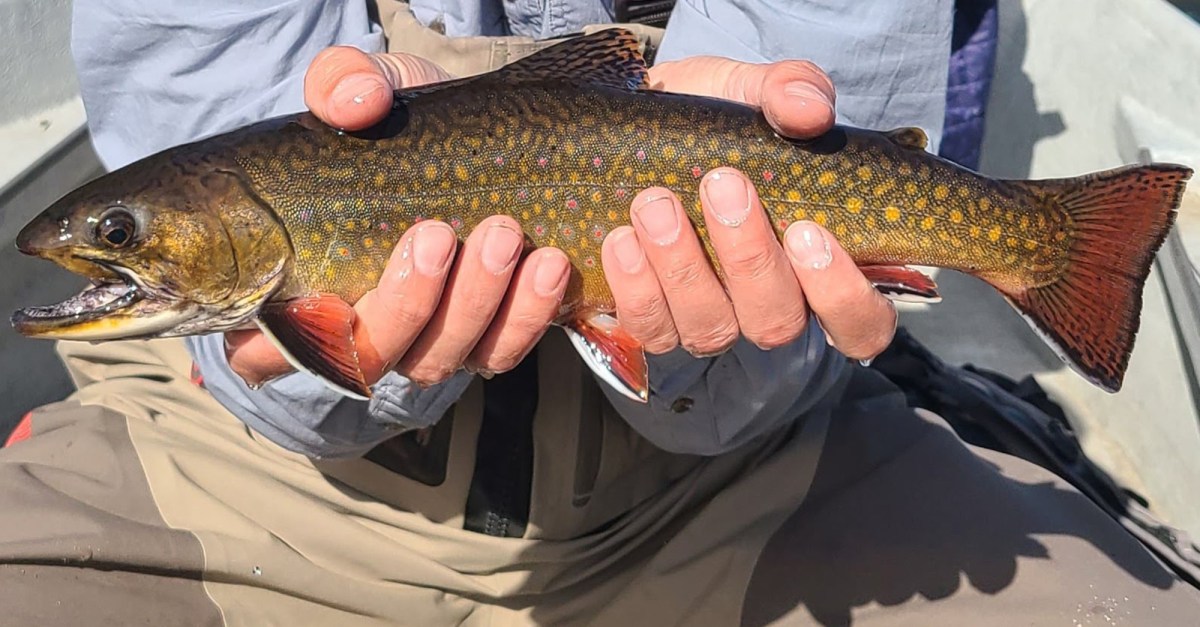
McKay explains that many of the state’s FFO waters are home to vulnerable populations of wild brook trout and/or landlocked salmon. These include some of the last true trophy brook trout fisheries left in the eastern U.S.
“Other than Labrador,” McKay says, “Maine is one of the last frontiers for wild brook trout … These are places where you still have a chance at 20-plus-inch brook trout. And the state wants to protect them.”
Other fly fishermen have drawn similar connections. The CEO of Maine Fly Guys, Greg LaBonte, writes in a recent op-ed article that “[these] designations exist for biological, not social, reasons.”
LaBonte goes on to argue that because fly fishing tends to be less impactful on wild fish than other methods, it would make sense to keep the state’s high-value fisheries closely regulated. Although every method of hook-and-line fishing impacts the resource, research and anecdotal evidence has shown that flies cause less damage to fish than trebles and baited hooks, especially when those flies are tied on smaller, barbless hooks.
However, as Bornstein points out, there are other FFO waters in Maine that are open to harvest, albeit with strict bag limits and slot sizes.
Read Next: It’s Time to Rethink Catch-and-Release Trout Fishing — or Get Much Better at It
“All we’re saying is that if you can go to a spot and catch and keep a fish, you shouldn’t need to use a fly rod,” Bornstein says. He clarifies that the lawsuit does not seek to change any existing catch-and-release fisheries. “And look, if the state wants to regulate the hooks, or if they want to regulate the type of lures, or ban bait — that’s fine. We agree that there is a biological need for that. The rod and reel shouldn’t make a difference, though.”
Accordingly, the plaintiffs argue in their lawsuit that because they “do not have the time” to learn how to fly fish, their constitutional rights to harvest fish are being limited. And it’s true that in many fishing scenarios, it is more time-consuming, and therefore more challenging, to catch a big, wild brook trout on the fly. Some might even say that’s the point.
Read the full article here
