




This story, “Wolves Don’t Live by Rules,” appeared in the March 1968 issue of Outdoor Life. Frank Glaser was a legendary predator control agent and the subject of Alaska’s Wolf Man, also by Jim Rearden.
It was a cold clear March day at Savage River on the north slope of the Alaska Range. I was sitting on a hill watching a muskeg flat on which several hundred scattered caribou were feeding. A quarter-mile below me, a coal ledge jutted from the 15-foot-high river bank, and a yellow seepage from it smeared the blue-white river ice. Five caribou stood licking at the stain.
I was looking for wolves, and idly I glanced at the five caribou from time to time as I swung my binoculars to scan the snow-covered land. After an hour of careful watching I saw a lone gray wolf trotting across the flat. Soon three others single-filed down the river to my left. Then another appeared on my right, picking its way upstream.
The five wolves were converging on the caribou at the coal seep.
The wolf on the flat trotted to the edge of the bank above the unsuspecting caribou and peeked over at them. Then it backed off to lie down and wait. The group of three wolves left the creek and disappeared into the spruces below me. I lost track of the fifth wolf.
I watched the five caribou. After about 10 minutes a gray wolf streaked out of the timber and grabbed a big cow by the flank. The remaining four caribou scattered as the frantic cow skidded and staggered, trying to shake the clinging wolf. She tried to jump from the slick ice to the bank but immediately fell, floundering on her side, the tenacious wolf still clamped firmly to her flank. Three of the other wolves appeared and swarmed over her, chopping and slashing.
And then, incredibly, she pulled free. All of the animals skidded on the slick ice, but the frantic cow made it to the bank, humped her way to the top, and hooked her front legs over. The wolf on the bank met her head-on, sinking his teeth into her nose. He hung on as the two of them rolled and flopped down the steep slope to the river ice.
A red stain spread across the ice as the five wolves killed the cow and started to eat.
Another March found me on the same hill, again watching scattered caribou and looking for wolves. Below, on the open flat, a lone cow was feeding. Three wolves, trotting single-file with heads and tails down, started to cross the flat half a mile downwind of the caribou.
When they caught its scent, one of them, a big gray, immediately lay down in the snow while the others turned and loped into a nearby draw. After his partners had been gone a few minutes, the big gray wolf openly ran to within 100 yards of the caribou, sat down in plain sight, and started to howl.
The caribou stopped eating and curiously stared at him. She even walked toward the wolf, occasionally bounding nervously into the air. The two other wolves came into sight behind her, sliding along on their bellies like cats stalking a bird. Frequently they raised up and peeked ahead to see how close they were.
The caribou remained intent on the performing wolf in front of her. The gray wolf howled, trotted back and forth, and gradually worked closer and closer to the nervous but fascinated caribou. When the wolf was within 40 yards, it sat and howled continuously.
One of the stalking animals dashed from behind a knoll about 30 feet from the caribou, grabbed the animal’s flank, and hung on. The two other wolves joined it in seconds, and the three of them quickly pulled her down.
Related: Barren Ground Caribou Hunts Are Disappearing — or Getting Outrageously Expensive
There you have two common daytime hunting techniques used by wolves. I have seen as many as six wolves play the decoy game — they’re very good at it. Sometimes, however, wolves simply run their prey down. One April, again at Savage River, I saw a cow moose on the skyline, running and continually looking behind her. Five wolves soon showed up on her trail. I grabbed my rifle and ran up to an open sidehill from which I thought I might be able to take part.
The moose ran into a dense patch of spruces, the wolves right behind her. After a while she came into the open, with the wolves jumping and biting at her and then leaping back as she tried to strike them with her hoofs. They were too far away for me to interfere, so I sat and watched through binoculars.
She made a game fight of it. As the wolves slashed at her, leaping in and dodging back, she stood on her hind legs time and again, running at them, pawing and striking with her front hoofs. But finally the wolves simply pulled her down.
When I got there, they had eaten a few pounds of the hindquarters and had left. That animal was slashed and bitten all over the body, and pieces of hide as big as a man’s hand had been peeled off. The moose was heavy with calf. I have seen pregnant caribou cows killed the same way.
As a private trapper and a government wolf hunter, I have observed wolves in Alaska since the late 1920’s, when — for the first time in this century — they became common in Alaska’s interior. The more I learn about wolves, the less I like to generalize about their hunting methods and other habits — wildlife doesn’t live by rules.
I have read many incorrect statements about wolves. Two in particular that many people believe are that all the wolves in a region join forces each night to hunt, and that wolves invariably hamstring big-game prey. Actually, wolf “packs” are almost always family groups, sometimes containing as many as two or three generations. However, during breeding season, when different families combine, I have often seen groups of 30 to 45 wolves.
At Savage River I was awakened early one March morning by the howling of several bands of wolves. I got up, dashed out with a rifle and binoculars, and located three bunches. As I watched, all three came together on a big flat. I’d guess that there were three or four families.
Suddenly all of those wolves appeared to pile on one wolf, and the growling and yipping carried for miles in the still, cold air.
I saw how I could get within rifle range by working through some timber. As I hurried along I pictured in my mind six or seven dead wolves and a bunch of crippled ones, and I figured that a lot of hides and bounty money were going to come my way pretty easily.
Related: I Spent 25 Years Trapping Wolves in the Canadian Wilderness. Here’s What I Learned
But my dreams were shattered when I got within rifle range. All the wolves had left — but two, and those two were mated. Not one injured wolf could I see. In the years since, I have found that wolves seldom seriously injure one another when fighting.
The largest bunch of wolves I have ever seen numbered 52. I had a good 45 minutes to count them. Fifty were black, and two were gray. The peculiar thing about these wolves was that they were together in October. Ordinarily the big packs form only during breeding season in February or March. Except during breeding season, strange wolves are not welcomed into a family. I once watched, for some time, a pair of wolves that had a den with a bunch of pups in it. The family group also contained four other adult wolves, which might have been brothers and sisters, parents, or even grandparents of the mated pair.
One day — when all six adults were lying about, sleeping after a night of hunting — a big gray wolf, strange to the group, showed up on a ridge and trotted casually toward the den.
One of the adults saw the stranger when he was 100 yards away and immediately ran toward him. The five others were right behind. The first wolf struck the stranger with a shoulder, knocking him over. Before he could recover, all six of them had him, holding him from all sides.
There was no snapping and letting go as you see in a dog fight — each of the six simply grabbed the visitor and hung on, stretching the wolf out and banging him against the ground.
After perhaps 30 seconds of this, they all suddenly let go and stood back. The strange wolf got to its feet, hobbled down the ridge a few hundred yards, and lay down. I didn’t see him in the area again.
Wolves are doglike in much of their social behavior, and it isn’t difficult to take advantage of some of their habits. When I first started to trap on Savage River in 1924, I noticed that my sled dogs refused to pass up the few scattered clumps of grass that were exposed on the high wind-blown ridges. They simply had to lift a leg to every clump, and they’d go far out of their path to reach one of these “signposts.” The next summer, I planted about 70 clumps of high grass on the ridges I trapped. I dug holes about six inches to the south of each clump and set spikes there to which I could fasten traps. When winter came and trapping started, I simply set the traps in the holes and covered them with dry dirt.
Wolves, like my dogs, would get the urge to raise their legs to these isolated clumps to leave their sign. As they did so, they stepped into my traps.
Read Next: The Wolf-Dog That Called in a Pack of Wolves for Frank Glaser
These were efficient wolf sets, and I also caught many foxes in them. An occasional wolverine or lynx would visit these clumps of grass, too, and I’d have their skins in my cache by spring.
I love the sound of a howling wolf, and after hearing it for years I found that I could imitate it. Often in the 1930’s, on quiet evenings at my trapping cabin at Savage River, I would step outside and howl. If wolves were around, they usually answered, and they would frequently howl for hours as I dropped off to sleep.
I have called many wolves to within rifle range. Pups are especially easy to call.
Once, my calling had quite an effect on a superstitious Eskimo. On that occasion I had been sent to Golovin, on the Seward Peninsula, to try to take some wolves that had been killing the Eskimo’s reindeer.
One morning I awoke and heard wolves howling near where the deer were grazing. An Eskimo herder and I went up on a ridge and counted nine wolves about two miles from us.
Soon a lone wolf howled behind us. I answered him, and he called back. We talked back and forth for some time before I spotted him with my binoculars. He was working his way across a big flat. As I watched him, he’d howl when I did and then come closer.
We lost sight of him in some low hills, but I kept howling occasionally. Finally he trotted into sight out of a ravine about 50 yards away, went up on a high snowdrift, and looked around, trying to find the “wolf” he had been talking with. It was an easy shot.
For the rest of my stay there, that Eskimo herder was half afraid of me, and he passed his uneasiness on to other Eskimos in the area.
I have often watched wolves hunting and killing moose and caribou in the daytime. But more often I have heard them killing caribou at night and have seen the kills the following day.
In my experience, February through April are months during which wolves seem to kill the most big game. The wolf’s breeding season starts in February, and family groups merge then as the unpaired young wolves select mates. When these large groups join forces, they make heavy kills.
When wolves and caribou were numerous at Savage River in the 1930’s, I could sense when there was going to be a big kill. As dark came on, there would be a lot of howling; I’ve heard as many as four separate packs within a few miles of my cabin. After the preliminary howling, all would be quiet, and I could almost feel the tension in the hills.
When the evening kill was made, usually around 10 or 11 o’clock, howling would start again. At that time ‘I’d usually be reading or finishing up a day’s skinning. Often the howling continued for hours after I went to bed. This seemed to be especially true on dark moonless nights.
I often investigated on the day after such a kill. Ravens would be flying around the dead caribou, so they were easy to locate. I’d find from one to 15 carcasses.
When attacked by wolves at night, a caribou herd crowds together instead of scattering and running. It’s easy for wolves to catch the terrified animals and slash open their flanks. The caribou’s paunch falls out, he steps on it and drags himself a way, and then he drops.
Almost invariably, all the animals killed in one herd will be within a few hundred feet of one another.
I think that the wolf is the brainiest animal in Alaska. He learns well, and he learns fast. A good example of this braininess is his reaction to being shot at from a small airplane.
In the early 1950’s, wolves existed in large numbers on the arctic slope north of the Brooks Range. Caribou were just recovering from a bad slump then, so the U.S. Fish and Wildlife Service, for which I worked as a predator agent, organized a wolf hunt with small planes from Umiat on the Colville River.
There are no trees in the area, so we could fly low with ski-equipped planes and kill wolves with shotguns loaded with buckshot, a technique that some bounty hunters and some sportsmen still use in Alaska.
Normally we searched for wolves at an altitude of about 400 feet. When we found a bunch, we’d make a circle a mile or so away, drop to within 40 or 50 feet of the ground, and then come in on them.
Occasionally a really smart wolf would learn to dodge left every time the plane got close, so that he would be under the plane and out of the gunner’s sight.
The wolves usually ran straight away in single file. We’d fly on their left, and the gunner would shoot out the right side of the plane, often at ranges of 20 or 30 feet.
Usually the first pass at a bunch of wolves was easy, and shooting was simple.
But the second pass was another story. By then the surviving wolves would have learned a lesson. Many of them would weave back and forth, at a dead run away from the plane, when we got within a couple of hundred yards.
Occasionally a really smart wolf would learn to dodge left every time the plane got close, so that he would be under the plane and out of the gunner’s sight.
We buzzed one wolf that stopped on the edge of a high rim. The terrain forced us to come at him from above, and each time we neared he dropped off the rim and out of sight. When we were directly above him, he would be hard to find and even harder to hit. I fired eight or nine shots at that wolf as we made pass after pass over him for at least half an hour. Finally my pilot made a dangerous approach from below and pushed the animal into the open, where I got him with a clear shot.
The belief that wolves always take sick, crippled, or otherwise misfit animals doesn’t always hold true. A wolf will take what is available, and he doesn’t go out of his way to kill the weak. Wolves commonly kill stragglers, but though some of these animals are weak, others are not.
A wolf’s teeth — the uppers fit on the outside of the lowers — work like a pair of shears. His jaw muscles are extremely powerful.
At one time, I had in harness a number of dogs that were three-quarters wolf. Their teeth were quite similar to those of wolves. They could hold a frozen rib of a moose or caribou in their front paws, feed it into the sides of their mouths, slice it off into quarter-inch pieces, and then grind the pieces into pulp.
A wolf can crack bones grizzly bear can’t break.
Some people are said to “wolf” food, and the word is appropriate in that context. I have opened the stomachs of hundreds of wolves and have commonly found fist-size chunks of meat there. The bitch wolf feeds her weaned pups by regurgitating such chunks — I’ve often seen these pieces around wolf dens.
I think that wolves are unusual in their awareness of man. Even in wilderness areas, where they have little or no contact with humans, wolves have a pretty definite reaction to an encounter with man.
It has also been my experience that the wolf is the only animal able to recognize a motionless man for what he is. A bear, moose, caribou, or any other animal I know about in Alaska cannot recognize a motionless man by sight alone, especially if the man’s silhouette is broken by a rock, log, or tree. But a wolf can.
Several times — when I have been absolutely motionless and wearing dull clothing, with the wind in my favor and my outline broken — wolves have approached, looked at me for a moment, and then whirled and run.
I don’t regard the wolf as a coward, as do many people. Actually he’s very brave.
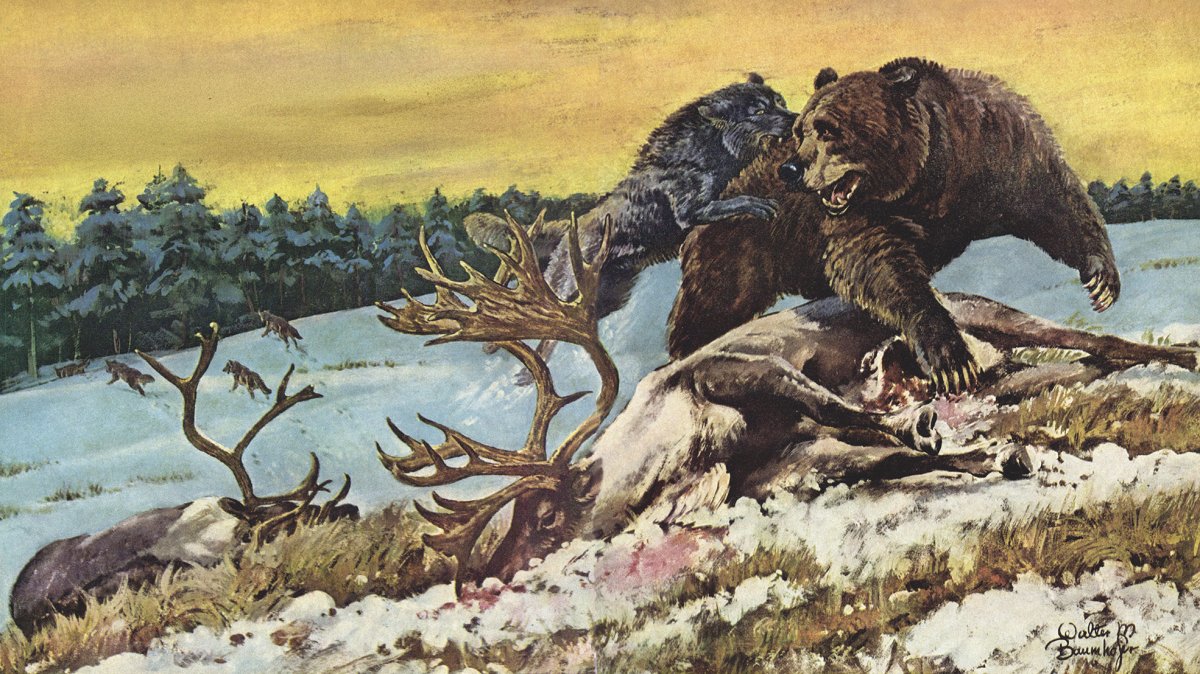
I once watched two wolves drive a large grizzly from their kill. Another time, I saw a family of wolves drive three grizzlies from their den.
On still another occasion, in Mount McKinley National Park, I was watching a family of wolves feed on several caribou they had killed. They would sleep, feed a bit, and then sleep some more. Eventually a big dark grizzly ambled up the river bar, feeding on roots and whatever else he could find. Suddenly he got the scent of the dead caribou, whirled, and sat up, leaning into the wind. A moment later he took off at a run toward the carcass of the wolf-killed caribou.
Six wolves were lying near the dead caribou, and when that bear plunged into their midst, they scattered in every direction. One big gray ran off a few yards, stopped, and howled. the others gathered around her, and then the five of them trotted off.
The last wolf was a big black. He stood watching as the others filed off.
The bear sprawled across one of the carcasses, watching the wolves leave. Then the black wolf walked, stiff-legged, from behind the bear. As he neared, the bear glanced around but didn’t move. The wolf walked as if he were on eggs — his tail straight out, his head straight — almost like a pointer on a hot scent.
When the wolf was about 10 feet from the grizzly, he leaped in and bit the bear’s back, hard.
I clearly heard the bear roar as he lurched over backward, reaching for the wolf. The wolf lit out downhill, with the bear hot on his tail. The bear gained, finally getting so close that he’d have had the wolf in another jump if the wolf-his tail held low and his hind legs spread — hadn’t made an abrupt turn.
It was a beautiful maneuver. The bear actually rolled over in his attempt to make the turn. He was as mad as a hornet when he picked himself up. He turned, walked back to the meat, and found the wolf already there.
The wolf backed off when the bear arrived, and then he lay down about 20 feet from the grizzly. But soon he circled, tiptoed close again, leaped, and bit, and once more the bear chased him down the hill.
The wolf tired of the game after about half an hour, and he trotted off in the direction the other wolves had gone.
It’s my opinion that the wolf has been called a coward because he is so shy of man and because he commonly hunts in a large group with the odds in his favor. But these facts demonstrate his intelligence to me.
A wolf can become lonely, I believe, if kept away from others of its kind. And a female wolf has pretty strong maternal feelings toward almost any pup. I used these traits to make $50 when a dollar was worth something.
The wolf backed off when the bear arrived, and then he lay down about 20 feet from the grizzly. But soon he circled, tiptoed close again, leaped, and bit, and once more the bear chased him down the hill.
It was spring at Fairbanks, and I was approached by a man named Van Bebber, who made a business of keeping and feeding sled dogs for people. A couple of months earlier, Van Bebber had acquired a three-year-old female gray wolf from a trader up on the Tanana River. The wolf was in a cage when he got it, and he had released it in a stout pen with 10 to 12-foot walls.
Van Bebber had a buyer willing to pay $200 for the wolf, but he had been unable to catch her and put a collar and chain on her. She was so violent when he tried force that he was afraid she would kill herself.
Since I drove wolf-dogs and was a trapper, Van Bebber reasoned that I was an expert on wolves. He offered me $50 if I could put a chain and collar on the wolf without hurting her.
It became obvious that the wolf was terrified of Van Bebber, so I asked him to leave. Then I took a three or four-month-old pup of his, put it on a chain, sat down in the middle of the pen, and started petting the pup.
I spent the afternoon there. Once in a while I released the pup, and it would run over to the wolf. She would smell it, it would try to play with her, and she would respond halfheartedly.
While petting the pup I would howl like a wolf, and soon the female was answering me, with a real low howl. By that evening I’d had my hands on the wolf two or three times. But each time, she leaped back stiff-legged and her mane came up.
Next day I went into the pen with a choke collar in each pocket of my coat, plus a chain. I figured that if I could slip the collar over her head, I could snap the chain into it afterward.
She circled me one way and then the other, fast and nervously. Again I howled and used the pup as bait, and I got my hands on her. Twice I almost had the collar on her, but she leaped back.
The third day, the wolf was noticeably tamer and very fond of the pup. She obviously had looked forward to our return — her actions said so when we came in.
It was almost anticlimactic when I slipped the collar over her head and, a little later, snapped the chain into it.
The wolf’s cruelty is not exaggerated. One September day, I noticed a bull moose standing in the river near my cabin. The next day, he was lying on the bank with his head on the ground. I went over to see what was wrong with him and found that, though he was alive, he couldn’t lift his head. Wolves had eaten 25 or 30 pounds of meat from one of his hindquarters. The suffering animal had been standing in water, trying to cool the feverish leg, when I had first seen him.
I shot the moose to end his suffering. Then I followed his back-trail to see what had happened. Five wolves had run and pestered him until he became exhausted and fell. They had eaten what they wanted and then had left — or perhaps they left because they heard my dogs barking or smelled my cabin.
Twice since then, I have found moose in similar conditions, both times in deep snow with a light crust that had supported the wolves but not the moose.
When wolves make a kill and are hungry, they’ll usually drink some hot blood and then eat the hams. Sometimes they’ll eat the tongue. A large number of wolves may eat an entire animal except for the skull and the very largest bones — and even these will often be cracked open so that the wolves can get at the marrow.
There are a great many variables in the relationship between wolves and big game. Some wolves are much faster than others. The speed of big-game animals, even those within the same species, varies greatly.
It takes a large number of wolves to pull down a mature bull moose that has hard antlers and good footing. But two or three wolves can finish off the biggest bull that ever lived if he is antlerless and is caught in deep and crusted snow. An animal in advanced pregnancy is vulnerable to wolf predation anytime. But the same animal at another time of the year might be able to run circles around the wolf, for the wolf is actually a relatively slow runner.
Because caribou are night-blind, one of any age or sex is highly vulnerable on dark nights. During daylight, however, practically any adult caribou can outrun wolves if he sees them in time. Wolves know this and hunt accordingly.
In the North, wolves depend more upon caribou for food than upon any other species of big game. Wolves exert strong influence on the caribou herds, especially young caribou.
In June 1940 in McKinley Park, Harold Herning, a park ranger, and I were eating lunch on a little hill overlooking a fork in the Teklanika River. In the V of the fork were 350 or so caribou, mostly cows, yearlings, and calves.
For several months previously, we had been observing a family of six wolves led by a small black female. Now, as we watched, these wolves trotted up the river and, upon smelling the caribou, dashed over the bank toward them. The caribou fled.
The little black female was much faster than the other wolves. She soon left them behind. Some 40 or 50 two and three-week-old calves bunched up and dropped behind the main body of caribou, and the black wolf was soon among them.
She grabbed one calf by the middle of the back, reared up, shook it, flung it aside, and continued the chase. She bowled over the next calf with her shoulder. Before it could get up, she grasped its back, shook the animal three or four times, and dropped it.
The third one was also knocked over. The fourth calf happened to be in soft ground, on which a wolf is clumsy. The black female hit the calf, knocking it down, but at the same time she stumbled and rolled end over end herself. The calf was the first to get to its feet, and as it started to run, it accidentally bumped into the just-recovering wolf, knocking her flat.
That angered the wolf, and after half a dozen jumps she caught the calf by the back and raised it high in the air, shaking it. Then she slammed the calf down, put both of her front paws on it, and actually bit out large chunks, tossing them aside as fast as she could.
The wolves didn’t eat any of those calves. Each had bites through the backbone and into the lungs and heart. Despite his savageness, however, I admire the wolf. He’s a fascinating animal, and I’d hate to see him disappear.
Related: I Was Asked to Investigate a Wolf Attack. Here’s What I Found
Alaska has taken some steps toward making the wolf big game (see “I Say Make Wolves Big Game!” OUTDOOR LIFE, January 1968), thereby reducing the danger of the animal’s being wiped out in our 49th state.
The wolf is a trophy of which any sportsman can be proud. But my guess is that there won’t be many wolves taken by trophy hunters. These fine animals are just too smart for that.
Read the full article here
