



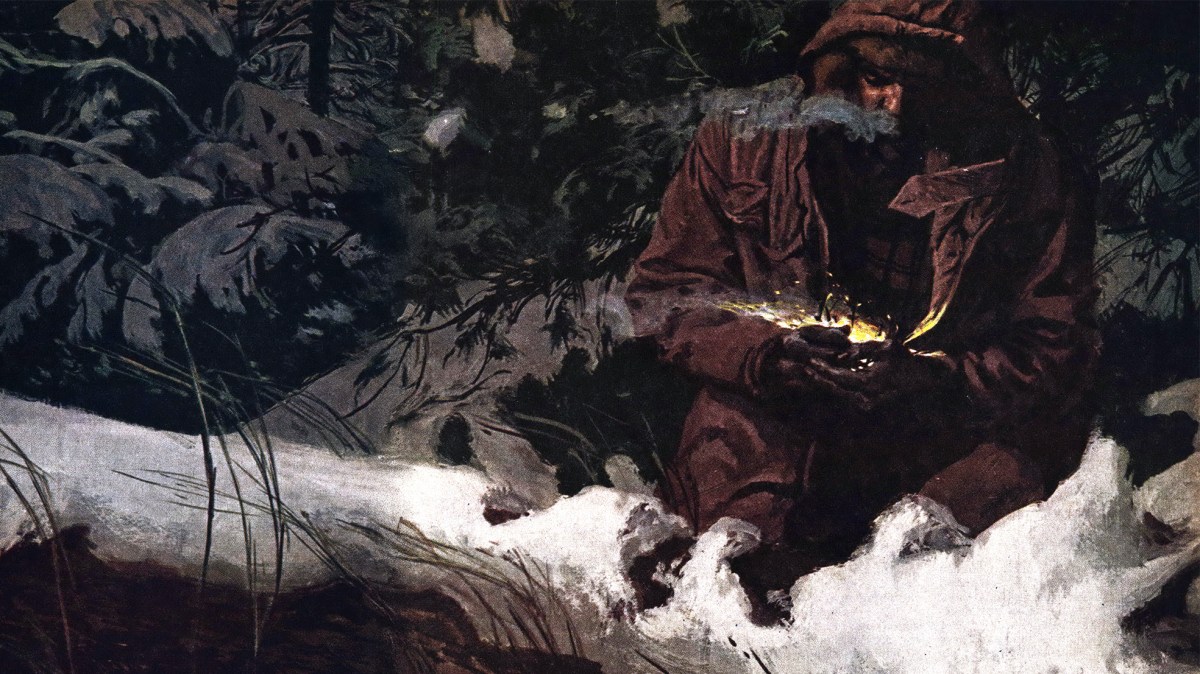

This story, “I Made My Death Bed,” appeared in the April 1965 issue of Outdoor Life.
When the time came for the 1964 deer season, my dad was unable to go, so I took his place in a party of seven hunters who had camped and hunted together for several falls in roadless country in Houghton County in the upper peninsula of Michigan. My six partners were Bill Vander Bos, captain of the group, his son Bill Jr., his brother Ralph, neighbor Gordon Coates, and Maurice Van Zoeren and Thane Barkwell. All were from Grand Rapids or its suburb, Jenison.
I’m also from Grand Rapids. I knew none of the six well, but they turned out to be a good party to hunt with.
We left home about 2:30 a.m. on Thursday, November 12, two days before deer season was due to open in the area where we intended to hunt.
We were driving a converted bus that was equipped to serve as our camp and were towing a jeep.
Our campsite lay in a tract of hills, ravines, and swamps between the Elm and Misery Rivers, west of State Highway 26 and east of Lake Superior, about 20 miles south of the city of Houghton, in the region known as Michigan’s Copper Country.
We drove steadily and reached the village of Donken, where we left the highway, in midafternoon.
There we turned off on a rutted logging road and followed it for five miles to the place where we were to camp.
The campsite was at the top of a big hill, high enough so that we could look out over rough, broken country and see Lake Superior miles away in the distance. The other members of the party were familiar with the area, having hunted there three or four years, but it was brand-new to me.
Related: The Best Survival Kits of 2026
In fact, I had been in the upper peninsula only a few times and had seen the Copper Country before. But I was by no means a beginner in the woods, and I had no reason to think anything out of the ordinary was going to happen on this deer hunt.
I’m 33 years old, a technician in the engineering department of the Blackmer Pump Company in Grand Rapids, and my wife Bonnie and I had celebrated our first wedding anniversary about a month before. I have two foster children, Linda, 5, and Michael, 10.
I’ve lived in Grand Rapids since I was 13, except for a four-year hitch in the Air Force, and I have hunted and fished all of those 20 years. I started hunting deer when I was 18. I also spent 16 months in Alaska while in the service and managed to get in quite a bit of hunting there. All in all, I thought I knew how to take care of myself.
We spent Friday getting camp organized and scouting nearby areas for deer sign. At daylight Saturday morning, we were in the woods. The weather was cold, and, except for the fact that there was no snow for tracking, conditions were ideal. The hunting proved to be good, and three bucks were killed that first day. Then our luck fell off.
A heavy fall of wet snow came on Monday night, and before the storm ended there were 12 to 14 inches on the ground. After that we saw little deer sign in the vicinity of camp. In three days of hunting only one of us got a shot at a buck, and the one member of the party who had a doe permit did no better. We concluded that the storm and deep snow had driven the deer down out of the hills and into their yarding areas in the swamps to the west toward Lake Superior. We were to leave for home Friday noon, and the only deer on the meat pole Thursday night were the three that had been shot on opening day. It looked as if four of us were due to be skunked.
But I voted for a last-minute try, and Bill Vander Bos Jr., Gordon Coates, and Ralph Vander Bos felt the same way. We started out right after breakfast, planning to be back around noon. The other three would break camp.
I headed for a small swamp to the north, found old tracks, and in less than half an hour jumped a deer and got one quick glimpse of him, enough to see that he carried a rack. He lit out northwest, and I took after him. Tracking conditions were perfect, and the snow was deep and heavy enough to tire a deer. I had heard many times of walking a buck down under those circumstances, exhausting him, and getting close enough for a shot, so I made up my mind to try it. It might mean I’d be a little late getting back to camp, but my partners would wait for me.
I’ve always made it a rule on deer hunts to let someone in the party know where I am going each day and in what direction I intend to hunt. That’s no more than a sensible precaution in case something goes wrong, and the thought ran through my mind that if I followed this buck I dian’t know myself where I’d wind up. But, if I hoped to overtake him, there was no time now to go back to camp and report my plans. And anyway, my companions could track me if the need arose. In jumping to that conclusion, I overlooked two factors. I had neglected to tell them that I intended to hunt north of camp, though I had mentioned it would be a good area to try. But somehow the whole party thought I had gone south. And the area around our bus was so tracked up by that afternoon that it was impossible to follow me.
I moved along at a good clip, but it wasn’t long before I realized that the deep snow was as much of a handicap to me as it was to the deer. For the first hour, he traveled steadily north-west, angling back and forth but keep-ing generally to that same direction. Then he turned southwest, dipping down into ravines along the creeks, following them briefly, climbing the next hill, dropping into another swamp.
I had jumped him north of the logging road on which we were camped, but it wasn’t long before he took me across it and on to the south. I recognized the rutted trail and made a mental note so I could find my way back.
I lost the buck after two hours of tracking when he went down into a yarding area in a swamp where the snow was crisscrossed with deer tracks. There was nothing to do but go back to camp. I still had an hour until noon, and if I hurried I’d be only a little late. I considered taking my own back track but quickly dismissed that idea. The deer had led me on too roundabout a course, and I’d lose a lot of time that way. For the last hour, I had walked generally southwest. If I headed back northeast, I’d cut the road and that would take me to camp.
I was tired and didn’t make as good time as I had at the outset. Shortly after noon I came to a logging road, but it didn’t look like the one I was trying to find. It was only a narrow trail marked by old wheel ruts, and the snow in it lay deep and unbroken. Neither vehicle nor hunter had passed this way since the snow came. The logging road on which we were camped was heavily used, and, where I had crossed it while following the deer a few hours before, I had seen signs of recent use.
Read Next: A Lost Kid Wandered into My Camp. It’s a Miracle He Found It
I knew there were a .u:.1.)cr of such logging trails winding through the area that were long unused and went nowhere. I concluded this was one of them. It wouldn’t take me back to camp or be of any help, so I turned away and trudged on to the northeast. From that minute on I was lost, though I didn’t realize it for several hours. The logging road I had left was the one I should have followed. Ahead lay only the rough, broken country on the headwaters of the Elm River.
I was fairly well prepared for the ordeal that was coming, but not well enough. I was wearing medium-weight thermal underdrawers, a T-shirt and sweat shirt, three pairs of wool socks, lightweight, insulated rubber boots, an insulated Dacron hunting suit with a hood on the coat, a wool cap, and leather gloves. I had my .300 Savage, scoped with a Weaver variable KV, and six shells. I was carrying a knife, compass, kitchen matches in a plastic container, and drag harness and rope for deer. I had no food.
Worst of all, I had been guilty of one great oversight. I wasn’t carrying a detailed map of the area and, in fact, had not so much as looked at one. I knew that Highway 26 lay several miles to the east and the roadless and unpeopled shore of Lake Superior to the west, but the latter knowledge was not of much use.
There was more than a foot of snow on the ground. The morning had been partly clear and not too cold, but now it turned overcast and a cold wind came up. I had perspired while tracking the deer, and I was cold in spite of the exercise of walking. I was getting more and more tired, too. About mid-afternoon I stopped, lighted a fire, and rested and warmed myself.
Not until almost dusk did I admit to myself that I was lost.
By that time, I was beginning to worry. I should have come out on the logging road long before, and I was slowly forced to acknowledge the fact that I was in trouble. The country was rough, and travel was becoming more difficult. I had followed the deer downhill most of the time, and now I was climbing back.
While I was resting, I heard shouts from the direction in which I thought camp lay, and I used two of my precious shells in replying but got no answer. It turned out that my partners blew car horns and fired shots at intervals all that afternoon, but I was too far away to hear the horns, and I wasn’t sure the shots I’d heard were signals.
Not until almost dusk did I admit to myself that I was lost. About that time I heard more shots, but they came from the west, and that confused me. I answered with three but again got no reply. That left me only one. I turned south in a final attempt to cut the trail east of our campsite, thinking I might have overshot camp during the afternoon. But I had walked only a short time before realizing I was too exhausted to go on. I’d have to spend the night in the woods, and this was anything but a pleasant prospect.
I stumbled around in the gathering dusk until I found a fallen tree that was held up off the ground by its upturned
roots. I scuffed the snow away under it, cut evergreen boughs to make a bed, and piled more boughs against the log to form a crude lean-to. Then I gathered dry wood and got a fire going.
For a little while I was fairly comfortable, but without an ax I could only break up small stuff, and the fire kept dying down. Each time it threatened to go out, I left my shelter and rustled up more fuel. Snow was coming down as thick as milk and the wind was blowing hard. That was a wretched night, and I lay awake, chilled and shivering, through most of it. But it was nothing compared to what was coming.
I know now that I made a big mistake the next morning. Highway 26 lay to the east of me, a paved road running southwest from Houghton. If I had used my compass and walked straight toward it, I’d have been out of the woods before nightfall. But I thought the highway was miles away and figured my best bet would be to head for the shots I’d heard from the west. From all I’ve been told, that kind of wrong decision is typical of lost men. Shortly after daybreak, I again heard shots off to the west. Convinced now that I had walked too far northeast, I turned toward them, assuming they had come from camp.
In midforenoon, stumbling along in deep snow, cold and discouraged, I heard a vehicle in the west and then two more shots. They sounded only a quarter of a mile away, and I used my last shell to answer, but the letdown of the previous afternoon was repeated. Officers who directed the search for me said afterward that the shots I heard probably were fired by other hunters who didn’t even know there was a lost man in the area.
The sound of the vehicle receded slowly and finally died away, and I heard no more shots. I walked west for another hour or two but found nothing, and I still don’t know what happened or how close the vehicle really was.
By that time, I was hopelessly confused. The rest of that day, I followed a straight course northwest toward distant shots. Actually, I was wandering as lost men do, still looking for the logging road that would lead me back to camp. I was terribly tired, and, though I suffered no discomfort from hunger, I was getting weak. I drank plenty of water from the many creeks I crossed, and that apparently kept me from feeling hungry. But I traveled more and more slowly, stopping often to rest.
My socks were soaked with sweat and snow, and I shivered as I walked. Shortly after noon, I lighted a fire and warmed myself as best I could. In mid-afternoon, I lighted another, and, after leaving it, I decided to abandon my rifle. I had no shells, it was heavy, and I felt too tired to carry it farther. Also, I was becoming very despondent, and the gun no longer seemed to matter. I leaned it against a stump and kept going. I had vague ideas about coming back for it but doubted I’d be able to.
Half an hour before dusk that night, I decided to stop. I found a fallen tree much like the one that had given me some protection the night before, dug away the snow, and built a bough bed and lean-to. Then I gathered dry sticks and made shavings.
My supply of matches was getting low and seemed to have gathered dampness. The heads were soft and wouldn’t Rtrike readily, I had nothing to strike them on and wasted half a dozen trying to light them on a thumbnail or against each other. Finally, one caught and flared and I held it against the shavings, but they wouldn’t burn. The wind blew the match out, and I realized with a sense of shock and fright that I had only one left.
I gathered dry twigs no bigger than straws, made a bundle of them and cupped it in my hand, then got down on my knees and shielded it with my coat. This would be my last chance for a fire, and I couldn’t afford to fail. The match struck, and I mumbled, “Thank God!” The twigs caught, and the fire licked up around my hand, but it was puny and flickering, no more than a candle flame. If it burned, I didn’t feel it. When the whole bundle was blazing, I laid it very carefully on the ground in a little place I had cleared and reached for more sticks. But in that instant, my handful of twigs fell apart, and the wind snuffed out the tiny blaze.
I stood and stared at the dead beginning of a fire, hardly able to believe my misfortune. Then I looked off into the snowy woods around me, where trees and stumps were turning indistinct in the gathering dark and where snow swirled in clouds ahead of a bitter wind. Somehow I had to survive the long, lagging hours of the night in that cheerless place, with only the poor shelter of a brush lean-to and without fire.
The first night had been bad enough. This one would be infinitely worse. Could I live through it? Would I see the first gray light break in the morning, or would the cold finish me before then? In all my 33 years, I had never known a minute as disheartening as that one.
I crawled under my lean-to at once. The wind blew hard and snow continued to fall. I learned later that the temperature fell to 10 above that night, but all I knew at the time was that I was dreadfully cold. Sleep was impossible, and after about an hour I crept out and cut more evergreen branches in the darkness, trying to build the lean-to thick enough to keep out the wind. Then, off in the woods, I heard a coyote howl.
I’m certainly not afraid of coyotes, but the thought flashed through my mind that this one might be following my tracks, and it scared me, I suppose because of my condition. If the animal attacked me under the log, I’d have only my knife for a weapon, and I was in no shape to fight even a small coyote. He howled off and on for an hour, and a little while after that I heard an animal prowling in the brush back of me. Then it came up to my log. It was probably just a porcupine, but at the time I thought it might be either the coyote or a bear, and I shook with fright and cold. I yelled, and for a minute or two everything was still. Then I heard it move slowly off.
When daylight filtered through the trees that Sunday morning, I crawled out and rubbed my arms and legs to get the blood going. “You’re still alive,” I told myself thankfully, but that was about all I could say. I had no food, no matches, no gun, and no knowledge of where I was or which way to go. I had never known such despair as I felt right then. I couldn’t give up physically, but I’ll admit I had surrendered emotionally as I trudged away from that wretched camp.
That day seems now like a bad nightmare. I didn’t give way to panic, as lost men often do, and run blindly through the woods, but I must have been pretty mixed up, for I can no longer remember whether certain things happened that day or the day before. I do know, however, that sometime that forenoon I heard three rifle shots rap out suddenly.
They sounded no more than 300 yards away, and I started for them at a run, yelling and whistling. There was no answer, and I slowed to a walk.
I walked toward those shots for half an hour, finally turned at right angles and walked for another 15 minutes, turned again, and repeated it until I had covered a half a mile square and come back to my own tracks. But I found no trace of the hunter.
My feet were so numb by that time that it felt as if I were walking on sticks. A shoulder ached badly, and I had a pain in the back of one knee that felt like an injured nerve. The knee hurt so severely that each time I moved on after a rest I groaned aloud. I have never had strong religious faith, but those dreadful days and nights certainly reinforced it. I prayed almost continuously, even shouting aloud to God, knowing there was no one else to hear and feeling I was entitled to a private session with Him.
I did a lot of thinking about my wife and two youngsters, and my dad and mother and brothers. In fact, I thought of little else. I could picture Bonnie and Mike and Linda safe and warm at home. Did they know I was lost, and were they worrying about me? Would I ever see them again?
Sometime around noon that day, I finally gave up all hope of finding either the logging road or camp, and I did what I should have done 30 hours earlier. I turned east in the hope of reaching Highway 26. I decided to follow my tracks back to where I had left my rifle, since they led in the same general direction. Maybe somebody could backtrack me later, assuming I got out, and retrieve the gun for me. After all, the rifle and scope together had cost $220, and suddenly I hated to lose them if it could be helped, though I still didn’t feel up to carrying them. I had no trouble backtracking and found the gun about 2 o’clock. Then I started walking straight east. That was the last I saw of my Savage.
I encountered a lot of creeks and beaver dams that afternoon, and there were places where the rough terrain forced me off course. But in general I kept heading east and southeast, the direction in which I knew the highway lay.
When dusk came, I was in hardwood timber, unable for the first time to find evergreen boughs. I came upon a fallen tree with snow drifted against one side and decided this was the best I could do. I scooped the snow from underneath, hoping to find a carpet of dry leaves, but there was only a handful. I was sure now that I was making my own death bed. It didn’t seem possible that I could survive until morning without even the shelter of a bough lean-to, and I resigned myself to the likelihood that this would be my last night on earth. How would I die? I’d heard it doesn’t hurt to freeze, but by now I knew that extreme cold is an awful thing to endure. When death finally came to a freezing man, did he simply go to sleep, or did he die aching in every bone of his body?
I’d probably find out before morning.
I squeezed under the log. The quarters were so tight that I couldn’t change position, and my feet and legs ached dreadfully. I was cold, terribly cold, but too tired to crawl out and try to get warm by moving around. Sleep came only for moments at a time, and it seemed as if the night would never end. But gray daylight broke at last, and, to my surprise, I was still alive. I dragged myself into the open, stamped my feet and pounded my hands together, and walked away to the east.
I heard no shots that morning. The storm had ended, the wind had died away, and the woods were eerily still. “Oh, God,” I thought aloud, “the weekend is over. They’ve given me up, and everybody has gone home!”
Actually, the search that had been under way since Friday night was being pressed harder than ever now.
When I failed to return to camp by dark on Friday, my partners got word out to Sheriff John Wiitanen, at Hancock, that a man was lost from their party. The sheriff sent cars to the area at once, and throughout the night they turned spotlights up into the sky, blew horns and sirens, and fired signal shots. But the heavy snowfall muffled the sound and blotted out the lights, and I was too far away to see or hear them. My companions spent all day Saturday searching for me, handicapped by the fact that they did not know which way I had gone.
Related: This Survival Instructor Wants You to Know the Wilderness Isn’t Out to Get You
“It’s an awful feeling when somebody in your party is lost,” Bill Vander Bos Jr. said afterward. “You walk around half dazed, wondering where he is and what you can do to help.”
It was necessary for some of my partners to be back at work on Monday morning, and, when the sheriff assured them that professional searchers would do everything possible and that they could be of no further help, they left for home Saturday night.
Meanwhile, sheriff’s officers and conservation personnel who were in charge of the search found themselves all but stymied by the bad weather. The storm that continued until Sunday night made it impossible to use aircraft or to find my tracks and limited the operation to a blind search on foot.
On Monday morning the weather cleared, and sheriff Wiitanen organized an all-out effort, though, as he admitted later, “By that time we were looking for a dead man.” A search party of 65 fanned out in the woods that morning, including sheriff’s deputies, conservation officers, national park rangers from the Isle Royale Park headquarters at Houghton, and local woodsmen who volunteered. Some were on foot, some on snowshoes, and some were using snowmobiles, and arrangements were made for an airplane that day. Nobody thought I was alive, and finding a dead man in snow-blanketed woods is close to impossible, but at least they intended to try.
When I left my makeshift camp that Monday morning, I was staggering rather than walking, falling every few yards.
When I left my makeshift camp that Monday morning, I was staggering rather than walking, falling every few yards. Then I heard what sounded like a stuck vehicle off to the east. The engine would roar, die away, again, and I tried to hurry toward it, hoping to find the truck before it freed itself and left. What I heard, actually, was a tractor at Messner’s sawmill near the town of Toivola.
About 9 a.m., I broke onto a logging road that showed signs of recent travel, and within half a mile I found the fresh tracks of a man. My spirits jumped! I was going to get out! There’d be shelter and fire and warm blankets, food and coffee. Later there’d be Bonnie and the children and home. If I live to be 100 I’ll never offer up a more sincere prayer of thanksgiving than the one I mumbled while staggering along that rutted road.
The noise of the vehicle grew louder. I rounded a bend and saw a pile of logs ahead. The cold and fatigue must have impaired my vision, for I saw nothing of the mill at first though it was in plain sight. It came into focus all of a sudden — the big quonset building, the plume of smoke from the stack, the sawdust pile, the sheds — like a blurred picture turning sharp. Four men emerged, and I stumbled to the nearest one and tried to babble out my story and my thanks all at once.
They gave me coffee and a beef sandwich, and while I wolfed it down they pulled off my boots and socks and gave my feet a chance to get warm. Two toes were frostbitten and black around the nails, but there was no other evidence of damage, and the toes have since healed nicely. I had come out at Toivola, about six miles from our camp, but I figure I walked no less than 30 miles in all.
The mill hands put through a call to Sheriff Wiitanen, and he left at once to take me to St. Joseph’s Medical Center in Hancock. I was treated there for exposure, frostbite, and hysteria. That last one came as a surprise. I knew I was exhausted and upset, but I didn’t think I was hysterical and I still don’t.
I was able to leave the hospital after 24 hours. Bonnie, my dad, mother, two brothers, and a sister-in-law came to take me back to Grand Rapids. We had a family reunion right there at the medical center. I was home for Thanksgiving.
Read Next: The Miraculous Story of How an Old, Lost Hunter Was Rescued from the Woods, Against All Odds
The sheriff and his deputies went back into the woods with a snowmobile and tried to find my rifle but couldn’t locate my tracks. So far as I know, the rifle is still there, and I have no hope of ever seeing it again.
I plan to hunt again next November, but there are several things I’ll do differently. I’ll never go into the woods again in any wild area without a good map. I’ll carry a candle for starting fires and something to strike matches on, which can be almost as important as the matches themselves. I’ll have plenty of shells in case I need to signal, and a small kit of dehydrated rations or jerky. My compass will have a luminous dial so I can travel at night in an emergency. And my hunting party will know exactly where I’m going each day and in which direction I intend to hunt. That last point be the most important of all.
Read the full article here
