



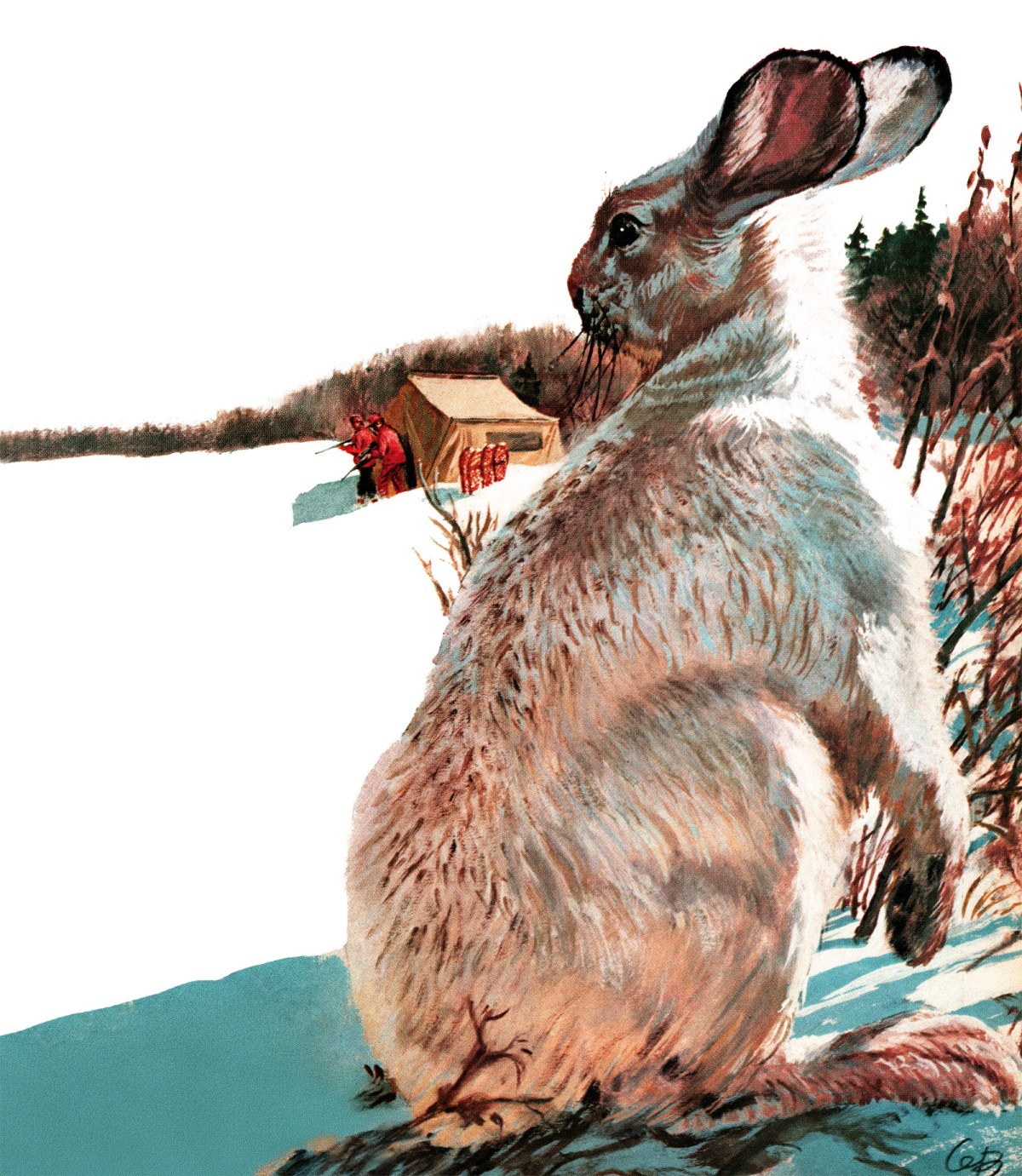

This story, “Snowshoe Runaround,” appeared in the December 1962 issue of Outdoor Life.
I stood at the edge of a snow-choked evergreen swamp, slowly congealing and thinking moodily how much white-rabbit hunting has in common with ice fishing, another glacial activity in which I find myself involved each winter.
In one of these undertakings, I reflected, you stand around freezing on the ice waiting for a red flag to pop up; in the other you stand around freezing in the snow waiting for a rabbit to pop up. And why do I get involved? It’s because back in the warm months, some character says, “Why don’t you come up next winter and shoot some rabbits or catch some fish?” and at the time, it seems like a wonderful idea.
This time it was Dick Fosie. Dick runs Bearcat Lodge up in Holderness, New Hampshire, and when I was there grouse hunting in the fall, the covers were thick with snowshoe rabbits. I didn’t shoot any, be-cause I didn’t want to corrupt Dick’s bird dog, but I did mention that a baked, stuffed hare would taste good.
“Why don’t you come up next winter and shoot a mess of ’em?” Dick suggested.
At the time, in the mellow October woods, it had seemed like a wonderful idea. “I’d love to,” I agreed.
So there I was waiting in the snow on a day last January with the mercury at 3 below. And to make matters worse, I was still trying to recover from a nerve-shaking incident that had occurred just before Dick and I left the lodge in the dawn’s early light. I had been standing beside the car waiting while Dick went out to the kennel to get his dog, Denny, when suddenly a flicker of motion caught my eye. A lump of snow beneath a gaunt lilac bush appeared to be hopping leisurely toward the shed, and as I stared, it resolved itself into a fat rabbit.
Dick Fosie has often described this Holderness area as a sportsman’s paradise, but I still hadn’t expected to find game right in the back yard. With fumbling fingers, I slapped a couple of No. 4’s into the tubes of my 16 gauge over-and-under and was just about to put meat in the pot when Dick and Denny appeared around the corner of the house. For a startled second, Dick stared at the tableau before him, and then his voice rose in sudden alarm.
“Don’t shoot!” he cried. “That’s Louella.”
As I lowered the gun in confusion, I saw that this rabbit had pink eyes and pink ears. Louella was the children’s pet, Dick explained, and she had somehow got loose from her cage in the barn. The next thing was to get her back. Denny didn’t help any. To him Louella was game, and he gave tongue in a ringing bass that brought faces to the bedroom windows. Dick’s long-handled boat net didn’t help either, and finally Rickie had to come down in his pajamas and drag Louella out from under the porch. Then we went hunting, but that sort of thing is a shock to the system at the edge of dawn, and the experience had left me shaken.
Now, out of the tangled heart of the swamp, there rose a startled yelp which changed instantly to a frenzied, deep-voiced chop, and at the sound, I was suddenly warm. That’s like ice fishing, too. When a red flag springs erect, you forget the chill wind and the numbing cold in the excitement of anticipation. But there the analogy ends. When a true-voiced hound opens on the trail of a streaking snowshoe rabbit, the moment packs a wallop all its own.
Denny was making this one sprint. Denny is half beagle, half black and tan, with some of the best traits of both. He has a choke-bored nose, powerful, driving legs, and the enthusiasm and stamina to stay with the quarry all day if need be. He also has a mellow, chiming bass voice that makes your backbone twang.
Dick’s shout came from the swamp: “Denny must have tripped over that rabbit. He’s sight-running him.”
He was indeed, and the chase was moving in my general direction. There was a breakable crust over the two-foot snow with two inches of fresh powder over the crust. Dog and rabbit could skim over it without breaking through, and Dick and I could skim over it, too, after a fashion, on snowshoes. I had just time to scramble to a little open place in the trees when the rabbit burst out of the laurel 40 feet away, back hunched, kicking his ears in great bouncing leaps.
It was an easy shot, and I figured this was one chase that was going to end in a hurry. I raised the 16 and blew a hole in the snow right where the rabbit had been but wasn’t. And that was it. There was no time for a second barrel; there seldom is. The rabbit didn’t go far, though. Dick has hunted this swamp for years, and he was at the right place at the right time to roll the swamp runner endways with a charge of 4’s. You can’t hide tracks in the snow, and when Dick came up. holding the rabbit out of Denny’s reach, my defeat lay plainly written in winter’s white page. As he glanced at me with a quizzical expression, I blurted
the first alibi that came to my mind.
“I was afraid it was Louella,” I explained.
Actually, you don’t really need an alibi for missing one of these white streaks, not ahead of a dog on a winter day, at least, for they are the swiftest four-footed creatures in the woods, faster even than the fox who must catch them by stealth. No dog can run them down in their native swamps. Add to that a bag of artful, dodging tricks that would do credit to Reynard himself, and you’ve got an opponent worthy of your best efforts, which often aren’t good enough.
And that’s a strange thing, too, because at any other season of the year, snowshoe rabbits are seemingly the stupidest critters on earth. Frequently in spring you’ll see them hopping leisurely along the sides of country roads or lying motionless in their forms among the evergreens. And in autumn, deer hunters blow their silly heads off with .30/30’s for camp meat as they sit obligingly or move listlessly off through the woods.
In winter, it’s different. Winter puts springs in their long hind legs. It puts zip in their movements and even seems to sharpen their wits. Then, at the first note of the trailing hound, they take off in great bounds and run like streaking white ghosts through the tangled evergreens, the embodiment of the snow-choked swamps. White rabbits and snowshoe rabbits are their common names, but actually they are hares, living their lives above ground and bringing forth their young fully-furred with eyes open and ready to run. Varying hare is the correct name. It’s appropriate because the animals’ coats turn gradually from summer brown to snowy white in winter.
There is just one weakness in the snowshoe’s tactics, and if it were not for this failing, few of them would be shot by hunters. His first maneuver when he hears the hound on his trail is a blinding burst of speed to rid himself of his pursuer. When this fails, he begins to cut his zigzagging capers, his dodges and twists and feints, sometimes racing in and out among the evergreens just out of sight, sometimes leading the chase right out of the country. But invariably — unless he loses the dog somewhere along the way — sooner or later he’ll circle back to his starting point.
he chase came racketing through the evergreens, and once I caught a fleeting glimpse of Denny as he flashed past an opening in the laurel.
Denny’s voice, echoing through the swamp in his short, mad chase, had startled other rabbits from their forms, as frequently happens, and it wasn’t 10 minutes before he had another one up and away. He gave notice with a challenging bawl that changed quickly to a rhythmic chop as he followed a smoking trail.
“Get down by the brook,” Dick said. “I’ll cut across to the knoll.” His snowshoes slapped the powdered crust as he loped away. Dick is a cat hunter, among other things, and he thinks nothing of a 20-mile jog through the winter woods on his long Penobscot webs. I don’t think much of it either.
I made my way more cautiously to the edge of the snow-mounded brook and stood gripping my gun in cold hands, straining my eyes into the depths of the clamorous swamp. The chase came racketing through the evergreens, and once I caught a fleeting glimpse of Denny as he flashed past an opening in the laurel. But his quarry kept just out of sight and gun range, an exasperating habit of these white swamp ghosts. Then the sound of Denny’s frenzied bugling notes changed direction and gradually faded away.
Dick came slogging over on his snow-shoes. “He’s left the swamp,” he said. “Heading for the hollow a mile away.”
If we’d been fox or cat hunting, we’d have had to follow the chase, but we knew that eventually the rabbit would be back. The question was when, and just out of curiosity I glanced at my watch: 11:20.
“You stay here,” Dick told me. “I’m going to mosey over to the edge of the clearing. He may come back that way.”
Alone beside the brook, I made myself as comfortable as possible among the laurel and settled down to wait. Slowly the frozen, seemingly deserted woods came to life. The chickadees appeared first, hopping about in the pines overhead, trilling their cheery notes. Deep in the swamp a jaybird screamed, and presently a solitary crow flapped past, looking down upon the snowy world and cawing his discontent. A few moments later, as I huddled deeper into the evergreens, a fat gray squirrel came bounding among the trees, jerking his tail at each leap, and scurried up the trunk of a tall pine.
And suddenly, over the murmur of the ice-muted brook, I heard Denny’s voice faint in the distance. The chase was coming back!
It was coming fast, too, and all at once the spot where I was standing didn’t seem “rabbity” any more. I was sure I ought to be across the brook and farther to the left. The same thing invariably happens when I’m on a deer stand, and usually my second guess is wrong. But I never seem to learn. Anyway, I tried to run to this new location the way Dick ran on his snowshoes, and at the third step I tripped over my webs and landed belly down in the powder. By the time I’d got untangled and regained my feet, all I needed was a carrot nose and a pair of raisin eyes to be set up in someone’s front yard.
Things worked out all right, though, because by that time it was too late to change position, and by that time it had become evident that I couldn’t have been in a righter spot. Denny’s voice rose in a crescendo beyond the brook, and a second later the rabbit burst out of the laurel, heading toward me like a missile. This time my charge of 4’s caught him in mid-bound, and he somersaulted to lie kicking less than 30 feet away.
Denny came storming to the end of the trail, and I let him mouth and nuzzle the rabbit for a moment before I lifted it out of his reach. Then, before I pocketed it, I held it for a moment more — yes, gloating, for every snowshoe rabbit bagged is a triumph in its way.
Close up, the difference in texture and coloring of the snowshoe’s coat from that of the Easter bunny – Louella, for example – is clearly evident. The snowshoe rabbit’s winter coat is not an ivory gloss but rather the white fluffiness of sifted snow. The edges of his ears alone do not change color but remain black tipped the year around. In winter, as he crouches in his form with his ears folded back, these black pencil lines give the effect of twig shadows on the snow.
Perhaps most interesting of all, though, are the white rabbit’s great splayed hind feet, six inches long, four inches wide, and thickly padded with downy fur, which allow him to skim over the deep snow faster even than Dick Fosie.
In the excitement I had forgotten to look at my watch, but as Dick joined me I remembered. It was now five minutes past 1, and the chase must have lasted at least 1½ hours.
A sandwich and a thermos of scalding soup back at the car, and we were ready to go again. That afternoon we hunted a smaller pocket, and Denny had hardly investigated its outer edge before his big voice opened. About three bawls later, from my stand on a wood road, I heard the blast of Dick’s 12 gauge double, but the chase kept rioting on.
“Did you miss?” I called, trying to inject a note of sympathy into my tones.
“No,” Dick called back. “This isn’t Denny’s rabbit. This is another one. The two must have jumped out together, and this one cut right in front of me.”
“If you fell in a well, you’d come up with a trout in your pocket,” I said, and I was about to elaborate on the subject when a sudden swerve of the chase caught my attention.
f the rabbit continued on this new course, he was shortly going to go across the wood road some 50 yards away, and I clattered off to intercept him. But he was too smart to fall into the trap, and at the last second he swerved again, ricocheting back into the depths of the swamp. Twice more he circled among the evergreens, and twice more Dick and I picked the wrong stands. Then, as I waited pant-ing beside a big hemlock, I saw a white streak flash between two clumps of laurel. One bound took it across the opening, and instinctively I yanked my gun up and fired into the brush the way you snap off at a grouse which has disappeared behind a screen of ever-greens. Sometimes these wild shots connect, as this one did, and those are
the ones you remember.
Denny started one more rabbit that afternoon, a long-legged jumper that gave us the runaround in the laurel for half an hour and then headed right out of the country. By the time he circle back, it was too dark to shoot, and Dick had to do some fancy running to collar the dog. When we got back to the car, a full moon was just rimming the eastern hills.
Not the least of the charms of Bear-cat Lodge are the meals Evelyn Fosie serves to hungry fishermen and hunters, old-fashioned New England meals that make you forget missed shots, lost fish, and weary miles of trail. That night she gave the troops baked beans in an authentic earthenware bean pot, along with ham, apple pie, and thick wedges of cheese. After dinner, as I sat cleaning my gun, Dick turned Lou-ella and a friend loose on the sofa “so you’ll recognize tame rabbits next time,” he explained.
Next morning we were up before dawn, heading for a wild, remote swamp at the base of Prospect Mountain. Dick had saved this spot till last. “I haven’t been in there this winter,” he said, “but last fall in deer season it
was crawling with rabbits.”
We hiked in along a winding wood road, the rhythmic crunch of our snow-shoes punctuating the stillness. In call-ing this Holderness area a sportsman’s paradise, Dick Fosie doesn’t exaggerate. Situated between Little Squam and big Squam lakes, it offers fisher-men landlocked salmon, trout, bass, pickerel, and perch; and to hunters grouse, rabbits, deer, and bears. This morning on the mile hike into the swamp we started grouse from the snowy, roadside evergreens, and we saw fox and cat tracks crossing our path. Dick averages 20 cats a winter, and his sports hung over a dozen deer to the lodge game pole last fall.
Where the white ribbon of road turned steeply up the mountain, we left it and struck out through the laurel to the edge of the swamp. A north-country rabbit swamp, of course, is not really a swamp at all in the generally accepted sense of the word. It is actually a thick, tangled mass of cedar, balsam, hemlock, alder, willow, and tamarack densely packed and growing out of a sea of laurel and ground pine. Some, like this one, are impenetrable. “There are places in there where there’s no room to put one foot ahead of the other,” Dick said.
These are the haunts that snowshoe rabbits love. Here they are born and live and die. Here they build their secret passageways through the thick, summer greenery, passageways which the winter snows betray. We could see the marks of their cuttings and the white ribbons of their trails leading out to the feeding grounds, branching, and fading away. Their tracks were every-where.
Dick unsnapped Denny’s leash, and as the dog bounded off, we followed a little way into the swamp and then be-gan to circle its edge. We could hear Denny’s pattering feet on the crust, and occasionally we could see his black-and-tan form flickering among the evergreens as he wove back and forth below us. Suddenly his deep bass rang out in a challenging bawl. It rose again and again and turned to a rhythmic cadence echoing through the swamp. I ran to an opening and saw a quick blur of white flash through a corridor of laurel. I raised my gun, but I was too late. One bound took the rabbit from sight, and not for a clamorous hour did he show himself again. When he did, Dick snapped a shot through the brush to end the chase.
The swamp was full of rabbits. As Dick had said, it was an untapped vein of snowshoes. By lunchtime we had four tucked away in our jackets, and truth to tell their weight was partly compensated for by the lightening weight of our ammunition. There was no return to the warm car that day, only a frozen sandwich and a quick sip of coffee in a stand of pines while gray clouds blanketed the sky and a keen-edged wind sliced through heavy cloth-ing. We were on the far side of the swamp by. now, close under the moun-tain, and now occurred one of the strangest incidents in all my years of hunting.
Denny had a rabbit up and away, dodging and twisting among the evergreens. For 20 minutes or more, the chase racketed through the swamp while Dick and I maneuvered for position. Then, as I stood beside an ancient blow-down peering through the brush, Denny’s frenzied chiming broke in mid-tone, wavered, and fell silent. There was something eerie about the sudden stillness, and Dick and I hurried over to investigate. There was something eerie, too, in what we found clearly written in the powder snow.
The rabbit’s triangular tracks led out of a snarl of cedar, spaced four yards apart, and between them lay Denny’s shorter bounds. Then, abruptly, the rabbit’s trail ended as though he had taken wing. And that, we decided, must have been just what happened. The spot was jumbled with Denny’s tracks, but incredible as it seemed, something faster than Denny, faster even than the streaking rabbit, must have swooped out of the white silence and snatched it from ahead of the dog. A snowy owl was Dick’s suggestion. At least, it was the only answer we could give to the mystery.
Certain it is that no animal in the north woods is more relentlessly pursued than the snowshoe rabbit. Defenseless, except for his built-in speed, he is the favorite meal of every predator. Hawks, owls, and eagles harry him from above; foxes, wildcats, lynxes, and weasels follow his trails through the swamps. When periodic epidemics thin his ranks, the predators starve; in cycles of rabbit plenty, the predators grow fat. The wonder of it is that any of his kind survive, but like his cottontail cousin he has his own answer to the problem. Three times a year the does bring forth litters of two to three young, and it is this fecundity that keeps the northern covers populated, come what may.
They’d certainly done a good job in this swamp. Only minutes after Denny had reluctantly abandoned the trail of the missing rabbit, he had another one going, a long-legged jumper that played ahead of him, zigzagging among the evergreens, just out of sight. And as Dick and I shifted positions back and forth, the first lazy snowflakes be-gan to sift down through the pines. The snow seemed to put new zing in the rabbit’s flying feet, for the chase that had been circling nearby now took off in overdrive and faded away in the distance.
“Heading for the mountain,” Dick said.
It was snowing harder now, and wet flakes were beginning to trickle down my neck. I raised my hood and brushed the snow from my jacket, waiting, listening, while out in the whiteness beyond, the chase went on. I could almost see the sprinting snowshoe zigzagging, back-tracking, bounding, swerving, using every trick of his clan to throw off the relentless hound.
Dick appeared like a wraith out of the snow. “If I didn’t know Denny, I’d think he’d struck a deer track,” he said, glancing at his watch.
We stood smoking, talking low-voiced, each with an ear cocked to the breeze. The minutes seemed like hours, but only 30 of them had passed when, suddenly, Dick held up his hand.
“They’re coming!” He tossed away his cigarette and jogged off through the brush.
I strained my ears, and over the hiss of snow through the pines I caught a faint thread of sound which hung and wavered in the white stillness.
I strained my ears, and over the hiss of snow through the pines I caught a faint thread of sound which hung and wavered in the white stillness. I stood a second listening, trying to trace the direction of the chase. Then I headed blindly through the snow to intercept it. On it came full throated. Denny had pulled out all the stops, and his big voice rolled and swelled across the swamp. But the snow played tricks with the sound. Once, dog and rabbit seemed to be coming straight toward me, but both of them passed by far to the side.
I heard the muffled blast of Dick’s gun, but still the chase continued. And then, straining my eyes through the white curtain, I saw a blur of motion thicker than the falling snow. Instinctively the gun snapped to my shoulder. Instinctively I swung with the bound-ing streak, and as the muzzles blotted it out, my finger squeezed the trigger. The white blur somersaulted and lay still.
What was the last run of the day. It was a long way to the car, and I still had a 150-mile drive to Westfield, Massachusetts. So we left the rest of the rabbits to their snowy winter swamp and trudged off through the falling snow.
Read Next: I Promised to Take My Boys Rabbit Hunting Every Day of Christmas Break
It’s a cold sport, white-rabbit hunting, fraught with discomfort and uncertainty, but its rewards are commensurate with its frustrations. I knew that the next time someone said, “Why don’t you come up and shoot some rabbits?” I’d promptly answer, “I’d love to.”
When I don’t, it will be time to hang up the 16 gauge for good.
Read the full article here
