



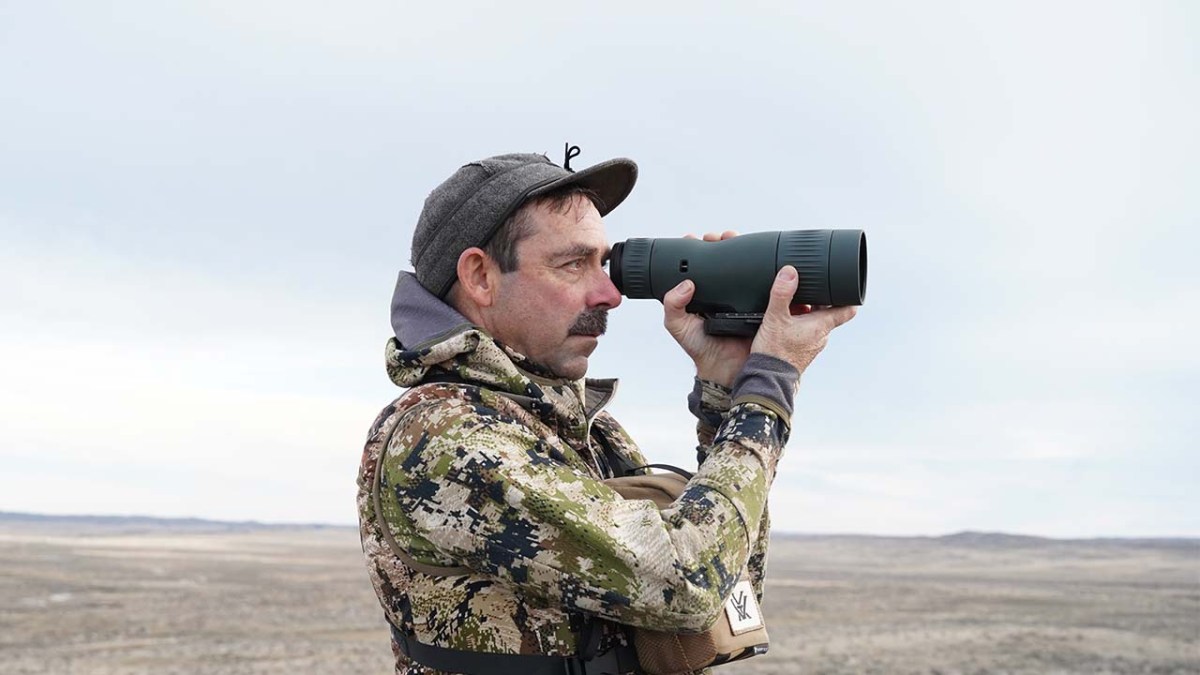

You might want to retire your binoculars. They’re about to be replaced by Swarovski’s remarkable new image-stabilized spotting scope, the AT/ST Balance.
With a pair of these image-stabilized spotting scopes, 50mm and 65mm versions, Swarovski joins Sig Sauer’s OSCAR6 and Kite’s pioneering APC Stabilized 60 to deploy a vibration-reducing (VR) gyroscope inside a field-worthy spotter. The value proposition of all these field scopes is that they make tripods obsolete. But Swarovski, by nailing ergonomics, optical clarity, vibration reduction, and ease of use, might also make binoculars obsolete.
I spent the last couple weeks with the 14-35×50 ST Balance. This is the straight-tube version of the new spotter. The AT (for angled tube) Balance is an 18-45×65 stunner. I hunted coyotes, glassed winter-range elk, and participated in the Audubon Christmas bird count with the ST Balance. I bumped around on prairie roads, gazed at constellations through it on sub-zero January nights, and tried to fool its image-stabilization software by glassing at highway speeds (I wasn’t behind the wheel).
My main take-away is that Swarovski has solved one of the pernicious problems with image-stabilized optics: calming the strange, stomach-clutching sensation of the digital software racing to keep up with the optical input. You experience this floaty sensation, this slight lag in the image, mainly when panning. It’s a dynamic that Sig Sauer has nearly resolved with its OmniScan technology, which adjusts the level of stabilization based on the amount of movement and vibration. But while Sig’s effort is useful and a marked improvement from versions without OmniScan, there’s still a slight lag in the Sig image, especially in windy conditions or when making aggressive panning sweeps.
I wasn’t able to detect this lag with the Swarovski. Instead, the unit calms hand- and wind-shake and even the bumps and pitches of a slowly moving vehicle, without degrading the image or creating that distinctive VR lag.
See It
Key Features
-
Angled or straight eyepiece models -
Objective:
65 mm (AT) and 50 mm (ST) -
Magnifactioin:
18-45x (AT) and 14-35x (ST) ( -
Exit Pupil Diameter:
3.6-1.4 mm -
Weight:
51.9 oz (AT) and 45.9 oz (ST) -
Field of View:
165-90 ft/1000 yds (AT) and 210-117 ft/1000 yds (ST) -
88 percent light transmission -
Price:
$3,999 (AT) and $3,849 (ST)
Effortless Ergonomics
I used the ST Balance both with and without a tripod, and while the tripod is useful for viewing small targets at the highest magnification, it’s way more effective (and fun) to free the spotter from the constraints of the tripod and simply hand-hold the unit.
It’s in this deployment, holding it in both hands — sometimes gloved, sometimes with my elbows on the hood or bed rails of my pickup, sometimes simply free-holding it — that the Balance’s ergonomics really showed themselves.
My front hand naturally finds the focus ring, located just aft of the objective lens. My rear hand easily finds the power ring. Using it to glass bedded elk off the hood of my pickup, I could riff from 14-power, at the low end of the power range, to 25- or 30-power, and then feather the focus without lifting my head from the infinitely adjustable eyecup. The image stabilization kept pace with my changes in magnification and focus, delivering a smooth, crisp, and vibrant image at every magnification, though as you might expect at higher powers the image is noticeably darker than at the lower end of the magnification range.
At lower magnifications, the Swarovski performed like a binocular, taking in great chunks of the prairie and delivering sharp, vibrant, and shake-free images. But the ability to zoom, and retain that same image clarity, is a talent no binocular can claim.
The AT Balance (untested) probably exhibits the same ergonomics as the ST version, but I can’t imagine the angled-tube spotter is as fast or intuitive as the straight-tube model, simply because the angled eyepiece requires users to hunt and peck for the target, 45 degrees out of plumb to the viewer. The straight-tube Balance is the better configuration for tripod-free viewing, simply because acquiring targets is as fast as pointing the straight scope at them and then tucking into the eyepiece.
It’s a little unsettling, this ability to glass distant targets with a hand-held spotter. Those of us who are accustomed to deploying a tripod are familiar with the tedious process of snapping the optic onto the plate, extending and leveling the legs, loosening the panning head, and then acquiring the target. We trade the tedium for the rock-solid glassing base the tripod provides.
I actually found the tripod a useful accessory for the ST Balance, but mainly as a device to give my hands a rest from holding the 2.5-pound spotter.
Read Next: Best Spotting Scopes
Swarovski Balance AT/ST in the Field
At about 11 inches long and 2.8 pounds, the unit is easy to tote in a backpack or even a spacious pocket of a field jacket, and it ships with a handy neoprene strap. I carried it on a number of coyote sets a quarter-mile from my pickup, a situation where I’d never deploy a non-VR spotting scope.
In the open country of eastern Montana’s prairies, where visibility is great for hunters but also for incoming coyotes, I want to minimize movement. A tripod-mounted spotter simply isn’t useful, because it takes so much time and movement to adjust the optic to the target. But the hand-held Swarovski was clutch, enabling me to glass what I thought was a sitting coyote at 700 yards only to find it was a curious shade pattern created by a mature sagebrush.
Turning on the image stabilization is a cinch. Just hold a button on the belly of the spotter, and a green light blinks to show the VR module is engaged. It’s easy to prove the power of the vibration reduction. Simply turn the stabilization switch off and watch the world get all squirmy with hand shake and vibration. Power up the gyroscope, and the image stills and becomes pleasingly crisp. The unit offers about 12 hours of use on a single charge of its rechargeable battery. To save battery life, the Balance shuts down after about five minutes of inactivity.
The infinitely adjustable eyecup extends or retracts to users’ preferences, and the overall balance of the Balance is just right, a bit front-heavy to settle in my hands.
The glass and coatings of the Swarovski are what you’d expect from the premium Austrian optics company. Edge clarity is very good and I couldn’t detect any flaring or other optical aberrations. I didn’t shoot phone photos or videos through the Balance, but the large exit pupil and field-flattener ocular lens both lend themselves to phone-scoping.
Demerits of the Balance AT/ST
The new Swarovski has its share of problems. The most pronounced is the tedious amount of time it takes users to riff from close focus of about 10 feet to infinity. It took me nearly three revolutions of the center-barrel focus wheel to make that journey. The fine gearing may be required to mate up with the image-stabilization module, but glassers used to responsive focus will be a little frustrated with the slow Swarovski.
The grabby green armor of the spotter is nicely textured, but it also seemed to pick up and retain every speck of dirt on the prairie and dog hair from my pickup.
The eyepiece on each Balance is fixed, which means it’s not swappable with eyepieces that contain reticles or have different magnification ranges. But the biggest ding is Swarovski’s fairly short 12-hour run time on its removable rechargeable battery. Both the Sig OSCAR6 and the Kite APC have run times in the 30-hour range.
The Balance is also damned expensive. The angled AT 18-45×65 retails for $3,999 while the straight-tube ST Balance in 14-35×50 version retails for $3,849.
Final Thoughts
Stabilized optics are becoming so widespread, largely thanks to Sig’s early market share of the category, that many brands are scrambling to produce their own versions. Swarovski’s Balance was reportedly in the works for a couple years, and the wait was worth it for what now represents the pinnacle achievement of the category.
The ST Balance has a wide range of applications, from go-light backcountry hunting to birdwatching to a handy truck optic to pull out and glass without requiring a window mount. The one element I was unable to test or determine is its durability. The Swarovski image-stabilization module is a free-floating lens element that’s unattached to retainers which is activated by motors that adjust it in equal and opposite directions to applied vibrations. Whether that system can handle the abuse of normal hunting situations, or the bumps and yaws of prairie two-tracks, is an open question.
But in my experience, the Balance’s utility fits neatly between a 10×42 binocular and a large-frame spotting scope. That it can capably do the work of each of them returns me to my original conclusion: It may make both obsolete.
Read the full article here
