



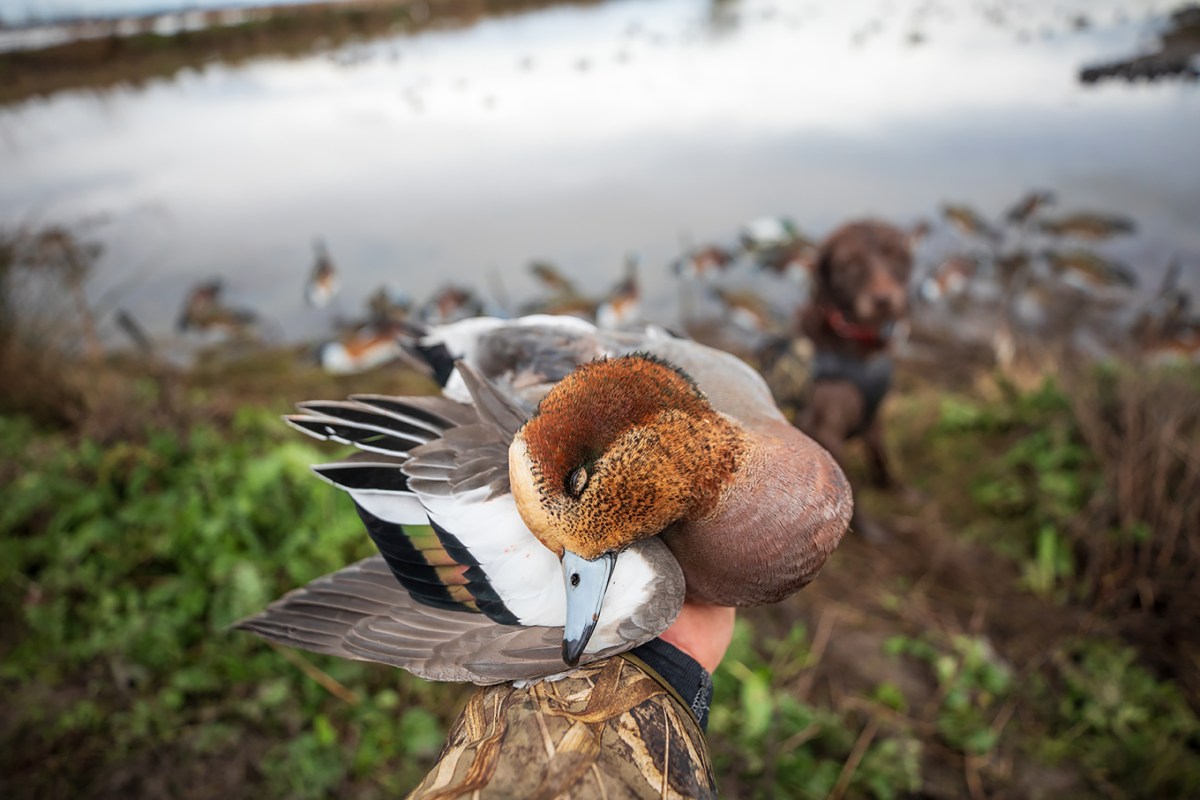

Ten minutes of shooting light remained. Echo, my then eight-year-old pudelpointer, and I had been tucked behind a tiny one-man panel blind for 9 hours and 45 minutes. We had one duck to go to reach our limit. But we’d been waiting for that one duck for the past five hours.
Stacked to the side of our little blind were six drake American wigeon. Their green and white heads shone in the afternoon sun. The morning began with dense fog. I shot at silhouettes of ducks as they cupped into the decoys. Late in the season, it’s easy to identify the football-shaped body of a drake wigeon versus that of more slender hens.
About 6,000 wigeon were using the pond. Due to recent rains, the water level was up, offering ducks easy access to lush, green rye grass. Here, ducks could graze along pond’s edge in the morning, then roost on the same pond for the day.
Two days prior to the hunt I picked up a stunning Eurasian wigeon on a trail camera set on a nearby pond. So that’s what I was waiting for. That one duck — a drake Eurasian wigeon.
Not until 1:30 pm did the fog burn off. With the sun at my back I could finally identify birds based on color, not just silhouettes. I passed more than 400 wigeon that afternoon, many of which landed and swam in the decoys.
With five minutes left in the hunt, I shot a hen green-winged teal, not to attain a limit, but to reward Echo. She’d sat so patiently all day, focused on the hundreds of ducks that dove into the small decoy spread. She aimed questioning glances when I didn’t pull the trigger. After so many looks, her eyes shifted to scorn. She wanted to retrieve ducks. The species doesn’t matter to her — but it matters to me.
The Wigeon Addiction
Eurasian wigeon are an Old World duck. As their name suggests, they’re common in Europe and Asia. Their tendency to migrate long distances to wintering grounds is the reason they’ve started showing up in the Pacific Flyway. The Euros I see likely come from Eastern Siberia, though apparently there’s now also a small breeding population in the Aleutian Islands of Alaska. Besides their coloration and call, they are a lot like our American Wigeon.
This new year marks my 50th season of waterfowl hunting. It took me 45 years to shoot my first Eurasian wigeon, though. It was actually a hybrid, an American-Eurasian cross. It was silhouetted when it came into the decoys early that morning. I knew it was a drake, but a Euro wasn’t even on my mind.
A flock of wigeon had come in from left to right. Three shots were fired. Two ducks fell. Kona, my male pudelpointer, delivered one duck to the blind. When I turned to the other side to take the other duck from Echo, I let out a whoop. Her eyes got wide and her tail began to wag. She’d never seen me so excited, at least not since her first duck retrieve.
The copper and green speckled head of that mature drake hybrid shined like a new penny. Its beauty took my breath away. It’s an image I’ll never forget.
But I’d been fixated on Eurasian wigeon long before I ever shot one. One moment in particular stands out.
The sound of heavy footsteps stumbling through dry leaves snapped me from a daze. “Young man, you better catch up to your group or you’ll be disqualified for slow play,” the marshal stated in a stern voice.
When I stood and slung the golf bag over my shoulder, half my irons fell onto the ground. “You alright young man?” the man questioned. Shaking, I wasn’t sure how to respond, so I was honest. “See that duck over there?” I said, pointing under tree limbs on the opposite shoreline of a pond. “That’s a Eurasian wigeon. It’s the first one I’ve ever seen. Do you know how rare they are around here?”
The man wasn’t a duck hunter. “Get moving,” he ordered.
I caught up to the group, avoided disqualification, and shot the worst round of my season. All I could think about was that Eurasian wigeon. It was 1982, my junior year of high school. Forty years and eight months would pass before I’d shoot one of these prized ducks.
The Chase
For the past five years, the valley I hunt in Western Oregon has seen more Eurasian wigeon with each passing season. January is the best time to get one. With an influx of these ducks in my area, my Euro passion transformed to an obsession. Routine scouting trips to find ducks turned into missions to specifically locate copper topped drakes among thousands of American wigeon. The year I shot my first Euro, I figured the odds were about one in 7,000. Everyday I look at that stunning drake, which sits mounted on my office desk. (I had one of the country’s best taxidermists, Pat Bradburn, do the work.)
Since then, that ratio has drastically changed. Two years later it was about one Euro to every 1,000 American wigeon I’d see. The season after that: 1 in 700. Last season it was down to about 1 in 400. And the first week of this January, 2026, it was about 1 in 250.
A few days ago I sat in my truck, watching and counting wigeon that were feeding on a pond in the late afternoon. Some were eating rye grass. Some were asleep on the water.
I counted just shy of 500 wigeon — 477 to be exact — on the pond. Not a lot by any means. I’ve counted over 5,000 wigeon on this pond in the past. I was hoping to see a Eurasian wigeon, but with such low numbers, I wasn’t counting on it.
Then, the light colored body of a drake illuminated in the afternoon sunshine. It floated amid 20-some other ducks. The light gray duck bobbed, and it finally turned in the slight breeze. That’s when a cream colored forehead appeared. Tucked beneath a wing, it was not easy to see. But I knew the moment I saw the pale colored body I was looking at a mature Eurasian wigeon. That brought the pond’s ratio to 1 in 477 ducks.
Minutes later, a bald eagle flew over the pond and a flock of 20 to 30 ducks jumped from tall grass along the pond’s edge. I happened to be looking right at them through binoculars. That’s when a juvenile drake Eurasian wigeon caught my eye. The ratio just hit the lowest I’d seen, around 1 in 250.
The Discipline
Scouting with me were two friends from North Carolina. It was the first Eurasian wigeon they’d ever seen. I’d be lying if I said shooting a Euro wasn’t their main reason for coming to hunt with me, despite the low odds I continually reminded them of.
But odds change. The next morning the three of us were in the duck blind, less than 50 yards from where we’d seen the two Euros.
“If you really want a Euro, we’re only going to shoot drake wigeon today,” I told them. “I’ll call the shots, but you guys have to be patient and very precise in your shooting.”
Ten minutes after shooting light, three wigeon circled the decoys. It was low light, but the plump silhouettes of two drakes materialized. I called the drakes and my buddies each dropped one. Kona retrieved one, Echo the other. They were both American wigeon; one was a stud that’s destined for the wall.
We shot a few more drakes over the next two hours. Hundreds of green-winged teal teased us in the decoys, along with a fair number of mallards. “I’ve never passed teal like that,” shared one friend. “I’ve never passed greenheads, either,” the other buddy replied.
By 9:30 the sun was up and the lighting was good. My friends were halfway through their limits. All the ducks in the blind were drake American wigeon.
Two wigeon sped into the decoys so quickly I didn’t have time to call the shot.
Both birds fell dead in the decoys. Both were hens. “You just reduced your chances of getting a Euro,” I joked. My buddies didn’t laugh.
Then the pintails began to arrive. In pintail-like fashion, a flock of four circled the decoys five times before committing. When the best drake dropped its feet, one buddy shot.
“That was the coolest thing I’ve ever seen!” he shouted. I gave him the look. “That’s my first pintail, ever!” He came back. “Is it a good one to mount?” Unfortunately, it wasn’t.
“If you think there’s a chance, I want to shoot a big one to have mounted,” he said. He shot two more drake pintails and was done for the day. The other buddy did the same. Neither had shot pintails before, let alone mature drakes. I understood where they were coming from. We saw hundreds of them over the course of three hours. And with a three pintail limit, I can’t say I blame them for shooting.
Both friends went home with exceptional sprigs for the wall. But for each of them, only three drake wigeon made up their seven bird bag limit. The three pintails and one hen wigeon, each, meant they reduced their chances of shooting a Eurasian wigeon to exactly 42.8571% that day. In an already low percentage game, those are not good odds.
“You mean to tell me you will actually hunt all day and shoot only drake wigeon, passing all these other ducks?” One buddy asked as we picked up decoys. “Yep, all the time” I responded. “You can’t shoot a Euro if you’re killing other ducks. It’s simple math.”
The Decoy Game
One afternoon, two seasons ago, I watched more than 5,000 wigeon grazing in a green rye grass field — the number one food source of late-season wigeon in our area. Two drake Euros grazed side-by-side on the near edge of the flock. I was focused on them through a spotting scope when three Euro drakes and a hen landed right next to them. Those four incoming birds could have landed anywhere amid the grazing flock that spanned 50 yards wide and over twice as long. But they chose to set down with two of their own kind.
That night I ordered a half dozen Final Approach LIVE Eurasian Wigeon decoys. We hunted over them the remainder of the season, shooting only American wigeon. But the following season my dad and I were in the same blind where I’d shot the hybrid. It was New Year’s Day, 2024. One of the first birds to drop into the spread was a lone drake wigeon. Dad was up. Just as the duck dropped its feet, Dad nailed it. Being backlit, we had no idea what it was until Kona arrived with the bird in his jaws. It was the most striking drake Euro I’d ever laid eyes on. Big, boldly colored. Breathtaking. And Dad shot it as it was landing in the Euro decoys.
The floating Euro decoys were set near the shoreline, between floating American wigeon decoys and a couple dozen Big Al’s American wigeon silhouettes staked on shore. The floating Euros clearly stood out.
Last season I supplied Big Al’s with a handful of photos to develop a line of Eurasian wigeon silhouette decoys. They printed some up and buddies and I hunted with them all season, testing them out before they hit the market. I shot a hybrid drake over them and another buddy nailed a nice Euro drake on an icy morning. The day before, my friend had heard a Eurasian wigeon calling on one of his cellular trail camera video clips. He went in early the next morning, broke ice, set out 12 floating wigeon decoys and a half dozen of the new Big Al’s Eurasian wigeon silhouettes. He staked the flat drake decoys on the upwind end of the set. He shot a limit of wigeon that day, the last one being a prized Euro that came in picture perfect.
The Sounds
Eurasian wigeon have a different sound compared to the typical American wigeon, which has a three notes–plus or minus. The call of a Eurasian wigeon sounds like a shrill sounding kazoo mixed with a screaming monkey. It’s a one- to two-note sequence that starts low and ends high. It’s raspy at first then hits a high, crisp, pitch at the crescendo before tailing off. Once you hear it, you’ll never forget it.
Three seasons ago I was hunting with my buddy Austin Crowson. He’s 29 years old and has shot 14 Eurasian wigeon. We set up in a flooded field where he’d been seeing about 10,000 wigeon feeding the previous three days. “There’s a dandy Eurasian drake in there,” he told me.
I’d gotten a juvenile Euro drake that I heard circle overhead, watched land, then jump shot. It was the first and only drake Eurasian wigeon I identified before pulling the trigger. Kona just seemed extra proud as he pranced in with that duck in his mouth.
Crowson and I planned to shoot only drake wigeon that day. We set out three dozen floating decoys and 12 dozen Big Al’s wigeon silhouettes, and we were halfway through our limit when a flock of 20 wigeon circled overhead. “Did you hear that?” Crowson asked. “There’s a Euro in there.” They were backlit so we couldn’t see any colors.
The flock left, along with our hopes of shooting a Euro. A few minutes later, a flock of 10 wigeon came in. The high, one-pitched note of a calling Eurasian rang clear. I began to shake. They circled again, but we couldn’t identify the prized duck.
“Let’s take ‘em this time around,” Crowson whispered, both of us working our wigeon whistles extra hard. “Shoot the bottom one!” Crowson shouted. I did and it fell. Crowson dropped two drakes from the right side of the flock.
The bird I shot was a beautiful drake Eurasian wigeon. I call that my 1 in 10,000 drake. It was the second Euro I’d shot that I heard before firing.
Scouting With Trail Cameras
I catch a surprising number of Eurasian wigeon on trail camera. While I use trail cameras all season to scout for ducks, come January, the number of trail cameras I set eclipses two dozen. In person, I can only scout one place at a time, maybe covering three spots in an afternoon. But my squadron of trail cameras can cover many places.
I set cams where I know wigeon are likely to appear this time of year. That’s mostly on the edges of farm ponds with fresh sprouting rye grass, in flooded rye grass fields, and in creeks and river sloughs where wigeon roost.
I run Moultrie cellular trail cameras and set each one on video mode. I’ve tried many trail cameras over the years and settled on Moultrie Edge Pros, both the 2 and the 3 models because of their quick trigger speed and utilization of Smart Zones. All cameras are on the longest video option, in high definition in order to capture sights and sounds. (A 15- or 20-second video reveals much more than a still image.) I’ve actually heard many Eurasian wigeon that I’ve never seen on trail camera. This valuable intel provides a starting point and boosts my odds of shooting the target species.
How Chasing One Duck Has Made Me a Better Hunter
When it comes to duck hunting, I like the game of chance. I despise targeting banded birds and won’t do it. In fact, if I see a banded or collared duck I deliberately will not shoot it. Part of the reasoning is the biology background I have, knowing the value a band holds. Part of that is the fact I don’t like givens. I like the element of surprise. I’ve been invited on hunts from folks who use skull boats to stealth in on Euros on the water and shoot them along the Pacific Coast. I have nothing against the approach; it’s legal and effective. It’s just not my style. I simply like going about it in my own way. I covet the process of scouting, setting up, trying to outsmart birds, and playing the odds. It’s not the most effective way, but it’s made me a better duck hunter.
Thanks to Eurasian wigeon, I scout much harder. I take detailed notes on what I see when scouting and hunting. And I pass on a lot of ducks while hunting.
In addition to being a full-time outdoor writer, I’m a wildlife photographer. Photography has taken my knowledge of animals and understanding of animal behavior to another level. When hunting, you might pull the trigger on a bull elk within a minute of spotting it. While photographing bull elk, I’ve watched them for hours, inching closer and closer to get the perfect shot. What’s learned during this laborious process is invaluable, and it has all made me a smarter hunter.
It’s much the same with chasing Eurasian wigeon. Passing ducks and looking for that special one offers the same education. Shooting a fast limit of ducks and being home before the sunrise is fun, but passing hundreds of ducks a day educates you on duck behavior, decoy placement, and calling. There’s no better way to boost experiential knowledge than by hunting. That’s what pursuing Eurasian wigeon has done for me. That’s why I’m addicted to these fine ducks, and why I have them to blame for so many sleepless nights this time of year.
Read Next: The 7 Best Late-Season Duck Hunts
The Passion
Last season a buddy picked up a flock of American wigeon on trail camera that landed in a newly flooded field. You could hear the distinct, two-tone, shrilling whistle of a Euro. The next day he caught the drake swimming in front of the trail camera and it was calling. Two days later he shot a drake Euro there. He wouldn’t have hunted the spot were it not for the trail camera, as fewer than 30 wigeon used the small pocket. His odds of success were high due to the ratio or birds, and the fact he was patient, not pulling the trigger until he was sure of the target.
The final few weeks of duck season mark the height of the wigeon migration in Oregon’s Willamette Valley. I’ve amassed more Eurasian wigeon decoys than I probably should have, both floaters and silhouettes. I’ve built multiple one-man panel blinds so I can be mobile and get where Euros are, and I have knocked on more doors than ever seeking permission to hunt these grand ducks.
In the past four seasons I’ve shot seven Eurasian wigeon. All but one hen are mounted, in my office, an arm’s reach away from the computer on which I type these words.
When I laid eyes on that rare Eurasian wigeon back in high school, I vowed to mount every drake Eurasian wigeon I shot, figuring I’d be lucky to get one. As I wrap up this story it’s nearly midnight. I hunted ducks two days ago and shot seven drakes, all American wigeon. Today, Crowson and I hunted for 9 hours and 45 minutes, waiting for a Euro to arrive. It never did.
My alarm is set to go off in four hours. I’ll be back in the same pond, searching for the two Euros I spotted a few days ago. I’ll hunt that spot multiple times over the last two weeks of the season, hoping a copper top appears. I’ll call lots of ducks, change up my decoy spread and question every move. Sleep won’t come easy and I’ll fall behind on work. I’ll blame Eurasian wigeon for that. But mostly I thank them. Because never in 50 years of duck hunting have I enjoyed the process so much.
Read the full article here
