



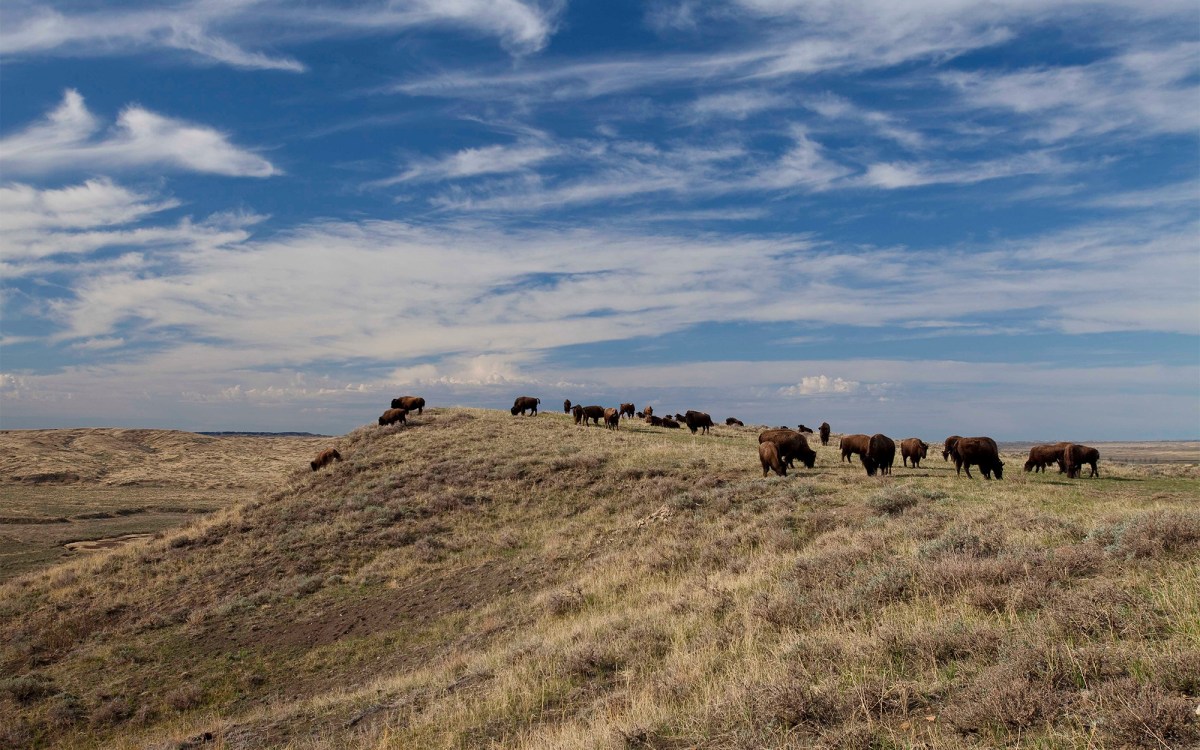

The U.S. Department of the Interior has said it will revoke the grazing permits that have allowed American Prairie to run bison on roughly 63,000 acres of federal public land in Montana. This decision would affect seven parcels managed by the Bureau of Land Management in Phillips County, and it would hinder the organization’s larger goals of conserving large swaths of intact grasslands while restoring the native grazers to those landscapes.
The Interior’s rationale for yanking the permits, according to its Jan. 16 proposed decision, is that under the Taylor Grazing Act, the BLM can only issue grazing permits for livestock managed for “production-oriented” purposes. It claims that American Prairie’s emphasis on conservation runs counter to those purposes.
American Prairie CEO Alison Fox criticized this reasoning as both unfair and inconsistent with long-standing public-lands grazing practices in Montana. She said in a response to the decision that it creates uncertainty, not just for American Prairie — which has been grazing bison using federal leases since 2005 — but for all other livestock owners in the West. She added that American Prairie plans to protest the decision and will take further legal action, if necessary.
“This is a slippery slope,” Fox said in a statement shared with Outdoor Life. “When federal agencies begin changing how the rules are applied after the process is complete, it undermines confidence in the system for everyone who relies on public lands. Montana livestock owners deserve clarity, fairness, and decisions they can count on.”
The grazing permits now in limbo were approved by the BLM in 2022 after years of analysis and public comment. The agency noted in its record of decision that the feeding habits of bison could lead to habitat improvements there, and that it had granted similar bison grazing permits on BLM lands in Colorado, North Dakota, Wyoming, and other Western states.
This approval, however, drew intense pushback from industry livestock groups and politicians in Montana, who considered it a radical proposal and an attack on the state’s ranchers. Those same groups challenged the BLM’s approval in court, and they are now celebrating the Interior’s more recent decision — one that was signaled in December, when Interior secretary Doug Burgum used his authority to assume jurisdiction over the long-running legal battle.
“[This] decision by the BLM is a win for Montana’s ranchers, our agricultural producers, and the rule of law,” Montana Gov. Greg Gianforte said in a press release praising the decision.
At the heart of this dispute are the livestock industry’s concerns around the impacts that bison could have on traditional grazing operations. American Prairie’s director of public affairs Beth Saboe says these concerns tend to be misplaced, and that the organization has proven over the past 20 years that cows and bison can — and do — coexist on the prairie.
Saboe explains that of the 600,000 acres in Montana that American Prairie manages, over 500,000 acres are being leased back to local cattle ranchers. The vast majority of the organization’s habitat base is public land, and American Prairie’s long-term goal is to stitch together both public and private holdings to establish a sprawling conservation reserve benefitting wildlife, ranchers, and the American public.
“There are 25 ranching families who run their cows on those leases, and it’s somewhere around 8,000 head of cattle,” says Saboe, who comes from a ranching family herself. “We know this region is very important to the livestock industry and the ag economy. What we’re saying is we can be additive. We’re not taking that land out of production.”
The organization also takes issue with the Interior’s core argument for revoking the grazing leases, which is that American Prairie’s bison are a conservation herd (emphasis added by the Interior), and not a domestic livestock herd used for commercial purposes. Saboe says these bison are actually classified and regulated as livestock by the state of Montana, and that “short of sending these animals to market,” they are also managed in the same manner as a production operation. This includes trading the animals with tribes and other organizations, and, when possible, donating bison meat to local food banks.
“We’ve also offered public bison harvests, where we give between 20 and 25 tags per year,” Saboe says. The tags are distributed through a lottery system, and successful applicants pay $300 per tag. “So, one, they’re paying for the tag. And two, they’re getting the meat. We’ve also donated numerous harvests to local charities as raffle items … Those charities have raised more than $150,000 over the last eight years.”
Read Next: After More Than a Century of Conservation Efforts, Why Can’t We Recover America’s Buffalo?
This would seem to align with the Interior’s own definition, included in its recent decision, of animals to be grazed and used for production-oriented purposes: “That would include their being used for their meat, milk, fiber, or other animal products.” And it’s only part of the economic value that these herds bring to America’s public land-owners. Bison contribute to healthier grasslands, which in turn provide more opportunities for hunters, ranchers, and the prairie’s other inhabitants.
“There aren’t many places left on the planet where intact prairie grasslands have been saved, and where this type of landscape-scale conservation is possible. Montana, and this section of the Northern Great Plains, is one of them,” Saboe says. “How will people feel knowing that our federal government has just said that our national mammal can’t graze on our public lands?”
Read the full article here
