



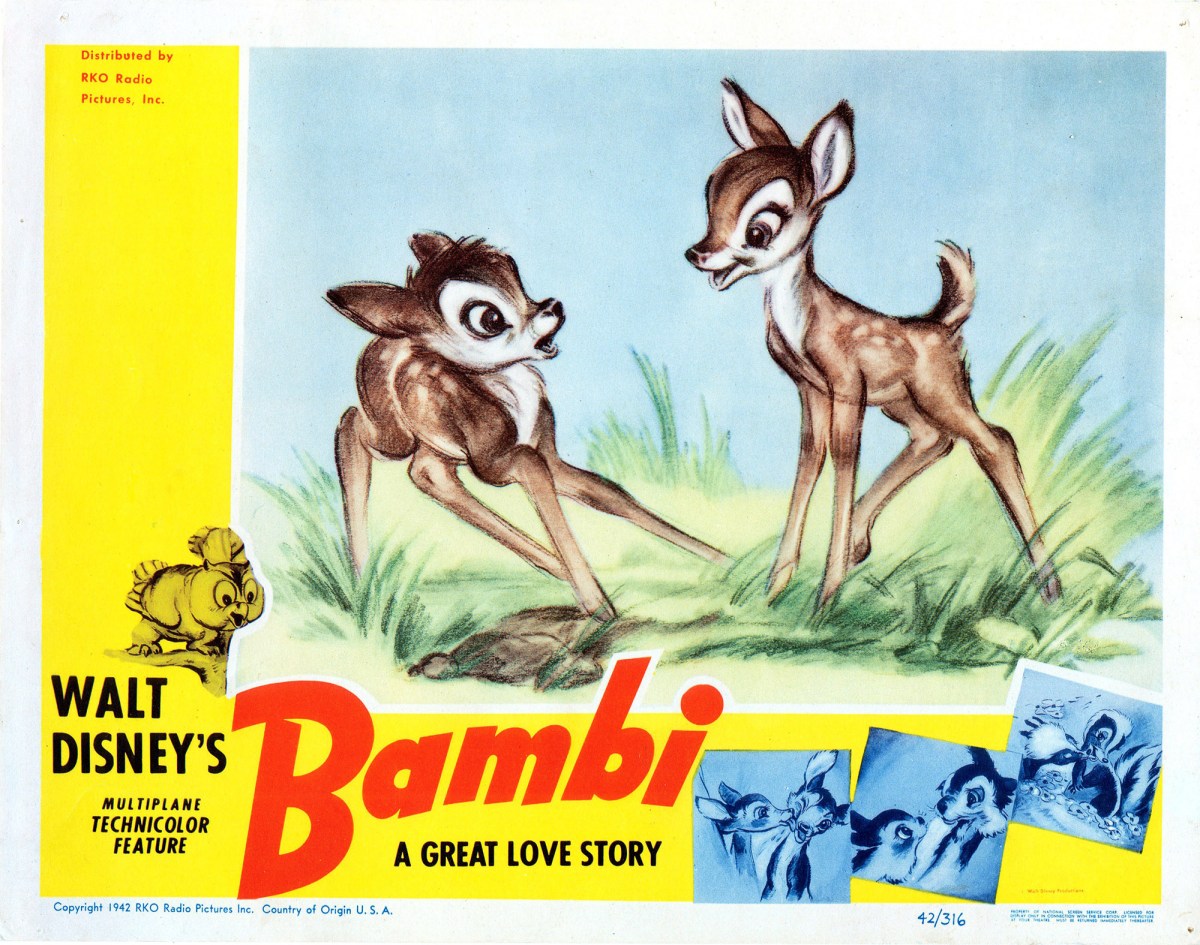

This editorial appeared in the September 1942 issue of Outdoor Life under the title, “Outdoor Life Condemns Walt Disney’s Film Bambi as Insult to American Sportsmen.” The magazine would’ve begun arriving to subscribers just as Bambi was released, on August 21, 1942. The column was not bylined. It appears to be written by the editor of the time, Raymond J. Brown, though it’s possible other editors contributed, too.
One point of contention outlined in the editorial is a key change in how Disney adapted the novel, Bambi, which originally depicted a poacher as the story’s villain. The book was written by Felix Salten, a hunter and Jewish author who ultimately fled his native Austria as Nazis rose to power ahead of WWII. His books, including Bambi, were burned and banned in Europe. A recent edition of the book ‘Bambi’ by the Princeton University Press, writes the publisher, “traces the history of the book’s reception and explores the tensions that Salten experienced in his own life — as a hunter who also loved animals, and as an Austrian Jew who sought acceptance in Viennese society even as he faced persecution.”
About the time that this issue of OUTDOOR LIFE reaches its readers, there is scheduled to be released in motion-picture theaters throughout the United States a film called “Bambi,” a full-length animated cartoon made by Walt Disney Productions. This picture is the worst insult ever offered in any form to American sportsmen and conservationists.
“Bambi” is a rather free adaptation of a book of the same name written by Felix Salten about twenty years ago. The book tells the life story of a deer in the Black Forest of Germany. In the film version the action is transferred to the United States, though not for patriotic reasons, and Bambi, which is the name of the deer whose story is told in both book and picture, becomes a white-tail buck.
Early in the film a villain is introduced; not in person, for he is never seen. But he is there nevertheless, a vicious, cruel, destructive villain, who casts a pall over the happy lives of the harmless forest animals. His sole purpose in life seems to be to kill and to lay waste, wantonly and needlessly. The name of this villain is Man. And, since his presence in the film is made known principally by the reports of high-power rifles and the whistling of bullets, it is logical to assume that the producers intended to depict the sportsman. Moreover, since the locale of the picture is the United States, we don’t see whom else they could have meant to portray except the American sportsman.
We are quite certain that nobody who happens to read these lines ever heard of an American sportsman shooting a doe on the first day of spring. Yet that is exactly what the invisible but active sportsman of the film does as he is introduced. At the end of his first winter, Bambi and his mother emerge from the forest. One little patch of green is visible in a snow-strewn field. “..Oh, Bambi!” cries the mother happily. “The first grass of spring!” Bambi and the mother doe leap eagerly across the field and begin nibbling at the grass. Then— Bang! Whe-e-e-e-e! And the mother deer falls dead. Bambi dashes away in terror. Eventually he is found by the king of the deer herd, who tells him, “Man has taken your mother away. I will protect you.”
Nice fare, isn’t it, to be served up to the patrons of motion-picture theaters, most of whom probably have never heard of game laws, or the protection and feeding of our deer population by federal and state conservation agencies and by sportsmen?
It is not our purpose here to tell the story of “Bambi.” But toward the end of the picture there is a forest-fire sequence that is a honey! And naturally it’s the villain of the piece, man, who starts the fire and lets it rage uncontrolled. Moreover, he starts it so soon after the frightened animals detect his presence in their forest that one might almost be forgiven for assuming that he started it intentionally. The villain, Man, also gives the movie goers a splendid idea of game laws and sportsmanship by running deer with huge, savage dogs.
The editor of OUTDOOR LIFE saw a preview of this film early in June and the following morning telegraphed Walt Disney as follows:
“Certain sequences in Bambi convey an erroneous and harmful impression that is certain to be resented by sportsmen and conservationists. I refer especially to the shooting of the doe in the spring which of course would be unlawful anywhere in North America, and to the portion of the picture showing the forest fire. In order to forestall unfavorable criticism when your picture is released I urge that you insert a foreword stating plainly that the picture is a fantasy and that its locale is not North America. The United States Fish and Wildlife Service, the Forest Service, the game commissions of the various states, and the fifteen million sportsmen who support the work of these agencies by the purchase of fishing and hunting licenses have done too much to protect our wildlife and our forests to be presented even by implication as vicious destroyers of game and natural resources. The point of view I am expressing is not that of one prejudiced person but is shared by several who saw the preview with me. You can readily check the possible reaction of sportsmen and conservationists by showing the picture to officers of the Fish and Wildlife Service and the California Department of Natural Resources.”
In his reply Walt Disney stated that it would not be possible to install a forward in the film, which, considering the fact that the picture was not to be released for some months, was puzzling to say the least. He added that he was sure the public would not accept it “as a criticism of our American sportsmen.”
“We merely followed the Felix Salten story,” he wrote, “as far as picture possibilities would let us, and if you remember the book it was a poacher in the Black Forest who killed the mother.
Well, if Disney and his associates wanted to show a poacher at work in the Black Forest, they took a queer way of doing it. As stated above, the locale of the Disney production is the United States. This is not an assumption Ono ur part. Walt Disney Productions and Radio-Keith-Orpheum Corporation, which distributes the picture, both prepared publicity releases stating that a cameraman was sent to Maine to photograph the forests of that state to provide backgrounds for the film. We said earlier that Bambi in the film is a white-tail deer, an animal which inhabits only North America. That is not merely the result of our own observation. When production of the picture began, its makers obtained a white-tail fawn in Maine, and shipped it to their studio in California, where it was used by the artists as their model for the picture’s deer hero.
And, in addition to that, the same fawn, now a full-grown deer, at this writing is in a California zoo, and a placard in his pen states that his name is Bambi. And in order to absolutely cinch the fact that they were making an American picture, the producers include among their principal characters cottontail rabbits, skunks, and chipmunks, which are not found in the Old World.
All of these facts were brought to the attention of Walt Disney Productions, and, when the producers declined to do anything to correct the obnoxious portions of their picture, OUTDOOR LIFE took the matter up with the distributors of the film, Radio-Keith-Orpheum Corporation. This company, possibly more concerned with the commercial possibilities of the production than with its artistic merit realized at once that it would be bad business to offend 15,000,000 hunters and fishermen, and the countless others who indulge in allied sports and are interested in conservation, and immediately advised Walt Disney Productions to include in the film a plain statement that the incidents depicted were not typical of the United States, but that on the contrary, because of the efforts of American sportsmen and conservationists, such things could not now happen here.
Walt Disney Productions, however, refused to heed the counsel of the distributors, so the film is going forth to spread the doctrine that the American sportsman is a cruel lawbreaker and a destroyer of natural resources. The tragic part, of course, is that the vast majority of persons who will see the picture do not know that this not so. Children, for example, who love the cute, little animals that Disney makes so lifelike and so appealing, will carry away from this picture an impression that sportsmen and conservationists could not dispel in a lifetime.
OUTDOOR LIFE did its best to get the picture fixed before it was released. Since that best was not good enough, this magazine considers it its duty to call the false and harmful features of the film to the attention of its readers, its contributors, and a long list of sportsmen and conservationists whom it can reach by mail. These include the rod-and-gun editors of the principal newspapers of the United States, the presidents of approximately 5,000 sportsman’s clubs, all manufacturers of sports equipment, and the heads of the various state and federal fish-and-game and conservation agencies. These men, informed, active, and vocal, may be able to correct, in part anyway, the unwarranted affront that the Disney film offers to American sportsmen.
Although our negotiations with Disney and RKO were, we supposed, conducted confidentially, somewhere a leak developed with the result that a Hollywood gossip writer presented the following gem in a syndicated newspaper column:
“How’s this for a laugh? Walt Disney’s ‘Bambi’ (Felix Salton’s [sic] story of a deer), to be premiered early in August, has started an undercover movement in the sporting world to boycott the production unless forword is inserted to the effect that any similarity between huntsmen (depicted only by off-stage gun fire) and themselves is purely imaginary — or something! ‘Man’ — who enters Bambi’s forest only to kill is (oddly enough) the villain of the piece, and our mighty nimrods are in a regular tizzy! These intrepid gentry, whose idea of heaven is to crash the newsreels, draped proudly across the hapless carcass of the day’s kill, are thrown into a good old-fashioned sweat by Disney’s tender and heart-warming presentation of the animal’s side of the case. Where in the heck do you suppose they ever got the name ‘sportsmen’?”
Read Next: Animal-Rights Activists Are Attempting a Ban So Absurd That It Would Affect ‘Every Oregonian’
Any comment on tripe of this sort would be futile, unless we were to say that, if our efforts to save sportsmen from insult — and at the same time help Disney, his distributors, and the theatre owners who will show his film — are a laugh, we’ll make a good-sized wager that we know who’s going to have the last laugh.
Read the full article here
