



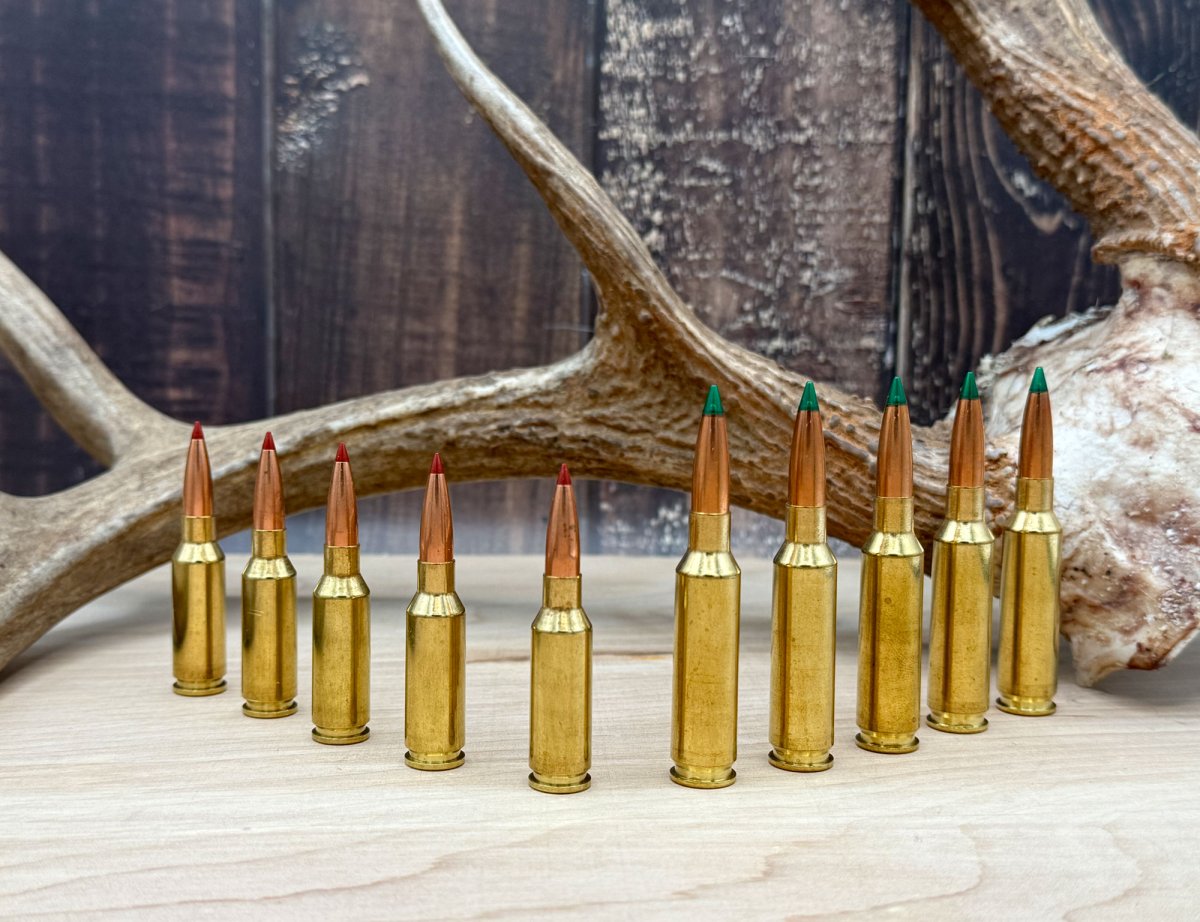

At first glance, comparing 6mm ARC vs. 6.5 Creedmoor doesn’t seem to make a lot of sense. However, as you peel back the layers, you’ll see that they do a lot of the same things well — and share similar limitations. Since the 6mm ARC was introduced in 2020, designed for military applications, it’s experienced a steady rise in popularity and is now offered in several popular and affordable rifles. Despite the vitriol levied against it, the 6.5 Creedmoor has, over the past 19 years, become the most popular centerfire hunting rifle chambering on the market. If you’re considering the 6mm ARC in comparison to the 6.5 CM, it’s not a matter of any single area of performance — they each have their virtues. Rather, you should consider which provides you the most benefits with the fewest drawbacks according to your needs.
Before we can make any valid or educated comparison, we need to understand the attributes and basic capabilities of each cartridge. First, we’ll look at each individually, then at how they compare.
The 6.5 Creedmoor
The 6.5 Creedmoor was launched in 2007 specifically as an ideal cartridge for NRA high-power competition. It had a short enough head height to fit in standard short actions while using high B.C. bullets, embraced modern cartridge design principles such as a 30-degree shoulder, low-taper body, and tight chamber specs, and produced low recoil. In the nearly two decades since, it’s grown into the most popular centerfire hunting cartridge of our time. Some credit hype, others say marketing is to blame for the Creedmoor’s popularity, but fact is, it’s a great cartridge and people like to shoot it.
6.5 Creedmoor Specs
- SAAMI Max OAL: 2.825 inches
- SAAMI Max Average Pressure: 62K PSI
- Parent Case: 30 TC
- Case Length: 1.910 inches
- Shoulder: 30 degrees
- Case Head: .473 inches
- Bullet Weights: 95 to 156 grains
- Approximate Velocity: 2,600 to 3,150 fps (from a 24-inch barrel)
- Powders: Medium-speed, H4530, StaBall 6.5, Viht N550, RL-16
What the 6.5 Creedmoor Does Well
The 6.5 CM has become so popular, largely, because it brings several appealing characteristics to the table. It’s versatile and can handle a wide swath of bullet weights. These range from 95- to 100-grain varmint bullets, to heavy 150-grain-plus pills. The most common loads use bullets in the 140-grain range at approximately 2,700 fps when fired from a 24-inch barrel.
Case and chamber design and its mild-mannered shooting characteristics make the 6.5 Creedmoor one of the most inherently accurate factory cartridges available. We know this to be true because we have tested every common, reasonable factory cartridge and have the receipts. Even compared to factory rifles and ammo in the steadfast .308, the 6.5 CM blows it out of the water.
The 6.5 CM has proven to be an excellent long-distance target round, and has grown well beyond its KD-range roots. Despite the popularity of the new 25 Creedmoor, the 6.5 still hangs as one of the top dogs in NRL Hunter, and is effective at hitting plates at 1,000 yards and beyond.
When employed within the design envelope for bullets — more on that later — the 6.5 CM has proven to be an excellent option for deer-sized game and quite effective on bears, elk, and moose — even grizzly bears. In short, it’s accurate, enjoyable to shoot, and a hunter’s dream.
Where the 6.5 Creedmoor Struggles
A good jag of the 6.5 Creedmoor’s woes are the result of inappropriate use — whether from willful or innocent ignorance. What I mean by inappropriate use is taking hunting shots with the cartridge outside the performance window of the particular system, or from beyond the shooter’s ethical distance.
What the 6.5 CM lacks is a lot of velocity. For most hunters, this isn’t a fatal flaw — as our generally acceptable, self-imposed limits fall within the cartridge’s effective range. But it’s critically important to pay attention to your actual velocity, and where your bullet drops below its designed impact velocity. As shorter 20-inch barrels become more and more prevalent, it’s important to check the data we are using.
On my most recent hunt, for mule deer, I was using a Nemo Arms Electus, with a 20-inch barrel, firing Federal’s 130-grain Terminal Ascent bullet. From that rifle, I had a muzzle velocity of 2,658 fps, significantly slower than the 2,800 fps box velocity, and the effective range a couple hundred yards shorter. My personally-imposed threshold of 2,000 fps only gave me about 450 to 500 yards in my hunting conditions. Velocities with common 140-grain bullets from 20-inch barrels are even slower, at around 2,590 or less.
The 6mm ARC
The 6mm ARC was released back in 2020 as an AR-specific cartridge designed to dramatically improve upon the ballistic performance of the 5.56mm NATO. It’s essentially a 6.5 Grendel case necked down to accept a .243-caliber bullet, and allows use of heavy-for-caliber 103- to 110-grain bullets with cartridges still fitting in a standard-length 5.56mm magazine. To avoid damage to bolt lugs, the cartridge was standardized with a pressure of 51,000 PSI — significantly lower than many modern cartridges. Still, it delivers much better downrange performance than the 5.56 — which typically tops out with comparatively stubby 77-grain bullets.
6mm ARC Specs
- SAAMI Max OAL: 2.260 inches
- SAAMI Max Average Pressure: 51K PSI
- Parent Case: 6.5 Grendel
- Case Length: 1.475 inches
- Shoulder: 30 degrees
- Case Head: .441 inches
- Bullet Weights: 55 to 115 grains
- Approximate Velocity: 2,400 to 3,600 fps (from a 24-inch barrel)
- Powders: Faster burning powders like TAC, Varget, CFE223, and Leverevolution
What the 6mm ARC Does Well
The most obvious thing that the 6mm ARC does well is it delivers heavier bullets with better downrange performance than 5.56mm loads in an AR-15. How much better? Well, the heavily employed MK 262 MOD 1 load, firing a 77-grain Sierra Matchking at 2,750 will drop around 485 inches at 1,000 yards and only be traveling at 987 fps. In comparison, the 6mm ARC, firing a 108-grain ELD-M at 2,500 fps from an 18-inch barrel will drop about 428 inches and retain a velocity of 1154 fps at the same distance. That’s about 57 inches less drop and the heavier bullet is traveling faster.
The 6mm ARC shares many of the qualities that make the 6.5 Creedmoor appealing to shooters. It’s inherently accurate, delivers excellent ballistics for the cartridge size, and is a lot of fun to shoot. Though it was designed to outpace the 5.56, this little round brings a lot of potential benefits to the table for hunters and target shooters too.
In both bolt actions and gas guns, the 6mm ARC has seen some success in PRS, where mild velocities, efficient bullets, and low recoil are all big benefits. What’s even better for target shooters is that because of its low charge weights, the 6mm ARC has great barrel life — approximately double that of the faster 6mm Creedmoor. Because it uses faster burning powder, those lower charge weights — about 30 to 40 percent lower than the 6.5 CM — can still produce similar velocities.
Hunters are often guilty of focusing only on velocity or bullet mass when evaluating a cartridge, and can easily miss some of the appealing characteristics of the 6mm ARC. From a 20-inch barrel, factory 103-grain ELD-X hunting ammunition will fire at about 2,640 fps and the bullet won’t pass below 2,000 fps until around the 400-yard mark — a good threshold for reliable ethical impact velocity. Even from a short 16-inch barrel, firing at 2,488 fps, you’ve got a solid 300-yard effective range.
The wildcard in this mix is for handloaders. Because the cartridge was standardized at 51,000 psi for the AR-15 platform, handloaders can safely use bolt-action-specific data to load it to 62,000 psi. Depending on your barrel, that can add an additional 100-200 fps. With equal barrel lengths, at bolt-gun pressures, the 6mm ARC nearly matches the .243 Win. in velocity.
Where the 6mm ARC Struggles
Like the 6.5 Creedmoor, the 6mm ARC is a modest-velocity cartridge. The most common loadings and barrel lengths will be between 2,600 and 2,800 fps. For target shooters, that isn’t a bad thing. However it does limit the 6mm ARC’s ethically effective hunting distance compared to faster cartridges that also use heavy-for-caliber, high-B.C. bullets. It is not a long-distance big-game hunting cartridge.
Practically speaking, the biggest limitation for the 6mm ARC is factory platforms. Because it uses a PPC bolt face, it doesn’t easily fit into standard short actions and bolt faces like the 6.5 CM. Magazines are more limited too. Whereas the 6.5 CM works with any .308 magazine, the 6mm ARC requires ARC- or Grendel-specific mags and there are just fewer options. MDT and Hawkins Precision offer quality AICS-pattern magazines and both Duramag and Geissele AR mags seem to work well. Fortunately, both Ruger and Savage offer 6mm ARC in affordable, accurate chamberings.
6mm ARC and 6.5 CM Head to Head
Both the 6mm ARC and 6.5 Creedmoor are excellent cartridges for hunting deer-sized game and, under the right circumstances, perfectly capable of a lot more. The 6.5 CM has an obvious advantage when it comes to bullet weight, but that’s only going to be relevant when also considering impact velocity. In fact, whether we determine bullet mass to be an advantage at all is a matter of specific context. In reality, on-game performance is going to be similar with both cartridges. If you’re deciding between the two, your choice will boil down to factors other than which has more kinetic energy — a useless metric by the way.
Factors That Don’t Actually Matter
When comparing cartridges, there are some fall-back factors that everyone likes to lean on that, frankly, don’t mean shit from a practical standpoint. Here are a few that, when comparing the 6mm ARC vs. 6.5 Creedmoor, really don’t amount to anything meaningful:
- Published velocity — It’s not worth quibbling over a hundred feet per second here and there. Velocities will vary based upon load, barrel length, and individual barrel. The most common 6mm ARC and 6.5 CM loads have pretty similar speeds.
- Trajectory — Someone selecting either cartridge for long-distance shooting already knows what they’re looking for, and doesn’t worry too much about something that can be fixed with a couple clicks on the scope. Trajectories within normal ethical hunting distances aren’t different enough to worry about. Even going with a lighter bullet at faster speeds doesn’t change this in a meaningful way.
- Downrange energy — Just forget it. This tells you nothing about how well the cartridge will perform on game. Mind your impact velocity and which speeds the bullet is designed to work within. If you use 2,000 fps as a safe minimum, you won’t get any surprises. Spoiler: Average loads from a common 20-inch barrel will drop below 2,000 fps at around 400 yards with both cartridges.
6mm ARC vs. 6.5 Creedmoor Trajectory
For the average hunter, the trajectories of the 6mm ARC and 6.5 CM are practically identical — regardless of some differences in bullet weight and muzzle velocity. Comparing these four representative loads shows a maximum difference of only about six inches at 500 yards. Each of these drops below 2,000 fps at about 400 yards.
Wind Drift of 6mm ARC vs. 6.5 Creedmoor — 10mph Full Value
The 6.5 Creedmoor has a demonstrable advantage over the 6mm ARC in wind drift, but that really only starts to matter at distances beyond 400 yards. In this scenario, the maximum difference in wind drift is about three inches at 400 yards. Both cartridges have increased wind drift with lighter bullets in their caliber. Note the 103-grain ELD-X 6mm ARC load has less wind drift than the 6.5mm 120-grain load. At 700 yards, the difference between ELD-X loads is seven inches.
Where The 6.5 Creedmoor Is Better
Here are some ways in which the 6.5 Creedmoor has a distinct advantage over the 6mm ARC (that actually matter):
- Platform support — the 6.5 Creedmoor is plug-and-play with all standard short actions
- Ammunition — By volume, there is much more high-quality 6.5 Creed ammo available
- Higher B.C bullets — Heavy 6.5 bullets will handle wind better, primarily benefitting long-distance target shooters
- Power-factor-based competition like NRL Hunter
Where The 6mm ARC Is Better
Despite some big challenges, there are certainly some ways that the 6mm ARC is favorable compared to the 6.5 Creedmoor:
- Powder consumption — the 6mm ARC produces similar velocities with 30% less powder
- Lower recoil — The 6mm ARC is extremely pleasant and easier to shoot accurately
- AR-15 Compatible — a 6mm ARC upper for your AR is a simple upgrade
- Competition at 1,000 yards and less where low recoil is a big advantage — PRS and some sniper-style matches
Final Thoughts
The 6mm ARC and 6.5 Creedmoor are two very different cartridges, but both cover quite a bit of the same terrain. Which one is better? That’s going to depend entirely on you and what you hope to accomplish with it. The average deer hunter would find either completely satisfactory or downright delightful, but one will prefer the 6.5 while the other falls in love with the ARC. Neither is wrong. If you still can’t decide, get both. You likely won’t regret that either.
Read the full article here
