



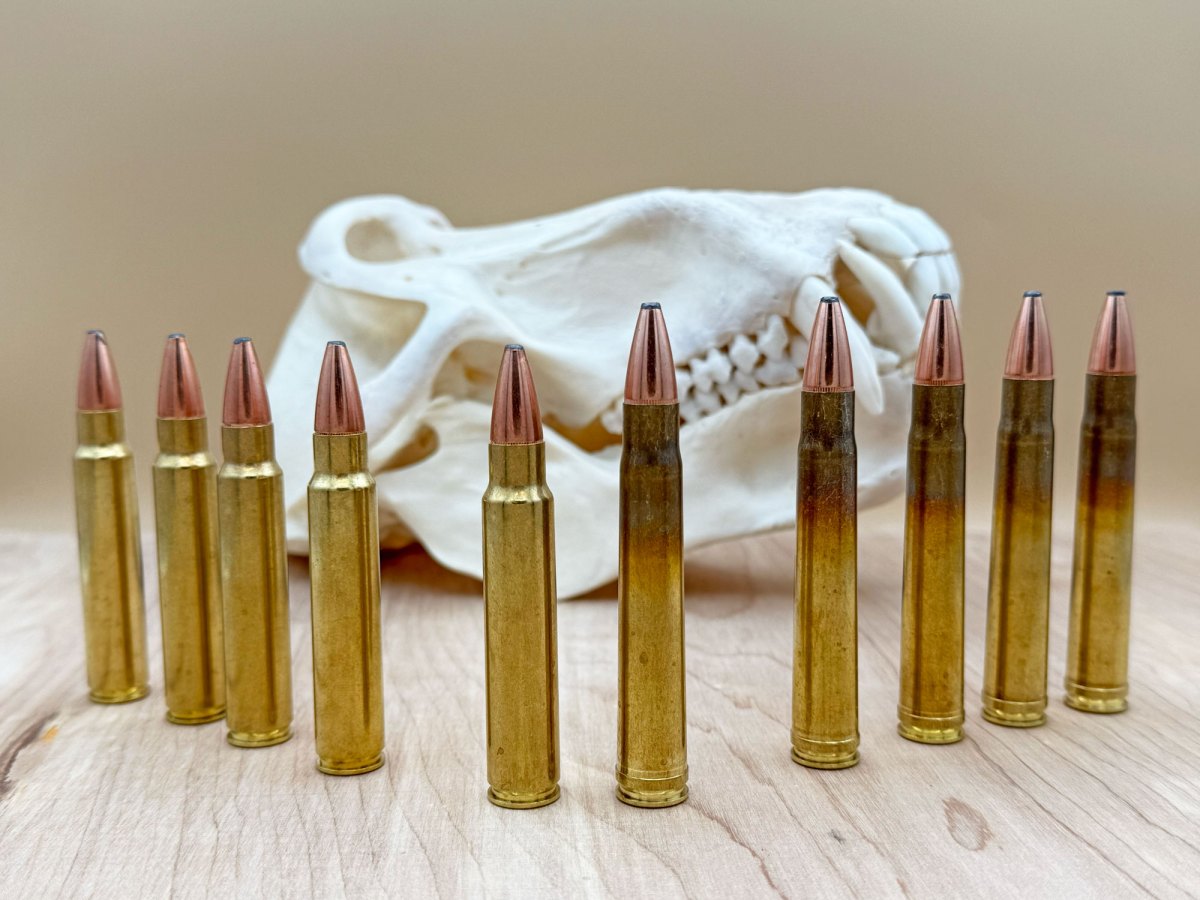

There isn’t much that’s left unsaid about the .375 H&H. The Brits introduced it more than a century ago and since then it’s been one of the most consistently successful rifle cartridges the world has ever seen. In any conversation proposing an ultimate all-around hunting cartridge, the .375 H&H is always in the top lot. But the newer .375 Ruger delivers the same ballistics as the .375 H&H — and from a shorter 20-inch barrel. With equal barrel length, it exceeds the .377 H&H. Both cartridges leverage the same twist rates to fire the same bullets.
There are other appealing characteristics of the .375 Ruger, which was created in 2007 and uses the principles we know as Modern Cartridge Design. But does that make it a better choice? Let’s take an in-depth look at both cartridges.
.375 H&H
The .375 Holland & Holland — originally known simply as the .375 Magnum — was brought forth in 1912 by the British, who chambered the cartridge in magnum-length Mauser 98 actions imported from Germany. The purpose was to provide a round that was suitable for dangerous game and also worked well in staggered, or double-stack, magazines. The rimmed cordite-charged cartridges of the day didn’t fit the bill. Initial offerings of the cartridge were in 235-, 270-, and 300-grain loads. These found great success among hunters in Africa and India. The first American .375 H&H rifles were also built on Mauser 98 actions, but the cartridge really became popular when Winchester adopted it in the Model 70 in 1937.
.375 H&H Specs
- Parent Case: Original
- Headspace: Headspaces off belt
- Head Diameter: .532
- Shoulder: 15 degrees
- Case Length: 2.850 inches
- Case Capacity: 95 grains H2O
- Cartridge Overall Length: 3.6 inches
- Projectile Weight range: 175 to 300 grains
- Velocity (270-grain SP from a 24-inch barrel): around 2,650 fps
.375 H&H Ballistics
One of the appealing characteristics of the .375 H&H is that it delivers moderately heavy bullets and good penetration in a package that has a more appealing ballistic profile than most of the thumb-thick dangerous game cartridges it’s often compared to. A key advantage was that, reportedly, all three initial bullet weight offerings — 235-, 270-, and 300-grain — generally impacted closely at reasonable hunting ranges of the time, which required no alteration of sights when switching between loads for different game on safari.
A modern hunter can use bullets as light as 175 grains — like the 175-grain Maxus from Cutting Edge — or the 185-grain Lehigh Defense Controlled Fracturing bullet. But more common bullet weights are 250 grains for tipped copper slugs and 270 or 300 grains for lead-core bullets or solids. The most common load for the .375 historically is a 270-grain semi-pointed soft point. Its average muzzle velocity from a 24-inch barrel is in the 2,650 fps range and the bullet is deadly effective on a wide variety of game. With a trajectory very similar to popular .30/06 loads, it’s a realistic option for distances out to 300 yards or further. The limiting factor will usually be how well the hunter can shoot it.
Here’s a look at the trajectory of the .375 H&H vs. the .30/06 to 300 yards.
An Unquestionable All-Rounder
Today, the .375 H&H has a long history of worldwide success, and many folks would choose it as top dog if they could only have one cartridge to tackle any game on the planet. The most common argument for the H&H is that the cartridge is manageable enough for smaller game, but still capable of stopping the biggest and most dangerous beasts. It’s often stated that if you want to bring one rifle to Africa that can do everything, it’s the .375 H&H. Though a bit threadbare, that logic has held up remarkably well over the decades and the H&H has an equally long track record in many wild places.
Read Next: .375 H&H Magnum: The Best Hunting Cartridge of All Time
Even back in 1953, majority opinion concluded that the .375 H&H was the ultimate around-the-world cartridge. That’s according to Jack O’Connor in a column he wrote for the February, 1953 issue of Outdoor Life titled The Great .375 Magnum. Interestingly, and much to the chagrin of the many disgruntled folks who think everything was fine and dandy in the old days and we don’t need any of these new cartridges, O’Connor points out that the .375 wasn’t universally accepted.
There seems to be very little neutral ground as far as the .375 is concerned. It is almost as controversial a cartridge as the .220 Swift and the .270 W.C.F. It is the darling of the small but highly articulate group of big-bore, heavy-bullet boys, who claim that no animal larger than a mule deer should be shot with a rifle of .30 caliber or less, or with a bullet weighing less than 250 grains.
Sound familiar?
He doesn’t elaborate on the specific points of controversy, but it likely resembled arguments being hashed out today. Strong feelings about rifle cartridges and their applications are eternal.
According to O’Connor, what really gave the .375 H&H its legs on American soil was the Winchester Model 70. Beginning in 1937, the American sportsman now had access to a reasonably priced .375 Magnum — $65 — as opposed to the $200 to $250 custom jobs.
The big brass of Winchester were surprised at how many .375s were sold, and I believe they are surprised at the number being sold today. The way the big guns move, you’d think rhinos were chasing kindergarten kids home in Westport, Conn., and brown bears were knocking over garbage cans in the backyards of Walla Walla, Wash.
O’Connor’s tongue-in-cheek description still fits today, you could say, as despite most of us having no practical need for something like a .300 Remington Ultra Mag, .458 Win. Mag., or the .375 Magnum, many remain enamored by them. He later goes on:
Many American guides in the Alaskan brown-bear country use .375s to protect their dudes in emergencies. One wrote me he could probably kill any brownie that ever walked with a .30/06, but having a .375 in his mitts filled him with confidence and made his dudes feel safe.
The .375 Ruger: The Modern Magnum
The .375 Ruger was introduced in 2007, along with the 6.5 Creedmoor, by Hornady. It was designed with a unique case and specifically intended to compete with the .375 H&H. In the collaboration between Hornady and Ruger, the cartridge was designed with what we now call Modern Cartridge Design principles — largely pioneered by Dave Emary. These include a relatively taperless case, 30-degree shoulder, tighter freebore, and a beltless design. These characteristics that have become such a standard, interestingly, were first worked out in the tiny .17 HMR cartridge, then expanded to virtually every new offering from Hornady since. The .375 Ruger hasn’t seen the wild success of the 6.5 Creedmoor, but that doesn’t mean it’s been a flop either. Ruger and other rifle companies continue to chamber the round, and it’s been quite popular among those who have use for such a tool — particularly here in Alaska. The .375 Ruger has a steady burn going among those who love it, and the case serves as parent to Hornady’s whole PRC line.
.375 Ruger Specs
- Parent Case: Original
- Headspace: Headspaces off shoulder
- Head Diameter: .532
- Shoulder: 30 degrees
- Case Length: 2.580 inches
- Case Capacity: 99 grains H2O
- Cartridge Overall Length: 3.34 inches
- Projectile Weight range: 175 to 300 grains
- Velocity (270-grain SP from a 24-inch barrel): around 2,800 fps
Where the .375 Ruger Shines
The .375 Ruger was designed, from the ground up, to be better than the .375 H&H. And, like many other modern cartridges, it delivers. If that causes your blood pressure to spike, or your waxed mustache to tremble, you may relax. The .375 H&H is no less fine a cartridge than it was before. As in O’Connor’s day, hunters often act as if you’ve shot their dog in cold blood if you dare suggest their darling cartridge that grew up with the Model T can be bested.
If anything, the .375 Ruger’s duplication of and improvement upon the .375 H&H should be taken as compliment to the latter’s longevity and effectiveness. As shooting editor John B. Snow says, and I find myself constantly repeating, no one would design the cartridge — .375 H&H in this case — like that today. The .375 Ruger shares the same head diameter, but sports a case design that’s optimized in several ways. First, it’s got much less taper than the H&H, which hardly has any shoulder at all and, combined with the 30-degree shoulder, results in about 4 percent greater case capacity in a cartridge short enough to fit in a standard long action. This case capacity allows the cartridge to match the velocity of the longer .375 H&H when fired from a 20-inch barrel, and beat it from a longer one.
Another improvement is the beltless design. In its day, along with other magnums, using a raised belt allowed more consistent headspacing with the tapered cases. The .375 H&H has hardly any shoulder at all, so headspacing would have been a nightmare considering varying chamber tolerances of the time. The downside is that the relationship between the case shoulder, neck, and the chamber could vary wildly from one manufacturer to another. Similar issues are baked into the SAAMI .300 Win. Mag. chamber. The .375 Ruger removes the belt and headspaces off the steep shoulder — something that’s easy to maintain today and promotes better accuracy and brass life. A tighter freebore diameter, nearly .014 of an inch tighter, also sets the .375 Ruger up for better accuracy. Some will argue that the sloppier tolerances are more forgiving in the variety of field conditions the .375 H&H has been used in, allowing more reliable chambering and extraction. As it turns out though, modern cartridges like the .375 Ruger work just fine in the shittiest gale rainstorms and coastal saltwater conditions too.
A Personal Favorite
I’ve been the proud owner of a .375 Ruger, a 24-inch-barreled Ruger Hawkeye, since about 2011, and it’s a rifle I won’t soon part with. I was attracted to the novelty of the fierce cartridge, but also have had some practical use for it. I employed it while working as an assistant guide for brown bears on Afognak Island, and it’s served as my primary rifle for walking into bear baits and tracking down bears that make it to the brush.
I’ve found first-hand that a 300-grain Hornady DGX at 2,600 fps will go end-to-end on a fleeing wounded 10-foot Kodiak bear and the only bear I’ve ever felt necessary to shoot to preserve my hide — a large black bear — crumpled when it hit him in the chest at 12 feet. This was after he’d stolen my chainsaw out of my boat, so he had it coming. More than anything, I have used the rifle to fix mistakes, mine and others’. The cartridge and rifle have always functioned well, and results are decisive if I can hit the mark.
Most recently, I’ve loaded my .375 Ruger with Lehigh Defense 270-grain Controlled Fracturing bullets at 2,800 fps. It’s a deadly combo, which produces dramatic wound cavities and fantastic penetration. While getting started with this bullet, I’d done a quick load work-up and brought a freshly-loaded box of 50 cartridges — my season’s supply — to the range to fine tune my zero before going to the brush. A former high school teacher of mine was there to zero his custom .375 Ruger before departing to southeastern Alaska for a brown bear hunt the next day. Distraught, he flagged me over to show me a poor group shot with the ammo he had. I told him, before running out to buy other ammo, to try a group with mine. After a fouling shot, the next three were touching. So went my season’s supply of ammo. After dropping a big brown bear on the spot, his buddy ordered some of those bullets and both killed moose with them the last couple years running.
.375 H&H vs. .375 Ruger: Head-to-Head
Picking the better of two cartridges involves a lot more than just looking at velocity or case capacity. A valid practical comparison must also consider other factors that contribute to success — or take away from it. Here are a few of the big ones:
Ballistic Performance: The .375 Ruger has a slight edge over the H&H in this category, but it’s so close that it’s essentially a wash. The difference is not meaningful except that the same performance can be delivered in a more compact rifle with the .375 Ruger.
Reliability: The .375 H&H has an arguable reliability and feeding advantage with its tapered case and larger freebore dimensions. In theory, this allows cases to extract more easily if they are over pressure or debris got into the chamber — something that’s quite realistic in the dirty conditions and potential extreme heat of a safari.
Accuracy: The .375 Ruger is quite accurate. It’s arguably more precise, on average, than the .375 H&H — simply due to the headspacing and chamber design.
Ammunition Availability: The .375 H&H has a strong advantage when it comes to ammunition availability worldwide. Ammo for the .375 Ruger isn’t hard to get, but it’s certainly easier to scrounge up a box of .375 H&H.
Rifle Platforms: The .375 Ruger has an advantage here, as it does not require a magnum-length action, and works well in shorter barrels. This isn’t a dealbreaker, but the shorter platforms that the .375 Ruger thrives in are handier and easier to run quickly — even if only a little bit. Cost is another factor. For a .375 H&H, you’re looking at a minimum of around $1,400. Savage and Mossberg both produce sub-thousand-dollar rifles in the .375 Ruger.
Recoil: The Downside of the .375 Magnums
The .375s kick hard, and don’t let anyone tell you different. Recoil of the .375 H&H is described by many gun writers — dead, drunk, old, and new — as a sort of stiff push. They’ll tell you a boy ought to be able to master it by the time his voice cracks or he’s no hunter. That’s bullshit. An eight or nine pound .375 H&H and Ruger kick like a sonofabitch. They certainly don’t punish in the same way some of the larger elephant and buffalo rifles do, but we don’t need to feign toughness like we’re back in elementary, flicking quarters across the desk into our buddy’s unprotected knuckles.
Shooting these cartridges from the bench is brutal. A .375 with a 300-grain bullet has about twice the free recoil of a .30/06 firing a 180-grain bullet. From a standing or field position atop sticks or a tripod, it’s much more tolerable. Younger and smaller shooters can certainly learn to shoot the .375s adequately, but it’s not easy and requires lots of practice. At $120 per box, that gets pricey. For the vast majority of applications, there are better cartridge choices for most shooters. In his 1953 column, O’Connor gives us both a valid evaluation and a very practical, and ego-free, suggestion regarding our aptitude for these boomers:
Some citizens dote on shooting the .375, and claim that doing so fills their souls with bliss. At some risk of being called a sissy, I’ll admit that my recoil tolerance is about 25 foot pounds, and when a rifle belts me around with more push than that, shooting it becomes something of a chore.
The .375 should be a beauty for long-ish shots on elk, on moose above timberline, or on grizzly, but only if the man behind it can handle the recoil and shoot his big Magnum accurately. Good way to find out is to try some practice shots at 200 yards — five from offhand, five from sitting, and five from prone. Then try the same strings with a .30/06 or a .270. If you find that your 15 shots compare favorably with the 15 fired from the less powerful rifle, then you’re justified in hunting with the .375.
I’ll argue that the .375 Ruger is an objectively better cartridge than the .375 H&H. It offers equal or better performance in more compact, handy platforms and, all else equal, I would have no reason to choose the H&H instead. However, the best performance doesn’t always mean it will be best for you. Nor does it mean that the .375 Ruger will replace the H&H. I’m confident that the H&H will continue to be more popular worldwide. If anything, the .375 Ruger’s improvements compliment the stellar record and history of the H&H.
Both these .375 Magnums are excellent cartridges, but if you’re swept up in magnum fever, remember that you pay for shooting these — both with your pocketbook and your shoulder. And unless you’re going buffalo or elephant hunting in Africa, or moonlighting as a brown bear guide in Alaska, you don’t need one. If only for nostalgia’s sake, have at it, just don’t be surprised when you don’t really enjoy shooting the damn thing. Fellow gun writer Richard Mann wrote, in his recent book on hunting cartridges, that every used .44 Magnum revolver for sale comes with a half-empty box of ammunition. The same is true of the .375s.
No matter how big, how powerful, how impressive a rifle is, it still cannot be counted on to kill consistently with a poorly placed shot. Break a front leg with a .375 and you have just broken a leg — you aren’t any closer to getting your elk than if you had broken it with a .30/30! — Jack O’Connor
Read the full article here
