




This story, “12 Tips to Improve Your Odds on Gobblers,” appeared in the February 1975 issue of Outdoor Life.
A number of years ago I had the good fortune to share a deer camp in the Colorado Rockies with Charles Elliott. Charlie is a longtime contributor to OUTDOOR LIFE, and he is also one of our field editors. That’s my job too. Over the years Charlie has hunted all over North America.
One night, after a long and pleasant discussion of elk, moose, sheep, and many others, I asked, “Well, what is the Number One trophy in this country?”
Charlie smiled and puffed his pipe for a moment. “There’s no doubt about it in my mind,” he finally replied. “It’s the beard of a wise old gobbler.” I’ve come to agree wholeheartedly.
Hunting the wild turkey has been an American sport since Colonial days, and the very best of the sport is experienced when the hunter calls the turkey to his shotgun. It’s one thing to snipe a gobbler at long range with a scoped rifle; it’s quite another to call him in close and then take him with a shotgun.
For many years the wild turkey was near extinction, but thanks to wise management programs the birds have made a strong comeback. Spring hunts are now permitted in about 30 states, and each spring more and more hunters discover the challenge of hunting these magnificent birds. To many hunters the gobble of the wild turkey is the most challenging sound on earth. Novices soon discover that bagging a wild turkey is no simple task, and veteran hunters often fail to score. After many years of hunting these fine birds and much talk with other hunters, I’ve developed 12 tips that could help you to get your tom this spring. I hope they will be your deadly dozen.
1. Blend in Perfectly
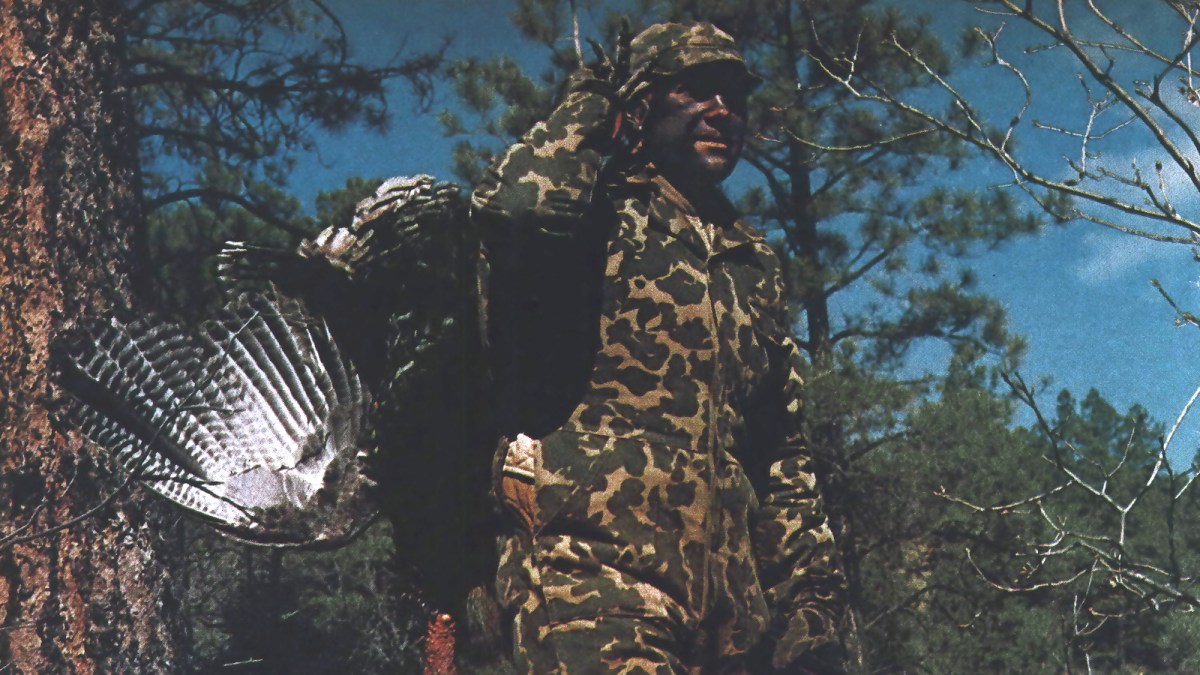
You’ll need camouflage clothing, and your outfit should really blend with the forest colors. Strong greens as the primary colors are quite conspicuous in early spring before there is much green foliage. Browns, tans, and other dull colors are better choices then. Late in the spring season it is best to use camouflage with a lot of green. Sometimes a small chink in your camouflage betrays you to a wary tom. One spring morning several years ago that was brought home to me with a vengeance. It was late in the season, and I still hadn’t collected my first gobbler of the year. For more than an hour I had been calling a gobbler, and he was moving in at last. The tom appeared atop a low ridge slightly to my right. He was only 30 yards away.
I was sitting on the ground, my legs drawn up and my shotgun resting on my right knee. I waited for the turkey’s head to pass behind a tree before I brought the muzzle to bear. Suddenly the gobbler peeked out from behind the tree, let out a loud pert, and ran back over the ridge.
I sat there and tried to figure out what had spooked my bird. I was camouflaged from head to foot, and I was sitting behind a fairly good blind, but the turkey had spotted me. Finally I saw that with my knees drawn up, an inch of my white athletic socks were exposed over the tops of my boots. My gobbler had seen that white cloth instantly.
Facial camouflage is essential. Some hunters use headnets. Charlie Elliott wears a camouflage face mask. I wear eye-glasses, and masks interfere with them and obscure my vision, so I smear my face and hands with camouflage grease. Since my spectacles have shiny wire frames, I always smear some greasepaint on them too to prevent reflection of light. I prefer to use grease on my hands instead of wearing camouflage gloves.
Most hunters also need a blind. I prefer one that is thick enough to break my outline but thin enough to see through in most places. Your blind cannot be constructed at predetermined locations. It must be built wherever the situation dictates, and it must be made quickly. A pair of pocket-size pruning shears are a great help. Small branches can be clipped quickly and almost noiselessly and fashioned into an effective blind in only a few minutes. Be sure that cutting vegetation is legal where you hunt.
The need for good camouflage and an effective blind was aptly put by turkey expert Jack Dudley when he said, “A buck deer thinks every man he sees is a stump, but an ol’ gobbler thinks every stump he sees is a man with a shotgun!”
2. Pick the Right Choke and Load
What gun and load are best? Almost any shotgun will kill a turkey if he comes close enough, but I recommend a 12-gauge gun with full choke or a double with modified and full chokes. Turkeys are big, tough birds, and they have tremendous strength. Their vitals are tucked away behind heavy feathers and huge breasts. Wild turkeys have blinding speed afoot, and a broken wing seldom puts a turkey in the pot. For this reason, all shots at gobblers should be aimed at the head and neck.
Last spring a hunting partner of mine cartwheeled a big tom at 40 yards with a heavy load of No. 4’s from a 12-gauge three-inch Magnum shell. Instantly the turkey was up again and running down a shallow ditch. My friend had no chance for a second shot, and he never got that bird.
Read Next: The Best Turkey Loads of 2026, Tested on Ballistic Gel
He found it incredible that any bird, no matter how big, could take such a hit and yet sprint away. Later in the season another friend of mine killed a big tom that previously had been severely wounded. He told me the gobbler carried at least
40 No. 4 shot in his left side. The old wounds were yellow and purple, but the turkey had no broken bones or other disabling injuries. That bird was apparently killed less than a quarter-mile from the ridge where my pal had wounded his gobbler in the left side.
As tough as the bodies of big gobblers are, the heads and necks are very vulnerable, and it takes only a few pellets there to anchor a bird. I prefer No. 6 shot. The patterns with tight chokes are dense, and chances of putting three or four pellets into the head and neck are better than they are if you use larger shot. This vital area is only an inch wide and about 12 inches long, so let your bird come in as close as you dare.
If possible, never attempt to shoulder your gun while you can see the gobbler’s head. If you can see his head, he can see you. Wait until the head passes behind a tree or thick brush. A turkey can duck a shot with uncanny speed.
3. Hunt the Prime Windows
The best time to hunt is daybreak, and it’s best to arrive in your hunting area well before daylight. Toms gobble most just after first light, in an effort to attract hens. This peak in gobbling activity usually lasts one to two hours, but mating gobblers can often be called up at any time of day. After an early-morning session with the hens, a gobbler’s ardor may rise again at midday.
Hunting in the afternoon is difficult. To me, the turkeys seem very, very cautious at this time. Late afternoon is, however, a fine time to scout and perhaps locate a gobbler going to roost. They often gobble when they fly up to a perch at twilight, so you may hear the bird. If you locate a roosting tom, return the following morning.
4. Set Up Where Turkeys Want to Be
Where should you take a stand? After a gobbler sounds off, try to move within 200 yards of his position, (150 yards is better), and then choose your position. If possible, it should be in fairly open woods. Gobblers are wary, suspicious creatures. They avoid thickets that could conceal a hidden enemy. Toms like fairly open terrain where they can see some distance, but they like to have thick cover nearby into which they can run. They like to run to safety rather than fly if there’s any choice. Many a turkey hunter has taken a stand in a thicket and called to a gobbler time and time again, only to have the bird walk away after a long exchange. Such a hunter has usually taken a stand in terrain the turkey dislikes and will not enter. One often-heard alibi among gobbler chasers is, “I sat down wrong.”
5. Don’t Move a Muscle
Sit still! You must remain absolutely motionless. Ninety-five percent of all failures are caused by hunter movement. Last spring I was calling a gobbler for a beginning turkey hunter. After an hour of calling and many replies, the gobbler stopped just out of shotgun range. Suddenly he ducked and vanished. I was scratching my head in puzzlement when my partner admitted that he had moved his hand forward on his gunstock.
Read Next: The 7 Biggest Turkey Hunting Mistakes That Will Keep You From Punching Your Tag
It is impossible to sit still if you are uncomfortable. I always spray myself with insect repellent and sit on a cushion. I assume the most comfortable position possible, because I know I may have to remain there for one, two, even three hours.
Gobblers seldom come straight to a hunter. They will circle, but keep your head motionless. When he is in front of you, follow your gobbler’s progress only with your eyes. He’ll usually come around again, and he may be within range when he does.
6. Don’t Get Discouraged by Bad Weather
As for the weather, the best of all days starts with a clear cool morning after a starry night and a heavy dew. On such mornings I have heard eight or 10 gobblers racking a prime patch of woods.
Gobbling activity declines in rainy, foggy weather. At such times turkeys avoid wet underbrush and favor open woods, old fields, and logging roads, though mating toms will respond to attractive hen calls even when it’s wet. One of the largest gobblers I ever called up came at midmorning through a steady drizzle. He gobbled only twice in an hour’s time.
7. Call with Purpose
When should you make a call? After a gobbler has rattled the woods with his first call of the day and I have moved to within 150 or 200 yards of him and set up my blind, I call once in hopes of a reply to assure myself that I haven’t spooked the turkey. This call also tells him where the pretended hen is located.
Most old-timers agree that very little calling should be dor.e while the torn is still on his roost. If you cannot resist the urge to answer those booming gobbles of his, do nothing more than cluck a time or two or make a few soft yelps to assure him that a hen is awaiting his arrival. Every turkey hunter has heard the advice, “When he answers, put your call away and get set with your gun.” That is poor advice.
Read Next: Turkey Calling Tips: How to Call a Turkey
Spring gobbler hunting is one of the few situations in which a hunter strives to become the hunted. You must convince an old gobbler that you are an eager hen. Give the turkey all the encouragement he needs. Call too little, and he may seek out another hen. But if you call too often, he will hang back and wait for the hen to come to him. I believe that the vast majority of hunters don’t call enough. Don’t be intimidated. If you make an unrealistic call, just come back right away with a good one. One poor call won’t spook an aggressive breeding tom. Sometimes a gobbler will come to the strangest sounds.
At the end of one hunt, I sat down and practiced every call I could remember and unintentionally called in two strutting gobblers with that continuous blend of mixed calls. I downed the bigger one.
8. Use a Turkey Call You Can Run Well
The best kind of call is the one that produces the best sound for you. The most popular calls seem to be friction calls, including the cedar box and the slate box. These calling devices are easily mastered, and thousands of turkeys have been called in with them.
A second group includes calls that are breath-operated turkey wingbones, pipestems (Turpin-type calls), and snuff-can calls.
A common failing of both types is that they all require the use of the hands. Therefore at least a little movement is necessary to use them.
Related: The Best Turkey Calls, Tested and Reviewed
In recent years the various diaphragm calls that are held inside the mouth have virtually revolutionized turkey calling. The sounds they produce are closest to the real thing, and no external motion is required.
I have learned to call with my own natural voice, but I learned to do it only after having mastered several handheld calls and mouth calls.
9. Practice Until It’s Natural
Regardless of the turkey call you select, you must practice. Stay with it until your wife threatens divorce and the neighbors call the law. You must learn to talk the language of the wild turkey.
Clucks and yelps are essential, and anyone who can make these two calls can eventually call up a gobbler. The best way to perfect your calling is to listen to the calls of live turkeys. Domestic turkeys make the same calls as wild ones. Listen in a poultry yard, and you will hear the familiar yelps and clucks, but there will also be whistles, peeps, chirps, purrs, whines, and other delicate sounds. Learn several of those soft little calls, and they will lend great authenticity to your repertoire of turkey talk. One of these little-known calls is often the final touch that brings a wily old tom within sure shotgun range.
If you do not have access to live birds, buy an instructional record. Most of these records include the basic calls as made by a skilled hunter, and several of them include the sounds made by live birds.
10. Speak Selectively
A few basic calls will serve you well in most situations. The cluck is the most common call, and it is usually the first call I make. I do a soft, unhurried series of two or three clucks with brief pauses between the notes. Yelps are used in series also. Usually I make one yelp, pause a moment, then come out with four or five in a series. Try to imitate the series and pauses of the wild birds you hear in your area.
Listen: You’re Not Calling Turkeys Aggressively Enough, and More Tips From Shane Simpson
Hens make a combination of clucks and yelps when calling to a gobbler. In the spring this is the mating call. I repeat this combination as often as each situation dictates. Some toms, like some men, want talkative mates while others prefer as little talk as possible.
Young gobblers, called jakes, often come to the “lost” call, which is nothing more than a long series of eight to 10 yelps that rises in pitch and volume. This call should of course embody anxiety.
The gobble is perhaps the most neglected call of all. It can be made with the cedar box, a diaphragm, or your own vocal cords. This call often moves a hesitant tom into range because he thinks a rival gobbler is moving in on his hen. The gobble is also useful for locating roosting toms because they frequently answer a gobble (or even a crow call) at daybreak. A gobble or two in late afternoon will sometimes cause an old tom to sound off. A word of caution is in order. Your gobble may also call up other hunters. Be careful.
Related: Why Do Turkeys Gobble at Owls?
The hearing ability of a wild turkey is fantastic, but the bird’s skill at locating the source of sound is almost unbelievable. When a tom hears you call for the first time, I believe he knows precisely where the supposed hen is making her appeal. Except when the hunter is on the move and trying to provoke a gobble with loud calling, I believe all calls should be made at low volume.
Sometimes two callers are better than one. Once, in western Oklahoma, Dwain Bland and I sat down 40 yards apart and stationed a shooter between us. We both called from time to time as we felt proper, and it wasn’t long before we had a bird.
11. Stay Patient to Close the Deal
The most critical time comes when the gobbler has approached to within 75 or 100 yards. No one knows what goes through an old tom’s head at that time, but they often lapse into silence. This gives the hunter the impression that the gobbler is making tracks to another part of the forest. Many a hunter has been fooled into giving up too soon. Stay with your blind 15 minutes after you are fully convinced that your gobbler isn’t coming. Remember that the tom will usually circle as he moves in.
Related: The Best Turkey Decoys, Tested and Reviewed
Once you have sighted your quarry, don’t call him again unless you are sure he is moving away from you. He knows right where you are, but a call when he is very close will pinpoint your exact position, and he will be more likely to spot any unnatural object or any slight movement you might make. Remember that movement spooks turkeys more than anything else.
How long should you remain in one spot? Stay put until you are certain that no turkeys are coming. Then move to another location, and try again.
12. Scout More Than You Hunt
Preseason scouting pays rich dividends. I begin my scouting several weeks before opening day. I try to be in the woods as often as possible at daybreak to listen for gobbling. By opening day I usually know the haunts of several barrel-chested old toms. I’ll try one, and if he isn’t feeling amorous, I can move on.
Related: How to Scout for Turkeys
Your state game department can direct you to areas with good turkey populations, but you must go out and learn the terrain. Topographic maps and a compass are a big help in locating ridges, hollows, and creeks. It is difficult to call a gobbler from one ridge to another, and gobblers sometimes hesitate to cross a creek to get to a hen. It pays to know what lies ahead when you are moving in on a gobbler at daybreak, and pre-season scouting is the only way to know that for sure.
Look for tracks, droppings, feathers, and scratchings. Immediately after rain is an excellent time to locate fresh sign.
A total of 34 states usually have turkey seasons. All but six of these states have spring hunts. States that had turkey seasons in 1974 included: Alabama, Arizona, Arkansas, California, Colorado (fall), Florida, Georgia, Idaho (fall), Illinois, Indiana, Kentucky, Louisiana, Maryland, Mississippi, Missouri, Montana, Nebraska (fall), New Mexico (fall), New York, North Carolina, North Dakota, Ohio, Oklahoma, Oregon, Pennsylvania, South Carolina, South Dakota, Tennessee, Texas, Utah (fall), Virginia, Washington, West Virginia, and Wyoming (fall).
It takes skill, work, and a lot of luck to bag a long-bearded old tom, but when the king of the forest comes strutting into view, it’s well worth all your time and effort.
Read the full article here
