



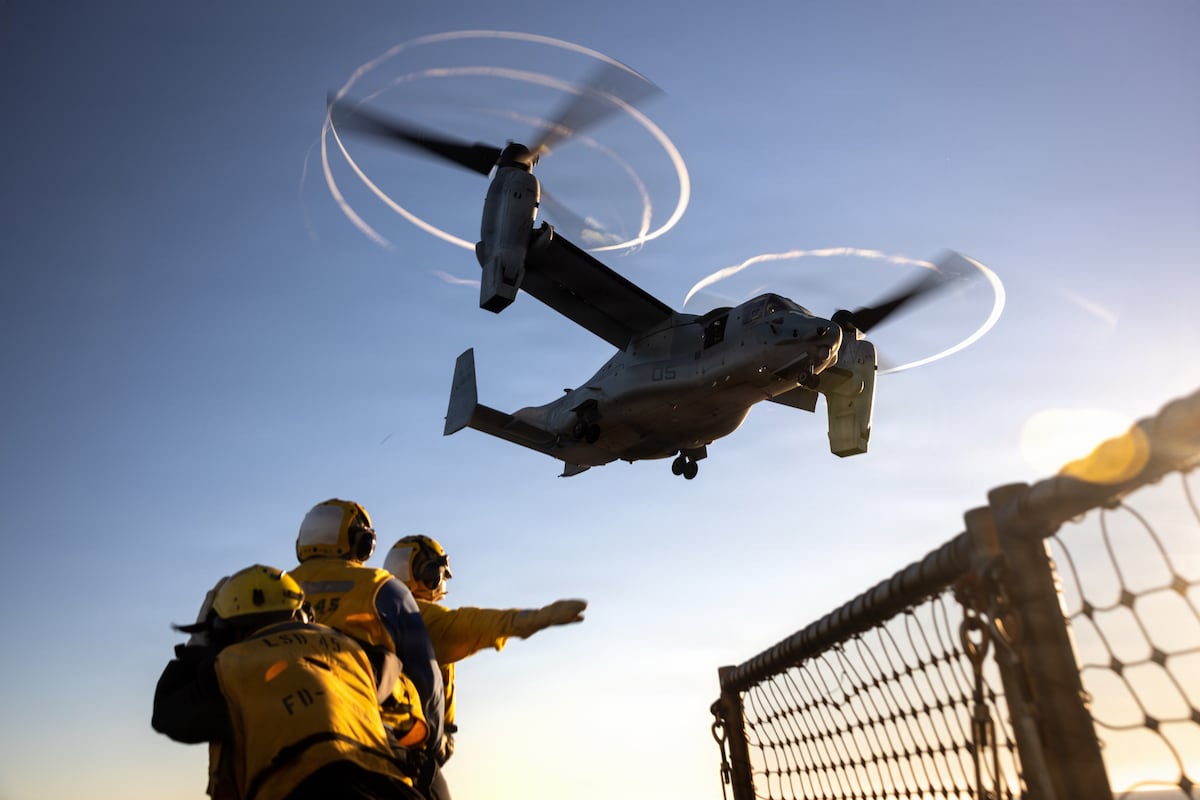

On the heels of 12 major mishaps in the last four years, the military’s first tiltrotor aircraft program must take “immediate and decisive action” to avoid more loss and tragedy, a new comprehensive review released Friday by the U.S. Navy finds.
The V-22 Osprey, which the Navy uses for aircraft carrier onboard delivery missions, is overdue for a midlife upgrade, spending far too much on unscheduled maintenance and contending with undertrained maintainers — all of which spell increased risk for a platform that has faced intense scrutiny since its earliest days in the air. The 33-page review recommends the establishment of a readiness and safety steering board to report annually to top officials on the Osprey’s status; initiation of the overdue midlife upgrade; and changes to establish a “proactive safety system” to identify and address mechanical issues before mishaps occur.
“When the V-22 Enterprise does not actively manage risks with the potential for catastrophic outcomes, the risks compound, increasing the likelihood of a catastrophic event that, if left unaddressed, will ultimately occur,” the investigation concluded.
The Navy’s review — and a simultaneously released Government Accountability Office report — follow a November 2023 crash of an Air Force CV-22 Osprey that killed eight troops, ultimately attributed to a gear box failure. In the dozen mishaps since 2022 involving Marine Corps and Air Force personnel, four Ospreys have been destroyed and 20 personnel have been killed.
The review determined that the Osprey is “accumulating safety risk” due to lagging timelines to fix identified problems; failure to follow airworthiness and flight safety procedures; missing airworthiness standards for some risks; and challenges related to differing safety standards and priorities between the three services that fly the Osprey. It also found the Osprey has suffered in readiness due to a failure to implement best practices across the services, persistent “reliability issues” and challenges in managing and delivering aircraft and parts inventory.
While defenders of the V-22 have accurately pointed out that the aircraft, at least in the Marine Corps, has a lower mishap rate than fleet averages, the report highlights other concerning ways that the Osprey is an outlier. The V-22, it found, has the second-highest number of “catastrophic” risks of any naval aviation platform, meaning components at risk of failure with catastrophic outcomes. Parts at risk are also 70% older on the Osprey than on other Navy planes, it found.
“As the first and only military tiltrotor aircraft, it remains the most aero-mechanically complex aircraft in service and continues to face unresolved legacy material, safety, and technical challenges,” the investigation notes.
In maintenance concerns, the Osprey is again at odds with other platforms, requiring 100% more unscheduled maintenance than the Navy average and requiring about 22 maintenance man-hours per flight hour, compared with about 12 for other aircraft.
“Despite numerous initiatives aimed at improving procedural compliance, most efforts to date have not led to significant improvements in safety outcomes,” investigators found. “A critical gap remains in the form of specific, measurable, and enforceable action plans, complete with clear timelines and accountable owners, to address the root causes of non-compliance, improve procedural adherence, or mitigate the effects of non-compliance at the enterprise-level.”
Among recommendations already being implemented are a retrofit of prop-rotor gear boxes to address identified risks; the development of risk mitigation plans; and a midlife upgrade, which is listed as “in-work,” with no estimated completion date. Establishment of new proficiency standards for maintainers is also underway across services. Other recommendations, like the establishment of a readiness and safety steering board, have yet to be started.
Anthony Krockel, a retired Marine Corps colonel who flew the Osprey from 2010 to 2018 and came to its defense earlier this year, saying its record “was not a safety outlier,” told Military Times he saw additional problems contributing to the aircraft’s woes.
While he noted that the aircraft was full of sensors and that issues could arise from crews’ failure to address the equivalent of “check engine lights” on degrading parts, he also said the Osprey had a track record of parts that failed well before their anticipated service lives were up.
“If something was supposed to last, you know, 10,000 hours before it is being replaced, it’s lasting, like, 2,000 hours,” Krockel said. “And so that’s what’s driving these really high unscheduled maintenance rates.”
That, in turn, he said, had a “cascading effect” on maintenance backlogs.
“So now you have to spend time that wasn’t scheduled on the backs of these Marines to fix the plane and, oh, by the way, because these components are breaking more often, you’re depleting the spares inventory much faster than was originally anticipated,” he said. “And so now you don’t have any spares on the shelf because they’re being used systemically, higher than originally budgeted for.”
Krockel said he’d still like to see a thorough review take place of the top 10 “degraders to readiness” involving the V-22, including the parts that most frequently failed.
“Some of them are technically challenging to fix. Some of them are logistics challenges,” he said. “So there’s larger challenges, but if you get those top 10 degraders fixed and get the aircraft to higher mission capable rates, then everybody wins.”
Hope Hodge Seck is an award-winning investigative and enterprise reporter covering the U.S. military and national defense. The former managing editor of Military.com, her work has also appeared in the Washington Post, Politico Magazine, USA Today and Popular Mechanics.
Read the full article here
