



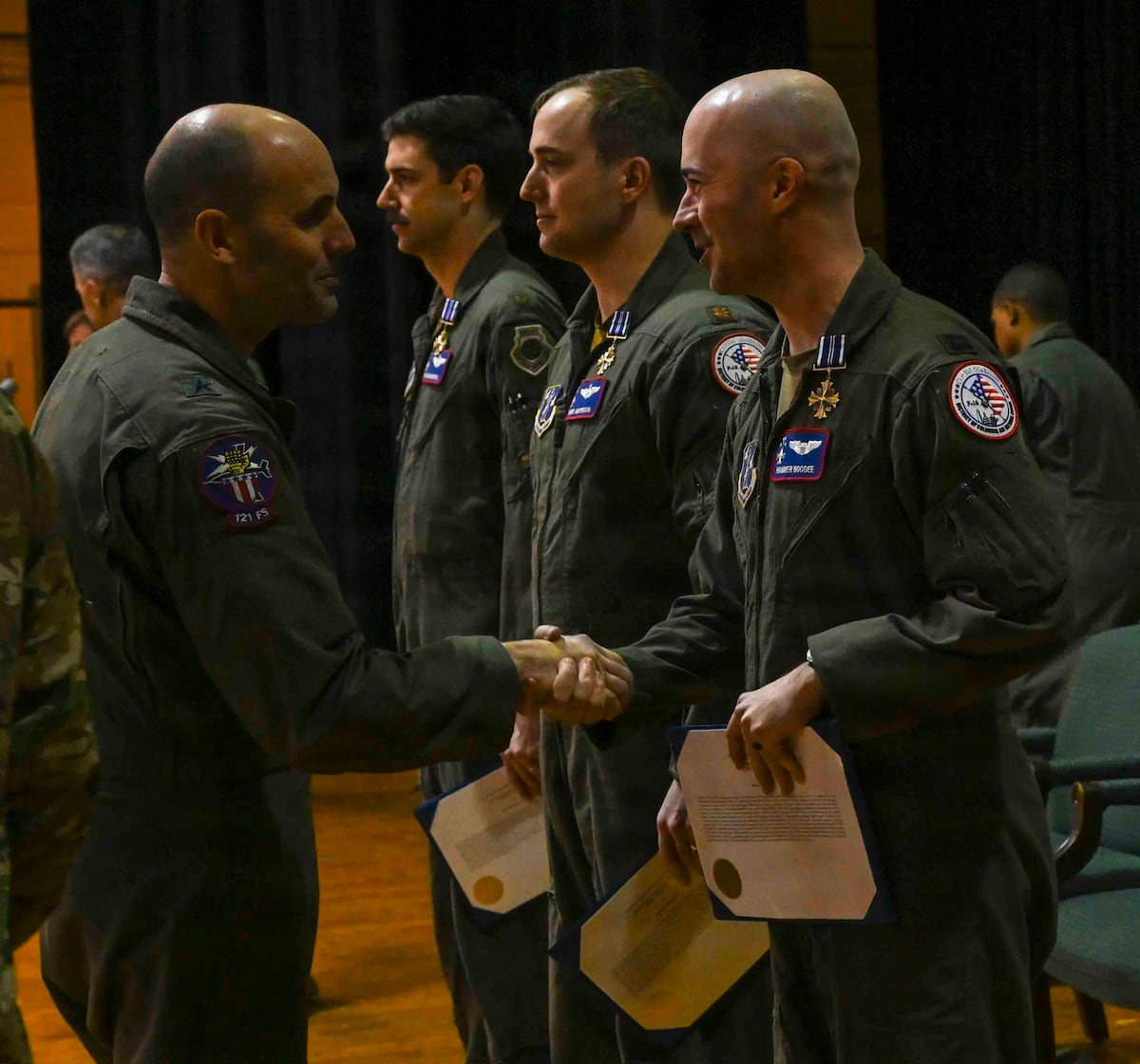

Three U.S. Air National Guard pilots received the military’s highest flying honor this week for their role in an aerial defense against Iranian drones and missiles heading for Israel in April 2024.
Maj. Benjamin “Boom” Saunders, Maj. Eric “Fume” Anderson and Capt. Ryan “Hammer” Boodee were awarded the prestigious Distinguished Flying Cross with “C” device for combat, according to a Monday release.
In a Feb. 1 ceremony at Joint Base Andrews, Maryland, USAF Gen. Steven Nordhaus, Chief of the National Guard Bureau, awarded the three pilots the honor for their actions on April 13, 2024, while deployed to Prince Sultan Air Base, Saudi Arabia, per the statement.
“When I read about the accomplishments of Viper 5-1 and 6-1, ‘air superiority’ comes to mind,” Nordhaus said in his remarks at the ceremony. “Elite and lethal.”
The three pilots were deployed among 12 F-16s in early 2024 as part of the 121st Expeditionary Fighter Squadron, U.S. Central Command’s 357th Air Expeditionary Wing, in support of Operations Inherent Resolve and Prosperity Guardian, according to the release.
During that time, Israel said that Iran and its proxy forces had fired over 300 ballistic missiles, drones and cruise missiles against Israel, but 99% percent of them were intercepted.
That success rate can be attributed to the slew of American forces, like the Navy and Air Force, that assisted Israel in addressing those airborne threats, including the one that occurred on April 13, 2024.
On that date, Saunders and Boodee were flying as Viper 5-1, and Anderson and his wingman were flying as Viper 6-1, the release says.
In anticipation of an Iranian attack, Vipers 5-1 and 6-1 were conducting a defense counter-air operation when Iran launched a large-scale retaliatory attack against Israel, containing one-way aerial attack drones and cruise and ballistic missiles, the memo reads.
Nordhaus highlighted how Saunders, Anderson and Boodee had to execute mission command themselves since they operated outside reliable radio contact and command-and-control.
Over 300 Iranian drones advanced toward Israel, causing the service members deployed in the area to counter the threat and utilize their aircraft missiles and 20mm cannons.
Saunders and Boodee flew searching for aerial targets while using night vision goggles, and while flying to meet a tanker for aerial refueling, Saunders detected a low-flying drone, the release reads.
Saunders took down the drone with a missile, tallying it as the first drone toppled by coalition forces that night.
The release said they then detected “traces” of more than 100 additional attacking drones, leading both Saunders and Bodee in F-16s to fire missiles at them until Viper 6-1, containing Anderson, arrived to assist.
“Saunders coordinated targeting of the drones and Viper 5-1 continued firing missiles until none remained,” the memo reads.
Saunders used his aircraft’s 20mm cannon in a low-altitude attack to take down the drone.
The release states that Viper 5-1 continued to coordinate targeting and refueling for both flights while continuing defensive actions — ultimately taking down 15 Iranian drones and detecting others for coalition forces to face.
“I could not be prouder of ‘Boom’, ‘Fume’ and ‘Hammer’, the 113th Wing, and the 121st Fighter Squadron,” Nordhaus said. “You represent the best of the National Guard, and you join the legacy of excellence in the National Guard.”
The Distinguished Flying Cross was established in 1926 and is the oldest U.S. military award for aviation, presented to an officer or enlisted person of the armed services for heroism or extraordinary achievement during an aerial flight.
The “C” device, tacked on the the award for some, differentiates for service or achievement under combat conditions, meaning the service member was personally exposed to hostile action or under significant risk of hostile action.
The three F-16 pilots are among others who received awards for their efforts in the April 2024 defensive operation. The other awards included: two Silver Stars; six Distinguished Flying Crosses with the “V” device; four Distinguished Flying Crosses with the “C” device; four Distinguished Flying Crosses; two Bronze Stars; seven Air and Space Commendation Medals; and seven Air and Space Achievement Medals.
Cristina Stassis is a reporter covering stories surrounding the defense industry, national security, military/veteran affairs and more. She previously worked as an editorial fellow for Defense News in 2024 where she assisted the newsroom in breaking news across Sightline Media Group.
Read the full article here
