



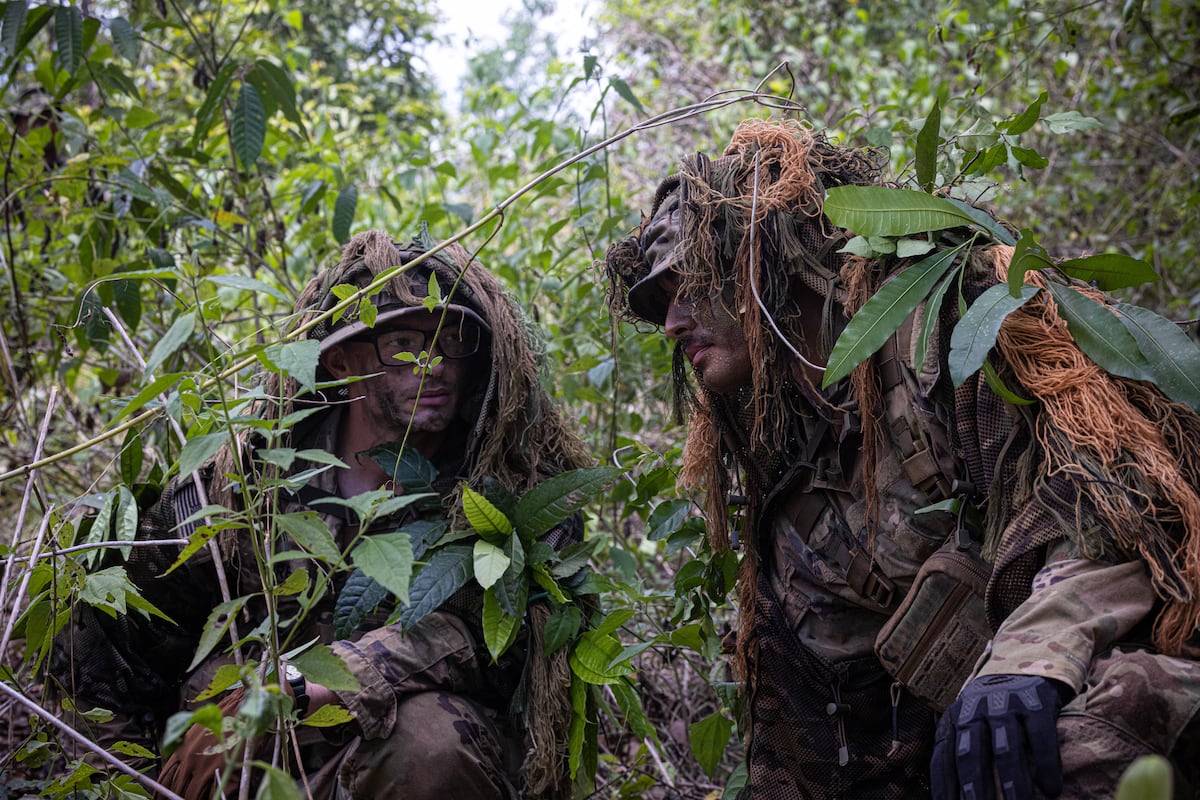

The U.S. Army’s rotation in the Philippines is easy to overlook. Experts say that might be the point.
The service confirmed this week that in July 2025, it established a rotational presence in the Southeast Asian nation. The roughly 50-person force is operating under U.S. Army Pacific with coordination through Task Force Philippines, a spokesman said Wednesday.
The move marks a change in how the Army engages with the sprawling archipelago, the service said.
“While the rotational force is not permanently assigned, this represents a shift from previous year’s iterative engagement cycle to a more sustained rotational presence, enabling deeper and more consistent collaboration with our Philippine Army counterparts,” Col. Isaac Taylor, chief of public affairs for U.S. Army Pacific, said in a statement.
The contingent’s mission centers on building “army-to-army partnerships,” and “improving infrastructure,” he said.
The Philippines once played host to a large U.S. military presence, but permanent U.S. ground forces largely left in the early 1990s after, against a backdrop of growing nationalism, the country’s lawmakers voted to close the major American installations.
Later military agreements allowed U.S. forces back to the country, but to a smaller and less-permanent degree.
U.S. Defense Secretary Pete Hegseth and his counterpart, Philippine Defense Secretary Gilbert Teodoro Jr., announced the formation of Task Force Philippines last fall. The effort, analysts said, could deter China from acting on its claims to the contested South China Sea.
While U.S. naval and air forces have anchored U.S. military posture in the region, the Army’s role has historically been more limited.
“The Navy and the Air Force tend to dominate the Indo-Pacific, just based on the capabilities they have in place,” said Katherine Kuzminski, director of studies at the Center for a New American Security. The new task force, she said, “is reinforcing the need for the Army as part of the joint force in regional security.”
Gregory Poling, director of the Southeast Asia Program at the Center for Strategic and International Studies, said the significance of the Army’s rotation lies in how it formalizes a presence that had already become routine. U.S. forces have operated in the Philippines regularly for years through training and exercises, even before this new development.
The service’s latest move reflects continuity and is taking a “model of a more persistent heel-toe rotational presence focused on the South China Sea and making it a little larger,” Poling told Military Times.
Those waters, in some areas rich in resources, are also claimed in part by Vietnam, Malaysia, Brunei, Indonesia and the Philippines. Tensions between the Philippines and China have escalated in recent years to include confrontations between Chinese coast guard ships and fishermen in disputed waters.
Poling also said that formalizing a task force could enable “quicker, higher-level communications” and increase the “pace of day-to-day interactions” between U.S. military personnel — particularly Army personnel — and their Philippine partners.
Incremental steps toward better connections between leaders of both countries — and the timing of when new military capabilities are introduced — can matter as much as their presence, according to Stacie Pettyjohn, director of the defense program at the Center for a New American Security.
The rotation is “a really modest step,” that is “very small, but it is not necessarily an inconsequential one,” Pettyjohn said in an interview with Military Times.
Those “smaller, gradual steps,” she said, “are likely to be denounced by Beijing, but not to provoke some greater response.”
Eve Sampson is a reporter and former Army officer. She has covered conflict across the world, writing for The New York Times, The Washington Post and The Associated Press.
Read the full article here
