



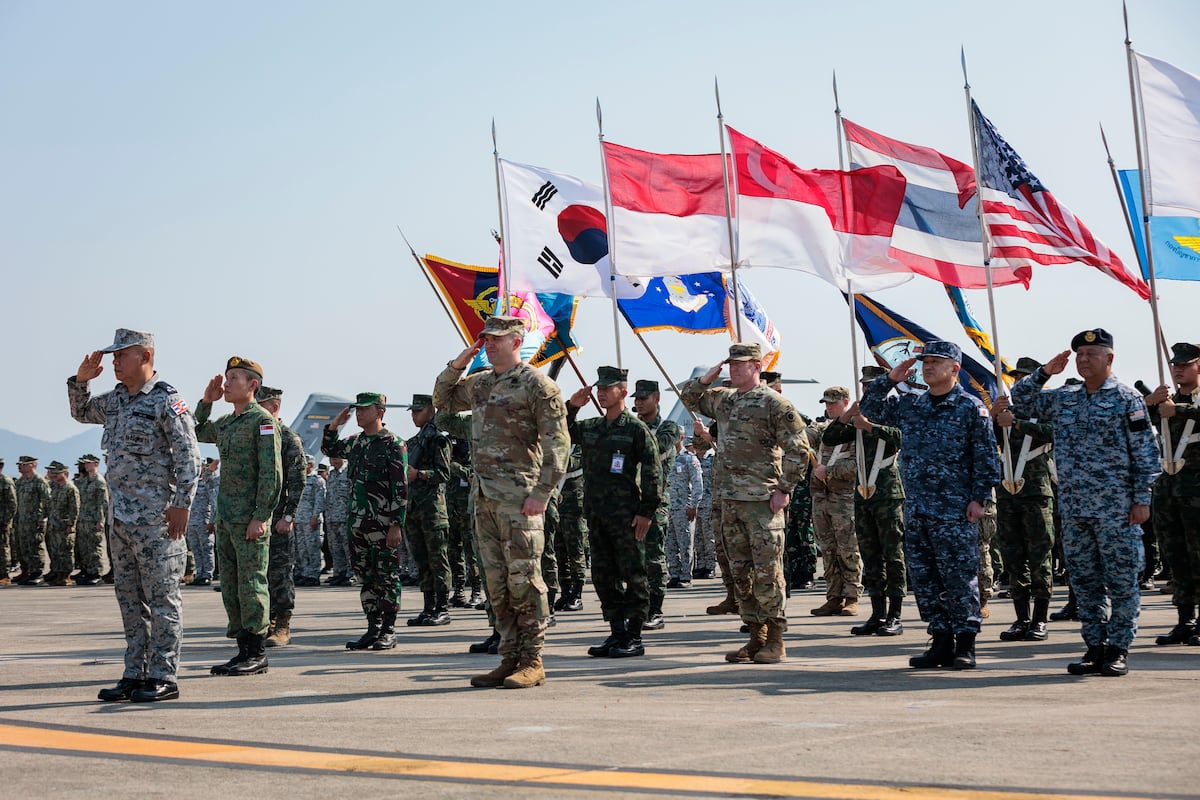

BANGKOK — On paper, the U.S. security alliance with Thailand is one of the strongest in Asia, dating back seven decades and backed up by military exercises each year with thousands of troops from both countries and many others.
Thailand’s drift toward China over the past decade, though, is turning the alliance into more of a paper tiger, some analysts say, with military and strategic consequences for the United States across the region.
“Thailand’s increasing ties to China accelerates the trend of the U.S. losing strategic influence in Southeast Asia,” Emma Chanlett-Avery, director of political-security affairs at the Asia Society Policy Institute in Washington, told Military Times.
“Despite Thailand’s status as a treaty ally of the U.S., Bangkok’s center of gravity has long been leaning toward the PRC,” she said, referring to the People’s Republic of China.
Bending toward Beijing
In 1833, Thailand, then Siam, became the first country in Asia to sign a treaty of amity and commerce with the United States, setting up diplomatic and economic ties. Over a century later, as the Cold War was heating up, Thailand was one of only three Asian countries brought into the Manila Pact of 1954 with the United States; it declared that an attack on any member was a threat to all.
Thailand went on to become a key staging ground for U.S. operations during the Vietnam War and was named a major non-NATO ally of the United States in 2003.
Since 1982, Thailand has also been co-hosting the annual Cobra Gold exercises with the United States. Chanlett-Avery called them the largest multilateral military exercises in the world.
However, she and others say Thailand has been leaning ever closer to China, its main trading partner, for some time.
Historically, the United States has been the largest arms supplier to Thailand. But after a 2014 military coup that toppled Thailand’s democratically elected government, Washington pulled back sharply, leaving Beijing to step in.
According to Australia’s Lowy Institute, China sold Thailand nearly $400 million worth of arms between 2016 and 2022, about twice as much as the United States. The Chinese hardware ran the gamut from surface-to-air missiles to radars and tanks. Thailand is also working with China on delivery of its first submarine.
While the United States still holds more — and more sophisticated — military exercises with Thailand than does China, China has been catching up, according to the Lowy Institute.
Chanlett-Avery said Thailand’s growing military ties with China mean the United States can no longer count on the access it once could for its own military.
“With the intensified strategic competition between the U.S. and China, Thailand has leaned heavily toward Beijing, solidifying the U.S. conviction that Thailand would not allow U.S. access to its bases in the event of a conflict in the Taiwan Straits,” she said.
A risk of decoupling
Zach Cooper, a senior fellow at the American Enterprise Institute, said the two allies are now at high risk of a “decoupling,” where they would no longer see their interests as well aligned.
He said that could lead to even fewer U.S. arms deals with Thailand, cutbacks in joint-training exercises, and less access to Thai bases including U-Tapao, a naval airfield on the Gulf of Thailand.
“What’s so critical about U-Tapao is the U.S. just doesn’t have a lot of operating locations in the Southeast Asian region, and so … the logistical aspects of maintaining a global military presence are quite challenging,” Cooper told Military Times.
While the United States could probably count on other countries in the region, he added, such as Singapore, Thailand is farther north than most of them.
“That has some benefits from a logistical perspective, especially as the U.S. is transitioning, say, between the Middle East and Asia or trying to operate a little bit farther north in Southeast Asia,” he said.
In a 2024 report on the missiles arms race in the Asia-Pacific, the International Institute for Strategic Studies said Thailand’s tilt toward China hobbles U.S. missile basing options as well.
The IISS report says Thailand “would be highly unlikely to approve the deployment of U.S. missiles” for countering what it calls the growing ballistic- and cruise-missile threat from both China and North Korea.
Cooper said Bangkok’s tilt may also restrain Washington’s defense cooperation with Thailand by limiting the military intelligence and technology it is willing to share and sell.
“It’s really going to make American intelligence officials a bit nervous that so many Thai leaders see their interests as more aligned with China going forward than with the United States. So, in that context, I think it would be hard to have the degree of confidence necessary to really share some of those more sensitive details,” he said.
There could be cases, he added, where the U.S. may be reluctant to hold some military exercises with Thailand in range of Chinese radars for fear of giving away certain U.S. capabilities.
Cooper said Thailand’s foiled bid for U.S. F-35 jets is a case in point.
In 2023, the United States denied Thailand’s request to buy up to eight of the Lockheed Martin F-35s, one of the world’s most advanced fighter aircraft. At the time, a Thai air force official told local media that Thailand’s relationship with China probably played a part.
Losing interest and influence
As Thailand has been turning toward China, though, the analysts say the United States has also been turning away from Southeast Asia, the mainland especially.
When the United States announced its “Pivot to Asia” in 2011, Cooper said, South and Southeast Asia loomed large in its strategic plans. But the focus is now shifting more to the east, he said, especially to the so-called first island chain, which roughly skirts China’s seaboard from Japan to Taiwan and on to the Philippines.
Cooper said the shift is reflected in the U.S. government’s latest National Security Strategy, which lays out each new administration’s security priorities.
“It’s a much more limited set of objectives, in my view, and one in which mainland Southeast Asia just plays a smaller role than I think it used to in U.S. thinking,” he said.
“And I think where this is leading is not a complete pullback but a sort of partial pullback from parts of South and Southeast Asia.”
Chanlett-Avery said Washington is elevating “minilateral” and trilateral security pacts with Australia, India, Japan and South Korea, for example, that mostly leave Southeast Asia out, the Philippines being the main exception.
The United States has been ramping up military ties with the sprawling archipelago to counter China’s increasingly aggressive forays into the South China Sea and around Taiwan.
But that still leaves its leverage not only in Thailand, but the region, on the wane, Chanlett-Avery added.
“With security concerns taking center stage, combined with the dismantlement of USAID, the two allies have grown apart,” she said. “The unfortunate byproduct of this dynamic is that U.S. influence has tanked, not only in Thailand but in Southeast Asia more broadly.”
Read the full article here
