



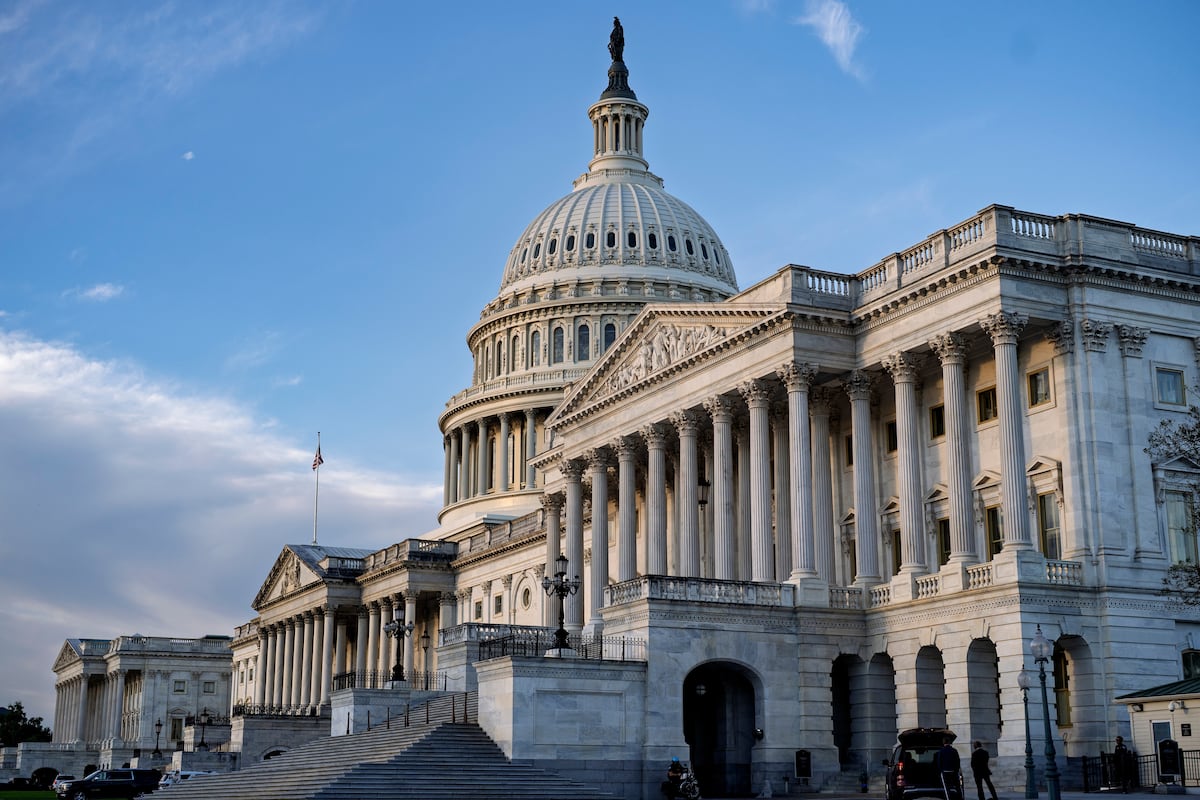

The Senate on Wednesday passed a major policy bill that authorizes the Defense Department to spend $900.6 billion in fiscal 2026.
The 2026 National Defense Authorization Act, which the House passed Dec. 10, will now head to President Donald Trump, who has pledged to sign it. The Senate overwhelmingly passed the bill 77-20.
The bill was praised by the top two senators on the Senate Armed Services Committee, Chairman Roger Wicker, R-Miss., and ranking Democrat Jack Reed of Rhode Island, who said it makes critical investments to strengthen the U.S. military.
“The bill sets us on a path to modernize our defense capabilities and augment our drone manufacturing, shipbuilding efforts, and the development of innovative low-cost weapons,” Wicker said.
The discretionary defense spending authorized in the bill would be $8 billion more than the Pentagon requested earlier this year, and fully fund major programs such as the Golden Dome for America missile defense shield and the F-47 advanced fighter, as well as providing the Navy funds to build more submarines and destroyers.
Wicker also lauded the bill’s provisions that seek to improve the Pentagon’s budget and acquisition processes. An executive summary of the bill said it adopted key provisions from Wicker’s Fostering Reform and Government Efficiency in Defense, or FORGED, Act that seeks to speed up development and production of new weapons by prioritizing commercial acquisition, slashing red tape and expanding the industrial base.
“In this NDAA, my colleagues and I have prioritized the structural rebuilding of the arsenal of democracy and returning the department to its warfighting mission,” Wicker said. “Crucially, it also contains the most sweeping upgrades to the Pentagon’s business practices in 60 years — a watershed moment for our military.”
The bill also seeks to reform the Joint Requirements Oversight Council by cutting “bureaucratic validation of service requirements,” the executive summary said, and instead focusing on fixing joint operational problems.
The NDAA authorizes funds to give troops a 3.8% pay raise, and would create a senior-level Defense Property Management Office to “fix unacceptable outcomes for military families during the moving process,” Wicker and Reed said.
“We face significant national security challenges, but this NDAA makes meaningful progress toward meeting them,” Reed said. “It enhances military readiness, supports service members and their families, modernizes combat platforms, and invests in critical technologies.”
The NDAA also includes a provision that would withhold 25% of Defense Secretary Pete Hegseth’s travel budget until he sends congressional committees overseeing the military “unedited video of strikes conducted against designated terrorist organizations” in the Caribbean region. This is intended to push Hegseth to release more information on controversial strikes against alleged drug-smuggling boats from Venezuela.
The bill would bar the Pentagon from cutting the U.S. military’s force posture in Europe or giving up the United States’ role in filling the Supreme Allied Commander-Europe position that commands NATO, until the secretary of defense assesses how those changes would affect U.S. and NATO interests and certifies to Congress that it would be in the national interest. It also would authorize a $200 million increase for U.S. European Command security assistance.
The NDAA contains provisions that seek to bolster allied and friendly nations against Russian aggression. It would establish a Baltic Security Initiative and authorize $175 million to “strengthen front-line deterrence against Russian aggression,” the executive summary said. It would also extend the Ukraine Security Assistance Initiative through 2028 and authorize $400 million in funding for 2026 and 2027. And it requires the secretary of defense to notify Congress if any decision is made to modify, restrict or terminate military intelligence, imagery intelligence or other such support to Ukraine.
It also fully funds the Pacific Deterrence Initiative, strengthens activities related to the AUKUS agreement between the U.S., U.K. and Australia and provides new authorities for cooperating with Taiwan.
The bill would also prohibit the Air Force from cutting its fleet of A-10 Warthog attack planes below 103 in 2026, and extend a prohibition on the Air Force retiring RQ-4 Global Hawk drones to 2030. And it requires the Air Force to keep at least 90 days’ worth of spare parts for the F-35 Joint Strike Fighter by the end of September 2028.
Stephen Losey is the air warfare reporter for Defense News. He previously covered leadership and personnel issues at Air Force Times, and the Pentagon, special operations and air warfare at Military.com. He has traveled to the Middle East to cover U.S. Air Force operations.
Read the full article here
