



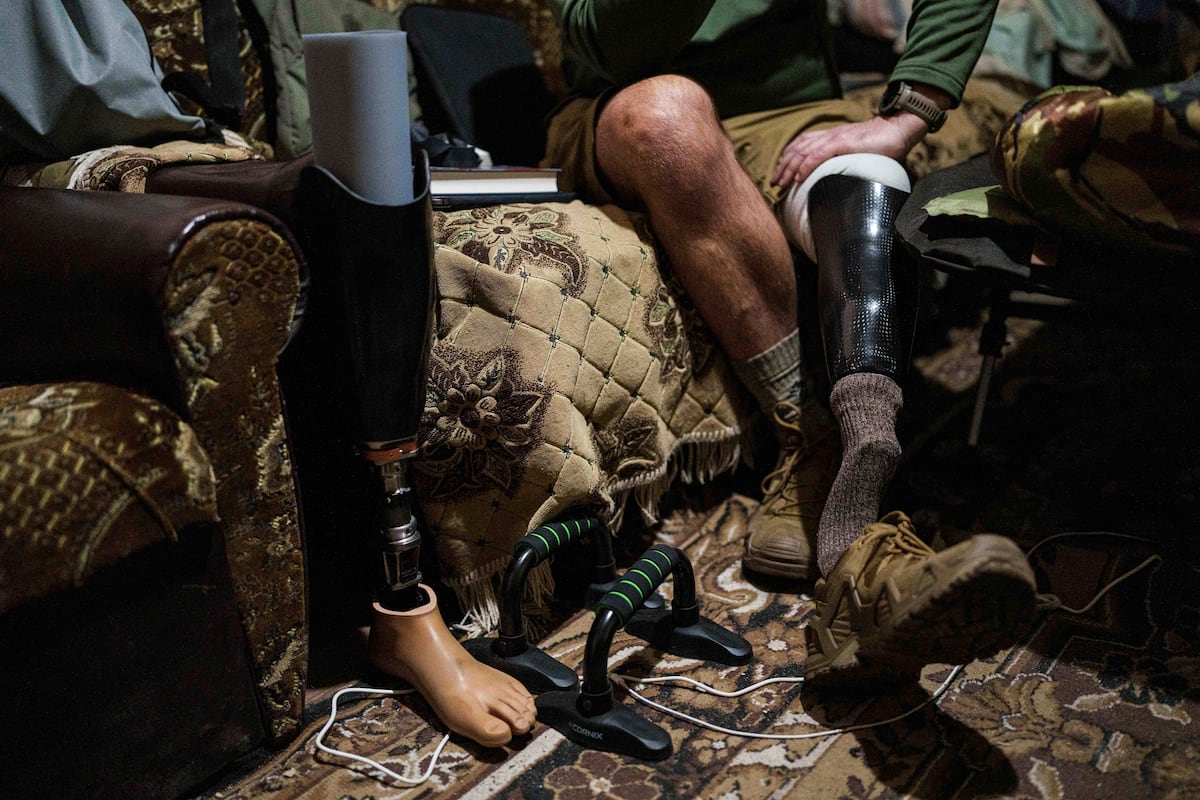

LVIV, Ukraine — “I’m not disabled, I’m upgraded.” These were words I remember vividly from one Ukrainian army veteran, Serhiy.
Like other Ukrainian soldiers, he identified himself by first name only for security reasons.
Serhiy had been lucky as far as injuries went. A mine had blown off his leg below the knee but he could comfortably jog and skipped about 20 reps with a jump rope, using his good leg.
He’d been far luckier, say, than a former engineer named Artem I met in Kyiv.
During Ukraine’s failed 2023 counteroffensive, a drone-dropped explosive had sheared him almost entirely in half. When I met him more than a year later in a rehabilitation center, he was walking on his arms, doing an assisted bench press, climbing ropes and said he could even comfortably drive a car.
It is as if Serhiy, Artem and others like them take the Green Knight from Monty Python’s admonition that “it is just a flesh wound” literally. They have found ways to live their lives as productively as possible — and many still want to serve their country, even back at the front line.
“Ukraine is the best place in the world for prosthetics, they have the most advanced care and equipment,” said Eddy Scott, a British humanitarian volunteer who lost an arm and a leg evacuating civilians in eastern Ukraine.
In the eight months he has been recuperating at the Superhumans Center, a state-of-the-art facility in Lviv, Scott has seen how Ukrainian surgeons have stitched up the most seemingly hopeless cases.
“They have the most people to learn on,” he says with a shrug and a weary smile.
Ukraine has perhaps 25,000 amputees, most of them veterans, and many more who have suffered all kinds of combat wounds and must be reintegrated into society — at a time when the Russian invasion continues at full pace in Ukraine’s east, and major cities such as Kyiv are being regularly bombed.
On top of it all, there is the mental trauma inflicted upon so many soldiers, not just for those fighting, but for prisoners of war who endured horrific conditions in Russian captivity.
I spoke recently with Oleksii, a soldier who was taken prisoner after the siege of Mariupol in 2022 and endured just under two years in Russian captivity.
He, like many, speaks in euphemisms, noting, “the roof is leaking,” to describe how lives fall apart when they return to Ukrainian society.
Oleksii said that the worst part of his return was the survivor’s guilt.
Despite being back in Ukraine with his family — and a supportive community of veterans — he was tormented by the knowledge that many of his comrades in arms were suffering the same torture and deprivation he had been subjected to.
“I knew 18 people who died around me” of disease, torture and starvation, he said.
Many soldiers say the difficulties in civilian life stem from knowing few people who truly understand their struggles.
Seeing young men and women enjoying coffee at the country’s chic cafes or partying in bars and nightclubs can yield feelings that sacrifices have gone unappreciated.
“It is their turn,” is how one veteran summed up the attitude toward those who have not yet fought in the war.
Some veterans, meanwhile, like Serhiy, have begun looking around for units that admit amputees.
The idea is less crazy than it sounds — with the rise of drone warfare, an operator sitting motionless in a trench or a farmhouse basement can do more damage than the best special forces soldier.
Tom Mutch is a Ukraine-based journalist from New Zealand. He is the author of The Dogs of Mariupol, available now.
Read the full article here
