



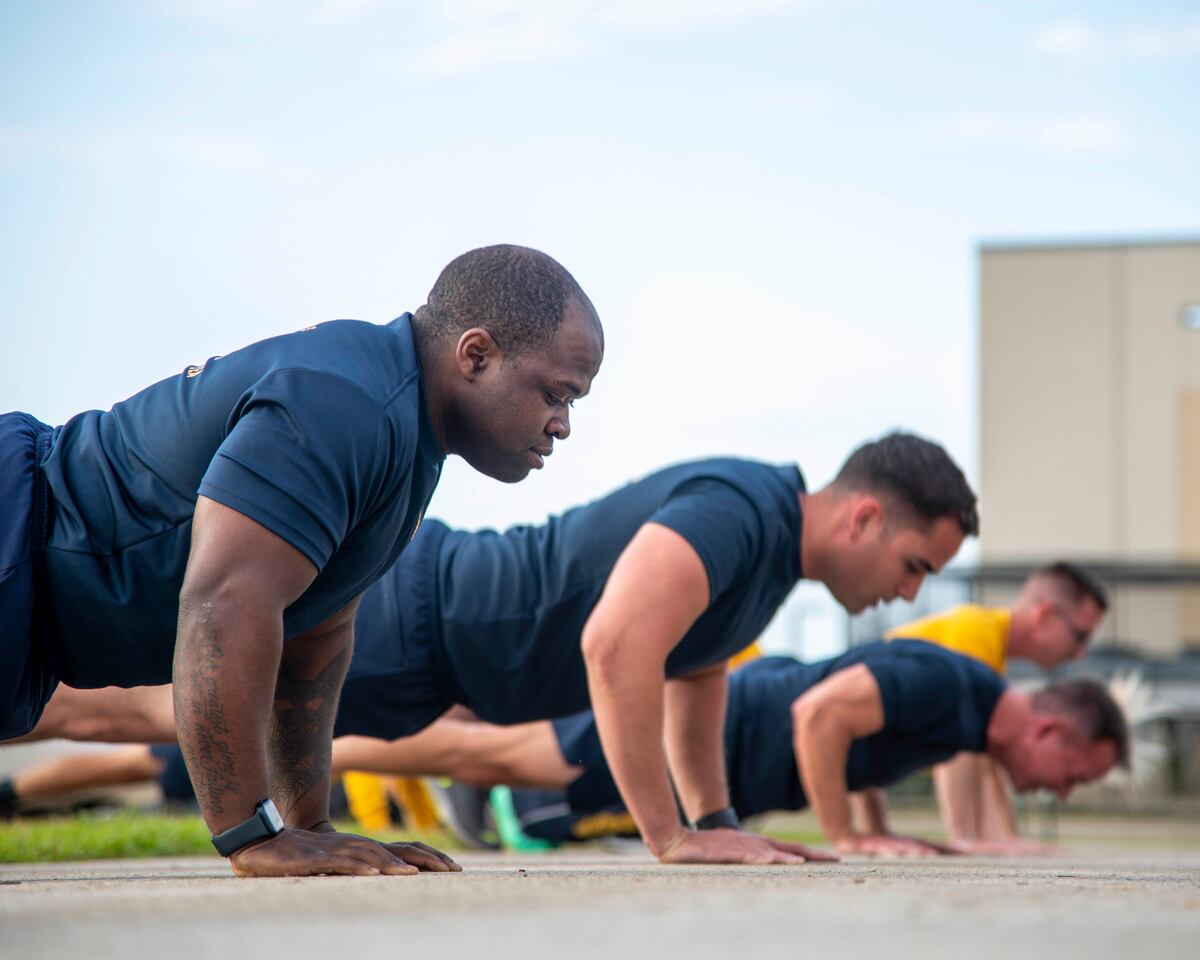

The U.S. Navy announced updates to physical fitness standards for sailors that will go into effect at the beginning of 2026, including aspects that will lead to a sailor’s administrative separation from the service.
The service provided a Dec. 30 fact sheet laying out shifts in policy on the NAVADMIN website, after publishing a document that outlined consequences for PFA failure on Dec. 16.
Most notably, the Navy is shifting from one fitness assessment cycle per year to two, which will extend from Jan. 1, 2026, through June 30, 2026, and from July 1, 2026, through Dec. 31, 2026.
The new policy also stipulates that sailors who fail three physical fitness assessments within four years will be processed for administrative separation, whereas the previous policy stated that two or more consecutive PFA failures would lead to the administrative separation process.
The new failures do not have to happen consecutively for them to lead to a sailor’s potential expulsion from the service.
Service members with 18 to 20 years of active-duty service are not exempt from the policy.
Once sailors are processed for administrative separation, they are ineligible for promotion, advancement, reenlistment or transfer unless they are able to pass another physical fitness assessment test.
Some sailors might be given an opportunity to take a special PFA authorized by a commanding officer, which, if passed, would halt the separation process and resume their opportunities for advancements.
RELATED
If another regularly issued PFA is administered during the time the sailor is still undergoing the administrative separation process, they are able to take that test in hopes of passing it and dodging administrative separation.
Specifically, active-duty sailors, training and administration of reserves and reserve personnel on active-duty orders extending beyond 12 months, will undergo two fitness assessments per year.
They will include two physical fitness assessments for most sailors and a physical fitness assessment and a combat fitness assessment for sailors in combat arms professions.
Drilling and reserve personnel on orders for less than 12 months will only be tasked with a minimum of one fitness assessment per year.
The new administrative separation process for sailors who fail their PFAs is mandatory as well, whereas before, the option to begin the administrative separation process for sailors who failed physical readiness standards was ultimately decided by commanding officers.
The previous policy was enacted to afford commanding officers more discretion in the event that a high-performing sailor, occupying an important billet was unable to meet PFA standards. Under that circumstance, the sailor would be allowed to continue to serve in their important role, according to a William Speaks and Lt. Kathryn Cole, spokespeople for the chief of naval personnel public affairs office who spoke to Military Times by phone regarding the new policy.
Past PFA failings for all sailors will be wiped clean beginning on Jan. 1, 2026, when the new policy begins.
However, some other programs — like commissioning programs and special duty screenings — might still acknowledge sailors’ past failures on physical fitness assessment tests, Cole told Military Times.
The body composition assessment, the Navy announced, was also changed so that the first step of calculating waist-to-height ratio is sex neutral.
The second step — a calculation of body composition — still abides by sex norms.
The body composition assessment exemption policy also changed so that sailors not within BCA standards now have to score an outstanding-low overall with an excellent-medium or higher in all three physical readiness test categories, which include arm strength, core strength and cardio.
Sailors returning from a 12-month deferment period post-pregnancy who are medically cleared will be required to take part in the next physical fitness assessment cycle, per the fact sheet.
Riley Ceder is a reporter at Military Times, where he covers breaking news, criminal justice, investigations, and cyber. He previously worked as an investigative practicum student at The Washington Post, where he contributed to the Abused by the Badge investigation.
Read the full article here
