



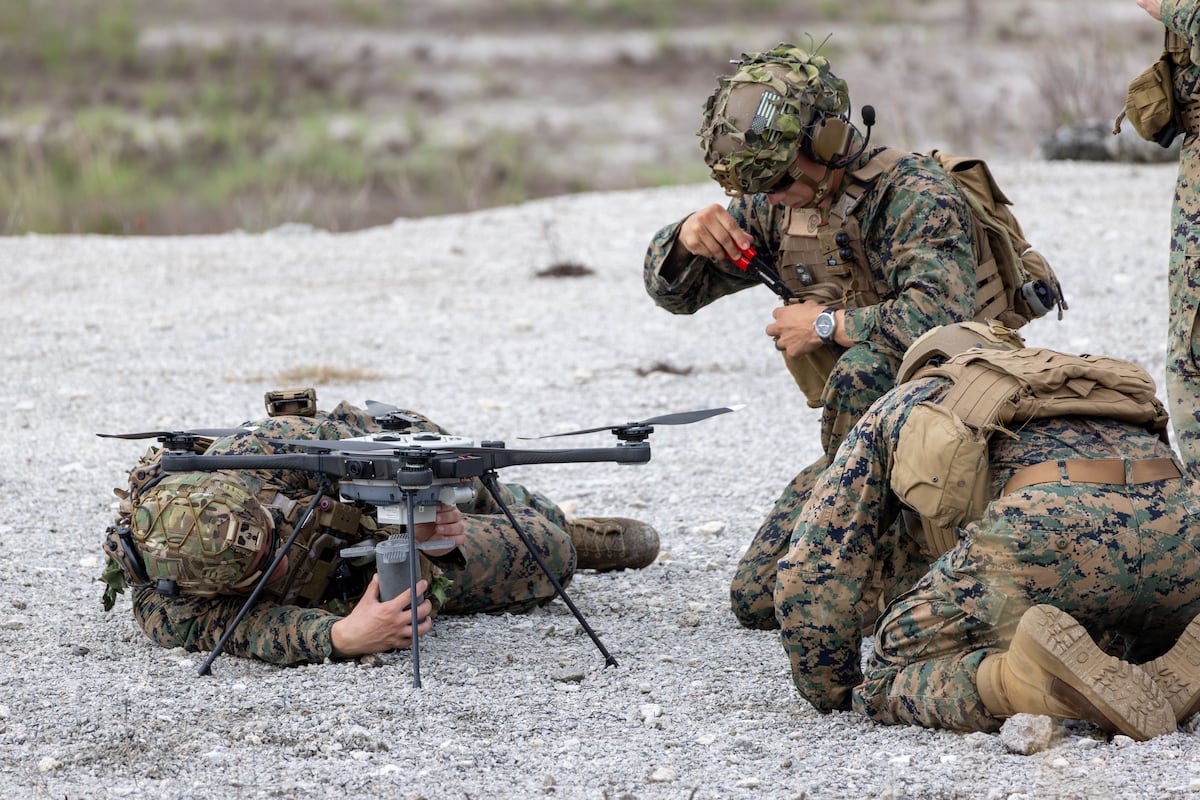

Keeping in step with the Pentagon’s push for legions of new drones, the Marine Corps is instituting new training to ensure the service has the right personnel to operate them.
The service is kicking off a series of new pilot programs aimed at meeting Defense Secretary Pete Hegseth’s $1 billion industry push to get more than 300,000 one-way attack drones into the hands of troops by 2028, according to a release.
Part of that pursuit includes practicing on new off-the-shelf platforms that, in turn, warrant standardized training prior to unit integration, the release stated.
“We are fielding these courses as pilot programs to move quickly,” Lt. Gen. Benjamin T. Watson, commanding general of Marine Corps Training and Education Command, said in a release. “This allows us to validate all aspects of the training, from prerequisites and instructional methods to resourcing needs and certification standards, ensuring that we refine and perfect the curriculum before it becomes part of our long-term training framework.”
Six pilot training programs and eight certifications are being established, each of which, while expected to evolve over time, will be aimed at providing fundamental skills in using both armed and unarmed systems while informing the best training approach, officials said in a Dec. 29 memo.
The names and descriptions of the six courses, which are open to any military occupational specialty, according to the memo, include:
- Basic Drone Operator (BD-O) Course: “Provide the foundational skills required to assemble, maintain and operate both full-acro and stabilized non-lethal drones in an operational environment.”
- Attack Drone Operator (AD-O) Course: “Provide the foundational skills required to tactically employ lethal attack drones.”
- Attack Drone Leader (AD-L) Course: “Provide the instructional understanding of Fire Support Plan integration, threat assessment, system capabilities and coordination with maneuver and fires.”
- Payload Specialist (PS) Course: “Provide the foundational skills and basic knowledge for safe explosive handling and preparation of pre-fabricated warheads used to arm lethal drones in an operational environment.”
- Attack Drone Instructor (AD-I) Course: “Provide the instructional skills required to administer and certify Marines in the BD-O, AD-O, and AD-L courses.”
- Payload Specialist Instructor (PS-I) Course: “Provide the instructional skills required to administer and certify Marines in the PS course.”
Marines seeking to attend any of the above courses must contact unit leadership, who must then coordinate with regional training hubs to confirm course dates and availability, the release said.
Regional hubs include the 1st Marine Division Schools; the 2nd Marine Division Unmanned Systems Center of Excellence; III MEF Expeditionary Operations Training Group; School of Infantry East; School of Infantry West; the Tactical Training and Exercise Control Group; and Marine Forces Special Operations Command.
The Corps’ Weapons Training Battalion in Quantico, Virginia, will serve as an interim central training hub until a long-term location is established, the memo added.
The Marine Corps has continued to find itself at the forefront of new drone technology adaptation, standing up the military’s first drone attack team this past March and, in June, publishing a 90-page guidebook on integrating small unmanned aerial systems, or sUAS, into formations.
Additional information about unmanned training programs and certifications can be found here.
J.D. Simkins is the executive editor of Military Times and Defense News, and a Marine Corps veteran of the Iraq War.
Read the full article here
