



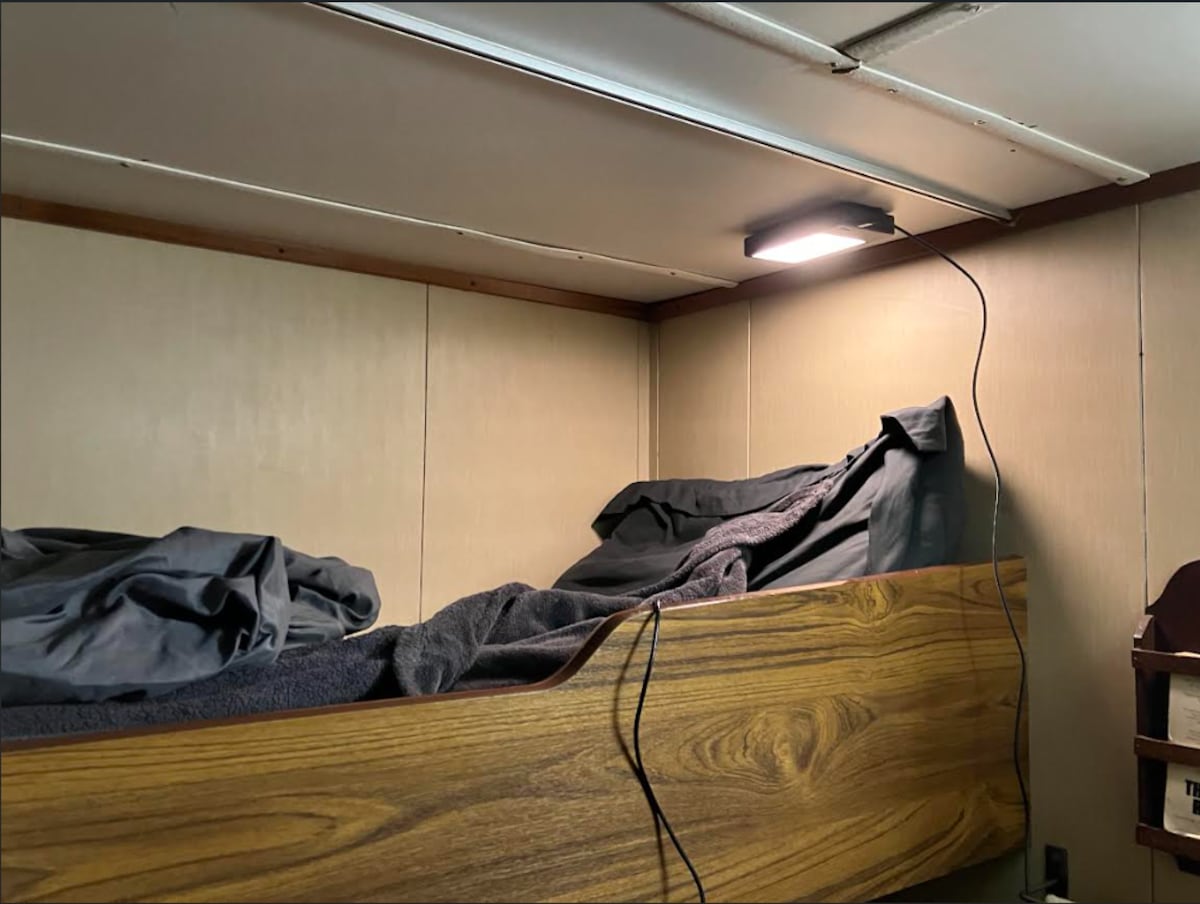

Anyone who’s ever sat under a special daylight lamp to combat the winter blues knows that strategically applied light can have a dramatic impact on exhaustion levels and overall mood. But can that effect also work for sailors standing watches at all hours in dark ship corridors and compartments?
That’s what researcher Eliza Van Reen is on a mission to prove. Van Reen, whose company Circadian Positioning Systems has worked on fatigue mitigation with NASA and sailboat racing crews, is now working with the Navy to show that her system could solve the thorny issue of establishing healthy circadian rhythms at sea.
A custom lighting “installation” that controls how and when sailors are exposed to light over the course of their ships is now underway on an Arleigh Burke-class destroyer assigned to Naval Surface Forces Atlantic, Van Reen said in an interview with Navy Times.
“[There’s] a small device that you can bring around that’s a little bit bigger than a cell phone, a little bit smaller than an iPad, that has custom LED chips in it that we’ve kind of hand-selected that can generate the intensity, spectral characteristics and so forth that are required to facilitate circadian rhythm alignment, alertness, or facilitate the transition from wake to sleep,” Van Reen said. “We have controllers … that allow for light recipes to be automatically delivered to kind of accommodate the operational schedule. So it allows us to deliver circadian targeted lighting that facilitates circadian alignment with the operational schedule.”
That “light recipe” is determined in part by data from a wearable patch that affixes to a sailor’s tricep, under the uniform, and can collect sleep cycle data for weeks without needing a recharge, staying stuck on through showers and everyday wear.
With other wearables, “you always have adherence and compliance issues, sometimes with people taking watches off and forgetting to put them back on,” Van Reen said. “So the patch seemed like a form factor where continuous data was allowed to be collected with more reliability.”
The “vetted and tested” algorithms that Van Reen’s company employs use that data to determine when to provide light to sailors, and in what combinations of brightness and quantity.
Crucially, it’s not enough to just replicate daylight for sailors, or to keep the lights bright from the start of their watch to the end. Rather, Van Reen said, there are specific times in a sailor’s own circadian pattern where light has optimum value. And that’s also where the concept of curated “light recipes” comes in.
“There’s certain information we can collect that will allow us to estimate circadian phase reliably,” she said. “You want to be delivering a specific type of light, so think intensity, spectral characteristics, either including certain things or pulling out certain things, to kind of control the type of light that’s being delivered at the right time — which is not necessarily clock time … Circadian phase is the important component here.”
To prove the administered light is making a difference to fatigue levels, Van Reen, in partnership with the National Atmospheric and Oceanographic Administration, is collecting saliva samples from sailors during parts of the experiment. The samples are used to measure melatonin levels every half-hour across a multi-hour stretch within a three-day test period. Brown University, in another collaboration, will help to process the samples and assess the data, she said.
“So we’re really trying to collect gold standard data that we’re able to map back on to the physiological regulation of sleep and wake,” she said.
While the current experiment involves a deployed destroyer, the first light installation experiment on an active ship began last summer and will continue through at least September. For Van Reen, however, her work with the Navy on circadian rhythms dates back to 2018.
Following the pair of deadly ship collisions in summer 2017 involving the destroyers John S. McCain and Fitzgerald, the Naval Postgraduate School awarded her a small contract to develop the circadian watch technology. Follow-on funding came from the Small Business Innovation Research program.
“We’ve been kind of jumping around within the Navy, who we work with, who’s kind of working on this problem, who owns this problem. Which is still a bit of an unknown,” Van Reen said. “Who actually owns the fatigue problem?”
Nearly a decade after the collisions — in which watchstander fatigue was explicitly cited as a factor — this remains a common contention. Another fatigue prevention experiment on the USS Gerald R. Ford carrier strike group began last year, with some 1,600 sailors equipped with Oura rings to track their sleep data and allowing commanders access to that information so they can make timely decisions about force employment.
John Cordle, a Navy human factors engineer who has since retired, lamented that the initiative, known as the Command Readiness, Endurance and Watchstanding program, or CREW, had yet to become a program of record after years of small and medium-scale experiments.
“It’s an example of a fleet initiative that needs to find a home up in Washington, but has yet to become interesting enough for that to happen,” he said.
Meanwhile, the problem of sailor fatigue continues to be a costly one for the Navy. Fatigue was cited as a contributor in the 2024 collision of two inflatable landing craft that injured three dozen sailors and caused $48 million in damage; and in the carrier USS Harry S. Truman’s collision with a merchant vessel last February.
Van Reen said her goal is to move past the research phase and reach a system that the Navy can deploy broadly and with consistent results. She declined to get specific about how much the light installation cost, but said it wasn’t comparable to “missiles, or anything like that.”
“In the grand scheme of things, it is affordable,” she said.
Read the full article here
