



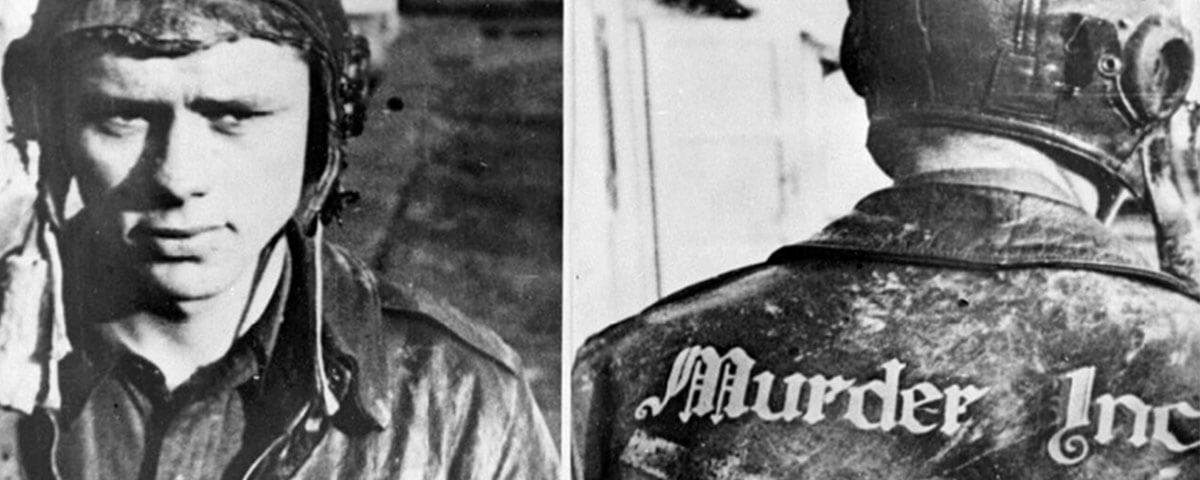

Kenneth Daniel Williams was falling from the sky.
His B-17, “Aristrocrap,” had just been shot over Bremen, Germany. A bombardier in the 351st Bomb Group, Williams was one of the few lucky ones of his crew — both the pilot and copilot of the Aristrocrap died in the Nov. 26, 1943, melee.
“The escape hatch was on the floor of the tunnel,” Williams would later write. “I crawled back to see if I could help the pilot open the escape hatch. As I crawled toward him the pilot put his foot on the hatch and forced it open. This took tremendous pressure since the slipstream was trying to force it closed. The pilot grabbed me by the waist and forced me head-first out the escape hatch.”
The crew was never supposed to be in the Aristrocrap. Rather, upon arriving in England in October 1943, they had been assigned the B-17 “Murder, Inc.,” an older plane that had seen continuous active combat. Williams related that it was customary to have the name of the plane painted on the back of one’s flight jacket.
But “as it turned out,” Williams wrote, “I was the only member of the crew whose jacket was painted before we were shot down in, ironically, another plane.”
When Williams landed, he was captured immediately and transferred to the POW camp Stalag Luft I. It took the Germans little time to take stock of their prisoner, with Joseph Goebbels, chief propagandist for the Nazi Party, seeing an opportunity to exploit the unique name inscribed on Williams’ flight jacket.
During a time when the pace of American strategic bombing of Germany was ramping up, the Germans leaped at the propagandic opportunity to label American pilots lawless “gangsters from Chicago” bent on killing all German women and children.
However, the stereotype that humor is lost on Germans actually rang true this time.
https://www.americanairmuseum.com/person/139168 that the flight jacket was “photo evidence for the underworld nature of [Allied] air terror” and that the American “air gangster identifies himself as part of a murder racket.”
But on the Allied side, the propaganda effort had the opposite effect. Pilots were seemingly delighted with the moniker, happy to be known to by their enemies as “gangsters of the sky” — a formidably cool moniker that somehow got lost in translation to the Germans.
Williams himself was born and raised in Charlotte, North Carolina, writing, “Contrary to some of the German propaganda, I was not a Chicago gangster,” adding that he had “attended local schools and went to Belmont Abbey College, an institution run by Benedictine Monks, many of whom came from Germany.”
After more than a year and a half in captivity, Williams and his fellow POWs were liberated on May 1, 1945, by the Red Army. Upon arriving home, the bombardier was greeted by hundreds of letters from all over the world wishing the “air gangster” well. According to Williams, “they all contained newspaper clippings of ‘Murder Inc.’ that they thought I might like to have as a souvenir.”
As for the jacket that caused all the trouble? Williams managed to bring it stateside and, as he put it, had “Murder, Inc. painted on [it] again exactly as it had been before I spent one night removing it. The jacket is old and stiff now and the lettering has faded, but I am wearing it as I write this.”
In 1986, the Murder Inc. jacket was donated, and it now hangs in the Smithsonian’s National Air and Space Museum.
Originally published on HistoryNet, our sister publication.
Claire Barrett is an editor and military history correspondent for Military Times. She is also a World War II researcher with an unparalleled affinity for Sir Winston Churchill and Michigan football.
Read the full article here
