



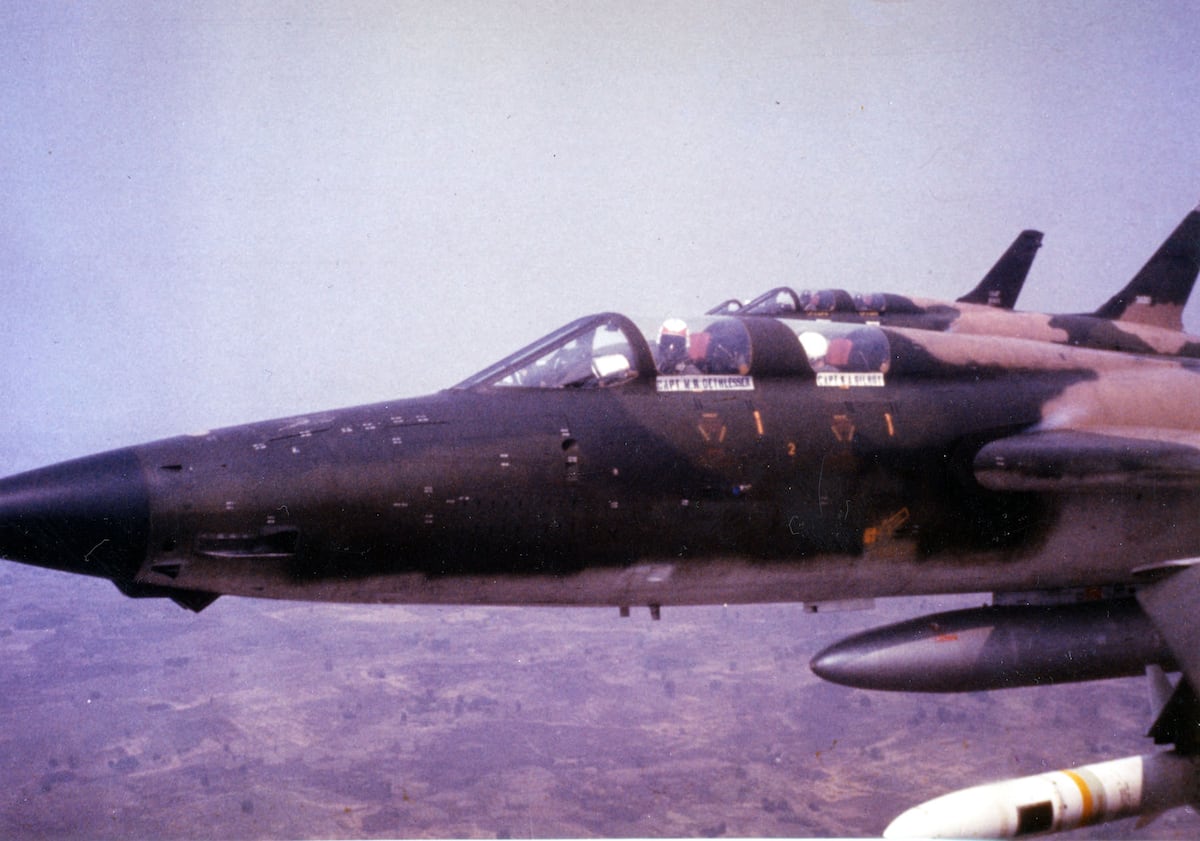

Even in its formative years during World War I, military aviators became aware that their worst enemy was anti-aircraft fire. And if one made it through that gantlet, the next worst thing a pilot could do was to return to his designated target, where an aroused and ready enemy waited. In the case of Capt. Merlyn Dethlefsen, however, mission came first, even if it set him against all the surface-to-air missiles anti-aircraft artillery and fighter planes the enemy could throw at him.
The son of a farmer and schoolteacher, the Iowan graduated high school at age 16 in 1951 and joined the United States Air Force in 1954 as a cadet in Royal, Iowa.
After more than a decade in the Air Force, Dethlefsen received his first combat assignment in October 1966 as part of the aerial fight in the Vietnam War. Dethlefsen flew Republic F-105s in the 333rd Tactical Fighter Squadron and later the 354th TFS of the 355th Tactical Fighter Wing, based at Takhli Royal Thai AFB.
The wing flew both single-seat Republic F-105D Thunderchief fighter bombers and two-seater F-105Fs. The latter, nicknamed “Wild Weasels,” carried a weapon systems officer to seek and destroy Soviet-built SA-2 SAMs or the radar that controlled them.
These “Iron Hand” SAM suppression missions, carried out at high speeds at low altitudes, had their own special dangers, made the more hazardous by the AAA and Mikoyan-Gurevich (MiG) fighters that were coordinated with by North Vietnamese ground control interception (GCI).
On March 10, 1967, Dethlefsen was flying his 78th combat mission and his target was the area around the Thai Nguyen Steel Plant, a heavily defended industrial complex about 50 miles north of Hanoi in North Vietnam, according to the State Department. At the time, the plant was North Vietnam’s first industrial center and produced 20% of its steel.
Dethlefsen’s WSO, Capt. Kevin “Mike” Gilroy, later commented that his pilot was “taciturn, a born-again Christian, and not at all the typical fighter pilot.” In Dethlefsen’s case, however, those traits proved right for the job.
As the Americans, led by Maj. David Everson with Capt. Jose Luna as his WSO, neared Thai Nguyen, the defenses opened up, blacking out the sky with a curtain of 85mm AAA. The flight’s No.4 man, Maj. Kenneth Holmes Bell, suffered major damage early on. Dethlefsen later reported on what followed:
“Both Mike [Gilroy] and I had seen some pretty intense flak in North Vietnam, but nothing to compare with this. The sky was literally black with flak — a greasy, deadly black. I lost sight of Lead in all the smoke. Suddenly I saw Lincoln 2 [Capt. William F. Hoeft] break to the right and heard the tell-tale shriek of a parachute beeper! Lincoln Lead [Everson] had been shot down! And Lincoln 2 wasn’t in too good a shape either. By all the rules I should have squirted off my missiles and gotten the hell out of there, but the strike force was still very vulnerable, I had fuel, missiles, bombs and guns, and the job wasn’t done yet.”
— Merlyn Dethlefsen
Dethlefsen flew a brief reconnaissance of the area. “It really wasn’t a matter of avoiding flak, that was impossible,” he said. “I had to find the least intensive area. The SAM site we were after was placed in close with several large 100mm anti-aircraft sites. Not guns—SITES! Each site had multiple guns in it.”
Having lost contact with Bell, Dethlefsen set up a “wagon wheel” pattern of attack. “I rolled in and began lining up the SAM site for a Shrike attack when something caught my eye,” he said. “How I picked put the MiGs in all that smoke and confusion I don’t know. I fired the Shrike and broke to the right, just as the MiG launched a missile at me.”
More worried about MiGs or SAMs at that moment, Dethlefsen flew into the AAA instead. During his second run through it, however, he felt “a slight bump.” They were hit. Evading a second MiG’s attack and sustaining another flak hit, Dethlefsen made a final strafing dive, firing off the last of his 20mm cannon ammunition before making for Takhli.
Among other things, he had destroyed two SAM sites and dodged two MiG missiles, helping the bombers carry out what was judged a successful mission.
However, the mission cost Dethlefsen his flight leader, Everson and Luna, who were taken prisoner and endured 2,187 days of hardship and torture in the “Hanoi Hilton” before their release on March 4, 1973. Bell and Hoeft managed to bring back their battered F-105Ds.
Unknown to the Americans at the time, the few MiGs they encountered were not North Vietnamese, but North Korean. Although the USAF confirmed both, a postwar check of Vietnamese records revealed a unit called Group Z that fought alongside the North Vietnamese.
On Feb. 1, 1968, Dethlefsen received the Medal of Honor from President Lyndon B. Johnson for his March 1967 exploits. Among the highlights of his subsequent career was service as assistant director of Lockheed SR-71 Blackbirds at Beale AFB, California, and director of operations for the Boeing B-52 wing at Dyess AFB, Texas before retiring as a colonel.
He died in Tarrant County, Texas, on Dec. 14, 1987, and is buried in Arlington National Cemetery.
Read the full article here
