




An animal that doesn’t scare you isn’t worth shooting. A hunting trip that doesn’t produce a few new gray hairs on your poll isn’t worth taking.
Now, I’ll admit that this is only one man’s opinion. I’m not bigoted about it. I’m not raising the issue of “sportsmanship”—I have no qualms about shooting animals. I know that the game species must be kept in balance. My attitude is a selfish one—I’ve reached the point where I don’t think it is any fun to shoot an animal that couldn’t hurt me if it were given the chance.
I’ve lived all my life in South Africa. I’ve been hunting in its tremendous stretches ever since boyhood. I spent my school vacations on a 70,000-acre farm that was overrun with game. And even today you can hunt for weeks on end in Bechuanaland, Rhodesia, South West Africa, or Mozambique (Portuguese East Africa), and shoot a different kind of animal every day.
Animals Worth Hunting
This is a pretty rich diet; you can get too much of it. That’s why I’ve come to rate only two or three animals as worth hunting. (In my part of the world, that is; I often think longingly of North America’s grizzlies and Kodiak bears.) The African lion is my idea of a prime antagonist. Next in worth I’d place the buffalo—a blindly courageous, charging monster that will still try to get at you after you’ve put half a dozen bullets into his heart. After that, perhaps rhinoceros, elephant, or tiger—though I’m not particularly interested in any of these. Give me one good lion hunt every couple of years and I’ll remain a happy man. Unless, of course, one of the cats puts an end to my career.
But I want to meet old Felis leo on decently even terms. None of this sitting-duck shooting for me. There’s been too much of it; it’s given the sport a bad name. Some “lion hunting” involves no more risk—and produces no more exhilaration—than shooting through the bars of a zoo. I’ve listened, and grown nauseated, while so-called “adventurers” have related tales of the hunt. All they did was to sit comfortably in a tree over a baited water hole and wait for some unwary lion to come in. And you can be sure they always had a dozen well-armed natives strategically placed, just in case. What possible kick can a man get out of that?
Baiting is not in itself reprehensible; it’s often necessary. But it shouldn’t be like putting cheese in a mousetrap. No, I’ll stay on the ground with the lion. If necessary I’ll crawl through the same brush that he’s crawled through. I’ll go looking for him until I get a fair shot. Maybe it will take days or weeks. But it will be worth the trouble, even if I miss. Even if I get a scare that shakes me from head to foot. And I don’t mind saying that I have been frightened!
Take that day a year or so ago. We’d started out not long after dawn, my native tracker and I.
I was carrying a Winchester Model 70 in .375 H&H Magnum caliber, loaded with 300-grain Silvertip cartridges. Chumbo had an old 7.9 mm. Mauser, one of my discarded rifles. We were in fairly dense country, an area dotted liberally with thorn-tree thickets and heavy underbrush, and full of shallow pools. Fifty yards of visibility was about as much as we ever got, and often we didn’t get that much. There were lions in the section, that we knew. But I was after a really big one.
On the Trail of a Big Cat
We moved along cautiously in the dim morning light, inspecting one water hole after another. Plenty of spoor, but nothing that promised much. Then, after we’d gone about a mile, we began to hear a lion “talking” in the forest, and Chumbo thought he might be a big one. The “talk” is a deep, coughing grunt—much like the grunt of an outsized pig.
Soon we picked up fresh tracks at the edge of a pool; they led in the general direction of the grunts. We followed along through thorn thickets and grassy glades, skirting swampy pools or wading through them.
There is no great difficulty in tracking a big cat. Even when he moves through water—and he’ll take to it readily—you can easily spot the crushed reeds that mark his entrance and exit. He’ll stick to the age-old game trails and your tracker knows his sign. In no time at all, though, I was soaked to the skin by swamp water. So we paused while I stripped off all of my clothing except footgear, hat, and underpants. Chumbo was quite comfortable—he seldom wears even pants. But how defenseless I felt for a moment or two; we take more comfort out of our clothing than we think. Then we pushed onward, sometimes crawling cautiously through the lush undergrowth, sometimes pausing at the edge of a little glade for a precautionary inspection.
It’s impossible to convey, in words, any notion of the tension—the exhilaration that grips one in a sequence of this sort. The unfriendly brush closes in, and even the birds scream imprecations as you disturb them. You pause frequently to scan your back track, for a lion is quite likely to try a flanking attack. You decide, though, that he’s probably up ahead. But where is the rest of the pride? Is there a big lioness gazing balefully at you from the brush not a dozen yards away?
Several times in the next half hour Chumbo and I almost caught up with our quarry. Never close enough to see him—just near enough to hear his angry, coughing grunts (evidently he was getting fed up with the pursuit) or to hear the squawking bush pheasants fly off at his approach. Chumbo stayed about thirty yards to my right; I like a good flanker, and he is really good.
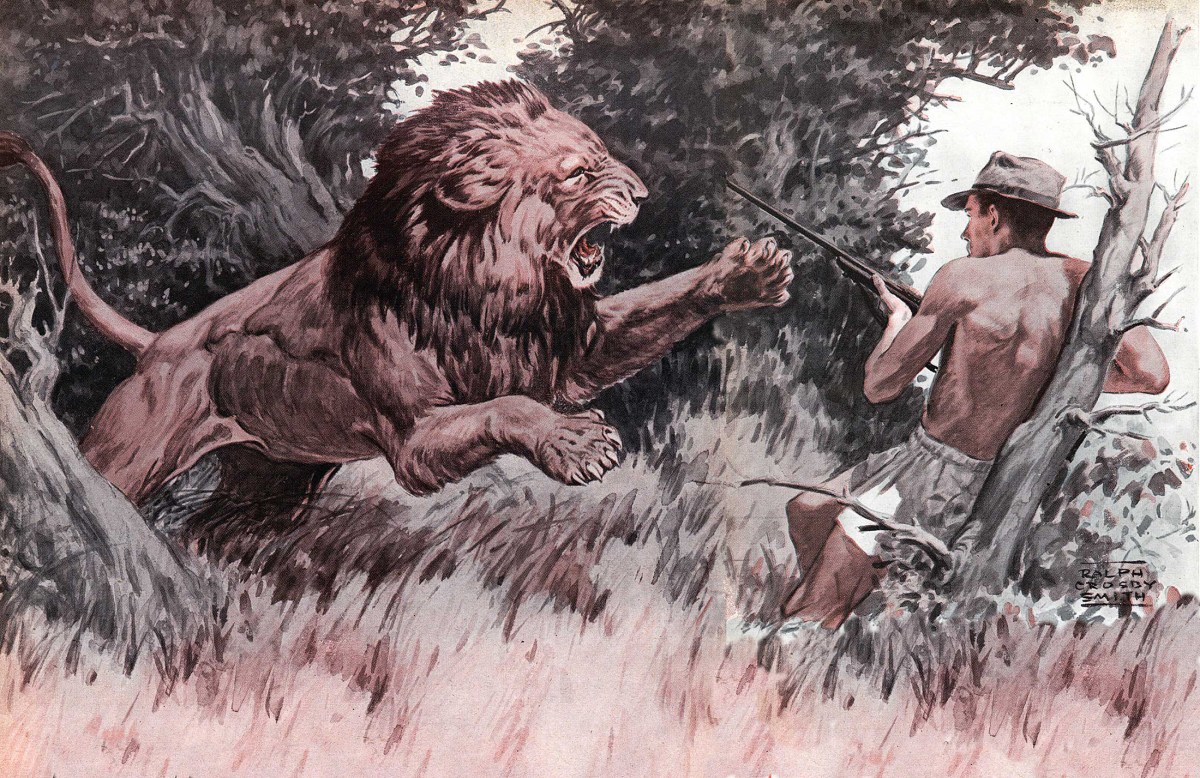
As luck would have it, we were momentarily separated by rather heavy brush. And I walked right into a terrific, jarring roar that set me back on my heels. At the same instant a huge, tawny shape hurtled out of the brush not four paces away.
Somehow I staggered sideways, brought up my rifle, and fired just as the great form flashed by. The muzzle couldn’t have been more than two inches from that tawny hide. But I might have taken a 500-yard shot for all the good I did. I found myself leaning against a slender tree, quaking from top to toe. A few great tufts of black mane fluttered on a bush. But the lion was gone.
The fact that I went on and got him later is not important. The point is that when you do this kind of hunting you’re spoiled for anything else. I have collected fine trophies, but not one of them means as much to me as the memory of that terrifying growl, that vivid, flashing streak of black and yellow that missed me by only a gun length.
Now, don’t get the notion that this is a case of fools rushing in where angels fear to tread. As a soldier, I’ve learned that recklessness is showy, but not very useful. Hence I exercise plenty of forethought and caution in my hunts. Bechuanaland is the kind of country where you must come to fairly close quarters with your game, but it will reward you well.
Bechuanaland (pronounce it Beck-oo-anna-land) is a vast, sparsely populated British protectorate straddling the Tropic of Capricorn in south-central Africa. A trifle bigger than the state of Texas, it has only about 2,000 European inhabitants and some 265,000 Bantu natives. Most of the territory is trackless, sandy country, alternately flooded in the rainy summer season, from September to April, and largely waterless in the winter, from May to August. There is plenty of water, though, in the great Okavango Swamp, where I hunt, and the winter weather is delightful. Days are warm and sunny, nights cool.
Thorns, Snakes, and Tsetse Flies
Because of its sandy soil, Bechuanaland doesn’t have any real forest—that is, a great variety of hardwood trees. But much of the country is covered with thorny acacias. These, combined with tall, rough grass and heavy brush, furnish superb cover for a vast game population. There are lions, elephants, hippopotamuses, rhinos, giraffes, buffaloes, leopards, and many species of wild antelope. There are deadly snakes to watch out for, particularly the puff adder and the cobra, as well as poisonous scorpions and tarantulas. The mosquitoes are big and vicious, and so is the tsetse fly, which can nip through ordinary clothing. But I’ve been bitten thousands of times without any dire results.
I rate Bechuanaland as tops in game country, first because it offers such an abundance, and second because it gives the man of modest means the chance to have at least one African big-game hunt. I believe that two men could enjoy a month of it, with camp and staff at the semi-luxury level, for about $600 exclusive of transportation.
Antelope and Buffalo—Plus!
My last hunting license cost $100. It entitled me to a very generous quota of the following animals:
Impala: An exceedingly beautiful antelope, ranging around 125 pounds when fully grown. The male has slender, lyre-shaped horns, which make it a striking trophy, and a golden-red coat.
Reedbuck: Another antelope, fawn-colored, weighing around 150 pounds.
Hartebeest: A good-size antelope, weighing around 325 pounds, with lyrate horns.
Gemsbok: One of the larger antelopes (around 450 pounds) and a very beautiful one, with long, almost straight horns.
Sable antelope: Another big fellow (500 pounds) with a dark coat and long, curved horns.
Kudu: A 650-pound antelope with very long corkscrew horns.
Roan antelope: A highly prized trophy, weighing upward of 675 pounds, with moderately long, back-curving horns.
Zebra: The handsome striped horse of Africa; a full-grown stallion weighs around 750 pounds.
Buffalo: Right up near the top of any sportsman’s want list, the African buffalo runs around 1,400 pounds, occasionally much more.
So much for game. No license is required for vermin, which includes the vicious wild dog (weight, about eighty-five pounds); the leopard (140 pounds); and—believe it or not—the lion! The king of beasts, whose weight averages around 475 pounds, is probably the world’s largest, most majestic, and most formidable “varmint.”
My latest hunt in Bechuanaland took place a year ago. The party consisted of myself, my brother, Vivian, and my friend Pete—Lt. Col. Chesley G. Peterson, who was the U. S. Air Force attaché in these parts. We set up our own safari in Pretoria, capital of the Union of South Africa. Our rolling stock consisted of a Ford truck and two jeeps. Into them we packed a large order of tents, bedding, cooking and camping equipment, tinned foods, beverage, and whatever else three men would need for a month afield.
As to armament, we proceeded on my firm opinion that you can’t be overgunned when you’re hunting lions and buffaloes. I’ve been through the mill and I haven’t yet found the perfect rifle. I started my African hunting years ago with a 7.9mm Mauser and worked through a 9mm Mauser, a .318 Nitro Express, and on up to a Winchester .375 H. & H. Magnum, my present weapon.
I’m not satisfied yet. The .375 with a 300-grain bullet develops 4,300 foot pounds of muzzle energy. I don’t think that’s quite enough for effective work on a lion or a buffalo, especially at close quarters, where a wounding shot may cost you your life. I’d like a bolt-action repeating rifle in the 5,000-pound class, but I know I’m not likely to get one.
True, the English double-barreled rifles, the .465 and .470, are in the 5,000-pound class or near it, but I’m not particularly impressed by them. Granted that you can get off two quick shots. At that point you have to make a quick exchange with your gunbearer. That’s not good enough in Bechuanaland, although it may be fine farther north in Kenya Colony, where you get long-range shots. Gunbearers quite often get panicky in the face of a charge by a lion or a buffalo and scamper for shelter. It’s a pretty awful thing to reach around for that second gun and find it isn’t there.
Like most experienced hunters I’ve learned to operate a bolt with considerable speed. No doubt the double-barrel user will get off his two shots more quickly than I. But then I can keep right on shooting, up to five shots, while he is making his exchange. Those five shots will generally take care of a lion, if you’re any kind of marksman. Not so the buffalo—he’s a different kind of beastie. Sometimes I wonder if anything short of an antitank rifle can stop him in his tracks.
The Medicine for Lions
Perhaps the .375 would be a good lion rifle with a different type of bullet. The Silvertip, it seems to me, expands much too quickly on dangerous big game. I’d prefer a 300-grain bullet that would penetrate to a much greater degree, mushrooming slowly and tearing vital tissues. It would enable me to get in a greater proportion of those crippling bone shots. I don’t expect my first shot invariably to kill a lion, but I do hope that it will earn me the chance of a second shot. Give me a slug that will tear a big wound and cause copious bleeding. Then I have a slowed-down animal and a good blood trail to follow. Shocking power alone doesn’t mean a thing on lions and buffaloes; you really have to destroy their vital organs to keep them down.
But on with the hunt! We headed our little caravan northward from Pretoria in July. Our destination was the great Okavango Swamp in northern Bechuanaland, some 700 miles to the northwest. The first day’s drive of 440 miles got us to Francistown. There the good highway abruptly ended. Beyond Francistown we rolled into really grim country: vast stretches of reddish, sandy soil, dotted here and there with shallow salt lakes—the famed salt pans of Africa. It is primeval wilderness: a region of swiftly running rivers in the rainy summer season and of dry desolation in the winter.
Safari Into Bechuanaland
Our map made the bold bluff that there was a “main road” between Francistown and the little settlement of Maun, some 320 miles away. That highway was just two never-ending ruts—and I do mean ruts. They were so deep that we did not have to steer the cars. For nineteen hours we bounced, jounced, and swayed—bruised top and bottom.
Maun has a hotel, an airport, sixty white residents, and a vast number of Bantus ready to hire out. We looked them over pretty carefully, examined their recommendations, and finally made a choice. Chumbo, the head tracker, agreed to come along for seventy-five cents a day, but the cook held out for a dollar. He was worth it, though, because he could speak English, which is a rare accomplishment among Bantus. We got four assistant trackers for fifty cents a day apiece.
You’ll begin to see why a safari into Bechuanaland is not beyond the reach of a modest purse. Provisioning the natives was no problem. They delight in a diet of corn-meal mush and wild game. And they’ll eat any animal but the hyena and the wild dog. Since even vultures pass up the wild dogs there must be a reason. Bantus consider lion meat a special treat—especially the heart, which is supposed to endow the eater with much courage.
The trip from Maun to the great swamp beggars description. Floods had turned the whole area into a vast, wrinkled mass of gulleys. When we finally staggered onto our camp site, three days out of Pretoria, my brother said mournfully, “I shan’t do much hunting. It’ll take me at least a month to recover strength for the trip back.”
Next morning my brother had his first look at the Okavango hunting country. “How,” he asked, “does one even find game in that morass—let alone shoot at it?” I could understand his feelings. All the way from Pretoria to Maun we hadn’t laid eyes on fresh water. Now there was water everywhere. True, it was collected in pools, varying from 100 to 400 yards in diameter and from one to four feet in depth. And there was quite a respectable amount of dry land separating the pools. But most of the land was covered with a thick growth of trees and brush. What Vivian couldn’t see at first was the vast maze of game trails that checkered the whole region.
We soon started out to reconnoiter the country. My brother took several trackers and went off on his own. Pete elected to travel with me. To guide us we had Chumbo and two of his assistants.
Then, a mile or so from camp, we came upon fresh buffalo tracks along the edge of a pool. Evidently quite a herd had been drinking there not long before; water was still trickling into some of the deeper prints. The country was fairly open—that is to say, we’d occasionally get visibility up to 250 yards. The trackers moved off fast and we soon ran down the herd. Most of the animals retreated into the bush at our approach, but one big beast took up a broadside station at about 200 yards and waited to see what we were up to.
The trackers urged me to shoot. But I wasn’t quite sure I wanted that buffalo. It was big, all right, and there was just enough light to make aiming fairly easy. But I couldn’t make out whether it was a cow or a bull, and put the question to Chumbo.
“M’dala! M’dala!” he said excitedly. Well, if he said it was a male, who was I to doubt him? I nodded to Pete. He brought up his .375, took careful aim, and fired. The buffalo whirled and started away, stampeding the rest of the herd. We speedily picked up the blood trail and followed it for 100 paces or so. Then we spotted the buffalo, again standing broadside to us and about seventy yards away. That’s a peculiarity of the big beast—he always turns broadside to a pursuer.
Buffalo Meat—and Trophy Head
Pete sent two more 300-grain slugs into the buffalo’s chest and it tumbled over. One final shot at close range shattered its spine. Now, four shots is par for the course, so Pete had nothing to be ashamed of. Nevertheless, I called the trackers together and gave them a stern dressing down. For Pete’s fine bull turned out to be, on closer inspection, a fat cow. The trackers had known this all along. But being Bantus they hankered for cow-buffalo beef, and they probably figured we wouldn’t notice the difference.
Pete deprecated all this fuss, for his cow had a really magnificent head. “After all,” he said, “when that head is properly mounted and placed on my wall, who in the world will be able to tell if it’s a gentleman buffalo or a lady buffalo?” I let it go at that; my concern had been that some calf might be deprived of its milk depot.
For the record: Only one of three heart shots actually reached the heart. The others blew up near the surface. We rested while Chumbo and his boys eviscerated the cow and cut off some choice meat. Then, since I was not anxious to return to camp so early, I volunteered to guard the buffalo carcass while Pete and the boys hiked back. They wanted to leave the meat with the cook and get a jeep to haul in the rest of the trophy. Someone had to protect the carcass meantime against vultures. I knew that they’d begin to gather in a matter of minutes. We could, of course, have covered the carcass, but that’s a risky proceeding, for vultures can spot an exposed hoof or a clot of blood at 1,000 feet. They are the most amazing, as well as the most repulsive, birds in Africa.
I prepared for a nap and Pete started back toward camp. I’ll let him tell his own story:
“It was a beautiful, sunny morning and I was in high spirits. Ahead of me Chumbo moved along quietly, sweat glistening on his back. That load of meat he was carrying must have weighed fifty pounds. He grinned happily, evidently in anticipation of the beef orgy that lay ahead. The other tracker was soon out of sight. Our route lay through a series of grassy lanes hedged in by heavy thornbushes; we never had more than fifty yards’ visibility. Everything was peaceful and serene. I pushed my arm through the sling of my rifle and carried it comfortably on my shoulder.”
Read Next: O’Connor in Botswana: Charged by a Cape Buffalo That Refused to Die
And Then it Happened
“We had just entered a narrow trail in the brush when Chumbo stopped so abruptly that I almost ran into him. ‘Buffalo!’ he grunted. And in that same split second an enormous cow burst out of the bush not fifty paces ahead. Talk about reflex action! I unslung, aimed, and fired that big .375 in less time than it takes to tell of it. The slug hit the cow high on the left shoulder, and she went to her knees in a cloud of dust. But only for an instant; she got up just in time to take another bullet in the neck.
“The rest is like a nightmare. The whole world seemed to come alive with buffaloes. We could hear them bellowing, snorting, and thrashing around in brush on all sides. Evidently we’d blundered into the midst of a big herd. The cow sank slowly to the ground, but just as it did two more burst into the clearing. Chumbo got his .303 British service rifle into action, concentrating on the smaller one, and managed to finish her with five shots.
“But he’d hardly had time to reload when the third buffalo charged us. At forty yards I fired at the only possible target, her head. The 300-grain bullet didn’t even slow her up. She came on with bellowing roars of rage. Both the tracker and I crowded behind the two-inch trunk of a thornbush. The cow swept by, one of her wicked horns raking at us and missing only by inches. Her momentum carried her for twenty-five yards, but she whirled and started back for us.
“Both rifles were now empty. Frantically I fished in my pocket for cartridges, but my sweaty hand brought up only two. We scooted around to the far side of the spindly tree as I reloaded. Now the cow was almost upon us again, bellowing in pain and with great spurts of blood gushing from her nostrils and shoulder. Just as I brought the rifle up she collapsed, literally at my feet. I could never have shot in time.
“Now two shots rang out behind me and I whirled in terror. The first cow had managed to get to her feet for another charge. Chumbo had gotten off two .303 bullets but they didn’t deter her one whit. Hastily I put the two .375’s into her. She fell again, still far from dead. We speedily got behind a large tree, and from that point we reloaded and shot her seven times more—before she finally died. The whole melee, from first shot to last, took only two minutes. But enough sheer panic was crowded into those 120 seconds to last me a lifetime.”
Later on we performed an autopsy on the cows. In the first and largest we found thirteen bullets, every one of them in a vital area. The smallest cow had succumbed to five .303 slugs, two of which were in her neck. The third cow—the one that had nearly ended two hunting careers—had five bullets in her heart. Pete’s first bullet—a hard-nose one, by the way—had pierced the skull and plowed through throat, lungs, and abdomen to wind up in the skin below the hip.
This episode illustrates the buffalo’s fight-to-a-finish courage. But I’d like to point out that I’ve never known a buffalo to charge a man without provocation. Pete had simply blundered into one end of a little glade as the buffalo entered at the other. The fact remains that a maddened buffalo is as nasty a beast as you’d want to face. Those sharp horns can disembowel a man, and the cruel hoofs can literally cut him into ribbons.
No Place for Cowardice
At day’s end we ranked high with our natives. That was well, for I have found that natives are quick to size up their bosses and act accordingly. Many Bantus have no great courage themselves but they expect a white man to have the heart of a lion. If he shows the least trace of cowardice or indecision they’ll refuse to take any risks with him, or worse yet, desert him in the face of grave danger.
The days were soft and sunshiny, but the nights were often cold. We had comfortable camp beds, and plenty of warm blankets. But I slept out in the open under the brilliant African stars. There were very few mosquitoes about, since we’d pitched camp quite some distance from swamp water.
Our clothing was simple: closely woven woolens and khakis, which discouraged the mosquitoes and tsetse flies; well-broken-in shoes with crepe soles; large slouch hats or light topees; and a plentiful supply of thick socks. We had a well-filled medicine chest and took regular doses of a malaria preventive.
Camp life wasn’t at all complex. Since I knew there was plenty of firewood in the swamp area we had not brought along a pressure stove and fuel. In the evening a pair of gasoline pressure lamps gave plenty of light for the boys to do their chores.
There were two main meals each day. Before setting out on our morning hunt, along about sunrise, we’d swallow scalding tea and eat a few rusks. Between 11 and 2 we’d return for lunch, which might consist of bacon and eggs, broiled game, vegetables, and fruits. Evenings we’d have a banquet of roast duck, pheasant, partridge, or guinea fowl, followed by broiled game steaks or a roasted joint. Then coffee, sweets, and perhaps an orange.
We’d been in camp about a week when the trackers came in with news of lions. Several prides, it appeared, had collected in a brushy, overgrown forest patch not very far away. The area was a dense one, and I couldn’t in conscience permit the party to go in there in search of trophies. So we decided to lure the lions out to the water holes, where at least we’d be able to get a fairly open shot, at say fifty or 100 yards.
Bait—and Wait
Pete shot a zebra stallion and we prepared to set it out as a lure. The boys ripped its belly open, then hitched the carcass behind a jeep with a length of rope. Next we dragged the zebra through several miles of likely country, passing as near to water holes as possible. Finally we parked it in a fairly open spot close to cover and covered it carefully with brush and vegetation. We hoped that with any kind of luck we could approach it upwind and through cover.
We had reasonably good expectations of success. The lion is not particular about his food. In fact, he’s quite lazy, much preferring to eat decayed meat rather than go to the trouble of making a kill. The trouble is, you never know when a cat is going to sit down to dinner; you may arrive too soon—or too late, when the carcass has been either devoured or dragged off.
We set out at daybreak next day to inspect our bait. We parked the jeep some distance away from it and proceeded on foot. Almost immediately we came upon the fresh spoor of two lionesses and three cubs. Soon we found a wildebeest or gnu, freshly killed and almost completely devoured. A little beyond that we spotted vultures; some were settled in a tree, others were hovering in the sky. That’s a good sign; if vultures won’t descend on a carcass it means that some large animal is near it.
Now, all this prospecting around took time, so the morning was well advanced when we finally approached our bait. I expected to find a pride near it, so we moved carefully down through cover. But not carefully enough. At the edge of cover we cautiously looked toward the bait, and were immediately spotted by a pair of well-grown lion cubs.
Their growls instantly aroused two big lionesses from a siesta. One of the cats quickly herded her cubs away, but the other turned toward us with a growl of defiance. Her great yellow eyes flamed dangerously; I knew she was about to charge. At only twenty yards I got the gold bead of my Winchester on her shoulder and fired just as she started to leap.
The bullet spun her around in almost a full circle, and she died on the spot with her head on her paws. It was rather weird to watch the flame in those great yellow eyes gradually grow dim and then go out.
We got the jeep and loaded the cat across its hood. That was quite a job, for she weighed at least 350 pounds. Then four of us jammed into the little vehicle and bounced back to camp. What a joy those jeeps were! There seemed to be no place they couldn’t travel nor any load they couldn’t carry. A plate on the dashboard proclaimed the maximum cross-country weight to be 800 pounds. But we frequently piled on a great deal more than that and the jeep never balked.
Our lures usually produced, but once in a while one would prove a dismal failure. Pete, for instance, killed a wildebeest and placed it near a water hole that showed considerable sign of traffic. He inspected it frequently in the next few days but the bait remained undisturbed, so he gave it up as a bad job and moved on to other things.
Then one morning Pete and a tracker started out for a more distant spot. They went as far as they could in the jeep, then continued afoot. Displaying no particular caution, since they were still some distance from their destination, Pete and the tracker blundered into the open only a few yards from the forgotten water hole.
Leo Reared Up and Roared
Just as they neared, a shaggy-maned lion reared up from behind the carcass and roared loudly. Like an automaton Pete threw up his .375 and fired. The big slug hit the lion in the heart and (praise be!) scored an instantaneous kill. A wounding shot would have almost certainly been fatal—to Pete. His tracker was some distance behind him and in no position to fire. Besides, he carried a .303, which is no great shakes as a stopper.
That “stopper” problem is a serious one, at least in Bechuanaland. Elsewhere in Africa—in Kenya, for instance—you find nice, open country, where it’s possible to keep a couple of hundred yards between you and your lion. But in wooded country, with its close-up shooting, you need some assurance that you can stop a lion before he can bring his fangs and talons into play. Your tracker should be able to stop a wounded cat dead in its tracks.
To my mind there is only one certain stopper—a 12 gauge autoloading shotgun. That’s not an original notion with me; the 12 gauge is widely used in Africa. Farmers usually keep one handy for dealing out sudden death to marauding lions or for dispatching those that tumble into pit traps. When your tracker loads a shotgun with five rounds of No. 00 buckshot he is really ready to repel boarders.
On buffaloes, of course, the autoloader is no more effective than a handful of popcorn. But after the incident I described near the beginning of this article I armed Chumbo with my 12 gauge, five-shot Browning. When I took another tracker along I gave him a rifle.
Since I seem to be handing out advice, I might touch on the subject of sights. Scope sights are almost totally unused in the game fields of southern Africa. They’d be more hindrance than help. They give you practically no extra advantage in close-range shooting and they slow up aim far too much in an emergency. On top of that the light is often bad. I favor an open rear sight—the familiar, ordinary U. My front sight is a gold bead which I wouldn’t trade for diamonds. It gives remarkable definition even under poor conditions. My brother is partial to the wide, shallow-V rear sight, for he says it gives quick centering. But for me its high shoulders tend to blot out too much of the target. Some of my friends like aperture sights, but to my mind they have many of the scope’s disadvantages.
Our party got action almost every day of the month-long hunt. Pete and my brother collected whatever lesser trophies they wanted and shot for the pot and for bait. We got our share of chances at big game, collecting some, muffing some. My brother flushes a dull brick-red whenever he thinks of one of his misses.
We were out one morning about half-past seven and had dropped in on a wildebeest bait to see if there were any visitors besides ourselves. There was—a magnificent black-maned lion, one of the finest I’ve seen. He spotted us just as we sighted him, at perhaps 100 yards, and he arose from his repast with the most majestic dignity I have ever seen. He gave us a calm but searching scrutiny and then walked slowly for cover, just like an actor making a good exit. He seemed to be saying to himself, “I want to get away from here quickly but I’m darned if I’ll run.” My brother looked on in fascination.
“Shoot, man!” I whispered urgently. “Shoot!”
Startled into action, my brother fired—and bowled the lion completely over. From the sublime to the ridiculous! Now our dignitary lay flat on his back with his four legs pointing rigidly to the sky. He looked for all the world like a drawing in a comic paper. We moved in quickly. But as we did, the big cat rolled over onto his side and started to get to his feet.
“Shoot!” I again urged my brother. I didn’t want him to lose this magnificent beast, nor did I want to interfere.
Frozen to the Spot
But Vivian seemed frozen. It was eons before he got that rifle to his shoulder again. And before he could shoot, the lion had disappeared into the brush. All the bullet had done, apparently, was to nick him in the spine and paralyze him momentarily. There was practically no blood and, of course, no trail we could follow. I might have gone in after him myself but I couldn’t in conscience risk my brother’s hide.
There is no substitute for experience in lion and buffalo hunting. I certainly should never advise you to undertake it without the restraining presence of a seasoned man. If I were an American planning a Bechuanaland hunt I’d try to arrange with some experienced sportsman to go along with me, perhaps by offering to pay the major share of expenses. You cannot depend on the native tracker’s wisdom.
I shall never forget my first lion hunt, many years ago. I went out with only a tracker, and the risks I took were appalling. I had a most indifferent rifle and, worse yet, the wrong kind of ammunition. As for my tracker, he was armed with an ax!
We found a freshly killed antelope, partly eaten, and followed the lion spoor away from it. Right into the brush we plunged. Soon we found we were walking in circles. And then I discovered, right on top of my own footprints, the giant tracks of a lion! I should have been frightened silly but I wasn’t. On we went until we came up with a small pride. We literally shooed those lions ahead of us until we got them out into a clearing. Then I picked my trophy and killed him with one shot. To top it all, when I opened my rifle to empty the chamber I found that the cartridge case had separated!
I hope I’ve learned something since then. Last time out, I shot a lion through the heart at forty paces. He reared up for a charge, his eyes aflame. I hit him again, but rather far back. He whirled and bounded into the brush. Now, I realized that my first shot had done some heart damage. So I sat down and smoked several cigarettes. After half an hour I proceeded cautiously on the blood trail, pausing frequently to make sure that no wounded and savage cat was concealed in ambush.
I found him about 300 yards deep in the brush, quite dead. If I had started in immediate pursuit he might have traveled a mile. When you know you’ve caused a mortal wound, take your time, for your game will lie down, stiffen and die.
Our month was soon up but we had a respectable score: Four lions, a lioness, eight buffaloes, and lesser game. The most expensive safari in the world couldn’t have provided us with more sport. There is plenty of game, and adventure too, in Bechuanaland. Come and get it!
This story was originally published in the August 1949 issue of Outdoor Life.
Read the full article here
