




“ALL RIGHT, RICK,” said Paul Hiller, our host and the skipper-owner of the Nan II, a fast 23-foot cruiser. “We should drift over a school of fish somewhere along here. Free-spool your rig to the bottom. Then reel it up slowly, jigging it gently all the time.”
“Will do,” said Rick Wills, a husky ex-heavyweight boxer who is now a lieutenant on the police force of Madison, Connecticut, my home town.
Rick carried out instructions faithfully, but there was a dubious look on his face as he lifted his terminal rig over the side. That look didn’t surprise me, for I’ve found that most anglers using this rig for the first time react the same way.
The contraption looks like something out of Weirdsville, no question about it. Above a shiny four-ounce diamond jig is a 40-pound-test monofilament leader to which are attached four blue, yellow, and white streamer flies. The streamers, three inches long, are spaced about 10 inches apart and are knotted to the main leader with two-inch lengths of 60-pound-test monofilament.
The Nan II drifted straight toward one of Paul’s landmarks, a clump of trees on Crane’s Neck, a fashionable island-community located on the south, or New York, side of Long Island Sound. The tide was in the final stages of flood, and the water depth varied from 10 to 15 feet.
I’d fished these grounds with Paul and his buddies before, but this August trip was Rick’s first out of Norwalk, Connecticut, where the Nan II is moored.
We had been under way for three or four minutes when Rick let out a whoop from his position in the starboard corner of the cruiser’s stern. “Something darn near yanked the rod out of my hands!” he said in amazement.
I turned and saw Rick wrestling with his mediumweight two-handed spinning outfit. He was just getting the situation under control when, with a vicious jolt, a second fish struck one of his free streamers.
Rick was taken completely by surprise, and his rod tip plunged beneath the surface before he could regain control.
“What in the world am I into?” he yelled.
“Just a doubleheader of bluefish,” said Paul with a laugh. “Hold tight. You’re in for . . . oops!”
Paul’s rod also went into a looping bend as one of his lures was struck savagely. I was about to make a wisecrack when I, too, had a slamming strike. Before I could get myself braced, a second fish hit my rig. Now pandemonium reigned aboard our boat.
On a whippy eight-foot spinning rod such as I was using, the hooking of just one sizable bluefish is a guarantee of high excitement. Two blues at once add up to a riot.
Blues are among the strongest of fish in their size bracket, and they are swift and loaded with stamina. Their runs aren’t long but are liable to lead in any and every direction.
And bluefish have their own ideas about how to carry on a battle. When one of the pair I had on streaked to the left, the other was almost sure to run to the right. When one of them plunged, his unwilling partner headed for the surface. And when one ran away from the boat, the other almost invariably headed toward it.
Such maneuverings place as much strain on a rod as anything I can think of.
Everything from hooks to rod butt held for me. After what seemed an inordinately long time, the blues tired from fighting one another and the tackle and were coaxed alongside the boat. When the upper end of the stout leader came into reach, I grabbed it and heaved the fish aboard.
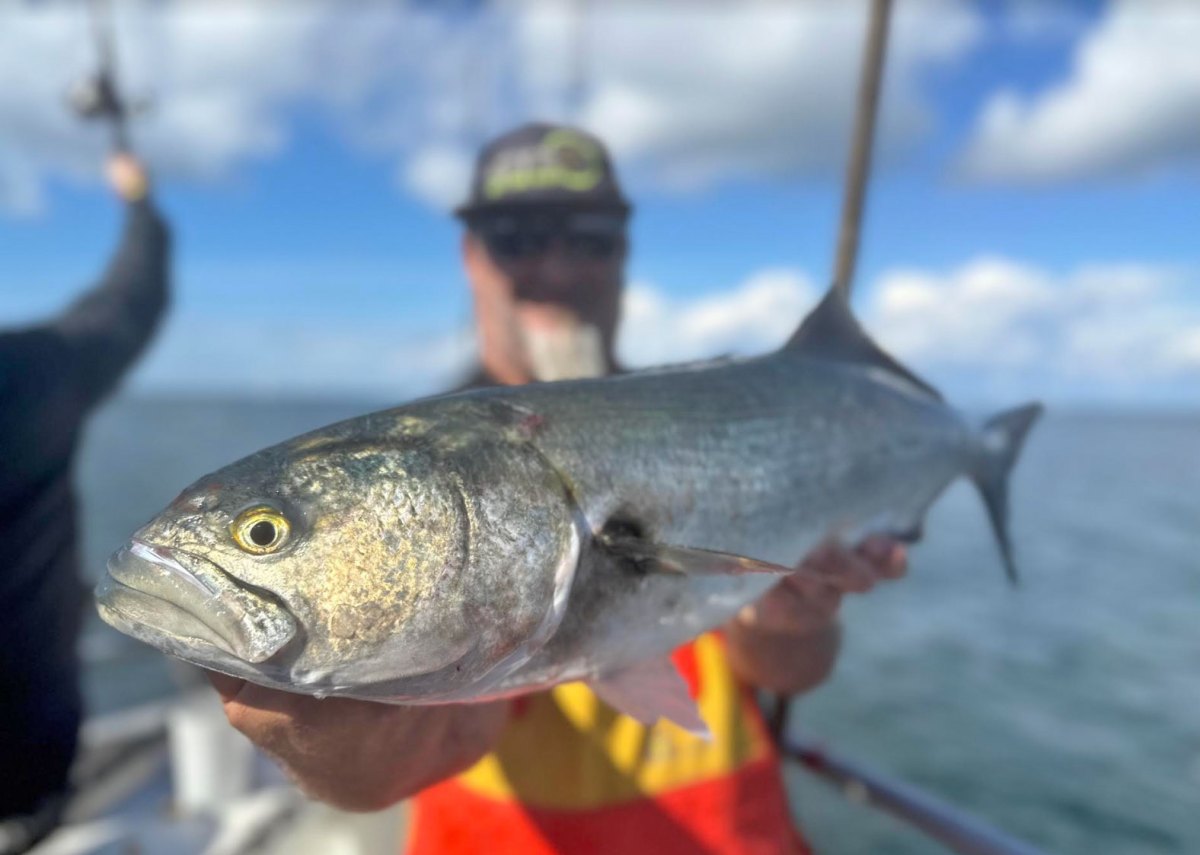
The blues were fine specimens, weighing five to six pounds apiece.
Unhooking bluefish requires caution. Their mouths are studded with needle-sharp teeth. And blues—unlike some other kinds of fish, including most barracudas—don’t stop snapping when they’re taken out of their element. A blue’s last snap generally accompanies his last heartbeat.
I held one fish firmly on the deck with my foot, grabbed the other one tightly across the back of the head, and removed the long-shanked hook. Then I unhooked the other fish.
On a calm day such as this one was, unhooking blues is comparatively easy. It’s quite a bit tougher when waves are bouncing a boat around.
Rick’s fish were now ready to be boated. With a bit of coaching from me, Rick grabbed his leader in the right spot and heaved his doubleheader aboard.
It took Paul a few minutes longer to bring in his catch. That son-of-a-gun had hooked not two but three blues!
“This is some fishing!” exclaimed Rick, mopping his forehead. “Who in blue blazes ever thought up a rig like this one?”
“It originated in Scotland,” Paul told us as he brought the boat into position for another drift. “Scottish commercial fishermen use these streamers, or similar ones, for mackerel. Their rigs hold as many as thirty-five streamers. When mackerel are plentiful, every hook is filled on nearly every drop. George can tell you that this rig works on mackerel.”
“It sure does,” I said, recalling an early-spring mackerel trip with Paul off Rhode Island. “And it works on cod and pollock, too.”
Paul and one of his fishing pals, Pete Klinkowski, developed our version of the streamer rig. It worked out so well that they now use it at least 75 percent of the time for nearly everything they go after in salt water.
“Look at those gulls working over there!” Paul said. “Let’s go.”
About 150 yards off our port side, a flock of screaming gulls were wheeling and diving for shreds of baitfish that were obviously under attack by larger fish. More gulls were racing to the scene from every direction. When we got close we could see many swirls.
“The blues are on top!” hollered Paul, “. . . and it will be great. Casting to ’em is even more fun than jigging.”
When Paul shut off the engine, kill-crazy blues were breaking all around us, some not more than an oar’s length from our boat. Strong in the air was the smell that always reminds me of a patch of cucumbers in wet weather; it is caused by the partly digested plankton from the bellies of torn-up baitfish.
Small blood slicks were among the swirls. So were some brownish patches, created when blues disgorged their stomach contents to make room for more.
Nasty characters, bluefish. But it is their buzz-saw disposition that makes them such great gamefish.
If long, accurate casts had been required, Paul’s multistreamer rig would have proved too cumbersome. But fish were everywhere.
My first cast went less than 40 feet and was at least seven feet to the left of the swirl I’d aimed at. But before I could turn the handle of my spinning reel half a dozen times, a brace of blues slugged a couple of my streamers.
Paul placed his cast where he wanted it and was into fish almost immediately. Rick cautiously lobbed his streamers about 25 feet out from the stern. No fish were showing at the moment the flies landed, but he was fast to a pair of blues before he could bring the rig in halfway.
If our lures didn’t find the fish, the fish found our lures. Incredible as it may seem to anyone who’s never been bluefishing, that’s the way it often goes when a blitz is under way.
This one turned out to be an unusually long surface blitz. Generally the blue hellions go down when boats begin to gather. Some 15 other boats were on the scene. Their occupants were fishing with plugs and spoons and were catching one blue at a time. They stared at us, wide-eyed, when we brought in doubleheaders and triples.
Our party took a doubleheader about every second cast and a triple about every tenth cast. During that blitz the school sounded three times, only to reappear a short distance away within a few minutes. Each time the fish came up at another spot Paul followed them with the boat.
We had filled one 50-gallon plastic container with fish and were well on our way toward filling another when the school abruptly disappeared.
“I don’t know about you guys,” said Rick shortly after the school vanished, “but my hands and wrists are sore. I’m not complaining, though.”
I’ve fished salt water for 40-odd years, and I have yet to meet a fisherman who isn’t a glutton for that kind of punishment. I know of few fish in the lightweight class, as saltwater gamefish go, that stir up more excitement than blues do. That statement applies to six-inch snapper blues as well as to jumbos weighing 14 or 15 pounds.
It has been my good fortune to catch bluefish by nearly every method of angling from “heaving and hauling” handlines holding pound-weight jigs through 300 feet of water, to tossing streamers and little spoons with tiny fly and spinning outfits. I’ve caught blues from southern Florida to the tip of Cape Cod. And I still get as excited about them today as I did years ago.
Bluefish aren’t particularly hard to catch, though they are sometimes selective about lures and how you present them, especially when the fish first arrive in New Jersey, New York, and New England waters in early summer.
The main trick in bluefishing is locating the fish and the levels at which they’re feeding. Gulls and terns are the best tip-off to concentrations of blues. Frequent trips to the bluefishing grounds will familiarize you with the best spots in any given area. And geodetic maps will show you the locations of reefs, rips, and other areas frequented by blues. You can get such maps at modest cost from marine-supply stores.
I rarely fish strange waters without first studying a geodetic map. In so doing, I’ve occasionally found hotspots unknown to local anglers.
A school of blues—restless, forever on the prowl for baitfish including mackerel, menhaden, herring, butterfish, and their own offspring—moves swiftly from one area to another. The far-flung migratory range of bluefish indicates their restiveness.
On our side of the Atlantic the blue’s range extends from Argentina to Nova Scotia, and in the Gulf of Mexico from Texas to the west coast of Florida. There are vast concentrations of big blues in the Mediterranean and African seas. Australia, the Cape of Good Hope, the Malay Archipelago, Natal, and the coasts of the Near East are other places.
The all-tackle record bluefish, as recognized by the International Game Fish Association, weighed 24 pounds three ounces and was caught in the Azores in August 1953. Larger ones have been caught on handlines in New England waters.
At Point Judith, Rhode Island, in 1931, I examined a trawler-caught blue that weighed in at 26 pounds. I’ve been told by New Englanders who served in the navy during World War II that blues of well over 30 pounds roam the waters off the coast of North Africa. These same men also told me stories about attacks on humans by those monster blues.
Far too little organized research has been done on bluefish, a species of great importance to both sport and commercial fisheries. It isn’t known, for instance, how far these toothed terrors will travel in a year, or even where those in the North Atlantic go when cold arrives. Many authorities suspect (and I’m inclined to agree) that the distance blues travel will prove astonishing.
One bluefish, tagged and released in New York waters in 1936, was caught off Mantanzas, Cuba, two years later. During that time the fish’s weight increased from one to nine pounds. In 1964, a blue tagged off Rhode Island was recovered less than six months later off Boca Raton, Florida.
The summer and autumn of 1966 gave me the best bluefishing days that I can remember. Seven of the nine weekend trips that I made with Paul Hiller, a design engineer, resulted in fine catches, and I’m sure that all nine would have produced if stormy weather hadn’t twice forced us to turn back before we could reach the grounds.
Besides Paul, Rick Wills, and myself, other fishermen aboard the Nan II on those trips were Pete Klinkowski, a machine-shop foreman; and John Zullo, a building contractor.
Most of our blues were caught in waters around Port Jefferson, New York, but on two occasions we found the fish near Rowayton, on the Connecticut side of Long Island Sound. Jigging the streamers on or near bottom accounted for most of our fish, but we enjoyed two other topwater blitzes such as the one I described earlier.
Blues can be caught in many different ways. They’ll go after such natural baits as chunks of menhaden or herring. But why bother with anything so messy when artificials will work as well?
Under some conditions, however, it is necessary to chum with natural bait in order to produce lively bluefishing with artificial lures. Quite often, chumming will attract blues to the surface.
That fact was demonstrated vividly one day two summers ago when I accompanied Lamont Williams, a jewelry salesman, in the Happy Hattie, his 27-foot cruiser. We were out on The Flats, popular bluefishing grounds about an hour’s run out of Brielle, New Jersey. No fish seemed to be around, and the gulls were idle. A couple hours of trolling with Japanese feathers and plastic-tube lures drew blanks.
Finally we each tied on a heavy diamond jig, dropped it to bottom, and retrieved it with sharp jerks. After 15 minutes of drifting, we latched onto a pair of eight-pound blues at a depth of about 75 feet.
“Bottom-jigging’s a good way to locate blues when all else fails,” said Monty. “But in my opinion it’s more work than sport. I’m going to see if I can chum the fish up. Then we can use our little baitcasting rods and toss popping plugs.”
While I caught a couple more blues by jigging, Monty brought a garbage can half filled with ground menhaden and mixed the fish hash with two buckets of seawater. He then ladled the potent stuff over the side in wide, sweeping arcs. Conditions were ideal for chumming, and the tide carried the mixture along at the same speed as we were drifting.
After jigging up my fourth blue, I put aside my rather heavy outfit.
I didn’t have long to wait. Several gulls that had been resting on the water nearby suddenly shrieked and took wing. A few seconds later Monty and I spotted what their keener eyes had already detected: a great, dark, undulating mass rising to the surface. It was a huge school of bluefish—at least a quarter-acre of them. Among the blues were hordes of baitfish.
Monty and I grabbed little plugcasting rods and flipped popping plugs—small red-and-yellow oval-shaped models bearing a single tail hook—into the melee.
I gave my popper a hard twitch, and one of the blues, apparently in an effort to beat several others to it, leaped completely out of the water, pounced on the plug, and was hooked.
Monty also hooked a blue. His fish broke off after a few hard shakes, but another blue inhaled the plug almost instantly.
For the next 45 minutes the action was as fast and furious as any I’d ever had. So many gulls were wheeling, swooping, and diving above us that they almost blotted out the sun.
Frantic gulls always make me nervous when I’m fishing with surface lures, for they often grab a plug and get hooked. And they’re mean little devils to free. Luckily, none of the gulls picked up our lures that day. Actually, the birds didn’t have many opportunities; the blues rarely left our plugs alone for more than a few seconds. Sometimes as many as eight blues would rush at a plug from all sides. It amazed me that no head-on collisions resulted.
Several times surging blues tossed a plug a foot into the air. And every time that happened, a leaping fish would grab the lure before it fell back into the drink.
Once, an attack by a pack of bluefish resulted in the severing of Monty’s leader, a 15-inch length of 40-pound-test monofilament. The loose plug was bounced around by the blues as though it were a beach ball. After maybe two minutes, one of the fish impaled himself on the hook, and the plug disappeared.
While all of this was going on, Monty watched in fascination, raising and dipping his rod and cranking his reel as though he were still playing a blue. Only after reeling in all of his line did Monty realize that he’d been cut off.
As nearly always happens, the blue blitz ended suddenly. One minute, the water was frothing as big fish attacked and small ones fled. The next minute, the sea was almost millpond-quiet, with the only signs of life being shreds of baitfish and a couple bloody slicks.
Our score, excluding the fish we’d jigged up before the big show began, was 17 blues, each weighing around eight pounds.
“Not a big haul, as bluefishing goes,” commented Monty, “but I’d rather have forty-five minutes of this kind of fishing than a whole day of bottom-jigging with heavy tackle. Wouldn’t you?”
“It was great sport,” I replied.
My reply was a bit guarded because I’m not what you’d call a discriminating fisherman. I simply love fishing, regardless of what kind, where, how, and how many fish are caught.
But to be perfectly honest, I do think that those slash-jawed bluefish are something special. As Sam Hitchcock, an old commercial fisherman on whose boat I worked as a hand during my teens, put it, “Nawthin’ that swims has got more gimp than a blue.”
That “gimp” was especially evident one sunny September day when Rick Wills and I, along with several of our friends, drove to Snug Harbor, Rhode Island, for a day of offshore fishing, chartering the Mako II, a 45-foot cruiser owned and skippered by Capt. Bob Linton.
With Rick and me that day were Les Ferris, a building contractor; Harold White, a lumber-yard superintendent; George DeVeau, sales manager; Frank Dutton, retired director of a state-operated home for boys; and Joe McClinton, a distributor of bakery products. All of us except Frank and Joe were members of the auxiliary police department of Madison, Connecticut.
Read Next: The 7 Best Saltwater Lures for Catching Everything
Shortly after sunup Rick, Harold, Frank, and Les were tending light conventional boat rods from which nylon-feather jigs were being trolled. I was on the bridge chatting with Bob Linton and with Sock Bezigian, another Rhode Island fishing captain, who happened to be pinch-hitting as mate on this trip.
Bob was maneuvering the Mako II in a wide circle over a ledge some 250 yards from the northeast shore of Block Island when he suddenly jumped up and yelled, “We’re into blues! They look like big ones, too. Get down there, Sock.”
Eight-pound blues are 28 or 29 inches long. But these monsters, at least 50 of which leaped out of the water as they pursued our feathers, were nearly a yard long.
All four of our lures were struck, and rods creaked under the lunges of the blues, some of which weighed 16 pounds. Some of the boys fought the fish standing up, others played them sitting down in fighting chairs.
When my turn at a rod came, I learned only too well that when a bluefish of that size wallops a lure at the end of 200 feet of line, it can give a fisherman all the trouble he can handle.
This school of big blues went down eight or nine times but each time reappeared again a short distance away. When the half-hour blitz was over, 37 jumbo blues were aboard.
This story was originally published in the September 1963 issue of Outdoor Life.
Read the full article here
