



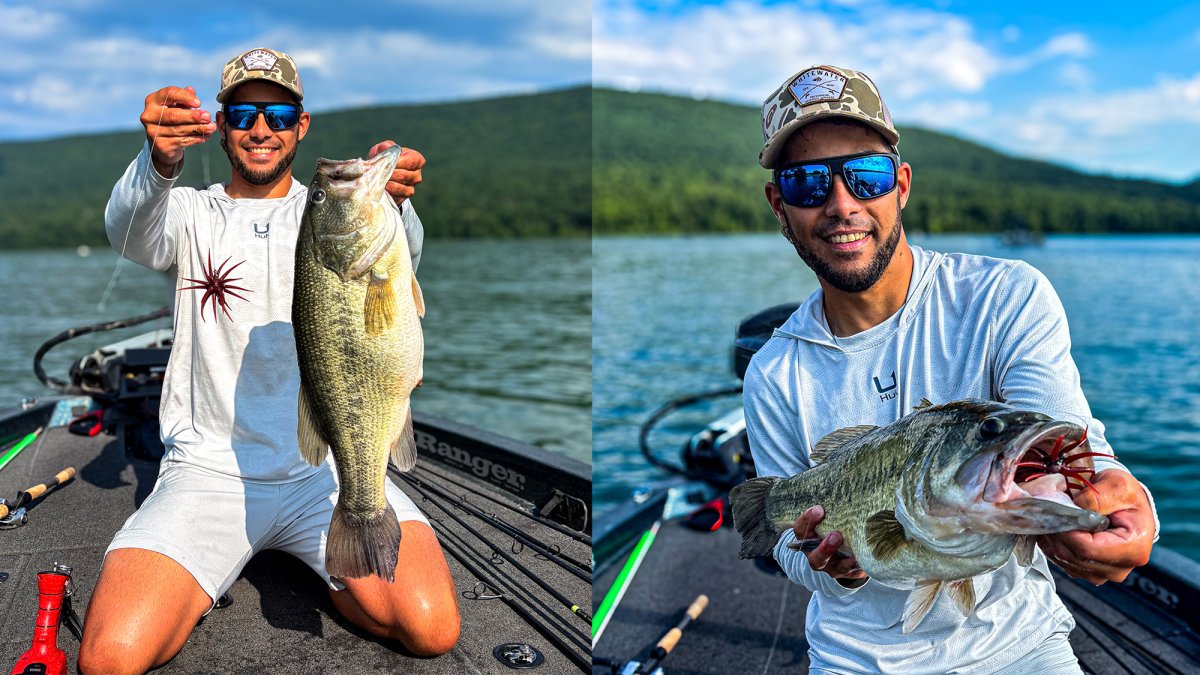

Each summer, the fishing industry has its big trade show in Florida. That means it’s a great time dig into the new baits, tackle, and fishing trends of the future. This year we sent our resident bass guru and manager of audience development, Derek Horner, to cover the ICAST show, where he got to talk with folks from all corners of the industry. Now, in general, innovation in the fishing industry seems to have slowed. But there’s this one bait that has absolutely taken the bass fishing world by storm. So in this episode of the Outdoor Life Podcast, we’ll talk about that hot new bait, plus other trends in the fishing industry and fishing media.
To listen to this week’s episode of the Outdoor Life Podcast, find it on Apple, Spotify, or wherever you get your podcasts.
Full Episode Transcript
Alex: I had to look up what ICAST actually stood for. I couldn’t remember. It’s the International Convention of Allied Sportfishing Trades. So there you go.
Derek: Now I know. And I just went.
Alex: Yeah. I don’t think anybody knows, but the deal is, this is just the fishing industry’s big trade show. You’ve got all the big brands, media, influencers — everyone from the fishing industry and sphere all in one place to talk about their new products and new ideas. And you just got back from there. So how was it?
Derek: Yeah. I kind of refer to it as the fishing-industry SHOT Show — just a lot less stressful, and maybe a nicer area than Vegas, depending on who you are. I mean, I enjoy going to ICAST every year. Mainly it helps me keep tabs on what’s happening in the industry, kind of where things are headed. I get to see a lot of my friends from college fishing and friends in the industry that maybe I don’t get to see other than a few trips here or there. And it gives me an opportunity to touch base with everybody else on what they think is happening in the industry. So the show itself is way better than going to SHOT Show, but it’s still very stressful. Lots of people, lots of booths, lots of sickness going around. Just a group of people that get together from all over the country — But I think, as a whole — and I’ll be honest — it’s probably my least exciting ICAST I’ve been to on an industry update.
Alex: Why? What do you mean by that?
Derek: It just didn’t feel very innovative.
Alex: Yeah.
Derek: There have been years in the past where I feel like every booth I go to, every lure company, every rod and reel company — there’s something that’s mind-bogglingly new. This year felt a lot like an extension of last year. So last year’s ICAST was the year of the dice baits. Every single brand was coming out with these little, tiny dice baits — the Strike King Tumbleweed, just to name one of them — but small-profile dice baits. Well, since last year’s ICAST, the big thing has been urchins. I know that it’s big because you Slacked me about it and said, “Hey, what is this? Should we write about it?” That tells me it has made it mainstream.
Alex: Yes. I am a very basic fisherman. Most of my fishing revolves around me taking my two daughters, who are age five, out fishing to catch bluegills with nightcrawlers. So that is what I’m most knowledgeable about. So when something triggers on my fishing radar, you know it’s trending. And that has taken over the bass scene this summer. So why is that?
Derek: I brought props, Alex. I have props.
Alex: Okay, great. So describe what you’re holding.
Derek: All right. So this here is the Berkley MaxScent ‘Moeba. So this is Berkley’s version. It looks a lot like a sea urchin — I guess that’s the best way to put it. That’s why it gets the name urchin bait. Basically, most of these are made of a TPE, which is a thermoplastic elastomer. Basically, it just means it’s highly durable. It’s pretty stretchy. It’s naturally buoyant. Now, this one is not all TPE, because MaxScent doesn’t allow for a TPE scent dispersion.
Alex: So what does it smell like right now?
Derek: Horrendous. It smells terrible. I’m gonna have to wash my hands when we’re done here. MaxScent historically has a rough smell. I mean, I’ve learned to love it, but it’s rough. So in essence, though, the idea is you can see how movable these little tentacles are. As this falls through the water with a very, very light weight system in it, it just creates this enticing pulse. And then when you get it near fish — typically people are fishing this, you don’t need forward-facing sonar, but with forward-facing sonar you cast it past a fish, let it sink down to their level, and then you pulse it. And these legs kind of pull back and then pulse. You pull back and pulse. And for whatever reason, they cannot stand it. They eat it aggressively. One of the questions that I asked a lot of the industry people I know is what they think it is, because my good buddy Shaye Baker and I still cannot agree on what we think it is.
Alex: Like, what does the bass think the bait is?
Derek: Correct.
Alex: What do you think the bass thinks it is?
Derek: I’m torn between [arguing] they have no idea and don’t care because they’re voracious predators, or it’s like a ball of fry. So this time of year, there’s a lot of little tiny baby fish, whether they’re baby bass or baby bluegills — everything just finished spawning a month and a half ago. There are a lot of balls of fry out there right now. They ball up. They get chased by everything that wants to eat them. Anything that’s a predator is looking for an easy meal. With all those little tiny tentacles, it does look similar to a ball of fry. So that was my initial thought — a ball of fry. However, Jay from BassBlaster said he does not think they have any idea what it is. They just eat it because they’re voracious predators, and they see something and it entices them. So do I have a good answer? No, I don’t.
Alex: So we’ve seen countless trends in lures and lure styles. And this trend — this actually catches fish, right? This isn’t just a marketing thing. These baits actually work.
Derek: Yeah. The fishing industry is very well known for catching anglers. Some lures that come to mind will be, like, 3D-looking or very art-focused crankbaits that look —
Alex: Perfect.
Derek: Perfectly like a shad. You don’t need it.
Alex: Right.
Derek: You can use a translucent color and catch them just the same. But these — so here’s the Hags Baits version. This is that TPE material, so you can see how stretchy that is.
Alex: Super stretchy.
Derek: Yep. For those familiar with Z-Man, that’s that ElaZtech. This catches fish and might not catch anglers. I know a lot of people are turning away from it because it’s the hip and popular thing. I’ll be the first to admit, two months ago I wrote my first story on these and said “You don’t need to jump on the bandwagon. I think a year or two from now, it’ll just be a thing of the past.” I might have jumped the gun on my own opinion there.
Alex: Now you’re on the bandwagon after fishing it.
Derek: I’m on the bandwagon.
Alex: Talk about fishing with it.
Derek: Okay. So I initially went out with some of the smaller ones. I have another one here that’s still in the package — this is, like, the Yamamoto Uni. It’s a little bit smaller of a profile. And I was catching plenty of fish on it. One thing I will say is they’re a pain to rig, and I did bring one of my homemade custom rigs to show people who are interested. But it catches a lot of fish. They fight over it, which is really cool to see on live. They can’t say no, for some reason. Which I think is also something that’s really frustrating for me — I don’t know why they can’t say no. And I wish I could, because I feel like if I crack that code, it might open up the door to other baits that aren’t this. Because, admittedly, these are very expensive. That ‘Moeba is a $15 soft plastic. These are, I think, $17. The Uni’s $15.
Alex: Holy smokes. Every time you lose one —
Derek: Every time you lose one, it’s gone.
Alex: And it could definitely be ripped off by one fish.
Derek: I’ve lost them when a fish comes up and jumps after you hook them and it throws it. And at that point, most of the time, I don’t care about the fish anymore. I’m on the trolling motor going toward it, trying to grab it. ’Cause I mean, for lack of a better term — post-tax, it’s a $20 bill. Just gone.
Alex: Yeah.
Derek: So it’s frustrating that I don’t know why they like it. But it flat-out catches fish. I’ve caught a lot of little guys on it. I’ve started to figure out — we’re in that summer pattern deeper. It takes a long time to sink. You have to have the right conditions. If it’s super windy, I usually try to stay away from it, because it does require… You can’t heavy-weight this thing and just sink it to the bottom. It just doesn’t have the action they’re looking for. But I did just catch, two Sundays ago now — the Sunday before, I caught a Pennsylvania eight-pounder on it, which is my biggest bass to date. That fish has probably been cast at 100 times this year by things that are not this. It came unglued on the bait when it saw it. It was one of the most aggressive strikes I’ve ever seen on live. It was probably 10, 15 feet away from the fish. I pulsed it, saw it kind of turn off the rock pile it was honed in on. And it hit it before my live sonar could even catch up to it.
Alex: Oh, wow.
Derek: I saw the fish start moving toward it, and then my rod is getting yanked out of my hand. I mean, it just smoked it. So yeah, they work really well. Now, my fear comes down to — hopefully too many people don’t throw them. I almost don’t want people to know about it. Not that this is going to hurt anyone — anyone who hears “urchin baits” and watches a podcast on it probably knows about them. But if you haven’t heard about it, go to your local tackle shop and you can buy some.
Alex: And your fear is that if they become as popular as, like, a Senko worm, and everyone has them, then maybe they’ll lose their effectiveness because bass are just seeing them all the time, everywhere.
Derek: Potentially. And I say potentially because everybody and their brother knows what a Senko is, and they still catch a ton of fish. So it’s really early to make a call on whether that could be the same as a Senko — something you can just constantly throw and get fish. There’s potential.
Alex: Have you seen a bait or a lure like this where, just for this window, it was the thing that was on fire, and then maybe it got too popular or too common, and then it kind of lost effectiveness? Have you seen that happen?
Derek: I have, yeah. So an example would be the MaxScent Flat Worm that Berkley made. I was in college at the time — I believe it came out in, like, 2016 or 2017.
Alex: That was your tournament-fishing prime, when it first came out. You were running around the country.
Derek: Most of these have those dates on them. Yeah. So during that time, very similar to now, if you found them in a store, you bought them out, because they were sold out round after round after round. It would hit a store, be gone. And then I contributed to that as well, because I couldn’t find them. Then I would go to my Bass Pro Shops, they would be taking them out of the cardboard box to restock, and I would just grab the box and be like, “Thank you.”
Alex: You’re panic-buying them.
Derek: Yes. Because they worked so well for largemouth — well, mainly smallmouth, but they also caught largemouth — and they were just the thing to have. Another example would be when the ChatterBait first came out. I think it was 2014, so very early on in my college career. I remember very specifically Brett Hite was throwing it up on Cayuga and smashing them on the north flat. And people were like, “What is he doing? This is, like, a weird jig thing with metal on it.” At the time, that was probably one of the more short-lived ones. And they still — don’t get me wrong, ChatterBaits still catch fish. Flat Worms still catch fish. But it’s not like… The first time you threw a ChatterBait at my local pond or local lake, you just smashed them. ’Cause they had never seen it, never felt that vibration in their lateral line. It was something totally different and new to them. Very similar to what the urchin is. The Whopper Plopper — I’m sure you’ve heard of a Whopper Plopper.
Alex: Oh, yeah.
Derek: Very similar. Now, I don’t get nearly as many bites on a Whopper Plopper as I did when they first came out. So yeah, there’s that cycle of baits.
Alex: The Whopper Plopper is something that I would still throw because it’s fun, but I think some serious bass dudes would kind of laugh at me for just throwing it.
Derek: Yeah. I mean, I used to be in that judgmental phase of my fishing career. Now? I’ve been beat by Jitterbugs. So I can’t judge people anymore. If they’re catching fish on it, fish it. It doesn’t mean I’m gonna fish it, because I can’t stand throwing Jitterbugs. I love them action-wise. I hate the way that they cast, ’cause they just, like, stop.
I can’t judge anyone for a Whopper Plopper. I just wish that it was as good as it was when I first started throwing it. But that cycle of baits that do really well and then kind of fall off has been in bass fishing since competitive bass fishing kind of began, way back in the ’60s, ’70s, and ’80s. We can talk about the Carolina rig being one that used to get thrown constantly and now is kind of like a sneaky little — like, “throw a Carolina rig, that’s old school” type of thing, where people don’t throw it. Spinnerbaits kind of got replaced by ChatterBaits. But spinnerbaits still catch the snot out of fish. It’s just, you don’t see many people throw them anymore. It just seems like now it’s less of a technique and more of, like, you see specific plastics or baits or profiles doing that cycle.
Alex: Yeah. You’re talking about, basically, a $20 soft-plastic bait that is used primarily in tandem with forward-facing sonar. So this is kind of the edge of technology and technique. And I wonder — has there been, within the industry, have we just kind of reached a place of comfortable acceptance with forward-facing sonar, and this is just where the fishing is gonna go? Or is there still that controversy of, like, “FFS is gonna put too much pressure on our fisheries, and we don’t know if this is good for the resource and for fishing overall?” Did you get any sense of that from the show, or from the folks you were hanging out with?
Derek: Yeah. I think within the actual industry itself — ICAST is not a consumer show, it’s industry only — I think the industry’s kind of widely accepted it. And I say widely generally, because the NPFL, which is a pro fishing league, doesn’t allow it. Major League Fishing has different periods where you can use it for a certain amount of time and then you can’t use it. And then Bassmaster is doing kind of an almost every-other type, where one tournament you can use it, one tournament you can’t.
Alex: And this is the first year of that, right?
Derek: For Bassmaster, yes, it is.
Alex: How’s that going?
Derek: As a fan, I actually really enjoy it.
Alex: Interesting.
Derek: I love the FFS tournaments. I love learning from the guys who are really good at it. I like the idea of requiring both sets of skills at that pro level. Not only can you read a screen, read a graph — maybe the young kids’ thing — but now you have to have that old-school ability, too: know how to read the terrain, know how to read a map, know how to find where the fish are staging without the technology to tell you exactly where they are. So as a fan, I’ve absolutely loved what Bassmaster’s done this year. Surprisingly, though — kind of in line with that — Bassmaster just announced that Garmin’s new ICAST 2026 launch of the LVS42 and LVS44, which are their new transducers, the LiveScope 2 system, will not be permitted for use in 2026.
Alex: Oh.
Derek: So these brand-new transducers are a no-go this year, and there’s gonna be meetings to decide whether or not you can use them next year. This comes down to technological advancements that Garmin’s coming out with, with the new transducers.
Alex: What do they do compared to the previous version?
Derek: What it’s done is — you have to think of Live as kind of like a cone going down through the water, right? So there’s a certain frequency of cone that you’re spitting out, and it brings back that sonar image. What they’ve been able to do prior to this point is very impressive. You get bottom contours, you can see fish swimming around, you can see your bait. Where you run into issues is at distance. So I have a Lowrance ActiveTarget 2 on my boat. I have it set to about 110 feet. Anything past that, like the 90-foot range —
Alex: It’s pretty blurry.
Derek: I don’t actually know what the fish is. It tells me there’s a fish in the water column, but until I get closer, it could be a huge bass or it could be a crappie. I don’t know. It’s just a big, giant mark on my screen that’s vertical and blurry.
Alex: So 100 feet, or 90 feet, that’s not that far, really — you know, 30 yards around the boat.
Derek: Yeah, I would say most of the time — let’s take, like, a half-ounce jig or something. If I were to rear back and fire it with a good baitcasting setup, I could probably get it 140 feet. Maybe 150 if the wind’s at my back. So call it half of your bomb cast with a fairly heavy lure. That’s what you can see most of the time.
Alex: You can see.
Derek: Most of the time with spinning gear, cut that yardage — or the foot distance — back. But yeah, it’s about as far as you can bomb, maybe a little shorter than that. It’s about as good as you can see. But what this new technology — basically what Garmin did with these new transducers — is, one, they removed the black box, which is just a rigging thing in the boat, another thing you have to power. They’ve removed that so you can go straight into your graph. That’s gonna be huge for them. It reduces the cost of the unit.
Alex: Oh.
Derek: So all of the people who say it’s super cost-prohibitive to get in — that’s been addressed. And it provides a clearer picture. So the 42HD is for basically, call it, 60 feet, 70 feet and in — super crystal-clear picture. It’s phenomenal in perspective mode. It’s phenomenal in forward mode. It’s just the clearest picture I’ve seen out of a live unit. And then that 44 is for your more long-range — kind of like where I’m at, the tournament bass fisherman who doesn’t want to be right on top of the fish because you might spook ’em. You try to stage back off of them, stay off the school. And it’ll show you a lot clearer. Instead of having those big long marks at 90 and 100 feet, it’ll shrink those down, more like it’s at 50 or 60 feet. So basically, to do that, to be super technological, they were able to shrink that cone. So at distance, it’s still a smaller cone. Coming out of the transducer, it’s shrunk down compared to what they had prior and what their competition has.
Alex: Yeah. So that is kind of for the higher-end, more experienced user, right? ’Cause it’s like — if you’re imagining a pattern coming out of a shotgun, it’s like a tight choke at the very beginning, right? Super tight cone.
Derek: Yep.
Alex: And then at distance it expands out, so you can see farther with it.
Derek: Very much so.
Alex: And, in theory, as more anglers get that, it just adds to the whole FFS tactics. You can be farther away, you’re less likely to spook the fish. The folks who are good at it have even more of an advantage now. So it just kind of furthers the march of the technology. And then I think the other thing is just how prevalent it is. Every once in a while, I’ll see someone with an FFS setup that I’m pretty sure is more valuable than the boat and motor that it’s attached to. This is not just for professional fishermen.
Derek: No. No. In the last, call it, two or three years — if you don’t have it on your local tournaments, like even your weekday nighters… I could go to a tournament tonight that’s a six-to-nine on my local lake and everyone has it. And there are people out there with, like, $15,000 graphs set up on a 2001 Bass Tracker.
The boat does not matter at this point. It’s however much money you can spend to have… I mean, there’s graph companies out there basically creating almost like a monitor, like you would for a video-gaming setup. So an NBT unit, for example — you could buy a 16-inch graph that’s just a monitor that you’re hooking into. To be really honest with you, Alex, I want one really bad, because they’re awesome. ’Cause then, basically, the more you can see on the screen, the more effective you’re gonna be. Some of these setups — especially now that you can link it to your back graphs, too. So I could have my trolling motor in and idling around and be using live — especially with, like, Garmin just came out with a spy pole, and there’s all these different accessories — where I can be sitting in my boat seat, staring at my console graph, using live to, like, “Oh, over there’s some stuff.” It’s crazy. The amount of technology, and frankly wiring, that’s going into these boats now… I’m running into an issue with my old 1992 Ranger, where I have trouble with how many wires there are, because it’s a foam hull. So if you want to see me have a terrible time, just give me new technology, and I will spend eight hours drilling holes in the hull trying to find where I can get through the foam. I hope whoever tries to buy my boat at some point in the future does not hear that.
Alex: So where this is going is, it doesn’t seem like the industry is throwing up… The industry isn’t self-regulating here. No one in the industry is like, “Whoa, guys, this is going too far.” But maybe some of the associations, like the bass tournaments, are a little bit. Maybe they’re trying to be a little more restrictive.
Derek: In my opinion, those are the ones that have to do it. It’s gonna be the tournament organizations. The industry itself is not gonna stop, because that’s where the money is. The money is crazy — we just talked about it. That’s where the money is. They don’t want it to stop. So someone has to be — if I put on my conservation hat for a second — someone has to be the adult in the room that says, “Is this good, or is it bad?” Right now, the industry’s just like, “money, money, money.” They don’t really see past that. So I’ve always said it’s gotta be the tournament organizations, or it has to be the state fish and wildlife agencies that say no. The problem is, as you know, there’s a lot of red tape that those state agencies have to work through to get caught up. I mean, Scott just worked on a piece about a range-finding crossbow scope that’s thermal — like, that’s gonna take them years.
Alex: Night vision.
Derek: Night vision, sorry. Yeah. Better. But a state agency — it’s gonna take them a year or two to decide if that’s cool or not. And in that time, the damage is already done, if it’s not cool. So the tournament organizations seem to be a lot more on the pulse of this. And outside of everyone who just works in the fishing industry, it is still very controversial. It’s very much like crossbows and compound bows. People who don’t like crossbows are very outspoken against it, just like they’re outspoken against FFS. People who like it tell those people to get with the times, get with the program — “If you’re not scoping, you’re hoping.” There’s even merch associated with being a scope hater.
Alex: Yeah, yeah, yeah.
Derek: And, you know, I fall in the middle, where I don’t particularly find it to be the best thing for future generations of fishing, if I’m really transparent about it. But right now, it’s legal, and I like competing. And if I don’t have it, I’m not competing at that level. And I’m not even trying to be a pro. I’m just trying to not get my money taken by a construction guy who wants to fish a Saturday-night tournament.
Alex: Or, like, a 17-year-old high-school kid.
Derek: I don’t wanna talk about it, Alex. It’s made me go a little crazy. But yeah, I don’t like being beat. I’m very competitive. So while it’s available to me, I’ll use it. I’m just maybe someone who’s willing to say, “Tell me I can’t use it, and I’ll be one of the first to take it off.”
Alex: Yeah. If you were to just go out and fish for fun, are you using it or not?
Derek: I’m using it.
Alex: Just because you can catch so many more fish, and that is fun. Catching fish is fun.
Derek: You know what the fun part about fishing is? It’s not fishing, it’s catching. I can catch way more with that. Especially when I go fun fishing, most of the time it’s probably crappie fishing, if I’m honest. If I wanna go catch 300 fish in four hours, I’m gonna go out at one of my local lakes, go offshore, find these schools of, like, 500 crappie that — if I’m in 20 feet — occupy 17 feet of the water column. And I’m just gonna sit there and pick them off one by one, and fill my livewells until I’m good, and then call it a day.
Alex: And, folks, listen to this one. He says he’s good — he means he’s at his legal limit.
Derek: That’s correct.
Alex: And then he stops fishing.
Derek: Well, depending on the body of water — one of them has no limits. But that’s where the “I’m good” comes in. But yes, for everyone else with crappie limits, make sure they’re proper size, length, all the requirements.
Alex: Yeah, that’s where this gets tricky. It’s someone like you — maybe you do that crappie trip a couple times a year, or maybe it’s not a lot. But if you were a fishing guide and you were taking clients out to catch crappies every day, you’re hammering them, you know? You’re putting —
Derek: A hurting on them, yeah.
Alex: You’re putting a hurting on them. And that’s where I feel like people start to really have some good points about restrictions around this technology. What else from the fishing industry kind of caught your eye there? Were there any trends or perspectives, just looking forward, that you’re like, “Ooh, that’s gonna be something to keep an eye on for the years to come”?
Derek: I wish I could say yeah. So, just to finish out the urchin talk real quick: Strike King came out with one, Rapala came out with one. So now basically every major lure manufacturer has one, and they’re all kind of a little different. Rapala added, like, a glass tube or something to the middle of theirs for weighting purposes. So looking ahead, I’m very interested to see what’s next for the urchin craze. I think there’s a lot of rigging options to come along. Just real quick, because I said I’d mention it — my favorite right now is, like, a straight-shank hook, and then I super-glue and then plastic-wrap a nail weight to it. So you stick that on your urchin.
Alex: And that is, obviously, to get the bait down. But does that kind of help keep the urchin on the hook, too, or is it just—
Derek: It does, yeah. So this kind of acts a little bit as a bait keeper as well.
Alex: Gotcha.
Derek: So it’s more likely to slide up the line. So we can put a wrap on the urchin side for now.
Alex: But people are gonna innovate off of this popularity, and we’re gonna see different rigging options and different designs, and maybe similar types of baits. I brought up a Senko worm before because it is sort of a similar idea, right? It is very subtle movement — it kind of sinks, but sort of suspends in front of the fish’s face—
Derek: Slow fall rate.
Alex: Yeah, slow fall rate. And it just seems like there can be other designs that also do that, right? So who knows what that might be next year.
Derek: If you figure it out, you might be a millionaire.
Alex: Leech on a slip bobber — that’s what I would do, I guess. A live leech on a slip bobber spins right in their face. They’re not saying no to that either.
Derek: Wow. I don’t even know where to get leeches, but — I like where your head’s at.
Alex: Gerry’s just disgusted. He doesn’t know what to say.
Derek: I don’t do live bait. I don’t even know where to start with live bait.
Alex: I don’t know. You don’t have to respond to that. It’s fine.
Derek: Okay, cool. Leeches. Yeah, so I think the logical thing is exactly what you said: kind of new profiles, and maybe there’s gonna be rigging options. I’d be willing to guarantee you, next ICAST there is an urchin rod —
Alex: Or several —
Derek: Oh yeah. That are technique-specific. Oh yeah. That’s coming.
Alex: That’s a little gimmicky to me.
Derek: Yeah. I mean, I’ve played around a lot with the rods. I know I said we were gonna wrap up the urchin thing, but it is kind of the big thing this year.
Alex: It’s the big thing this year.
Derek: I found a medium-heavy, moderate-fast, like, crankbait rod — like a 7‑2 crankbait rod — to be the ticket. I’ve been throwing a Fenwick HMG, and I really like that it stays loaded. Because, like I said, they hit it really hard. So you need something that can take that and flex with it, rather than a fast-action jig rod or something that’s not gonna have a whole lot of bend.
Alex: You don’t need that really sensitive feel, because they’re inhaling it.
Derek: Yeah. Basically what you feel through the line is it hitting the back of their throat. It’s a crazy thing. They come up to it and, like —
Alex: Okay.
Derek: And you feel the dunk of them sucking it in.
Alex: I just thought of one. How about mini urchins for panfish? Let’s go, Derek. That’s gotta work. Come on.
Derek: I know. That’s gotta work. Little mini ones. Well, I know people are starting to catch walleye on the smaller ‘Moeba, the 3.5-inch one. Also, it’s really fun to talk about these urchin baits, because prior to Berkley coming out with theirs, which is measured in inches, everyone was using millimeters. So this is a 17- or a 19-millimeter. It’s the only thing to make Americans photo with the metric system.
Alex: That’s how popular this bait has become — that we’re measuring things in millimeters.
Derek: Yes. But yeah, so we’ll wrap up the urchin side now. Other things I really noticed with this ICAST: lots of re-releases, or updates to products. So here I have the Shimano Curado DC. This is their brand-new 150. They had a 150; this is the new version of it. They have an updated braking system on the side here. They’ve basically just redesigned the DC — they put a new digital control system in it that’s higher-tech, newer tech. I think the original 150 came out in, like, 2018, so it’s been eight years. So new tech, new design. Daiwa did the same thing with their BG line, which is a spinning-reel line. I noticed a lot of what we’re looking at now on the spinning-reel side is necked-down spools, which reduces oscillation, gives you further casting distance. There’s a lot of small nuances that I picked up on from these re-releases — everyone’s kind of doing the same thing. They have the tech, it’s already been built, but how do you add one thing that gets it just that much further, that adds five, 10 feet to your cast? It’s a product-line update. And I saw a lot of those this year. I didn’t really see anything crazy new. Another example — I have a rod here. Now, this is not one of the brand-new ones, unfortunately; I want one. But this would be the Shimano and Jackall Poison Adrena. They came out with a Poison Glorious this year. It’s even lighter weight than this. It maintains that carbon wrap. Phenomenally lightweight rod. They’re super high-end.
Alex: It looks beautiful.
Derek: Oh, it’s gorgeous. I mean, it is a gorgeous rod. But the Poison Glorious takes the best things about this. They took some new technology, made it even more lightweight — whether that was changing the guides to, like, Fuji Torzite, or changing the wrapping system so it doesn’t require as many wraps. That’s how down in the weeds we’re getting on these advances. It’s a good time to be an angler, because all of the technology is there for you, and it has been for years and years. So now it’s being refined.
Alex: It’s kind of working its way down.
Derek: Yeah. It’s being refined, and then those refinements make their way down the product lines. I’ll give Shimano a nod for this on the spinning-reel side. Every reel that they create is based off of the Stella, which is, like, the reel. But now, all the way down to their call-it $120 spinning reel has some of the same technology that the Stella has. Whether it’s the rotor, the reel-handle design, that spool design — it has some piece of Stella in it. So for 120 bucks, you’re getting some of the same features that are in that mortgage-payment spinning reel.
Alex: Yeah. You’re kind of leading me into prices here, but that’s definitely something that I think all anglers have noticed — just the inflation of fishing gear prices. And I’m not gonna make you do an economic deep dive here, but is the industry kind of just like, “Yeah, everything’s more expensive”? A lot of this stuff is imported, and all imported products are dealing with potential tariffs, and that’s just the name of the game? Or is there any sort of response, like, “Okay, we gotta figure out how to make more affordable products”?
Derek: I get a lot of the “they’re just gonna pay for it anyways” vibe, if I’m honest with you. And I say that with an asterisk. There were some brands that I ran into that, frankly, I had not heard of — and I will be the first to admit that happens to me. I’ll run into a spinning-reel brand and be like, “I’ve never heard of this.” An example — I’ll give them a shout-out — Bates. B-A-T-E-S. I never heard of it. Apparently they’ve been around for several years, according to their marketing guy that I talked to, but I’d never heard of them. But I took my time out of my day to swing by and see what they were about. They’re kind of transitioning to try to become more of that American-made option — which is really difficult in the fishing industry. Outside of lures and stuff, which, you know, Berkley does most of their stuff in-house — outside of lures, when you’re talking about rods and reels, it is very difficult to have an American-made product. Shout-out to, like, St. Croix, who makes their own rod blanks in America. We’ve kind of lost that in the fishing industry — that “buy American.” JDM just seems to produce the really, really good stuff. Not that St. Croix rods aren’t good — I like my St. Croix stuff too — but I don’t think there’s as much of a push for that “buy American.” So, with that, Bates is handcrafting their frames and bodies in America, and then they’re shipping in some of those extra parts — your gearing, your ball bearings — things that frankly are gonna cost an arm and a leg to make here, that they can get, and kind of even out their price for being able to machine and manufacture their own aluminum frames and bodies here in the US. So I think that, on the smaller scale, some of those smaller brands and companies might be taking that approach, where they’re trying to use that as a selling point, right? The problem is, it’s not cheaper. It just feels better.
Alex: Right. Yeah. That’s the thing about American-made products, especially the nice outdoor gear that’s made in America — whether it’s fishing rods or knives or apparel, backpacks and stuff like that. It’s usually more expensive.
Derek: More expensive.
Alex: Yeah, often significantly more expensive. But the hope is that people have that point of pride, to buy American, and that’s why they go for it — because even with the tariffs and the inflation of costs for fishing gear, the American-made stuff is still more expensive. I wonder, just for the media side of it — fishing media. Not to toot our own horn too much, but that’s a big part of the industry, too.
Derek: It is.
Alex: Fishing has obviously grown a lot through COVID and post-COVID. It just seems like there’s so many people out there, and almost every lake you go to now — especially around here in the Midwest, Minnesota, Wisconsin — boat ramps are packed. People are out fishing. And the fishing media seems like it has also grown a lot, with so many different content creators and these niche YouTube channels. I wonder, having watched a lot of this stuff and seen it kind of grow — what is your take on where the fishing media is at right now? What do you think is kind of the next evolution of it? And I’ll give you a little context for this. For years, it just seemed like the individual YouTube influencer was, like, “That’s the next thing.” But that’s been that way for probably eight years now, maybe more. So are we just still in that, or is there a next thing coming?
Derek: I think we’re still moderately in that. And I say moderately because we lost the big guys — and if they listen to this, they might tell me otherwise, but it’s the facts. Like, the Googan Squad; you guys know who I’m talking about. The Jon B.’s, the LunkersTV. They all hit it big. They came out with their own products, promoted those for several years, and then just kind of faded away. Some of them are still doing some videos here and there, but it is not what it once was. Back in, call it, 2019, they were it. Everyone wanted to work with them. Everyone was watching them.
Alex: It seemed like every video was getting millions of views, and now that isn’t the case anymore.
Derek: Yeah, it dissolved. So since they kind of faded into moderate obscurity — I’m not gonna say they’re obscure now, but moderate — you’ve seen a lot more, like you noted, niche influencers coming out. So, like, this guy is the non-FFS bass influencer. Randy Blaukat, Intuitive Angling.
Alex: Yeah.
Derek: That’s his thing.
Alex: That’s his thing. That’s all he does.
Derek: He’s got that crowd. Yeah. He used to be a phenomenal professional angler. Most people don’t know that about Randy, but the early 2000s — like, Skeet Reese’s days, Takahiro Omori, all those — Randy Blaukat was up there with those names. Nobody knows that. Regardless — there’s niche panfish guys. There’s niche kayak guys that are always testing products for kayaks. I’ve seen a lot of that influencer gear-review stuff starting to grow a little bit more, too, where they’re doing that minute-and-a-half-long, like, “I went to ICAST and I found this cool kayak thing. Here it is.” And they’re not getting paid for it. They’re just doing it. As far as other fishing media goes, I’ve noticed the trend of — yes, obviously video’s big, but people are kind of coming back to writing. I think there’s this resurgence in reading, which —
Alex: What?
Derek: Good for us, right?
Alex: I did not think that this is where this was going, but go on.
Derek: I think people are reading because you can’t really fake writing. You could AI it, but it’s pretty easy to catch on when AI writes something. Whereas you can AI videos now — I don’t think this is a surprise to anybody — you can AI videos that you can’t tell are AI. I’ve gotten caught before, where I’ll be like, “Oh my gosh, did you see this?” And then I watch it another 10 times, and I’m like, “Oh, that’s not real.”
Alex: Yeah. Especially — I see this more and more at the YouTube roundup videos of, like, “These are the five best baitcasters of 2026.” And it’s all just —
Derek: All AI-created.
Alex: And, for someone who is not in outdoor media looking at this stuff all the time, you could totally miss the fact that this is AI-generated. You might think that someone took the time to review these lures and make this video. But no, it is just AI slop.
Derek: It’s just slop. And I pray that it’s not just us that can see that it’s slop. I’m starting to believe more and more that people are becoming more aware of it. You know, they’re reeling on the wrong side, but the handle’s on this side. There’s little tiny things that I can pick up, especially on the fishing and hunting stuff, that — that’s slop. But I think there were a lot of people in the industry that were like, “I’ve been doing a lot more reading newsletters and reading articles, because I can tell from the get-go if it’s been AI-generated content, or if it’s a real person sitting there giving me their real thoughts and opinions, or their real gear review.”
It’s kind of, for now at least, the way to bridge the gap between, like, “is this crap,” or “is this actually a real person talking to me?” And I never thought that AI would choose to go the video route first. I thought that, frankly, as an outdoor writer, we were in trouble. But it seems like they focused more on that video side, because it’s where everyone was, with TikTok and reels and shorts and all these things. But there was definitely a trend in a lot of my meetings about talking through that — where the industry and anglers want that real review. And that’s where, for OL, for us, it’s really big, because it’s what we pride ourselves on. I’ll be the first person to tell any brand, “I’d love to try that out. I’ll be honest, though — if it stinks, I gotta tell people. And if that’s not up your alley, fine.” But it’s what people come to us for. If I’m doing an urchin roundup and one of them claims to be TPE, but I do this and it snaps —
Alex: Then we know.
Derek: I’m gonna write it. I’ll be like, “It’s not TPE. Or if it is, it’s some take on TPE that is clearly garbage, and it’s bad, and don’t buy it.” So I think the greater trend that I’m seeing is just — whether it’s video or writing — it’s honesty. People want honesty. I feel like we’ve seen this massive technological boom in videos and virality, and then you find out that your favorite influencers are fake. You meet them in person and they’re not who they are online. People want —
Alex: Yeah. Or even not so extreme as that, but they have a brand deal and they’re getting paid to promote a brand. And that’s not necessarily bad, but of course they’re gonna be positive about the new product that that brand produces. And that’s just not a reliable way to get information about how a product’s gonna perform on the water. So yeah, I think — definitely, the outsider looking in — it seems like the fishing media kind of got saturated with that. So I hope that there’s this kind of next version. And there are great folks doing this kind of stuff, and there are great publications out there still doing it. So I hope that they rise above the AI-generated content and survive.
Derek: Yeah, I hope so, too. I mean, just to touch on the guys who have the brand deal, or the gals who have the brand deals — they gotta pay the bills, too. And I get that.
Alex: I mean, it’s their job, in some way, to create content that’s positive for a brand. It’s just that they’re so good at it that the viewers don’t necessarily know that that is why they’re doing what they’re doing, you know?
Derek: Right. And I think we also have to remember that most people are not interwoven into the outdoor space as tightly — to where, every day, I’m viewing different people posting different things about the outdoors. For them, it might be one out of every 15 things they see as they scroll through their feed.
Alex: Where for us, it’s everything. Yeah.
Derek: So I think it’s a lot easier to be tricked by that. And then you feel that sense of betrayal — I’m sure this will hit home for people — where all of a sudden it’s a different brand that’s the best. And then you do a little bit of research and it’s like, “Oh, they signed a new brand deal with a different brand. Well, I thought you said that this was the best.” And whether that’s fishing or hunting, we see that constantly. And that’s where having people like us, and other publications similar to us, that take that step back and say, “We don’t have brand deals. We work with anyone and everyone, and here’s our thoughts on those products” — it puts us in a kind of unique spot. And I hope that our listeners to this, and our readers and video viewers and all of that — our people in the Outdoor Life sphere — can rest easy knowing that the information they’re getting is actually true, and I’m not paid to say it.
Alex: Yeah. So, just to wrap this up — you’re not being paid by Big Urchin money to promote urchins.
Derek: I would kill for some Big Urchin money right now. I have a feeling that is a multi-million-dollar industry right now. No, I have not been paid.
Alex: You kind of push urchins. You were skeptical of it, and then you came to it only after fishing it — which is what it should be.
Derek: Yeah. And, you know, you catch your personal-best largemouth… And to say that as someone who fishes occasionally is like, “Wow, nice, you caught your personal best.” But, Alex, you know I’m a freak. I love to bass fish.
Alex: And you fish that spot all the time.
Derek: All the time. Yeah. And I’ve traveled the country. I’ve fished Texas, Florida, Louisiana. I’ve fished the big-fish spots, and my biggest largemouth to date ever came out of Pennsylvania on a stupid urchin.
Alex: Well, Derek, thank you for going to ICAST and sharing that with us.
Derek: Of course.
Alex: Good luck. Who knows? Maybe tomorrow you’ll catch a nine-pounder on an urchin.
Derek: I have a tournament Friday night. That’ll probably be my next urchin escapade.
Alex: All right, man. Good luck.
Derek: All right. Thanks, Alex.
Read the full article here
