



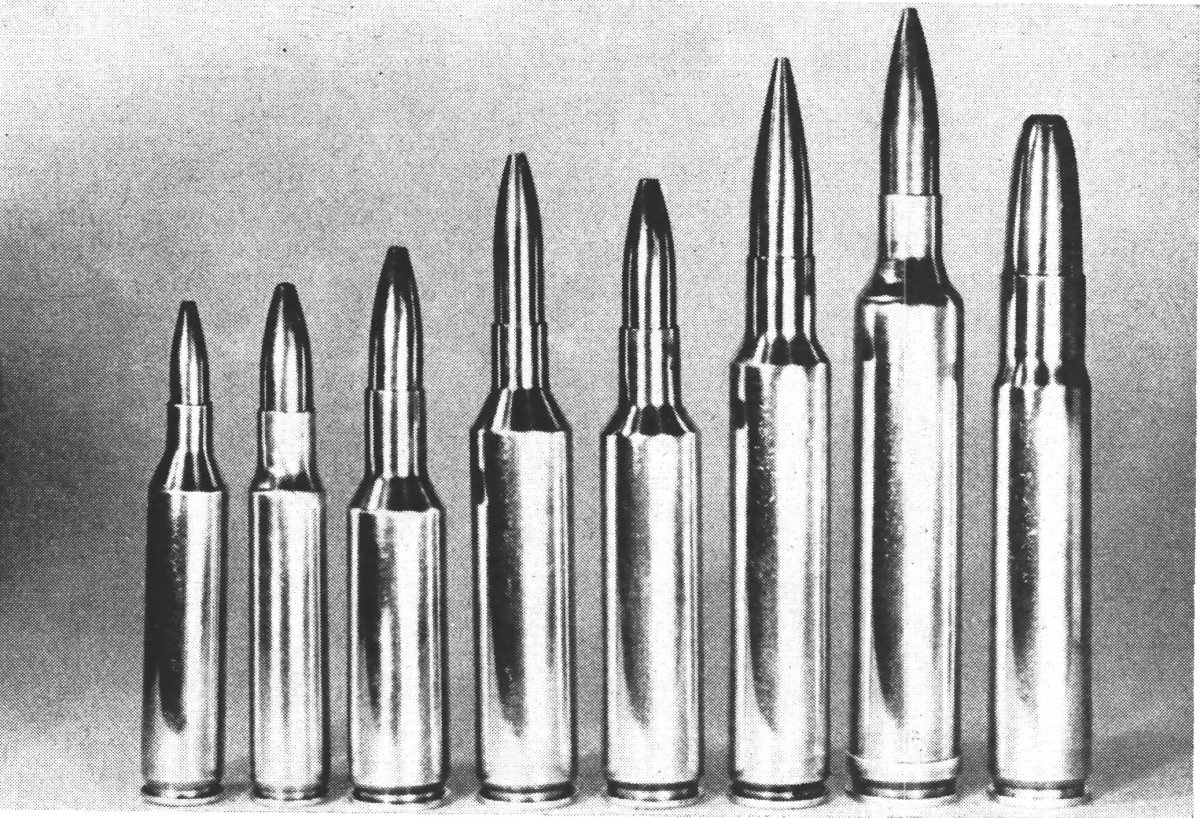

THERE IS SOME peculiar quirk in the makeup of many shooters that causes them great dissatisfaction with their guns and ammunition. Ever since some ballistic nut back in the middle ages dumped some powder and rocks down a length of pipe and got it to shoot, man has been trying to get his guns to shoot straighter, faster, flatter, and farther.
The manufacturers of guns and ammunition come out with something “new and better” often enough to keep us satisfied. But for some folks, “new” is never new enough and “better” is never good enough. These are the wildcatters, those nearfanatical gun buffs who endlessly seek to improve the performance of firearms by designing and redesigning cartridges.
By simple definition, a “wildcat” cartridge is one that is not manufactured by a major ammunition company. Once a wildcat is loaded by a large company it becomes legitimate and is no longer a wildcat.
This was the case with Remington’s .22/250 and .25/06 rounds. The .22/250 began life in the early 1930’s and was made by necking a .250/3000 Savage case down to .22. This is why it is called .22/250. If you compare a .22/250 case with a .250 Savage case you’ll find that everything is the same except the neck diameter.
Some confusion clouds the actual development of the .22/250, but the credit usually goes to either Jerry Gebby or G. L. Wotkyns. During its early development the .22/250 was known as the Wotkyns Swift or Wotkyns Original Swift. I’ve seen varmint rifles stamped .22 WOS. The Wotkyns version of the Swift very nearly became the .220 Swift introduced by Winchester in the mid-1930s.
Jerry Gebby, the Ohio gunsmith who was also associated with early work with the .22/250, titled his version of the round the .22 Varminter, and he went out and obtained a copyright for the name.
The .22/250 turned out to be among that one-tenth of one percent of wildcats that really have something to offer. It was fast, accurate, and easy to manage. I owned three or four of them during the 1950’s and never had anything but good results.
When Remington started looking about for a hot new .22 caliber a few years back they realized that they would have a hard time improving the wildcat .22/250, so they made a smart move and made it legit.
The .25/06, another wildcat, can be traced back even farther than the .22/250. This round was first made by simply necking .30/06 cases down to .25 caliber.
25 Creed vs 25 Weatherby RPM (vs the World)
I expect that experimenting with the .30/06 began shortly after the cartridge was introduced in 1906. The late Captain Neidner, a famous rifleman of his day, is most often credited with the development of the .25/06. In fact, it is still often referred to as the .25 Neidner.
Other wildcats that have hit it big in recent years are the .243 Rockchucker, which was designed by Fred Huntington, president of R.C.B.S. reloading tool company; and the .240 Page Pooper, designed by Warren Page, president of the national Shooting Sports Foundation. Huntington made his .243 Rockchucker by necking .257 Roberts brass down to a 6 millimeter. Page made his “Pooper” cases by necking .308 cases (7.62 NATO) down to 6 millimeter. The Page Pooper became the .243 Winchester, and Huntington’s Rockchucker became, after minor changes, the .244 Remington.
Basically the idea of a wildcat cartridge is to improve the performance of a bullet of a given weight and diameter beyond that which is possible with a standard factory case. Let’s say, for example, that we want to get more velocity with a 180grain .30-caliber spire-point bullet than is possible with the .300 Holland and Holland Magnum standard case. The standard factory loading lists 2,920 f.p.s. (feet per second) with the 180-grain bullet, but we have a notion that if the same bullet is going 200 f.p.s. faster it will kill the sabre-toothed sloth deader and quicker.
Obviously, in order to do this we need to burn more powder, but in order to burn more powder we need a bigger case to hold the extra charge. The next step, therefore, would be to grind a chambering reamer, which, in turn, will be used to increase the size of the existing .300 H & H chamber. This is usually done by increasing the case diameter at the shoulder, making the shoulder angle more radical, and even by moving the shoulder up the neck somewhat. When a standard .300 H & H round is fired in this reformed chamber it expands and takes on the new, enlarged form. Now the case will hold more powder, we can get the additional velocity, and we can kill all the sabre-toothed sloths we want. Actually, wildcatting is far from being all that simple. For one thing, the law of diminishing returns plays a big hand, and so does the old proverb that says you can’t get something for nothing.
When we start enlarging a case so that it holds more powder, we also wind up with more pressure. In fact, in most instances the pressure goes up a lot more than does the velocity. As a result, a little extra velocity is paid for with a lot more pressure. The limiting factor is the strength of the rifle’s action and the cartridge’s brass. When chamber pressure exceeds the strength of the case and the action, the whole works simply lets go.
Even when chamber pressures are held within limits, extra heat and erosion that result from burning all that powder mean shortened barrel life. An extreme example would be something like a .378 Weatherby case necked down to .22 caliber (which has actually been tried). Barrel life, I expect, would be something like 100 rounds or less.
The most commonly wildcatted case is the venerable .30/06. There are two reasons. First, the tremendous amount of empty .30/06 cases available. Second, the fact that the ’06 case head size is right for surplus Springfield, Pattern 1917 Enfield, and Mauser actions. Thus, when a wildcatter starts looking around for raw material, there are plenty of cheap actions and lots of cases that go together quite well.
Over the years the ’06 case has been cut off, blown out, necked down, squeezed in, and altered in so many other ways that I can’t begin to list them. But if I had to, I’ll bet I could think of at least 50 wildcat forms of the .30/06. The best known is the now legit .25/06. Other fairly well-known versions are the .35 Whelen, which is the ’06 case necked out to hold a .35 caliber bullet, and the 6mm/06, which uses a .243 bullet and is usually called the Super Varminter.
Virtually every standard case that is commonly available has been used as the basis for a score or more of wildcats. Some are pretty good, some are bad, and some are even worse.
Not all wildcats were designed solely to increase velocity. The 6×47, for example—currently a very popular wildcat—is a good case in point. According to bench-rest shooting regulations, a rifle that is designated a “sporting rifle” and is used in competitions in the sporting-rifle classification must, among other restrictions, be of .243 (6 millimeter) or larger caliber.
Of course, the bigger the cartridge, the more the recoil, and recoil is no friend to the super-accuracy boys. Even the .243 Winchester and 6mm Remington rounds, which meet the minimum bore-size requirements, are too pushy for really good bench technique. Their case capacities are also a bit too much for optimum bench-rest loading.
Since the bench-rest shooter fires only at 100 and 200 yards, he doesn’t need lots of zap; he needs only a case that can be loaded to an ideal ballistic configuration. Thus, the 6 x 47 was thought up. All in all it is simply the .222 Remington Magnum case with the neck opened up to 6 millimeters. With a full charge of powder behind a 75-grain bullet, the velocity is less than 2,700 f.p.s.—but is it accurate!
I have a custom bench-rest 6×47 rifle that has averaged well under a half-inch for six consecutive five-shot groups at 100 yards in actual competition. One group measured less than two tenths of an inch.
At present the 6 x 47 holds a sort of semi-official status in that Remington does furnish a finished rifle in this chambering—its ultra-accurate 40-XBR. Another cartridge that enjoys this semi-official position is the .30/338, which is also chambered by Remington in its 40-X rifle on a special-order basis. But, as with the 6×47, you can buy the rifle, but you can’t buy the .30/338 ammo.
About a year before Remington officially announced its .22/250, Browning offered a bolt-action rifle in .22/250. This was a bold move, especially for usually conservative Browning, but it was a good idea and, as it turned out, a smart one. More recently Harrington & Richardson marketed a .17 caliber rifle called the Ultra Wildcat. This little rifle, based on the Sako action, was chambered for a version of the .223 Remington necked to .17 caliber and called, naturally enough, the .17/223.
For the past three years I’ve been busting prairie dogs with a .17-caliber cartridge based on the .222 Magnum. This is hotter than either the .17/223 or .17 Remington. The rifle will group inside an inch at 100 yards and is pure hell out to about 300 yards or so. I’ve chronographed some of my loads at more than 4,000 f.p.s.
A few months ago I got two wildcat rifles built on pre-’64 Model 70 Winchester actions. I wasn’t interested in the cartridges, but I did want the actions for custom sporters to be built at some future date. However, since the barrels were both in good shape, I figured it would be a good idea to get some use out of them.
One is chambered for the little-known 6mm Donaldson International, a target round; the other is for the hot 6mm Remington Improved. I had fun with both. The 6mm Donaldson International is the .250 Savage case necked down to 6mm. Top velocity is not impressive, in the low 3,000’s, but the rifle sure can stack the bullets on top of one another out to 300 yards or so.
The 6mm Remington Improved, however, is a horse of another color. Top loads give upward of 3,800 f.p.s. with a 75-grain bullet. Accuracy, from a 26-inch medium-heavy Douglas barrel, has been exceptionally good, with some 10-shot groups as small as fiveeighths of an inch at a range of 100 yards.
In the accepted parlance of the wildcatter an “improved” chamber is one in which a standard factory round as well as the wildcat version can be fired. Of course, when a factory round is fired in an “improved” chamber the case expands to the improved dimension and thus becomes grist for the wildcatter’s handloading tool. When standard factory loads, or their equivalent, are fired in an “improved” chamber the velocity is the same as or a tiny bit less than is normal for the round. Only after handloading with an “improved” charge do velocities get above average.
One might think that firing a standard-dimension round in an oversize improved chamber would result in some pretty sloppy accuracy. This is not the case. In fact, sometimes the exact opposite is true—that is, unexplainably fine accuracy. Also, it has been observed that this peak accuracy sometimes occurs only during the fireforming process. This has been a bitter pill to swallow for those who have always held that a perfect case-to-chamber fit produces the best accuracy. This paradox is being studied, but so far as I know nothing definite has been established.
The pride of my wildcat battery is a custom rig on a Model 70 action with a 30-inch Atkinson stainless-steel barrel chambered for an improved version of the .280 Remington. This job is not an attempt to pick up extra velocity. Instead it’s a scientific attempt to achieve a specific velocity level for reasons of accuracy.
A few years ago, when Sierra introduced it’s 168-grain 7mm boattail match bullet, I had a special 7mm Remington Magnum rifle made up just for 1,000-yard shooting. My reasoning was that this combination would be super for long-range target shooting. About that time several other experimenters tried virtually the same thing. By and large everyone had pretty good results with the combination, but we found that the best performance level with that bullet was not at the upper velocity levels but rather at a comparatively mild 2,950 f.p.s. or so at the muzzle.
It is no trouble to load the 7mm Magnum down to these levels, but there are a few problems. First, the cartridge case is only partly filled with powder. This can sometimes cause erratic velocities, which, in turn, cause spotty accuracy, especially at longer ranges. There is also the fact that even with the reduced loads quite a bit of powder is being burned and barrel life is not so good as it might be.
At top-level loadings the 1,000-yard match winning accuracy life of a 7mm Magnum is somewhere between 300 and 600 rounds. Even with the reduced loads, barrel life is not appreciably lengthened. It occurred to me, therefore, that rather than getting 2,950 f.p.s. from the top-down, it would be wiser to go at it from the bottom up.
The .280 Remington, being a true 7mm (.284), was the logical case to use, but in its standard form, 2,950 f.p.s. is a little too much to expect with a 168grain bullet. With an improved version, however, I’ve hit the nail right on the head! With 59 grains of No. 4831 powder, the velocity levels of the Sierra 168-grain and the Hornady 164-grain are just what I wanted. Pressures are normal, the case is well filled with powder, shot-to-shot velocity is uniform, and groups run a bit less than an inch for five shots at 100 yards. Hopefully a little tinkering will improve accuracy even more.
What many wildcatters fail to realize is that at best all they’re doing is altering the shape of the powder package. The factors that are most important to actual performance, such as propellant and bullets, are beyond their control. The propellants and bullets used in wildcat cartridges are the same as those used in commercial rounds. As a result, wildcat performance is seldom much better than we get from standard stuff. In fact, of all the wildcats I know, I’d say that better than half are inferior to corresponding commercial rounds.
Read Next: Why Some Rifle Cartridges Endure, and Others (Even Favorites) Die Out
A remarkable exception is a cartridge called the .224 Clark, designed by riflesmith Ken Clark of Madera, California. Rather than relying on existing bullets to achieve his aims, he designs and manufactures his own 80 and 82grain .22 bullets. These ultra-streamlined bullets have a ballistic coefficient and sectional density that are exceptional. For ultra-long-range shooting, this is the ultimate .22 varminter.
The Clark case is the standard .257 Roberts necked down to .22 and with the sides and shoulder blown out for greater capacity. Velocities of 3,600 f.p.s. are possible, but the most-accurate load I’ve tried in the Clark is 50 grains of No. 4831 for a muzzle velocity of 3,500.
The .224 Clark is a highly specialized and expensive combination. A barrel with a one-in-nine twist is necessary to stabilize the long bullet. Also, with such a super-high-intensity round, you can’t expect barrels to last forever.
Wildcatting can be mighty interesting, and the results can certainly be worth the extra expense of special chambering reamers, special dies, and so on. Yet, even though I currently own six or seven wildcat rifles, I’m not what I’d call a wildcat fan.
By and large, the standard factory rounds give more performance than most shooters can use. This is especially true of hunting rifles and hunting cartridges. For every species of game known to man there are a hatful of factory cartridges that are plenty adequate for the job. Thus, my interest in wildcats is mainly a concern for improved accuracy or specialized performance within a certain area.
Still, I suppose there’s no denying that urge we all occasionally have for something new and better and different and faster.
The Best Deer Hunting Rifles
Read the full article here
