




OUR LUCK WAS good that morning. We picked up the track of a medium-size bear right after daylight. It was on a sandy trail along the Sturgeon River Gorge in the Ottawa National Forest in the Upper Peninsula of Michigan 15 or 20 miles southwest of Baraga.
The bear had fed during the night in a stand of oaks nearby, and the track was smoking fresh. In fact, he’d been eating acorns there all through the fall and was too fat for a long run, but we didn’t know that then.
We put down Joker, Lightning, Preacher, Rebel, Candy, and Ranger, all seasoned bear hounds. They jumped him in five minutes and drove him down into the thick tangles along the river.
That gorge is one of the greatest places for bears I have ever seen. It’s roadless country, rugged and wild, a mixture of swamps, ridges, and beaver ponds. It’s laced with ravines, and there isn’t one logging trail. To the west, rough hills make it difficult to reach. Along the east side, a cliff rises 200 to 300 feet and there are only a few places where a man can climb up or down.
It’s a tough hole to get into, and not many hunters make it. The bears have things about the way they like them, and they have increased accordingly. I have never seen bear trails so heavily used as they are in that gorge.
When our dogs sent this black bear skedaddling down into the thickets, we figured we might be in for a long hard day, but he wasn’t up to that. The pack treed him on our side of the river in 30 minutes.
There were six hunters in the party—Bill Warn, Rich Porteen, Carl Imhoff, Stuart Willett, Danny Porter, and myself. We are all from Michigan. In addition, John McGinty, a local conservation officer, and Bob Rafferty, a game biologist, had come along to observe the hunt and give us a hand in taking out any bear we might kill.
Imhoff is from Lakeview; Willett, a retired Flint teacher, lives in Greenbush. Both are veteran bear hunters and have hunted with me many times over the years. Porter lives at Boon, near Cadillac, and has kenneled and helped me train my bear hounds for a long time. I’m general agent for a life-insurance company at Grand Rapids, and I’m a member and former chairman of the Michigan Natural Resources Commission. I have kept bear dogs and hunted bear every chance I’ve got since 1946.
The two others, Bill Warn and Rich Porteen, were novices but very eager. Rich, a teacher from the town of Bailey, is a coonhound man and had tried bear hunting a few times with his own dogs, but it hadn’t paid off. For Bill, a young Grand Rapids food broker, it was only his second bear hunt, and so far he’d had no luck either.
The two of them had left home the night before. They drove the 400 miles to L’Anse, where the rest of us were staying in a cabin, and arrived at 2 in the morning. They got about three hours of sleep, hardly enough to fit a man for bear hunting, but they are around 30 and in good condition. When we rolled out an hour before daybreak, they acted as though they had slept a week.
I was first at the tree when the dogs put the bear up, but Rich panted in right behind me. On our hunts any bear treed goes to a hunter who has never taken one. First one there gets first crack, so this 200-pounder belonged to Rich. At 8 a.m. the hunt was over, and an hour later we had the bear out of the woods.
It’s not very often we kill a bear before noon, and then it usually takes another two or three hours to drag it to the nearest road. After that we call it a day. We figure one is enough for a hunt, and midafternoon is no time to start a second chase.
But this time it seemed too early in the day to knock off, and I knew this would be my last chance for the year. Michigan’s 1968 bear-with-dogs season had opened September 10 and would close November 5. It was limited to the Upper Peninsula because of a drop in the bear population south of the Straits of Mackinac.
We had made three hunts earlier with my dogs, three or four days each time, and had enjoyed unusual luck, taking 14 bears up to that morning. It was October 19, and while the season had almost three weeks yet to run, I wouldn’t be able to take time off from my job for another hunt. So all in all, I didn’t think much of the idea of quitting at 9 o’clock in the morning.
It was Danny Porter who said, “Let’s have a look for the big track.” He didn’t need to say it twice.
The big track, as Danny called it, had special meaning for me. The year before, in that same gorge, I’d had one of the most hair-raising encounters that have come my way in more than 20 years of following bear dogs. I told the story in “Face To Face,” OUTDOOR LIFE, July 1968.
With my hound pack off on a track of their own, I blundered into a big bear. Brush deflected my first shot. I was carrying a .401 Winchester selfloading rifle, no longer made, and I had gotten sand in the clip without knowing it. When I tried for him again, the gun failed to fire. I stood there with a jammed rifle while the bear and I stared each other coldly in the eye at 10 feet. But before I could replace the sandclogged clip with a spare I had in my pocket, he decided not to pick a fight. That bear melted into the brush, and that was the last I saw of him. But I hadn’t forgotten the scare he had given me. That big black was one of the things that had drawn me back to that same area a year later.
I have no proof, of course, that the big track we found on our 1968 hunt was made by that same bear, but nobody can convince me otherwise. I’ll tell you later why I’m so sure.
We had come across the oversize track on two other hunts before that morning when Danny suggested having another look for it. But each time it had been more than a day old, so we hadn’t let the dogs go. Now we were destined to have better luck.
Half an hour after we’d started our second hunt of the day, I heard Danny whistle from the top of a ridge. When I got up to him he was standing beside a fresh bear track printed deep in the wet sand of a trail.
“There’s your bear,” Danny said. It was a track to make a man’s heart thump. “There can’t be two like that around here.”
We turned the six dogs loose, and they went bawling into the steepest part of the gorge. From what happened, I assume that the bear must have been lying up very close to the river and that the roar of water kept him from hearing the hounds until they were almost on top of him. We heard them jump the bear.
For a while there was a hot time—a running fight between six bear-hating dogs and a quarry big enough to eat all of them alive. I was keeping to a ridge above the river, where the going was better. The growling and barking drifted up to me loud and clear, but I couldn’t get a glimpse of bear or dogs.
The bear was headed downstream through very thick stuff. From the sound of things I gathered he went into the river a couple of times, as though intending to swim across, but backed out and kept running. He knew where he wanted to cross, wasn’t ready to come to bay, and was too much bear for the dogs to hold until he made up his mind to stop and fight them.
Less than 200 yards above Sturgeon Falls, where the river plunges over a 35-foot drop, he came smashing out of the brush and plowed into the water.
I was halfway up the side of a steep ridge, and I had a ringside view of the whole affair. I had watched dogs fight a bear in the water of a beaver pond many times, but I had never witnessed anything like this. I saw something proven that I had known for a long time was true. A bear is a far more powerful swimmer than a dog.
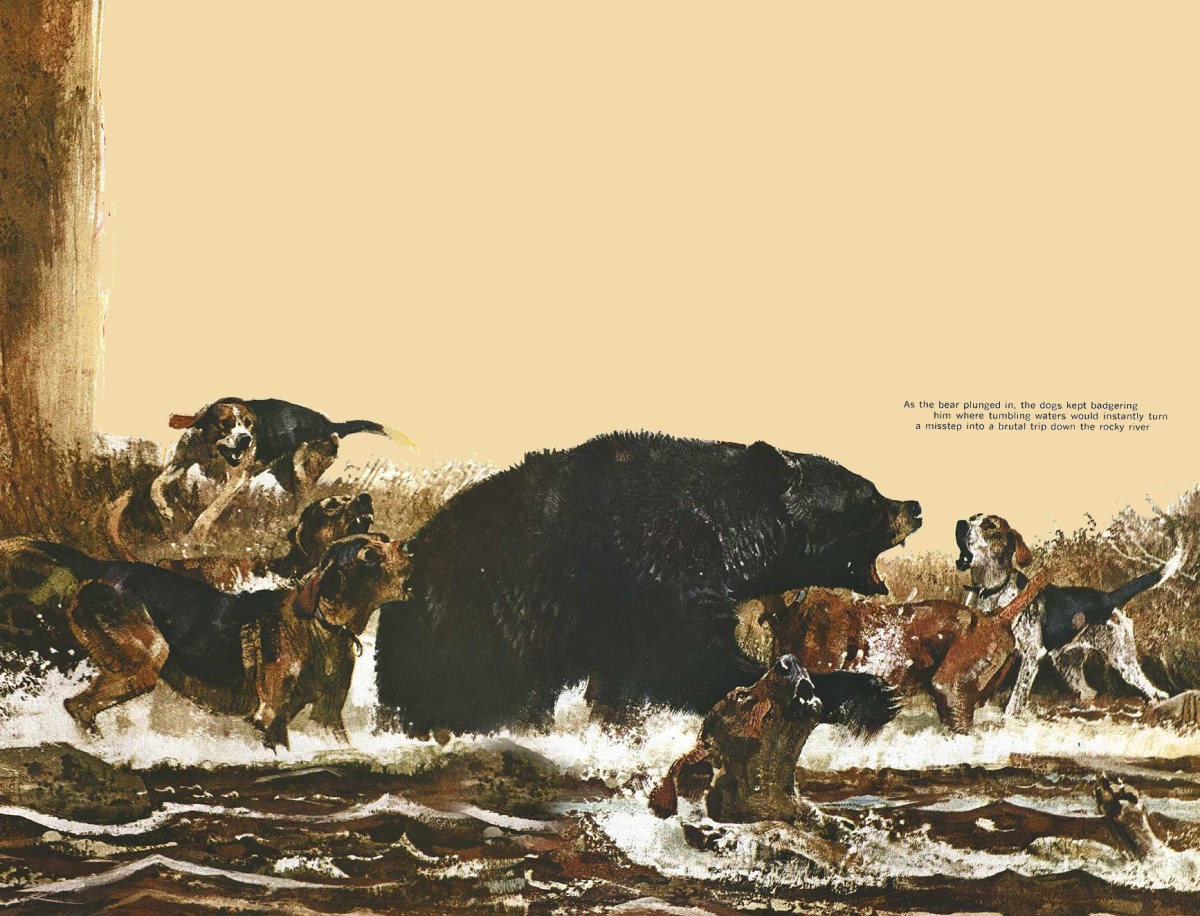
The Sturgeon at that point is about 100 feet wide, and it was swollen by hard rains and very swift—a tumbling millrace among big rocks. When the bear plunged in, the hounds were all around him, snarling, snapping, badgering him from every side. The instant a dog lost its footing, the current swept it away.
The bear swam almost straight across, but I couldn’t shoot, because Michigan game laws forbid killing a bear or a deer while it’s in the water. The fast current didn’t seem to bother the bear too much, but it was rough on the dogs.
Two hounds were carried down among the half-submerged rocks along the shore. They were buffeted and pummeled and came close to drowning. About 100 feet below the place where the dogs had gone in, two of our party, down on the bank by that time, waded out, grabbed the dogs, dragged them ashore, and tied them to trees to keep them from trying again.
The four other dogs kept going, half swimming, half rolling through the rapids, and finally reached the far side 50 yards downstream from where the bear had come out. They had taken a beating, but they climbed the bank and came barreling back again.
Like the 200-pounder we had encountered earlier that morning, this bear was too fat for a long run. He was big enough to give the pack a rough going over had he elected to come to bay, but he seemed to lack the grit for that. Or maybe he had never been run by dogs before and saw no reason to fight when he could avoid it by climbing. The hounds overtook him halfway up the first ridge, and he treed without an argument.
Bill Warn, Rich Porteen, and I met on the bank about where the bear had crossed. Above the noise of the rainswollen river, we could hear the steady chopping of the dogs at the tree. They were half a mile away, but it was a still, cloudy day and sound carried.
Bill Warn had said earlier that morning that he’d swim the Sturgeon to get a bear if he had to.
“There’s a good bearskin rug over in that tree,” I told him, “but if you want it you’ll have to get across, so you might as well start swimming.” He didn’t exactly swim, but he did the next best thing.
He and Rich waded out into the current a few yards apart. Rich made it safely to the far side, but halfway across, Bill got into trouble. He had cut a staff to help him keep his footing on the slippery rocks—the Sturgeon is swamp-stained and he couldn’t see bottom—and he was groping carefully ahead in fast, waist-deep water, bracing himself with the staff in one hand and holding his rifle high with the other.
In midstream he came to a big boulder that split the current, and suddenly the rush of water wrested the staff out of his grip and forced him against the rock. Bill made a lunge to free himself, lost his footing, and went down. Rolling about the way the dogs had, he was swept downstream almost as far as they had been. When he crawled out of the river, the only dry things on him were his hat and a pack of cigarets he had tucked under it.
On that side of the Sturgeon, the ground rises 50 or 60 feet up a very steep slope, and Bill was so whipped that, as we watched, he clambered up among the trees on his hands and knees. That was a crossing I didn’t want to make if I could avoid it. I had caught a hard cold a few days before while hunting in the rain, and I didn’t think an icy bath would do me any good. Anyway, I felt sure Bill and Rich could handle the rest of the business by themselves, so I stayed where I was.
Bill went out of sight over the canyon rim, and a few minutes later a shot rapped out—and then a burst of four or five more. The dogs quit barking, and I knew the hunt was finished. I looked at my watch. It was only 10 o’clock in the morning. We had set some kind of record—two bears in four hours.
It was hours later, however, before I learned what had happened at the tree.
Rich got there ahead of Bill. He stayed out of sight and kept an eye on the bear. When Bill arrived, the hounds were fretting at the foot of the tree and the bear was perched 20 or 30 feet off the ground, staring down at them.
“I tried to play Indian and sneak up without making a sound,” Bill told us, “but I was winded and I suppose I was about as quiet as a bull in a china shop. All of a sudden the bear’s head whipped around. He was looking straight at me.” The toughest bear, treed or at bay, is not likely to let a hunter walk up to him if he can help it. No matter how busy he may be with the dogs, if he hears or sees a man approaching, his attention shifts to the man and he gets uneasy.
“He got a good look at me,” Bill told us, “and then he came sliding down that tree like a streak of lightning.”
Bill’s rifle was a .30/30 lever-action Marlin loaded with 150-grain softpoints.
“Believe me,” he told us when it was all over, “before I hunt bears again I’ll buy a Magnum.”
He got in one shot as the bear came skidding down. Under the circumstances it was a good one—right in the neck. The bear hit the ground unable to run—at least he didn’t—but still on his feet and as full of fight as a poked-up hornet nest. By that time Rich had caught and tied one dog. The three others swarmed all over the bear, and it was only by a miracle that none of them got hurt.
Every time Bill aimed he could see more hound in his sights than bear, and he held his fire.
“He’s your bear. Get in and finish him!” Rich prodded.
“I ran up within about five feet,” Bill related, “but that bear was mad clear through. He was growling and biting and whipping back and forth, and that seemed too close for comfort. I shot whenever I could see an opening, but I’ll admit I was backing up while I was shooting.”
It took four shots, all in the neck and head, to put the bear down, and then he was still growling and snapping at the dogs. Bill jumped in and fired another into the back of his head, with the muzzle of the Marlin only a foot or two away, and that ended the fight.
Bill and Rich took off their belts and tied the rest of the dogs. Then they gutted the bear. Bill said afterward he didn’t think they’d ever get through the fat. Rich came back to the bank of the river to let the rest of us know what had happened. Bill stayed with the kill. He built a big fire, took his wet clothes off, and dried them.
We still faced the job of getting the bear out of the woods in one of the most rugged and inaccessible areas I have ever hunted. I knew how much Bill wanted to take his trophy home in one piece, but I wasn’t sure we could do it. We’d have to skid the bear down to the river, get him across, and then drag him to the top of the gorge up an almost vertical cliff more than 200 feet high. The best we could hope for there was a slope so steep a man would have to pull himself up by hanging onto the few trees that grew out of the rocks.
There was one possible alternative. If we could get close enough on logging trails on the west side of the river, we could take him out that way. It wouldn’t be so steep.
I climbed back to the Forest Service road at the top of the gorge, and John McGinty and I located Bob Rafferty. Bob was driving a four-wheel-drive wagon with a winch in front, and he and I headed for the nearest bridge over the Sturgeon to see what could be done.
Every logging trail in the area was a sea of mud from the recent heavy rains. We winched our way across a couple of bad spots, then bogged down and had to get a woodcutter to pull us out with his tractor. At that point we gave up and went back to the gorge.
By the time we got there another hunter had joined the party. He was Lieutenant John (Jack) Fisher, the son of Hugh Fisher, who is district law supervisor at Baraga for the Department of Natural Resources. A year or so before he had written me from Vietnam to say how much he was looking forward to getting home and going on one of our bear hunts. He was back in this country for a week or two on leave.
He and Danny Porter, Warn, and Porteen were waiting at the river. Bill and Rich were still on the far side. They had brought the dogs down, and we called them across. They needed to be put into their trailer to warm up after the swim, so Danny started for the top of the gorge with them while Jack Fisher and I got ready to cross the Sturgeon and help Rich and Bill with the bear.
In the army Jack Fisher had learned a trick or two for dealing with such situations. He had brought along 100 feet of light rope. He chose a rock of the right size, tied it to one end of the rope, swung it around his head a few times, and sent it sailing across the river. It fell just short, splashing into shallow water close to the bank.
Bill fished it out, and he and Rich made their end fast to an overhanging tree. We did the same on our side. With the rope to hang onto, we were ready for the crossing. Fisher stripped to the waist, so he’d have something dry to put on when he got across. I didn’t.
The water was wretchedly cold, but the rope was a big help. In five minutes we were on the far bank. When we got up to the bear, my misgivings mounted. Even though he was gutted, I estimated he still weighed close to 400 pounds. I wasn’t at all sure that four of us could drag him.
We started for the river. At the top of the grade, he got away from us on the steep slope and went sliding and bumping clear down to the water’s edge.
Porteen, Fisher, and I crossed the river again. Bill Warn stayed on the far bank. When we were ready, he tied his end of the rope to the bear. He pushed and we pulled. Together we managed to maneuver the carcass into the river. The current caught it and swept it down and across in a wide arc until it brought up against the rocks on our side. Bill then waded the river again the way he had the first time.
We had to use a stout pole to pry the bear off the rocks and get him up onto the bank. Once we had him on dry land, Bob Rafferty brought a small hand winch from his vehicle. Then the hard part began.
Danny Porter and John McGinty, Stu Willet, and Carl Imhoff were all on hand now, and a couple of other hunters who had heard about our kill had come down to the river. In all we had a crew of 10 or 11, and we needed every man, for the bear was soaking wet and heavier than ever.
We winched him half a mile. On the side of the gorge we pulled him up a few feet at a time and held on for dear life to keep him from sliding back, while one man clambered ahead and fastened the winch to the next tree.
It started to rain, and darkness came on long before we reached the top. When we finally had him at the Forest Service road I looked at my watch again. It was 10 p.m., 12 hours after Bill had made the kill.
Had we shot the bear that had confronted me the year before? I still think so, and I’ll tell you why.
To begin with, they were about the same size (this one weighed 380 pounds field-dressed), and as Danny Porter had said when we stood looking at the track, it hardly seemed likely there’d be two that big in the same locality. They frequented the same places and used the same trails too, and their tracks looked the same.
Read Next: Trolling for Bears in British Columbia
I had backtracked my face-to-face bear after he had cleared out, and I had studied the sign carefully. He left the biggest track I had seen in many years, and I concluded then that he had exceptionally large feet for his size, and so did the one we had killed. And they both took short steps as though they were too fat and lazy to hurry. If I’m right in believing they were one and the same, I assume he was the boss of that country and could take all the time he liked.
Finally, when I encountered him the first time, he showed that he was not afraid of a man. And when the dogs got on his track a year later, he apparently wasn’t afraid of them either. Anyway I add things up, I get the same answer.
But I’m still not sure about one thing. My bear hunt of the previous fall had had a very lively sequel now, and I guess you could say I “got even” with him for scaring me. But every time I think about dragging him out of the gorge in the darkness of that rainy night and finishing two hours before midnight, I ask myself if maybe he didn’t have the last word after all.
I can make you one promise. If I hunt bears another 50 years, I’ll never try to take one of that size out of a place like that again. We could have skinned him and packed the pelt out in an hour or two. Bear meat just isn’t that valuable for eating or bragging, even if Bill’s whole neighborhood did come around to admire his trophy when he got it home.
This story was originally published in the July 1969 issue of Outdoor Life.
Read the full article here
