



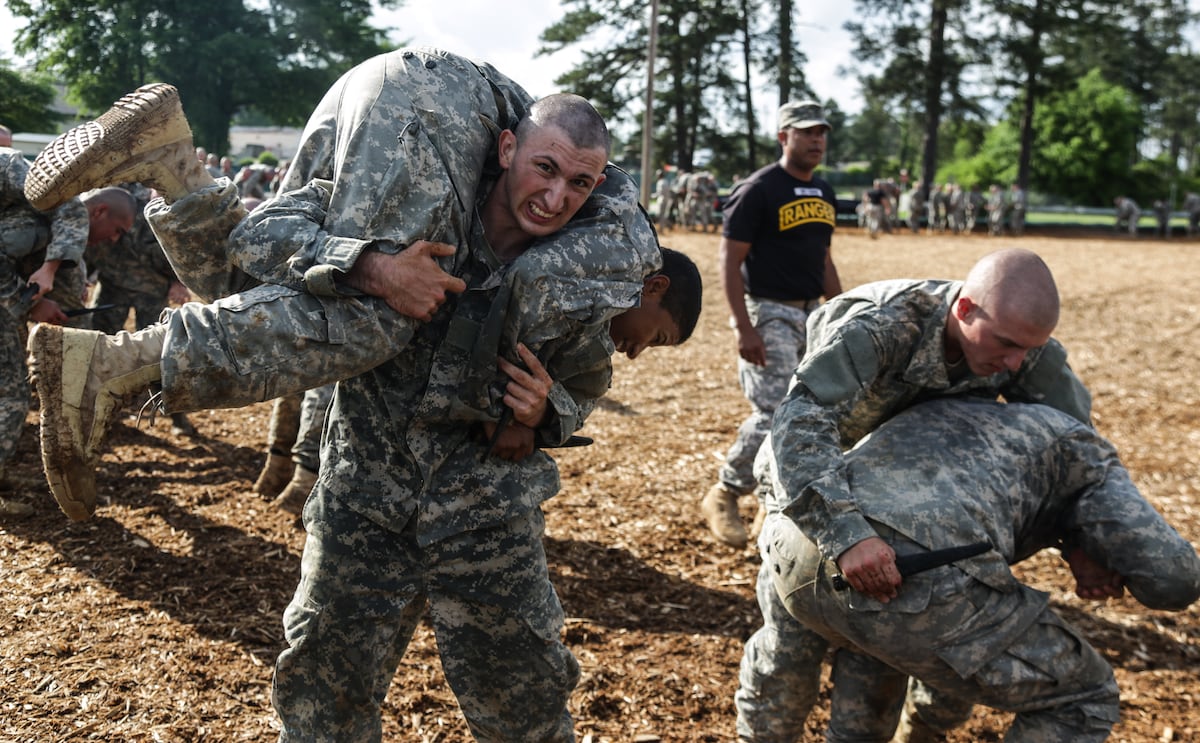

For weeks, Army Ranger School students put their bodies through a physical ringer, carrying heavy loads and marching far distances with little to eat and sparing sleep. But when Army researchers measured the course’s grueling toll, they found that female soldiers experienced fewer physiological changes than their male counterparts.
Researchers tracked hormone levels, blood markers and body composition over the weeks-long school and the findings, published this month in the Journal of Applied Physiology, are among the first to compare how male and female soldiers respond to the Army’s premier leadership course.
The new information comes over a decade after the Pentagon lifted its former ban on women in combat arms roles. In 2015, Ranger School opened to all qualified applicants and since then, over 150 female soldiers have graduated. Thousands more have served — and are serving — in frontline roles, in a change researchers say that underscores the need to better understand how prolonged military training affects women’s health.
The study, first reported by Task & Purpose, found that while both men and women lost weight and body fat during the course, men experienced more widespread changes across hormone systems and blood markers. Women also experienced hormonal changes, but they were less extensive and largely concentrated during the mountain phase of training.
The findings, researchers said, “indicate that multi-stressor environments may disproportionately affect male physiological markers, whereas females exhibited fewer, phase-specific changes.”
The study used data from 36 Ranger students — 10 women and 26 men — between 18 and 36 years old. Sixteen completed the school in the standard 61 days and the rest recycled at least one of the course’s three phases, taking an average of 94 days to graduate.
The data comes months after the Pentagon launched a formal review of the “effectiveness” of including women in front line roles, a move critics say forces women to continue proving they belong in combat arms positions long after meeting the Army’s standards.
The review followed criticism of women in front line jobs by Defense Secretary Pete Hegseth, who before taking office said that women should not serve in ground combat roles. Hegseth later softened his position, saying at his confirmation hearing that “if we have the right standard and women meet that standard, roger, let’s go.”
Eve Sampson is a reporter and former Army officer. She has covered conflict across the world, writing for The New York Times, The Washington Post and The Associated Press.
Read the full article here
