



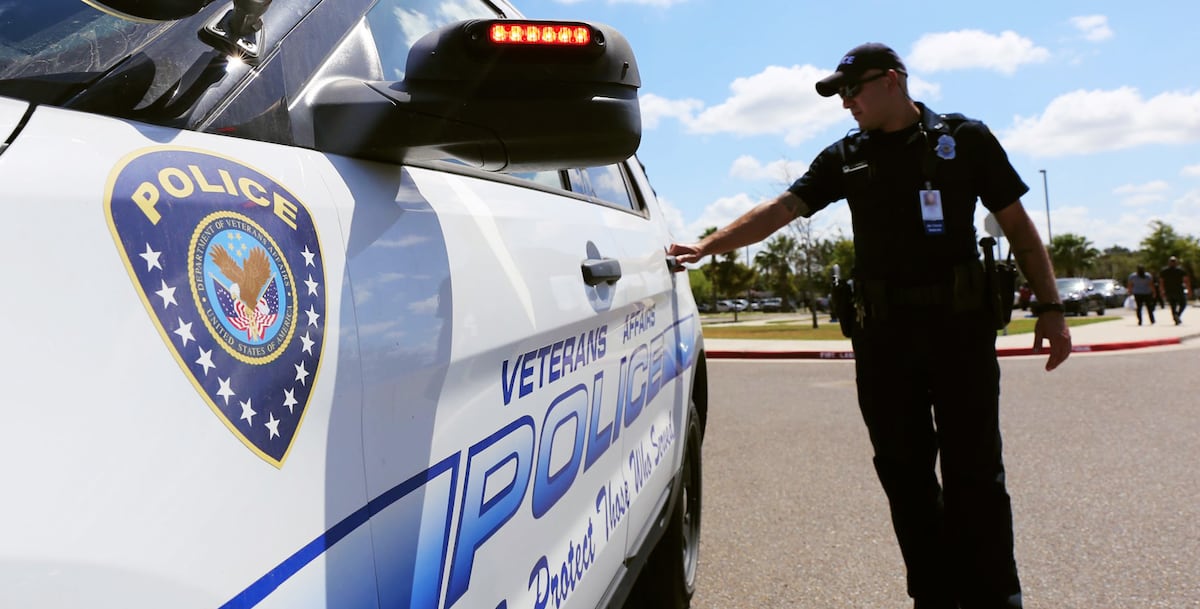

The Department of Veterans Affairs’ 5,000-member police force is being consolidated under a new Office of Operations, Security, and Preparedness to improve service and retention, department officials announced Wednesday.
The move is transforming a force currently managed by individual medical centers and civilian administrators — a change that should make it easier to recruit, pay and train officers, according to the department.
Wednesday’s announcement follows a series of reports critical of the VA police and a May Senate hearing that examined problems in the force.
The Government Accountability Office published a report in April that found numerous safety concerns at VA facilities. During a covert review of 30 VA hospitals and other facilities, GAO investigators found that just two had medical detectors, and of those, one was inoperable and staff failed to intervene when the other was activated.
Investigators also found that staff failed to stop knives from entering the buildings, didn’t intervene when an investigator drank water out of a vodka bottle and allowed investigators to enter non-public spaces, including labs and treatment rooms.
The GAO reported similar problems in 2025, finding that contracted guards – the VA has about 800 – did not prevent prohibited items such as blades or batons into facilities about half the time.
The VA’s Office of Inspector General found last year that 58% of VA facilities experienced shortages in their forces, making VA police “the most frequently reported severe nonclinical occupational staffing shortage.”
Reginald Neal, assistant secretary for operations, security and preparedness, told Senate Veterans Affairs Committee members in May that the structure, along with incorrect pay classifications for officers, made it “difficult to recruit, retain and promote seasoned officers.”
“Our VA police endured inconsistent policing standards, which led to a lack of both accountability and discipline. Often our professional officers were used to perform non police functions, including in some cases, serving as valets to park cars,” Neal said.
Under the consolidation, the VA now will have a law enforcement chain of command that falls under an assistant secretary in VA headquarters. Officials said the reorganization will be completed by October.
VA also will classify police officers at higher pay grades, starting at the Government Services-6 level, or roughly $48,000 a year for a rookie in a location such as Atlanta, Georgia, an increase of $5,000 from the starting position of a GS-5. Jobs also will be offered through the chain of command up to the senior executive service level, providing room for promotion and seniority.
According to the VA, this will create stability and make the VA a “more attractive place to work” for law enforcement.
“These reforms will help us accomplish that mission by creating a stable VA police force with clear lines of authority, accountability and career progression. The result will be better police recruitment and retention as well as improved safety and security for Veterans, staff and visitors,” VA Secretary Doug Collins said in a statement Wednesday.
While roughly 98% of the VA’s police work involves non-violent crimes, VA police officers may face life-threatening situations, including patients who threaten visitors and staff, suicidal veterans and opportunists looking to steal from the VA or deal drugs on VA campuses.
In March, a VA social worker was killed at a VA clinic in Jasper, Georgia, by a gun-wielding patient; a uniformed security guard on duty took part in apprehending the suspect.
Daily, Neal said, the VA police focus on assisting veterans.
“VA policing involves so much more in law enforcement,” according to Neal. “When [veterans] come and they seek care, it’s more than just going to see the doctor — the issues, the emotions, all the frustrations that we carry with us when we go to a facility. Our VA police are the first ones that you see when you come to a facility. They’re the last ones you see when you leave. The VA police officers set the tone for that visit.”
Patricia Kime is a senior writer covering military and veterans health care, medicine and personnel issues.
Read the full article here
