



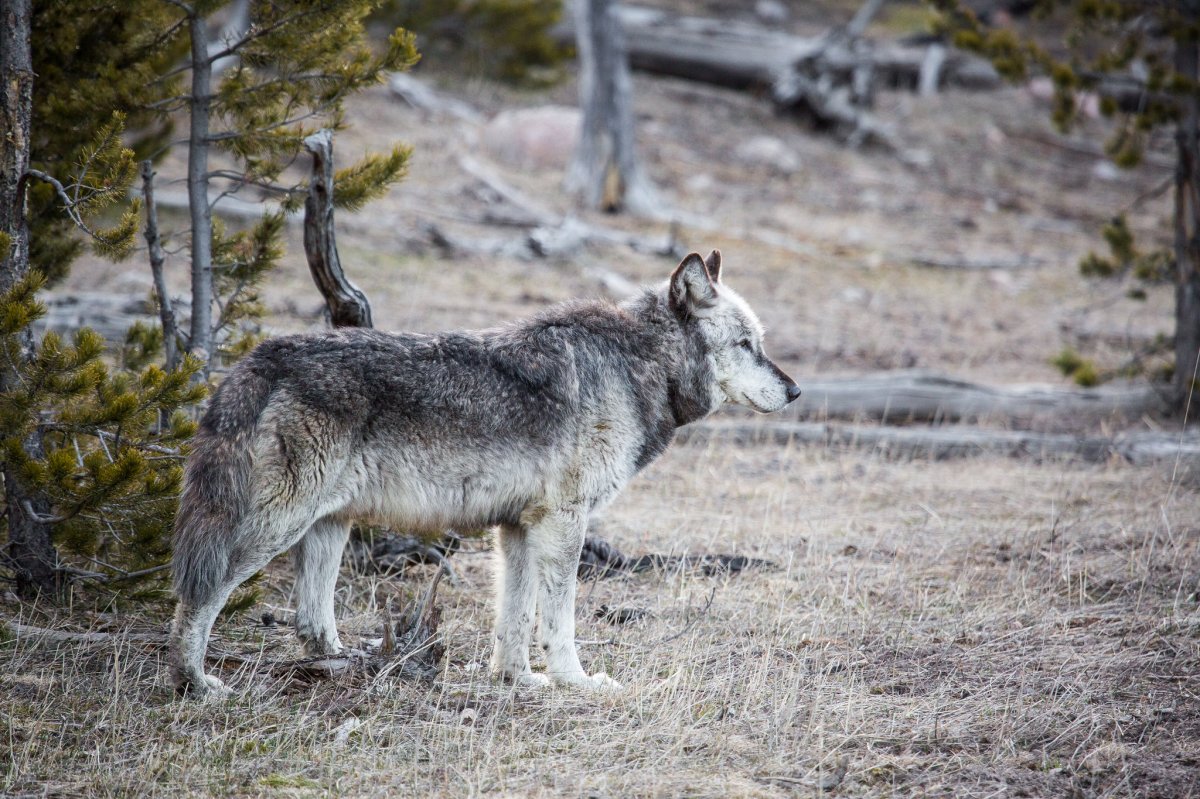

A recent report on Wyoming’s wolves is drawing attention to a longstanding belief among some Americans that wolves in the Cowboy State are significantly bigger than gray wolves in other parts of the Lower 48.
WyoFile, which recently explored this topic with key wolf biologists, noted a conspiracy theory that Canadian “superwolves” translocated from Alberta and B.C. to Yellowstone and Idaho years ago were a “bigger, invasive species” than the wolves extirpated from the Lower 48 during colonization. That’s simply not true, experts say — superwolves aren’t a thing. That’s because the same species, Canis lupus, ranges from Alaska through Canada into the upper West and the Midwest.
Still, Wyoming’s wolves do appear to be a bit heavier than gray wolves in other parts of the Lower 48, according to figures in Wyoming’s annual gray wolf monitoring and management report, published last month by Wyoming Game and Fish, plus several federal agencies and tribes. Biologists captured 196 wolves outside Yellowstone from 2012 to this past winter, and found their overall weight was 92 pounds.
Here’s a breakdown of those findings:
- Juvenile males (9 to 12 months) averaged 80 pounds
- Juvenile females (9 to 12 months) averaged 71 pounds.
- Adult females (one year or older) averaged 90.5 pounds and rarely broke 110 pounds.
- Adult males (one year or older) averaged 106.5 pounds, “similar to a Bernese mountain dog”
- The heaviest male and female maxed out at 154 pounds and 112 pounds, respectively
- It’s rare for a male exceed 130 pounds and for females to exceed 110 pounds.
- Both sexes increase in weight until they are 4 to 5 years old and then remain stable or lose mass as they age.
- Very few wolves are captured that are older than six, which reflects their relatively short lifespans in the wild
Compare this to neighboring Idaho, where adult male wolves weigh 70 to 110 pounds while females weigh 60 to 80 pounds. In the Upper Midwest, the Voyageurs Wolf project noted in 2021 that the biggest wolf the program had ever studied was an “exceptional” male that weighed 91 pounds, and the next largest was 89 pounds. The project noted that typical wolves in that area of Minnesota weigh around 61 to 62 pounds, with males averaging 68 pounds and females weighing 55 pounds.
One simple explanation for Wyoming wolves having heavier weights, as wildlife managers point out in their report, is that most states just aren’t tracking wolf size as closely.
“Overall, Wyoming wolves appear typical in weight, but comparative weights are rarely published for other areas of North America,” reads the report.
Other states may also be capturing and recording weights at different times of the year, when wolves aren’t as bulky (that 91-pound wolf was weighed in late May). Still, there’s a big difference between an average weight of 92 pounds for Wyoming males and an exceptional outlier in Minnesota, where the heaviest wolf on record was still one pound shy.
So, what gives? Researchers have a few ideas.
Wolf Ecotypes
Wolves, like many other species, can and must adapt to their specific environment. This adaptability creates what the Wyoming report refers to as “ecotypes,” which “are often thought of as subspecies” that best suits wolves to a particular habitat and prey base.
One oft-cited study of wolves and the ecotype theory found that after genotyping wolves, patterns of local adaptation by wolves reflected “strong ecological divergence among habitats.” In other words, where a wolf lives and what it eats influences its size, among other physical factors.
Prior to European expansion and colonization in the West, two different wolf ecotypes — one at home on the plains and one more suited to mountainous terrain — may have met in Wyoming. This transition from grassland prairie to mountains stretches from southeast to northwest Wyoming. The plains wolf ecotype was extirpated thanks, mostly, to government eradication efforts, wildlife managers note in the report.
“The mountain wolf ecotype, however, persisted just north of the U.S.-Canada border. This is the ecotype that began natural recolonization of northwest Montana, and was the source of wolves captured for reintroduction efforts in [Wyoming in] 1995. This has led to significant discussion in the public sphere regarding the appropriateness, and expected larger size, of wolves captured for reintroduction.”
Unsurprisingly, there aren’t particularly reliable records from before colonization and settlement of just how much wolves of different ages and sexes weighed.
Coyote Genetics Could Contribute to Smaller Body Size
Some historical interbreeding of gray wolves and coyotes may also affect body size. One researcher, who founded the North American Canine Ancestry Project, found between 10 and 20 percent coyote ancestry in some Great Lakes wolves (though not the Voyageurs wolf population), but none in wolves she tested from the Rocky Mountains and other Western regions.
Prey vs Predator Size
The size of a wolf’s prey, research shows, seems to correlate to its own body size.
“Wolves in our system, and a lot of the Great Lakes region, are killing deer. And deer are considerably smaller than elk and moose,” Voyageurs Wolf Project leader Tom Gable told WyoFile, adding, “You don’t want to be any bigger than you need to be to kill your prey. You don’t need to be 100 pounds to kill a whitetail deer, whereas that might be very advantageous when you’re killing elk or taking down a moose.”
One study of Yellowstone wolves found that body size helped wolves hunt prey like bison and elk. Bigger — that is, heavier — wolves weren’t particularly fast or good at singling out an elk, but they did have the edge when it came to taking down prey. (You can read more about this over at WyoFile.)
Bergmann’s Rule
One principle that’s often used to address size variation between species is Bergmann’s Rule, also sometimes called Bergmann’s Law. It holds that individuals within certain species — gray wolves, in this case — can vary by size across their range. The closer an animal lives to the poles, or in colder climates, the bigger its body size.
“Wolves are one of the most broadly distributed mammalian carnivores,” notes the report, “inhabiting all ecosystem types in the Northern Hemisphere from desert to tundra.”
While Bergmann’s Rule doesn’t apply universally to all animals, there’s convincing evidence the theory applies relatively well to larger-bodied mammals. Picture a Saskatchewan whitetail and compare its body size to a Texas whitetail. Both deer are the same species — Odocoileus virginianus — but on average, you’ll have a harder time hauling that Canadian buck back to the truck.
Read Next: I Spent 40 Years Living with Wolves. They Still Manage to Surprise Me
But the temperature variation between different gray wolf population groups is fairly similar. Wyoming and Minnesota are within a degree of each other’s average annual temperature (42 and 41.5 degrees respectively), though historically Wyoming was substantially colder than Minnesota during the 20th century. This is due, in part, to its higher altitude.
Idaho has similar historical temperature to its neighboring Wyoming, though its current average annual temperature is above Minnesota’s, at 44 degrees.
It’s also worth noting that we’re talking about gray wolves in the Lower 48 when comparing Wyoming wolves. In December 2024, two Alaska trappers reported a wolf weighing in at 149.6 pounds. Across the state, the Alaska Department of Fish and Game reports that female wolves weigh about 90 pounds on average and males weigh in between 100 and 110 pounds.
During his career at ADFG, biologist Mark McNay captured and weighed more than 300 wolves. The biggest he recorded was a 143-pound male he caught in the Alaska Range in 2003. That particular wolf was the alpha male in a pack of 16 and was coming off a fresh kill. A full belly can add plenty of weight to a wolf — up to 15 pounds, according to the Wyoming report.
Related: Wyoming to Cut Area Wolf Harvest in Half Amid Disease Outbreak Near Yellowstone
John Burch, a National Park Service biologist who worked in both Denali National Park and Preserve and the Yukon Charley Rivers National Preserve found the wolves in the Yukon Charley (which is farther north) were bigger on average than Denali wolves. His data shows that males in the Yukon Charley run about 5 pounds bigger than Denali Park males and females are about 2 pounds larger.
Of the 179 wolves Burch captured in and near the Yukon-Charley Rivers National Preserve from 1993 through 2011, the average weight for adult male wolves was 111 pounds and 97 for females.
Read the full article here
