



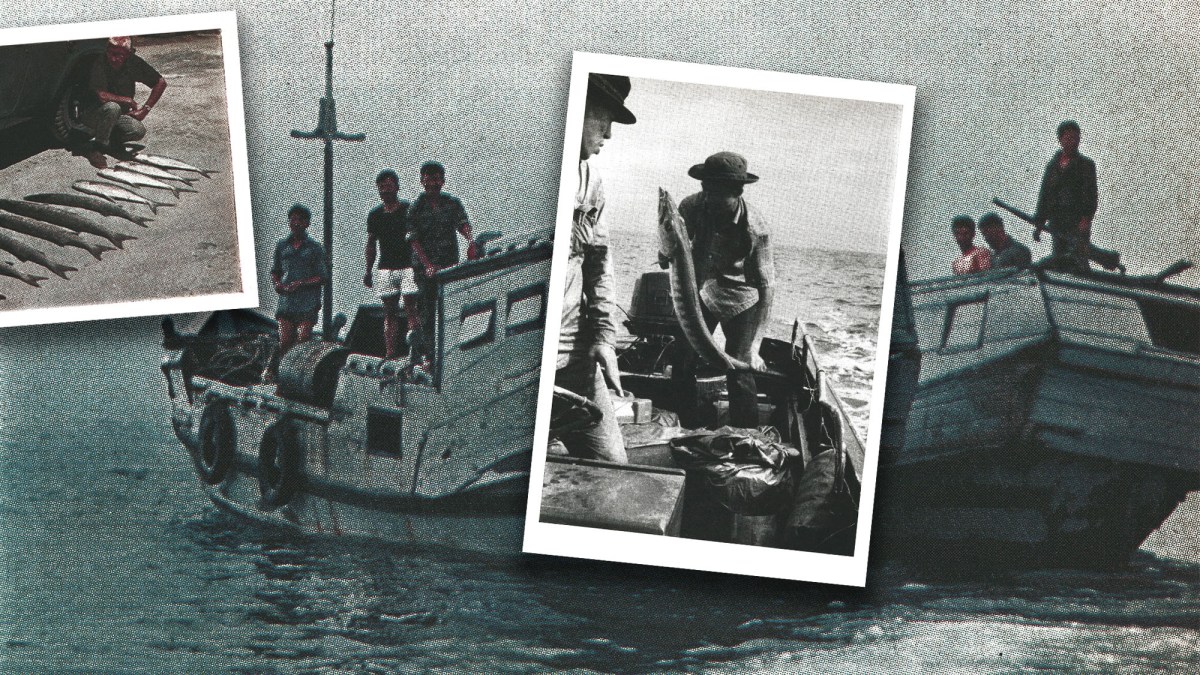

This story, “Fishing Under the V.C. Guns,” appeared in the July 1969 issue of Outdoor Life. The prison referenced in the story is the infamous Phú Quốc Prison, also known as the Coconut Tree Prison, operated by the South Vietnamese government.
I saw small boys catching 10-inch shrimps with hook and line, so I figured that bigger fish were around. A while back, I had resolved to find out. But the Vietcong were all over the place, shooting at whatever Americans ventured near.
It wasn’t until last November, when things quieted a bit, that I finally found myself on Phu Quoc Island in the Gulf of Siam, trolling rods in hand. A boat was being loaded for the expedition.
“A screwy way to start a fishing trip,” I reflected as the gear went aboard Sam Hosier’s 17-foot American-made outboard. Handlines, my tacklebox, an ice chest containing baitfish and beer, and a paper bag full of sandwiches made up our equipment.
But the Vietnamese crewmen were putting aboard a small arsenal as well. There was an evil-looking M-79 grenade launcher with a sack of grenades, and an M-16 rifle with extra clips of ammunition. Big binoculars and a two-way voice radio completed the load (the radio, Sam told me, was tuned to a Vietnamese Navy command junk somewhere out there in the wet). Sam wore his ivory-handled 9 mm. automatic pistol. Being able to pat my own peashooter, a .38 caliber snub-nosed revolver, made me feel a little better. We were a kind of gunboat, with all that weaponry.
I had learned after I got to Phu Quoc (I hadn’t necessarily expected this kind of venture) that the big fish are found either way out in the gulf, where the deep-water commercial fishing boats go, or just off the island — no place else. Our open boat limited us to inshore fishing, and the shore along which we were going to fish lay in Vietcong country. During the whole of the trip, we’d be within firing range of V.C. coast-watchers among the trees and tumbled boulders that come down to the water along the big island’s western edge.
And the V.C. weren’t just sniping with popguns, either.
I’d seen four-foot red snappers brought in by the Vietnamese commercial boats, and I wanted to go for them — and for whatever other kind of fish we might turn up in these waters, which have never been exploited by sportfishermen. But our host, Commander Nguyen van Hoa, was not enthusiastic.
“There are plenty of rosefish down there,” the commander said, using the Vietnamese word for red snapper. “But we’d have to stop the boat and fish on the bottom.”
His eyes followed the coastline up which we’d be traveling.
“To stop might be dangerous,” he said. “We’d make an easy target. But we will do it if you really want to.”
I thought about the weapons with which the Vietcong of Phu Quoc Island are known to be armed: Russian-made AK-47 rifles that fire accurately out to 500 yards; B-40 rockets; submachine guns of several varieties; and 60 mm. mortars that can reach out 1,800 yards. We’d be less than 500 yards from shore the whole trip and sometimes as near as 150 yards, so Sam Hosier had told me. To drop anchor would make us sitting ducks for any marksmen among the rocks and trees.
“No thanks,” I told the commander. “Let’s just troll.”
It was our boat’s fuel can that determined the terms of the trip. There was gasoline enough for an hour of running up the coast to where the fish were supposed to be, for exactly one hour of trolling, and for the hour’s run back to the dock. Sam carefully measured the supply. He left us a ten-minute margin, to prevent a miscalculation from stranding us on a hostile beach.
With the fuel in order, we went aboard.
We were five all told. Sam Hosier, a 45-year-old Texan, joined the army at 15, served in three wars, and retired in 1963 with the rank of Sergeant Major in the Special Forces. He is the lone American civilian on Phu Quoc Island, where he works as
U.S. advisor to the local government. His family lives in Bend, Oregon.
The three Vietnamese members of our group were Commander Hoa and a couple of militiamen from his staff. One of them, Nguyen van Nam, came along to bait hooks and land fish, but his sharp-eyed buddy, Ho Xuan Thu, had another duty. For the entire three hours it would be Thu’s job to scan the shore for Vietcong guerillas, the grenade launcher and the rifle at his feet.
As for myself, I’m a civilian foreign-service officer of the U.S. Information Agency, serving as chief of political warfare, propaganda, and information in that part of Vietnam south of Saigon (mainly the Mekong River delta).
A tropical rain was falling as we pulled away from the dock at Duong Dong, the small town that passes as Phu Quoc’s capital. We covered everything, including ourselves, with ponchos, and took off into the dark wetMonday morning, tooling north at 25 knots, trailing a wide wake in the bathtub-warm waters of the Gulf of Siam. The island loomed close on our right.
Sam was operating the 85-horse-power outboard, and I was musing about what it would be like to fall overboard — maybe into the jaws of the daddy of a small hammerhead shark that we’d seen back at the dock. I kept a sharp eye out for the seagoing cobras that I knew are common in the gulf, and for the tortoises whose shells the island people fashion into combs and bracelets for the tourist trade in distant Saigon.
Phu Quoc, remnant of an ancient mountain peak, rises out of the Gulf of Siam a few miles south of Cambodia and 37 miles southwest of the nearest mainland of the Republic of Vietnam, which governs it in dispute with the Vietcong. The island is rugged and hilly, covered with triple-canopied forest, and fringed with rocky promontories that jut out between narrow white-sand beaches.
The island’s 13,000 people live in a half-dozen coastal hamlets, one of which — far to the south — adjoins a camp for prisoners of war. Except for the hamlets, the prison complex, a couple of abandoned rubber plantations, and some coffee groves, the island is jungle, and the jungle belongs to the V.C.
It was not always so. In French times, Phu Quoc was known for hunting. There are wild buffalo and boar in the wooded canyons, sizable brown deer, monkeys (which the island people eat), pythons of up to 18 feet long (islanders eat them, too), crocodiles of up to 12 feet, and deadly aggressive bamboo vipers everywhere you go.
There ought to be tigers, too, and there were at one time. Local legend says that the last pair of them roamed the island fairly recently. But then, the legend has it, the tigress died, and the male, crossing to the mainland to find a new mate, was grabbed by a giant clam and held by the tail until he drowned.
Quite a bit is known about the Vietcong on Phu Quoc. Most are islander criminals who have fled to the jungle or deserters and draft-dodgers avoiding government military service on the remote and hated mainland.
The island’s V.C. total about 300. Their main force is organized as a 120-man company, and the rest roam the island in squads or by twos and threes. They prey on the legitimate population when they can, and live on what rice they capture in raids plus their own jungle-grown bananas, sweet potatoes, manioc, breadfruit, and mangoes.
Fishing boats are fair game for the V.C.; part of the catch can be “taxed” away from the fishermen. Our passing boat would be observed from the beach — of that Commander Hoa was sure. And if two of the passengers were identified as Americans, the shooting would start.
Well, there we were anyway, out in the gulf, the island gliding by on one side and nothing but lukewarm salt water on the other as far as Thailand. The November rain was cooler than the salt spray, and both drenched us despite our ponchos.
Peering out to the rear, a few hundred yards off. I watched the pepper-growing hamlet of Ong Lang (population 100), its handful of thatched houses. overshadowed by a tall mist-enveloped mountain, recede behind us. Seven miles from our starting point we passed Cua Can (population 500), a pepper-growing and fishing hamlet marking the northernmost outpost of government control. From here on — and we had 14 miles yet to go — anybody on shore was Vietcong.
Sam kept the boat on a straight course, which put us maybe 500 yards from shore some of the time but brought us within 150 yards of the beach as we passed frequent rocky, wooded capes. We were half an hour out when a couple of moored junks loomed out of the rain. I had a moment of uncertainty (enemy craft, maybe?), but they turned out to be patrol boats of the Vietnamese Navy, on station to intercept the armed Vietcong smugglers who regularly try to skirt the island with arms and personnel bound for the mainland from Cambodia.
Sam detoured the outboard so that we could say good morning to the crews. We passed close by the junks, and Commander Hoa exchanged salutes with the sailors.
We ran the last 20 minutes in hot sunshine. My clothes dried out, and I figured that it was time to rig my rods. Visibility improved as the rain receded. Cambodia loomed distantly ahead. On our right, within pistol shot, was the Phu Quoc shoreline.
Guided by the commander, Sam was steering a straight course for some sizable chunks of offshore rock. There were maybe eight or 10 of the outcroppings, two or three acres in total extent, sticking out of the gulf with the swell breaking quietly against them. We’d passed a dozen such formations on our way up the coast, but the commander identified this one as our destination.
“Rocher Plat,” hes aid. “This is where we fish.”
Sam, following the commander’s instructions, slowed the boat to about five knots, and we began a slow wide sweep around the clump of rocks. Our lines went over — my trolling rig and the handlines of Sam and Nam. Commander Hoa trained his binoculars on the shore, watching for trouble, and Thu stood up in the boat, his own sharp eyes sweeping the treeline for possible enemies.
We weren’t trolling for panfish; I could see that for sure as Nam fixed our big hooks with baits from the ice chest. Each bait was a mackerel-type fish maybe eight inches long, identified by Commander Hoa as “bac ma” (translation: silver-cheek). It was cut along the backbone to give it a wounded look.
It was 9:40 a.m. as Sam and I checked our watches — we had exactly one hour to fish.
The bottom was rocky, as I was to discover. Sam steered us on a zigzag course, circling the patch of rocks but varying our position continuously to prevent a shore-based gun from targeting our path through the water. Since we had to keep moving for our own — going from five knots up to 10 and back again in an irregular sequence — we used one-pound sinkers, which kept our hooks a little way above the bottom 20 feet down.
Our lines hadn’t been in the water more than a couple of minutes when the action started.
A heavy strike nearly took the rod out of my hands. I heard a crack. Then my line went limp. At the same moment, Sam yelled.
His heavy monofilament handline was streaking overboard, and Sam was trying to hold onto it with ungloved hands.
“The damned thing’s cutting me!” Sam shouted, and there was blood on his fingers.
Thu, a callous-palmed peasant, came to the rescue, playing Sam’s fish with both his hands and one foot. He had the heavy line running between his big and second toes, using the slot as a guide. It took Thu about five minutes to subdue the first fish, which did a lot of splashing near the boat.
Since there was some mystery about what our catch would be, I helped Thu heave it aboard. And after one glance at its dangerous-looking mouth, I kept hands and feet well out of its way as it thrashed around in the boat.
“Trang,” Commander Hoa said, giving the Vietnamese name for the fish.
I couldn’t identify it, but it was surely a member of the mackerel family, being close to the albacore in appearance. It had a mouthful of the longest, meanest, needle-sharp teeth I’ve ever seen in a fish, and they explained the loss of the one I’d hooked.
My fish not only had bitten easily through my nylon-and-wire leader, costing me my terminal tackle, but had also broken the tip of my heavy cane rod on the strike. Piano wire would not be too strong for those jaws, and I broke some out, shifting to my spare rod and spinning reel.
Sam kept steering in a wide eccentric circle around the rocks, but nothing happened until we returned to where we had hooked the first fish.
Wham! Again a line went wild. Sam by now had found some rags to protect his hands, and this time he boated the fish himself.
It was a long, round, needle-nosed thing with angry eyes and a lot more fight than even the first fish when it hit the bottom of the boat. And if that “trang” had had a mouthful of teeth, this baby — blood cousin to a barracuda, though Commander Hoa called it a “nhong” — had a regular forest of darning needles filling its jaws. I took a look and imagined what a pack of these seagoing wolves — this one was more than three feet long — could do to a man in the water.
We made still another circle, and all was quiet until we again reached the magic position. Something big hit me, but he headed for the bottom, bending the stiff glass rod as if it were a twig, and wrapped the line around the underwater rocks. That took care of my last heavy sinker, and though I rigged with a four-ounce job, I didn’t have another strike on that rod.
These fish were feeding deep. They had to be in some special kind of hole. For, so help me, every time we circled and reached that spot, one of us took a fish on a handline. We caught three more “albacore” and four more “barracuda,” all of them 36 to 42 inches long.
And once, Sam brought in a lovely basslike fish, all chocolate brown with brilliant purple spots. It was smaller than the others but just as toothy. Commander Hoa called it a “mu” and said that it is the best-eating fish in these waters, snappers included. We averaged six minutes a circle around Rocher Plat, which gave us 10 passes over the hole — and a fish on every pass. Toward the end, Commander Hoa was exhibiting renewed interest in the nearby shore, training his binoculars on the treeline. Thu and he were talking in low voices and pointing to the beach as if they’d seen something moving over there.
The tumbled boulders, and the shadows in the trees behind them, looked ominous to me. I was getting nervous enough to start seeing things, but then our watches showed our time was up.
“Got to start back,” Sam said, and I didn’t object as he gunned the motor up to 2?5 knots for the return trip while the rest of us put away the gear. The island slid by on our left, just as close and still as before, just as silently threatening. If the V.C. had watched us on the outbound leg, had got arms, and were waiting for us to come back — a favorite ambush trick of these people — we might be in trouble.
But maybe they were taking a vacation that day, for the hour-long trip passed without much incident. The motor heated up, turned cranky, and conked out a couple of times, but Sam got it going before we drifted far toward the beach. The morning calm had given way to a deep swell, and we hit bottom every once in a while, taking considerable spray.
We came up on Cua Can, and after that OngLang. And then we heard shooting.
Unmistakably, these were the sounds of mortar fire, and we had a bad few minutes. But then, rounding the last cape before Duong Dong, we could see shells bursting against the hill that overlooks the town, and hear their blasts seconds later. It was the town’s militia unit engaging in target fire. We were home free.
Read Next: I Hunted Ducks from a U.S. Naval Destroyer During the Korean War
A sizable delegation of townspeople met us at the dock to see what we’d caught. A lot of oohs and aahs, particularly from the women, greeted the fish as we unloaded. We looked around for scales but couldn’t find any, so we had to estimate weights. The consensus was that the total weight of our catch was upward of 60 pounds, which figured out to more than a pound per minute for the hour we had been able to fish. Not bad for a first try in new waters.
And guess what we did with the catch:
First off, Thu and Nam carried away a fish apiece, for services rendered.
.Friends of Sam and the commander got the rest, except for the largest barracuda, the largest albacore, and the bass. These we had for dinner, prepared by the wife of Sam’s landlord with considerable help from the neighbors. We were six at the table, and the menu consisted of lots of beer plus:
•Fish soup, prepared mainly from parts of the albacore, along with chopped greens, sliced green onions, and shredded cocoanut.
- Broiled barracuda steaks and broiled albacore steaks with local lemon.
- Baked whole bass with mushrooms.
- Baked sections of barracuda.
- And the featured dish, cooked by ourselves. You can try it at home if you have a chafing dish. Here’s how:
Slice raw barracuda or other white-meat fish into thin bite-size strips. Have boiling in the center of the table a mixture of equal parts of vinegar and cocoanut milk, with some thin-sliced onions. Give each guest a cooking tool (we used chopsticks) and a small bowl of peanut oil flavored with anchovies and chopped hot peppers. Everybody cooks his own piece of fish in the boiling liquid, dips it into his sauce, and eats.
We finished the meal with local oranges and strong Phu Quoc coffee. Nobody went to bed hungry. And Sam’s neighbors feasted on what was left over.
Read the full article here
