



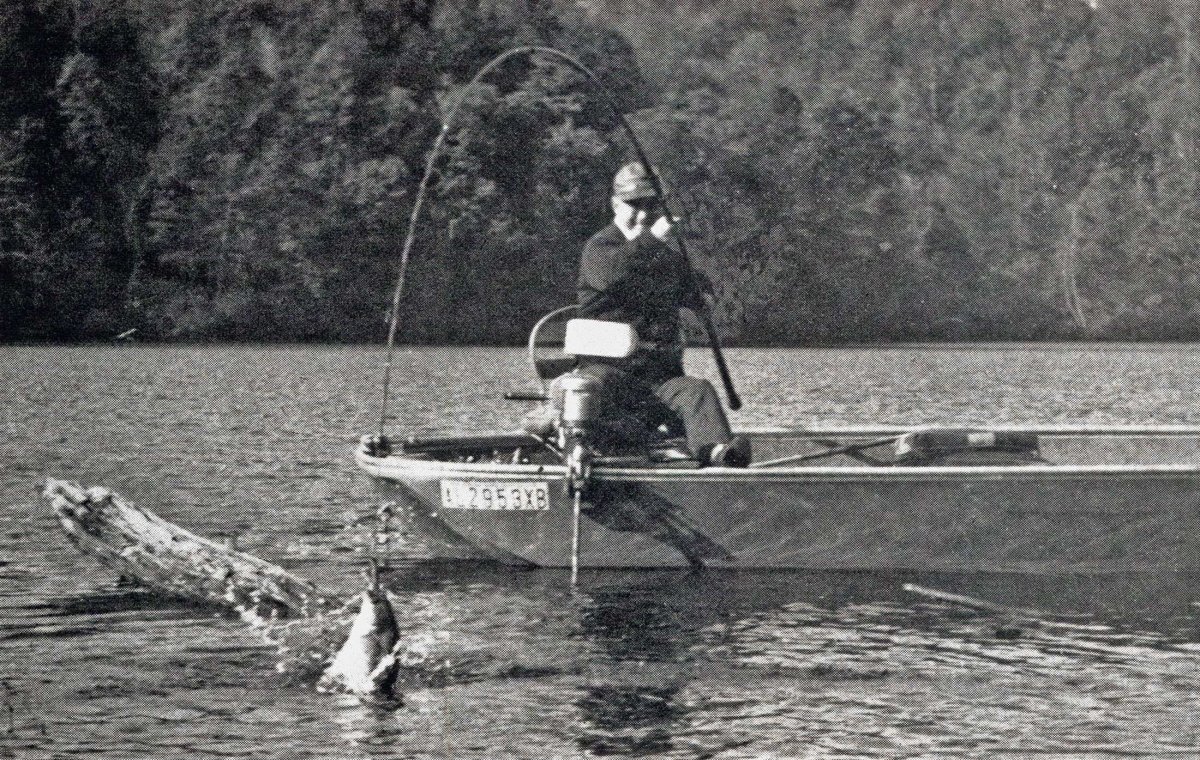

For half an hour I jockeyed my boat along, parallel to Bill Sloggett’s with my camera cocked and ready. At least I thought I was ready.
I wanted to photograph an infuriated bass clobbering the business end of a jiggerpole, but even a timber rattler can’t strike that fast. My reflexes simply could not take up the slack in time to catch the explosive smash as a three-pound largemouth vaulted into the air on the other side of a floating log with the jiggerpole lure in its mouth.
I did manage to click the shutter as Bill heave-hoed the bass into jumping over the hazard. That accomplished, Bill plunged his pole down into the water to hold the bass under and swung hard toward the stern of his boat. In one easy, flowing motion, Bill then swapped ends on his pole.
Holding the butt high, and grasping the forward section in the fashion of a hand-liner, he assisted the largemouth’s final jump and brought him in over the gunwale.
The bass shook the plug loose and drummed out a bongo rhythm on the bottom of the boat. After the fish finally settled down, Bill eased it into the live well and returned to his swivel seat in the bow. He was as nonchalant as a shoe clerk ringing up one more sale.
I reckoned the elapsed time from strike to bass in the boat at 15 seconds, perhaps a second or two less, but certainly not more.
Jiggerpole bass fishermen are really very sharp anglers, though to some people they are very strange. If you have ever fished the lakes and rivers of the Deep South, you have probably seen at least one zany-looking character moseying along close to shore in a boat while he slapped the water with the tip of an 18-foot pole.
Perhaps there was another character steering in the stern, but odds are that the jiggerpoler was a loner. If you tapped the side of your head and winked knowingly at your partner, it was because you couldn’t see the commotion in the jiggerpoler’s live well or the lumpy burlap bag trailing in the water alongside his boat.
Bill was christened William Lloyd Sloggett. He weighs 148 pounds, stands five feet three inches in his socks, and is built along the lines of the American bison — heavy shoulders and torso. Three loves consume the major portion of Bill’s time — a huge white-and-fawn tomcat, jiggerpoling, and Gracie. Gracie is Bill’s sidekick. She has a pleasant disposition, and she’s almost as nutty about bass fishing as her husband.
At age 57, Bill has managed to accumulate a comfortable nest egg, and now he works a three-day week as warehouse auditor for a hardware firm. Most of his free time is spent jiggerpoling the boondocks along the Black Warrior River Bargeway where it divides Jefferson and Walker counties in north-central Alabama. He lives in Hueytown, a suburb of Birmingham.
Hair-raising excitement and bass on the table await those who are ready to pay the price. Jiggerpoling, Bill points out, is a demanding art. Perseverance and concentration are the keys to success. You have to keep the pole and the lure constantly zigzagging through, around, over, and under the weeds and debris where this specialized kind of fishing works best.
The beginner finds out that the effort is tiring, but he soon gets used to it. Be assured, though, that the fatigue results more from mental strain than from physical exertion. After an hour, more or less, even a veteran takes a break to sip coffee and nibble a cookie or perhaps make a few casts with ordinary tackle. When Bill called time out, I climbed into his boat for a chat. The first item to draw my attention was the electric trolling motor mounted on the gunwale of the boat near the bow.
In addition to the regular steering handle, the motor had a piece of 1-inch strap iron fastened around it. Where the ends of the strap joined opposite the ordinary steering handle, it was formed into two flat extensions that were held tight together by a bolt. Bill steers mostly with his feet from his high perch. One foot goes on the regular steering handle, and the other rests on the strap-iron extensions. By moving one or both feet, he can swivel the electric motor around to steer. He uses the regular gasoline-powered outboard motor in the stern as a stabilizing drag while underway with only the bow-mounted electric motor running. Bill moves his boat along handily and silently as he maneuvers his lure through log jams and into pockets and tiny coves. A footoperated lever starts, stops, and controls the speed of the electric motor. Both his hands are free to handle the jiggerpole.
Tall fishermen may find it uncomfortable to hunker up in the bow as Bill Sloggett does, but the jiggerpoler should take his seat in the bow a few inches above the gunwale of his boat. A swivel chair bolted to the forward seat is a great help, though you can do without it. If you have only the usual thwart, don’t sit with both feet forward. That situation makes it difficult to turn around and maneuver the bass toward the stern of the boat. Instead, straddle the seat with one foot in front. and one foot aft of the seat. Even then, you must swing the forward foot back over the seat, and then stand up to muscle the bass. That position gives you enough leverage to lift your fish into the boat after you have swapped ends on your pole. For safety’s sake, no matter how you fish, make sure that there is no clutter of tackle in which to entangle your feet. If your boat is quite small.
There is really nothing new about jiggerpoling except that artificial lures have replaced animal skin and live bait. The art’s origin is lost in antiquity. Our Southern forefathers used it to put plenty of fish on the menu.
With the advent of the multiplying reel a generation of long-line anglers was born. Then spinning and spincast gear plus monofilament line came along, and jiggerpoling was almost forgotten.
What jiggerpoling lacks in sport, it makes up for in excitement. And no sophisticated threadliner will scoff who has once experienced the electrifying jolt of a six-pound bass socking the business end of a jiggerpole. There’s nothing but your shoulder sockets to absorb the strain.
The first item on Bill Sloggett’s list of jiggerpoling gear is a can of dull-green paint. The paint is applied to the upper half of the pole and to the shaft and propeller of the electric motor.
Furthermore, Bill’s boat is painted green, and he says the paint job doubles the score that could be made by anyone fishing from a shiny aluminum boat or one painted a light color. He reasons that the jiggerpoler operates very close to his quarry in shallow water that’s often as clear as gin. Except for the lure itself, there must be no reflected light to flash an alert.
The pole itself must be strong and light in weight, and it must have a whippy end even after you cut off two or three feet off its tip. Select an imported bamboo not less than 20 feet in length that is symmetrically tapered and has a comfortable hand-fitting butt. Cut off the two or three feet. The new tip should be fairly stubby but whippy. Paint the pole dull green from the tip back to the middle.
Tie the line to the middle of the pole and then spiral it around the bamboo to a point 4.5 inches from the tip. There make four or five loops around the pole, put the line through the loops and cinch it down tight into a nail knot. This is a safety measure. If the business end of your pole should break, the line will still be attached to the heavy middle section. Now use an improved clinch knot to secure a large snap swivel to the line. Your snap swivel should be approximately six inches below the tie to the pole, and the tie to the pole should be 4.5 inches from the pole’s tip. As I’ll point out later, there is a very good reason for not tying your line to the extreme tip.
Most veteran jiggerpolers use a bamboo cane, but Bill Sloggett and another good jiggerpoler by name Bobo Johnson use 20-foot fiberglass telescoping poles. They both say glass is inferior to bamboo because of its excessive weight and exaggerated flexibility. In fact, they advise the beginner against using one. They use them only for their ease of transport.
Bobo, an adventurous veteran, secured a durable rod guide to the top of each section of his fiberglass pole. The top guide is secured 4.5 inches below the tip. An automatic fly reel loaded with 30-pound test monofilament completes this rig.
I mention this type of gear for the benefit of those who will think it a shade more sporting. Bobo warned me though, that lots of big bass are lost with that type of tackle. Bill Sloggett advanced an explanation. Except in the spring of the year when bass are whooping it up, he said, they are hiding out and sleeping off a full belly after a night on the prowl. When a noisy plug the size of a half-grown mullet invades the privacy of their bedchambers, they are aroused to fight rather than eat. Fewer than half are ever solidly hooked. Without a reel, you dump the bass in the boat before it can shake the plug loose.
The jiggerpoler relies on four types of lures that have one quality in common. They are all pike-size big. Bill, like all the old-timers, favors wooden plugs over modern plastics. It’s easier to doctor a wood plug with splashes of gaudy paint. Newcomers may ha.ve to settle for plastic plugs or do as Bill Sloggett has done — whittle out a few and paint them.
Bill advises against the use of cutrate lures because of their lack of action and their inferior hooks. Hooks must be strong, they must be sharp, and you should have replacements.
Jiggerpoling is a rough sport and hooks are often straightened out or stripped off the lure. Straightened hooks should be replaced, not rebent.
Jointed plugs, better-known in the Deep South as crackbacks, get top billing under normal water conditions. For no apparent reason, though, some second-choice plugs sometimes arouse more action than the top-ranking crackbacks. These are weighted cigar-shaped minnows with spinners fore and aft.
When the water is dingy to muddy, use big, bulky floaters with spinners on both ends and try metal noisemakers.
Flash is of first importance even with dark lures used at night or in discolored water. In clear water, gold, silver, and touches or streaks of red are good. Bill’s top-producing lure is a hand-crafted crackback that he painted natural aluminum and then decorated with a gold stripe intersected by a large gold spot on each side. When the colors on any of Bill’s plugs begin to fade, they are in for a shining up or fresh paint.
Controlled noise is the key to successful jiggerpoling. You learn to produce the right music or forever remain a dub at the game. That’s the reason for tying off your line 4.5 inches from the tip.
The jiggerpoler holds the pole’s butt with one hand while his other hand grips the pole some three to four feet up the shaft. By jigging with his forward hand, he constantly slaps the water with the tip of his pole to create a bubbly wake ahead of the approaching plug. As Bill Sloggett puts it: “If your pole isn’t kicking up a bubbly wake, you’re not jiggerpoling.”
The commotion cannot be correctly executed with the line tied directly to the tip of the pole.
When the water is clear. Bill moves along at a steady clip under low power. His plug executes erratic zigzags and spiral patterns over and under logs, into pockets, and along the edges of weeds.
Piers and boathouses often yield resting lunkers. Many an old mossback has been snaked out by running the plug under the water-level doors of a boat shelter.
Silt-colored water calls for a change in lures and tactics. The jiggerpoler slows down and switches to the big floaters or metal fussbudgets. He sneaks up to logjams or brush or to weed patches. Then he stops. If the debris is just below the surface, he uses a bulky floater. If weeds or debris are thick and stick up above water, he uses a metal lure with a single upturned hook.
While stationary, the jiggerpoler sweeps his lure in figure eights and tight circles, all the while keeping up a steady spat, spat, spat with the tip of his pole. He doesn’t hurry. He works each likely spot several minutes before moving on.
The veteran jiggerpoler dislikes the spring. Why? Because he invariably catches his limit before he is ready to call it a day. The bass are concentrated in shallow water close to shore. They are gorging in anticipation of the spawn. An erratic lure kicking up like an injured minnow triggers fast action.
I asked Bill why he believes jiggerpoling gets more large bass than conventional plugcasting.
“That’s elementary,” he replied. “The plugcaster tosses in a peanut-size lure and immediately reels it away before the bass can make up its mind. On the other hand, the jiggerpoler swishes a bellyful of porkchops under the fish’s nose long enough to excite his appetite or raise his hackles.”
When surface water warms to 80 degrees or more all the bass are supposed to retire to deep water during daylight. Jiggerpolers have proven that this is not so. These fishermen continue to pull monstrous bass out of water barely deep enough to cover their dorsal fins.
Bill cited the scientific fact that Mother Earth is reluctant to change temperature. During the hot summer months the shaded, debris-clogged shallows are often a bit cooler than deep water.
Another factor in holding bass close to shore is the abundance of oxygen released by shoreline weeds. In fresh water, this life-essential element is the byproduct of vegetable life and it is more abundant in weedbeds along shore.
“During the summer doldrums,” Bill says, “jiggerpole the boondocks. Stash your crude tackle and break out your sophisticated gear for display, if you wish. You’ll be the envy of every nonplussed fisherman on the dock. Fall is the time to really whip up the action.
Move along at a more rapid pace and really spat it up with the tip.
Fall bass average larger, and they are more savage. It’s the time for busted jiggerpoles and hook replacements. It is also the time for bruised ribs if you allow the butt of your pole to slip.
Jiggerpolers have proven that not all fish hole up in deep water during the winter. Radiant heat is the answer. If you sit in the sunlight filtering through a pane of glass, you will feel radiant heat even though the glass is cold to your touch. The identical phenomenon occurs with unruffled clear water.
The black bass is a member of the sunfish family, and all sunfish love to bask in the radiant heat of the sun on a calm winter day. You will still find them near cover, but the veteran jiggerpoler confines his winter efforts to the sunny side of the lake or river .
Having gotten a belated start myself, I am not completely gone on jiggerpoling as the one best way to catch bass.
This story was originally published in the June 1970 issue of Outdoor Life.
Read the full article here
