



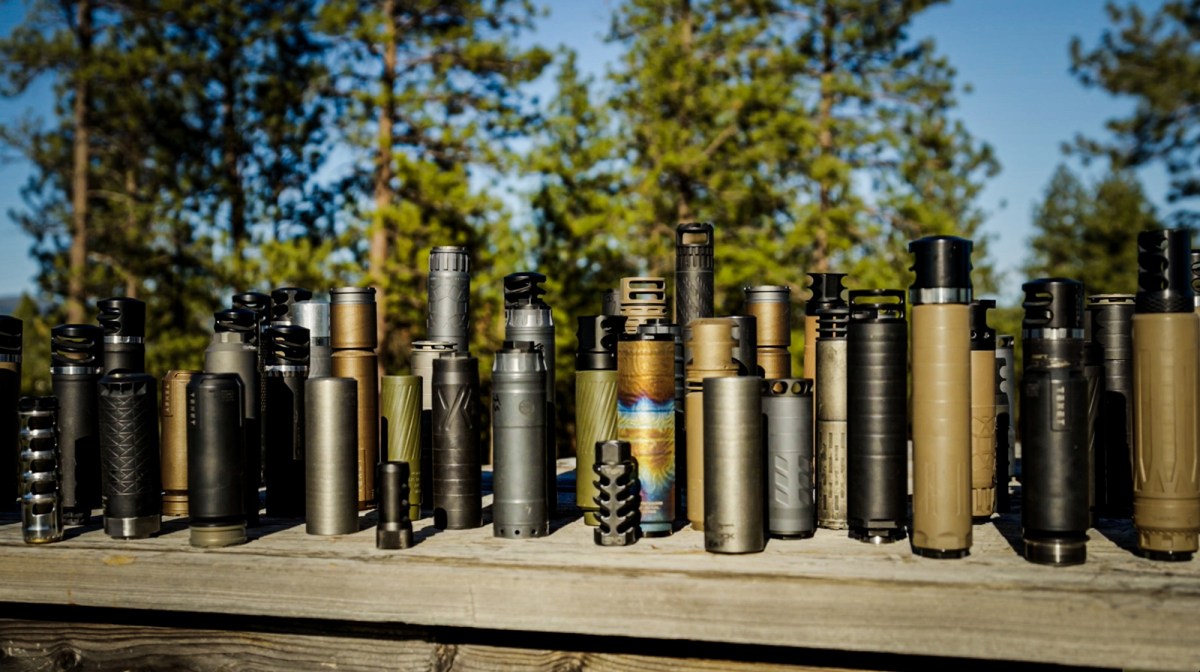

The suppressor landscape is rapidly shifting. The jack-of-all-trades silencers that once dominated the market have had to make room for specialized suppressors that excel at specific tasks. That’s why we conducted a test to put a spotlight on cans catering to two growing niches: competitive long-range rifle shooters, and hunters who are concerned with the weight of their gear.
Table of Contents
Goals of the Test
With these end users in mind, we gathered a field of suppressors, some brand new, others well-known mainstays, to see which did the best job of dampening recoil, which were quietest, which are the lightest, and which struck the best balance of all three qualities.
We tested most of the suppressors in multiple configurations, with different muzzle devices, and in different overall lengths when applicable.
Along with the suppressors, we evaluated some popular muzzle brakes. In part, we did this to see how the recoil-reducing suppressors compare, but also to assess how they perform in their own right.
One thing we didn’t include was pricing information, because we tested so many combinations of suppressors combined with aftermarket brakes. Roughly speaking, the cans featured here run from $500 to $1500, and the add-on brakes are $200 to $300.
The video (above) shows the results of each suppressor and its iterations on individual graphics. The video also presents a summary of the suppressors that did the best in the categories of recoil, sound, and overall weight.
In the video I discuss the test’s methodology, which you can also read about in detail below.
What Matters to Competitive Shooters
Competitive long-range shooters are primarily concerned with spotting hits and misses through their riflescope and, secondarily, reducing the pounding on their ears and general fatigue from high-volume shooting over a two-day match.
Suppressor weight is sometimes also a consideration: In shooting disciplines with weight restrictions, lighter is generally better. In the PRS realm, where some rifles are pushing 30 pounds, a heavy suppressor is sometimes preferred.
The cans that have cropped up to cater to these folks are typically modular, with multi-port muzzle brakes, and can often be run in long or short configurations. They do a good job cutting recoil but are often quite loud, too.
What Matters to Serious Hunters
Another group looking for specialized suppressors are hunters who want to keep the weight and overall length of their rifles down while muffling the sound signature as much as possible. Thanks to the miracle of 3D printing, we have some new designs that are head-scratchingly quiet considering their weight.
Some of these cans are modular, but many have one-piece construction to keep weight down while maintaining strength.
The Best of Both Worlds
It’s possible to get high level performance from individual cans that will appeal to competitive shooters as well as hunters obsessed with ounces.
In some cases you can take a popular lightweight can, like a Silencerco Sythe Ti or CGS Hyperion, attach an aftermarket brake from Recoil X or Area 419 and significantly improve its recoil mitigation. But there are impressive newcomers too, like Clovis, Tenet, and Unknown, that hit a sweet spot with their weight, recoil reduction, and sound.
Some Critical Caveats
All the numbers we measured for recoil and sound are solid and defensible. We took great pains to ensure the results were repeatable. And while they tell us a lot about the relative performance of these suppressors, they don’t paint the entire picture.
In addition to reviewing the selected highlights from the test, I urge you to look at the caveats I discuss farther down.
That critical context will help you avoid misinterpreting the data and explains our testing methodology.
Key Takeaways
Here are the results showing which suppressors excelled at recoil reduction and sound mitigation, as well as which are the lightest. We also cover muzzle brake performance.
Best Recoil-Reducing Suppressors
One thing our test clearly indicates is how effective the Recoil X brake (which can attach to many common suppressors) is at cutting recoil. When you scroll through the complete data you’ll notice the dramatic difference it makes when a can’s flat cap is replaced with one. The brake adds three to four ounces to the total weight of the system, but typically cuts the recoil by 12 to 13 inches. (With our test gun mounted in a sled on tracks we measured how far the apparatus moved with each shot. Less movement indicates less recoil.)
In the case of the Silencerco Omega 300, the Recoil X brake reduced the distance traveled from 36.7 inches with the flat cap to 21.9 inches — a 14.8-inch improvement, while just adding 2.7 ounces.
The Area 419 Gen 2 Maverick brake also did an excellent job slashing recoil, and in some cases edged out the Recoil X, as with the Silencerco Scythe STM in the long configuration. With the Area 419 aboard, this suppressor recoiled an average of 22.8 inches to the Recoil X’s 23.1 inches. As I discuss below, however, this difference is essentially imperceptible to the shooter. (One inch less of measured movement amounts to about a 4 percent reduction in recoil.)
The difference you will notice between the brakes is their weight. The Area 419 Gen 2 is heavy by design (it’s geared toward PRS shooters) and adds about 9 to 10 ounces to the suppressor.
Another brake to keep an eye on is the Tango Bravo by Wyoming gunsmith Trevor Tesmer. His brakes cut recoil nearly as well as the Recoil X but were a few decibels quieter.
I also want to give a nod to Tenet. The Limited 30 suppressor with a two-port brake turned in excellent results (21.9 inches of recoil) while weighing significantly less than the other cans in this group. This new company’s products do an impressive job striking a balance between recoil mitigation and light weight.
One last point to note is that the performance of these braked cans rivals what we were seeing from state-of-art muzzle brakes a few years ago. The APA Gen 2 Fat Bastard is a highly respected brake and in our test averaged 20.5 inches of recoil and 167 dB. The top-performing cans aren’t far behind, but are much quieter.
(Click here to jump to the complete data at the end of the article.)
| Suppressor | Recoil Avg | Sound Avg | Weight | Length |
|---|---|---|---|---|
| CGS Hyperion 762 K (Recoil X Gen 2 Brake) | 20.5 in. | 157.3 dB | 14 oz. | 8 in. |
| Area 419 Maverick Gen 2 30K (Short) (Recoil X Brake) | 21.4 in. | 159.7 dB | 14 oz. | 7 in. |
| Silencerco Omega 300 (Recoil X Gen 2 Brake) | 21.9 in. | 148.1 dB | 18.4 oz. | 7.9 in. |
| Tenet Limited 30 (Horizon Two Port Brake) | 21.9 in. | 145.6 dB | 8.6 oz. | 7.2 in. |
| Clovis Precision Sabertooth 5 (Recoil X Brake) | 22 in. | 156.1 dB | 12.6 oz. | 6.8 in. |
| CGS Hyperion 762 SK (Recoil X Gen 2 Brake) | 22.1 in. | 153.6 dB | 12.8 oz. | 8 in. |
| Silencerco Scythe Ti (Recoil X Gen 2 Brake) | 22.1 in. | 142.3 dB | 12 oz. | 7.6 in. |
Lower numbers are better for recoil and noise.
Best Sound-Reducing Suppressors
In the minds of most shooters, the primary job of a suppressor is to cut noise. To that end we used a sound meter positioned one meter off the left-hand side of the muzzle to take readings and averaged the results from four shots.
The cans listed here all performed very well. The Tenet Reserve is remarkable for its sound reduction compared to its weight, but if you’re looking for the lightest, quiet can, the Airlock Zero Gravity is a winner.
The PTR Vent 1 is one of the most distinctive suppressors in the test. It is printed out of a metal foam in a process known as PIP for “purposely induced porosity.” Viewed up close, the end cap and interior walls have a texture like a sponge.
The caveats below touch on the subject of a can’s tone compared to its decibel value. And PTR Vent 1 has one of the most interesting, and pleasant, tones we’ve ever heard. Take a look at the facial expressions in the video when we shoot it. The reactions tell the story.
(Click here to jump to the complete data at the end of the article.)
| Suppressor | Recoil Avg | Sound Avg | Weight | Length |
|---|---|---|---|---|
| Tenet Reserve 6.5 | 35.2 in. | 129.9 dB | 8.3 oz. | 8.2 in. |
| PTR Vent 1 | 29.8 in. | 130.7 dB | 16 oz. | 9.1 in. |
| Mack Bros Zenith L (Factory Brake) | 28 in. | 133 dB | 12.4 oz. | 7.9 in. |
| Able Theorem L | 34.8 in. | 133.5 dB | 16.1 oz. | 8.8 in. |
| Silencerco Scythe STM Long (Single Port Factory Brake) | 31.1 in. | 134.9 dB | 19.2 oz. | 7.8 in. |
| Thunder Beast Ultra 9 Gen 2 | 34.4 in. | 135.2 dB | 13 oz. | 9 in. |
| Airlock Zero Gravity 7mm | 34.4 in. | 135.4 dB | 6.7 oz. | 5.5 in. |
Best Lightweight Suppressors
As I mentioned above, the Tenet and Airlock Industry cans have distinguished themselves in this test. And delivering performance in a lightweight package is one of their sterling qualities.
A perennial drawback of suppressors is how they can unbalance a rifle and make for awkward handling and transport.
That’s a big reason behind the trend of rifles with shorter barrels — 20 inches or less. Pair one of those with these suppressors and you’ll hardly notice the can at all. At 5.5 ounces, the Tenet Limited 6.5 is the lightest in the test, and an average sound reading of 141.3 dB is very good performance.
For just half an ounce more, the Airlock Zero Gravity 6.5 is notably quieter. Depending on your priorities, either is a good option.
Mack Bros was one of the sleepers in this test. Going through the full data we were impressed by how well the company did across all categories. And Unknown Suppressors has been making waves with its Reaper and NHS — a competition-oriented can that stands for Not Hearing Safe. After running them through our test protocol, we see why.
The Silencer Co Scythe Ti
See It
I’d also be remiss if I didn’t acknowledge the Silencerco Scythe Ti. This can has been around for a while now — and has a reputation for rupturing that isn’t without merit — but if someone is looking for a do-it-all suppressor, it is hard to beat.
With the factory end cap it is lightweight and quiet, but with the addition of a Recoil X brake it does an excellent job mitigating recoil.
(Click here to jump to the complete data at the end of the article.)
| Name | Recoil Avg | Sound Avg | Weight | Length |
|---|---|---|---|---|
| Tenet Limited 6.5 | 31.1 in. | 141.3 dB | 5.5 oz. | 5.2 in. |
| Airlock Zero Gravity 6.5 | 38.5 in. | 135.7 dB | 6 oz. | 5 in. |
| Silencerco Scythe Ti | 32.1 in. | 137.8 dB | 7.3 oz. | 6.2 in. |
| Mack Bros Zenith K (Flat Cap) | 39.3 in. | 149.8 dB | 7.7 oz. | 4.5 in. |
| Thunder Beast Ultra 5 Gen 2 | 37.8 in. | 147.4 dB | 8 oz. | 5 in. |
| Diligent Defense Enticer S-Ti | 36.8 in. | 138.9 dB | 9.3 oz. | 6.8 in. |
| Unknown Reaper | 34.4 in. | 143 dB | 9.3 oz. | 6.3 in. |
Muzzle Brakes and Bare Muzzle
This project focused on suppressors, but we wanted to put some brakes to the test as well. This data isn’t exhaustive. There are a ton of brakes out there we didn’t shoot. But the results were revealing, nonetheless.
The CHAD brake is in a class of its own. It is heavy, but it cut recoil like no other muzzle device. The MPA DN5 and APA Gen 2 Fat Bastard, both commonly seen at PRS matches, also did well.
Other brakes performed no better than the best braked suppressors in the test. There’s still a case to be made for those products — namely that they are legal in places where suppressor ownership is prohibited.
This chart also shows how the rifle did with a bare muzzle, which is a useful baseline to compare any suppressor or brake against.
(Click here to jump to the complete data at the end of the article.)
| Brake | Recoil Avg | Sound Avg | Weight | Length |
|---|---|---|---|---|
| Bare Muzzle | 39.5 in. | 165 dB | N/A | N/A |
| CHAD muzzle brake | 16.5 in. | 168.9 dB | 14.7 oz. | 4.6 in. |
| MPA DN5 | 18.1 in. | 166.9 dB | 6.9 oz. | 3.1 in. |
| APA Gen 2 Fat Bastard | 20.5 in. | 167 dB | 7.8 oz. | 3.5 in. |
| CGS Hyperion 762 K (Recoil X Gen 2 Brake) | 20.5 in. | 157.3 dB | 14 oz. | 8 in. |
| Recoil X Gen 2 Brake on Area 419 Adapter | 21.9 in. | 165.7 dB | 13.9 oz. | 4.6 in. |
| CGS Hyperion 762 SK (Recoil X Gen 2 Brake) | 22.1 in. | 153.6 dB | 12.8 oz. | 8 in. |
| BOSS Top Shot (Recoil X Gen 2 Brake) | 22.8 in. | 152.5 dB | 14.7 oz. | 6.9 in. |
| CGS Hyperion 762 SK (TSV Hybrid Bolt Recoil Brake) | 23.1 in. | 148.6 dB | 11.1 oz. | 6.3 in. |
| Hellfire Brake | 23.5 in. | 167.7 dB | 4 oz. | 3 in. |
| Area 419 Maverick Gen 2 Brake | 24.2 in. | 167.5 dB | 16.7 oz. | 4.6 in. |
| BOSS Top Shot (Factory Brake) | 24.4 in. | 155.3 dB | 14.6 oz. | 6.2 in. |
Caveats Concerning the Results
I mentioned above that this data requires context to understand. I’m going to step through each of the test criteria to explain what you can glean from these numbers as well as what shouldn’t be inferred.
Judging Recoil
The values listed are in inches and show how far our test rifle, which was mounted on a sled on tracks, moved backward. The lower the number, the better the suppressor or brake did to cut recoil. The results varied from 16.5 inches, with the CHAD muzzle brake, to 40.4 inches, from the Able Theorem S.
The majority of the suppressors, most of which had brakes, landed in the 20- to 30-inch range. Many suppressors had the same final number, measured down to the tenth of an inch.
What an Inch of Recoil Signifies
For context, a one-inch difference in travel amounts to about a four percent difference in felt recoil. Will most shooters be able to tell the difference between a can that scored 21 inches versus one that scored 23 inches? Not likely — to say nothing of those within a fraction of an inch of each other.
There’s also the matter of how the recoil is experienced by a shooter versus our test sled.
Some of the suppressor-brake combos that ended up with a higher recoil value shoot flatter and are less disruptive than others that did better in our test. From the shooter’s perspective, recoil only matters to the extent that it throws off our sight picture — or not. A softer-recoiling system (as measured in this test) might have more barrel whip than a suppressor that did “worse.” Just because some cans have lower recoil values doesn’t mean its recoil as experienced by the shooter is necessarily superior.
Sound Readings
Our sound measurements were taken by a Larson Davis Spartan Model 821 meter positioned one meter to the left of the rifle muzzle, the mil spec standard. Those values are consistent, though if you pick through the full data set, you’ll notice some suppressors exhibit notable first-round “pop” while others remain steady across all four shots.
We would have liked to gather sound readings at the shooter’s ear position, too — and plan to in future tests — but because of the way sound reflected off our shooting bench, those numbers weren’t consistent and, therefore, not something we were comfortable using.
Sound is a complex metric. If you want to dive down the rabbit hole, I suggest you look at the Thunderbeast’s Silencer Summit from last year and check out their results and methodology.
Our single point of measurement tracks well with their conclusions, which reinforces our confidence in our numbers.
Tone vs Decibels
Shooting so many suppressors in sequence really drove the point home about the difference between a measured decibel reading and the tone as experienced by the human ear. For instance, the Scoute OTB registered values of 144.5 dB to 150 dB, depending on its configuration. Those values put it right in the middle of the pack. But the tone of that can was noticeably more pleasant to the ear than others that were objectively quieter per the sound meter.
Weight Measurements
We used a calibrated scale to weigh all the suppressors and brakes, but there are caveats here, too. Many of the suppressors in this test were new or had been shot very little. And many were beloved workhorses with thousands of rounds through them.
Dirty vs Clean Cans
While it would be nice to run nothing but pristine cans for a true apples-to-apples evaluation we were more interested in casting as wide a net as possible.
It wasn’t feasible to assess the condition of each can, in terms of the degree of use it had been subjected to relative to the cleaning and maintenance it had received over its lifespan, if any.
In one case, a Thunderbeast Ultra 7, the weight was so off from the factory spec that we pulled it from the test. It had several ounces of built-up fouling, which certainly had a negative impact on its sound and recoil measurements. It was disappointing to exclude it, since the TBAC Ultra 7 is a gold standard, especially in competition circles. But it was the right thing to do.
Another source of variability we couldn’t fully account for was the hub mount on every can. Some of the cans had hubs from other manufacturers, which can add (or subtract) a fair amount of weight.
This is another way the new out-of-the-box cans had a potential advantage.
How to Interpret the Numbers
So please keep these things in mind when judging the results.
The recoil reduction data is very useful to compare the relative performance of the cans to each other. Same goes for the sound – the numbers give an excellent account of their relative performance.
Beware of “Scores” Based on This Test
These numbers aren’t, however, indicative of an absolute ranking that’s set in stone. There’s enough squish in these numbers — as I detailed above — that drawing such a conclusion would be misguided.
Furthermore, any attempt to combine these numbers into an aggregate score, and use that “score” to rank these suppressors, would be misleading.
Since we’re making all the data public, other companies will be free to present, and potentially manipulate, the information as they see fit. But there’s only one official outlet for this data, and that’s here.
Outdoor Life’s Test Standards
I’ve been testing gear at Outdoor Life for 25 years, and we are very careful with how we present our findings.
Some tests and methodology support a tacked-down ranking of products with a final score. This suppressor test does not. This is our first go at a suppressor test and while we stand by the data, we also understand its limits — and want you to as well.
Joseph Ewing and Outdoor Life will continue to work together to refine our methodology. So in future tests you can expect even stronger data that will support more definitive conclusions.
Origin of the Suppressor Test
This test is the brainchild of Joseph Ewing — a Montana-based shooter — and Carson Lilja and Kris Huber, a couple of his trigger-pulling buddies.
They came up with the idea of mounting a rifle on a sled atop a pair of tracks and measuring recoil by triggering the gun and seeing how far back it pushed the apparatus.
This was born from the desire of these shooters to gauge the performance of their own gear. But when Ewing published the data on the twenty-something cans they evaluated, it generated a firestorm of interest within the precision shooting community — as well as among suppressor manufacturers.
It certainly caught my eye and, right after the information came out, Joseph and I had conversations about a second, more ambitious, suppressor recoil test. This is that test.
Methodology
The sled that holds the rifle has wheels that glide down tracks. On the side of the fixture is a ruler with measurements from which we take a recoil reading. At the same time, we’re measuring the sound at the muzzle.
The rifle is triggered by an air bladder inserted in the trigger guard that allows us to fire it without handling it.
The rifle is a typical competition build. It’s a 6.5 Creedmoor on a Lone Peak Fuzion action with a Lilja barrel. Carson Lilja donated a new barrel for this project and, by the end of the day, it had more than 600 rounds through it.
Despite the brutal treatment, it still shot tiny groups after we concluded the test, which is a testament to its quality.
We had a supply of custom ammo, courtesy of Michael Hallak at Vantage Research. He loaded several hundred 145-grain Barnes Match Burners that produced consistent velocities around 2800 fps.
We shot each iteration of the suppressors four times and averaged the results. Initially we had planned to do five shots, but we found the data was consistent with four. We only need to shoot the muzzle brakes three times to get valid data.
Calibration
Joseph’s sled is a sensitive instrument that requires calibration. We shot it with two suppressors to establish a baseline, one with a brake and one without.
After every 10th suppressor or so we tested, we would check the calibration again. We did this more than a dozen times during the day.
As the day got hotter, the sled would move slightly more freely, so we would add weight to it to get it back to the baseline before proceeding. At one point, in an excess of caution, we retested a batch of 12 suppressors to ensure they had been properly evaluated.
The Full Results
Final Thoughts on the Suppressor Recoil and Sound Test
A test of this sort is bound to ruffle some feathers. That’s why we’re sharing all the data we gathered so you can examine the results yourself. We went to great pains to gather unbiased and defensible information. I believe we accomplished that, but we’ll let you be the judge.
I’m excited to continue this effort with Joseph and expand the scope of the test to include other categories of suppressors. This is especially relevant right now given the degree of change in the world of silencers. We’re seeing new and clever designs that are making many traditional offerings obsolete.
Suppressor manufacturers are scrambling right now to adjust to this new reality, and our goal is to keep you informed about which of them are succeeding.
Read the full article here
