



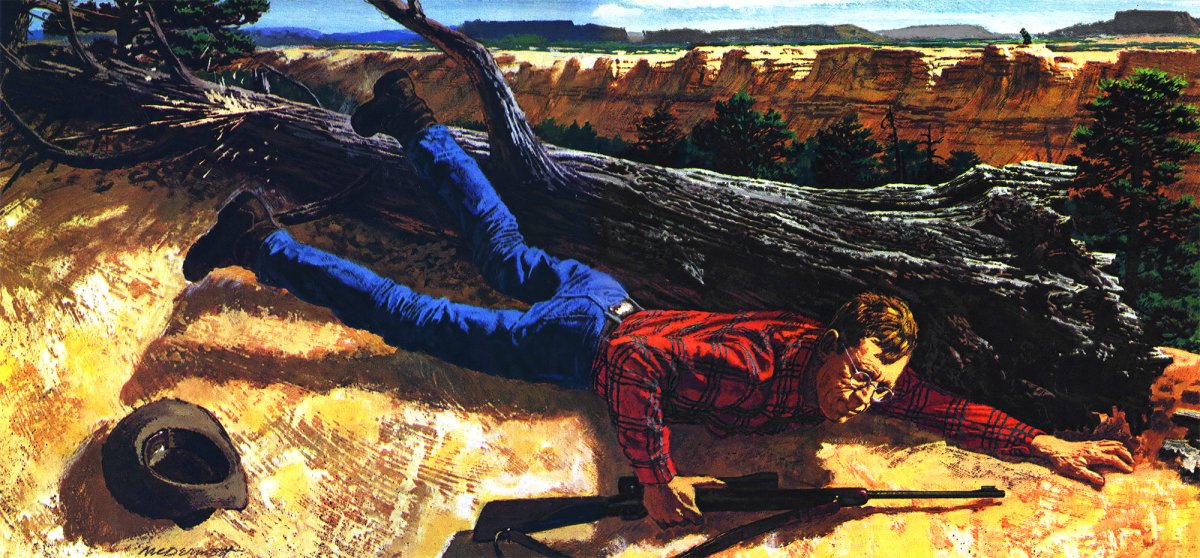

This story, “Why You Shoot Your Uncle for an Elk,” appeared in the April 1973 issue of Outdoor Life. Hunting accidents were much more common in the mid-century — before the advent of mandatory hunter safety courses. Hunting is now a relatively safe sport.
It was a bitterly cold day, overcast, and with just enough wind to drive the cold through your clothes and into your bones. It was almost but not quite snowing. The few flakes that fell were as hard as sand.
An elk hunter whom we shall call Joe Smith had just about had it. His pickup was parked some three miles away on a forest-service road. He had seen plenty of sign but no elk, and he had decided that the animals were down in the bottoms of the draws and in the heaviest timber. On the edge of a little mountain meadow below him was a dead tree that would make good fuel. He decided to go down there, build a fire, get warm, then hunt back toward the truck.
Joe was wearing wool underwear, heavy wool lumberjack pants, two wool shirts with a light down jacket over them, shoepacks, and two pairs of wool socks. Over all this he wore a pair of white cover-alls to break the wind. On the back of the coveralls in large red script was JOE’S SERVICE.
Joe was bending over, trying to get a fire started, when another elk hunter saw him. This other hunter put a rifle bullet right between Joe’s shoulder blades.
The day after I began work on this article, I was drinking my morning coffee and reading a local newspaper. Elk season had opened in some areas of Idaho two days before, and when I turned to the local-news page I instantly saw this headline: HUNTER IS KILLED BY ANOTHER’S SHOT.
It was the old familiar story. A hunter from California had come to Idaho with his father to hunt elk. The two men had succeeded in shooting an elk and were engaged in cleaning it. Both were bent over the elk as they worked. Then the younger man stood up. Another hunter about 100 yards away put a bullet into his chest and killed him instantly.
The hunter who was killed was wearing an olive-colored jacket. I have never seen an olive-colored elk, and neither has anyone else. No one as far as I know has ever seen a white elk with Joe’s Service· in red script on its hide. No one has ever seen an elk wearing a scarlet shirt and a fluorescent-yellow vest, but some years ago an Idaho elk hunter so clad had his arm shot off by another elk hunter.
I have been shot at only once. That was many years ago in the high plateau country of central Arizona. Deer and turkey seasons both were open. I was pussyfooting along through the yellow pines and Gambel oaks on one side of a canyon, hoping to see a bunch of turkeys before they saw me. It was about 8 a.m. on a bright sunny day, but the air had been cold during the night and the frost on the grass was just beginning to melt. I saw a good deal of fresh turkey sign, and I thought the birds would probably be feeding in the sun to get last night’s cold out of their bones.
Across the canyon at a distance of 300 yards or so I had from time to time seen another hunter. I had looked at him once with a funny little French binocular I had at the time. He was wearing a pair of blue bib overalls, a green sweater, and a blue stocking cap.
Suddenly I heard the crack-boom of a bullet fired in my direction — the crack of the bullet breaking the sound barrier followed by the boom that is the report of the rifle. That bullet passed within prob-ably 15 or 20 feet of me. I shouted. Across the canyon I could see the other hunter kneeling and aiming at me. I let out another yell and threw myself behind a log on the ground. Again I heard the crack-boom as the bullet came my way.
I crawled around to one end of the log and peeked. The hunter was still on one knee with his rifle trained toward my log. My life was in jeopardy, and yelling had done no good. I had to take radical action. I switched off the safety of my .30/06 and fired a shot close enough to the hunter to make him aware of my presence. He leaped to his feet and ran.
Later in the day I ran into him.
“Ah,” I said. “You’re the guy who took a pot-shot at me this morning. What in the hell did you think I was?”
At first he denied shooting at me, but then he admitted that he had shot at a turkey across a canyon and was very much astonished when the turkey shot back. How a tall guy in a 10-gallon hat and a red-plaid shirt resembled a turkey was something he was a bit vague about.
In the fall of 1935, I was hunting deer in the Kaibab Forest north of the Grand Canyon in Arizona. All hunters at that time were supposed to camp in three or four campgrounds. I had shot a very fine buck that day and had walked back to camp with the buck on my horse. By the time my companions and I had cooked and eaten our dinner it was well after dark.
We were drinking our coffee and talking about the day’s hunt when a tall man came over to our fire and asked us if during the day we had seen a companion of his, whom he described. We had not. At the time, we all noticed that the man seemed worried beyond all reason. If his companion had got lost, he wouldn’t starve to death or freeze to death in the night. The Kaibab was full of roads, and he would certainly stumble across one the next morning if he had not already done so.
In a half-hour or so the members of the large party to which the missing hunter belonged began firing their rifles in the air to guide their companion in. One man had a spotlight on his car and swept the sky with it. Again the tall hunter came and asked us if we had seen the missing man. We thought it odd that he asked us twice.
Then one of my companions, a professor of economics at the University of Arizona, turned to me and said: “I’ll bet that fellow who has been over here twice knows more about where the missing man is than he lets on. There’s something fishy about this.”
When we left the next morning to drive home, a search for the missing hunter was being organized. The hunter was found dead. He had been shot from across a wide draw by the young man who had been so worried. His story was that he had seen movement and had thought his companion was a deer. When he discovered what he had done, he panicked and could not bring himself to admit it. However, he had left his tracks and they were easily identified.
The man who was killed had been very popular. The hunter who fired the fatal shot was ostracized by the people of the small town where both had lived. Finally the man who fired the fatal shot was unable to stand the social pressure and moved away. This hunter’s carelessness had disrupted and perhaps ruined his life and had given him a burden of guilt he may never have got over.
If what I have written so far has made many readers think that half the gunners in the world are out to get them, let me say that one person most apt to shoot you is YOU. In a recent year, 37 percent of persons who died in hunting accidents in California were their own victims. People kill themselves by leaving guns loaded and then pulling them out of automobiles muzzle-first. They also cross fences with loaded guns and then pull the guns toward them. In my youth I knew two boys who killed themselves that way when hunting quail.
Excited hunters, loaded guns, and automobiles are bad combinations. A Californian was road-hunt-ing in a jeep when he saw some deer. He grabbed his rifle and tried to scramble out of his vehicle. The muzzle caught in his jacket, and the trigger caught on the 4-wheel-drive selector. The rifle went off and killed the hunter.
So far I may have given the impression that anyone who goes hunting is taking his life m his hands. Actually the man out hunting is far safer than he’d be if he were driving or riding in an auto-mobile. In California, according to Hilton Bergstrom, hunter-safety train-ing officer of the California Fish and Game Department, for five years the ratio of hunters to accidents was 1: 6,677. It was 23 times as safe to go hunting as it was to go out in an auto-mobile.
From 1961 through 1964 in 46 American states and seven Canadian provinces, 1,110 fatal and 6,397 non-fatal hunting accidents were reported. Of these, more than one-third were self-inflicted-again proving that the hunter can be pretty dangerous to himself. More than 1,000 fatal hunting accidents in the U.S. and Canada in four years sounds like a great many. If there were only five fatal accidents it would be five too many, but far more people are killed by automobiles in the U.S. and Canada in one month than are killed by hunting accidents in five years.
Anyone who follows a few simple rules will never shoot himself.
He should learn a good deal about his weapon: how to load and unload it, how to put on the safety, what the correct cartridges are and what they look like, how to sight it in, how to clean it and take care of it.
The moment he picks a gun up he should open it to ascertain whether it is loaded or unloaded.
He should form the habit of NEVER putting a loaded shotgun or rifle in an automobile or taking one into a house. He should NEVER carry in a saddle scabbard a rifle with a cartridge in the chamber.
He should NEVER have a cartridge in the chamber of a rifle or a shotgun unless he believes he is in the presence of game.
Once there is a cartridge in the chamber of a rifle or a shotgun, the hunter should know every instant where the muzzle is pointed and NEVER point it at himself or any other person.
Once the gun is chamber-loaded he should ALWAYS remove the cartridge in situations where he might not have complete control of the weapon. Many a man has been killed because he left his gun loaded while he climbed a fence. Many a man has killed himself or someone else because he leaned a loaded gun up against a well, a tree, or a fence — and it fell down.
Many hunters have the ghastly habit of using hunting scopes as a substitute for binoculars (a poor practice at best) and then peering through their scopes at every doubtful object — including me. It scares the hell out of me to see a hunter across a canyon level down on me with a scope-sighted rifle. How do I know that he isn’t going to touch one off? I was mistaken for a turkey once, so why shouldn’t someone decide I was a deer?
But the most careful hunter in the world, the cautious person who never would by accident shoot himself or anyone else, can still get knocked off by a jittery, careless, excited hunter.
Who is the person who shoots another? According to Hilton Bergstrom he is apt to be young — under 25 — and Bergstrom also believes that the more experience a hunter has had the less likely he is to shoot someone else. Many observers believe that there is a relationship between the way people drive automobiles and the way they hunt. The careless and reckless driver tends to be the careless and reckless hunter. Just as drivers under 25 cause more than their share of automobile accidents, so do the young hunters.
But my own notion is that hunters get excited not necessarily because they are young but because they are inexperienced. I have seen middle-aged and even elderly men helpless with excitement. Gray hairs don’t necessarily bring calmness, good judgment, or wisdom.
The most likely time to get shot is during the first few days of the hunting season when the woods and hills are crowded with hunters. For the same reason, the most automobile accidents occur on holiday weekends when the highways are crowded with automobiles.
The 1965 Uniform Hunter Casualty Report shows that more people are shot with shotguns than with rifles and far more at under 50 yards than over. The report also shows that hunting accidents occur most frequently between 2 p.m. and 4 p.m., undoubtedly because more hunters are out during those hours. As a group, rabbit hunters have the most accidents, beyond doubt because of the great number of people who hunt rabbits. Deer hunting is the next most dangerous.
More hunting accidents happen on clear days, undoubtedly because there are more clear days than overcast ones. Oddly, more hunting accidents occur in the open under conditions of good visibility than otherwise. Of the 82 accidents listed in the 1961 report from California, 61 happened on clear days, 60 involved distances of 50 yards or less, and 45 involved shotguns. The hunter casualty report that I have previously referred to lists 21 causes for hunting fatalities. Among them are: “cleaning gun,” “gun dropped from insecure rest,” “shooter pulled trigger inadvertently.”
Most of the accidents where one hunter shot another are concentrated under the following headings: victim moved into line of fire, victim covered by shooter swinging on game, victim out of sight of shooter, victim mistaken for game.
My notion is that there are really only two reasons for accidents. The first and most important reason is wild excitement, panic, a form of buck fever. Second reason is unfamiliarity with the firearm, resulting in poor gun handling. People who pull triggers inadvertently, drop guns, shoot themselves or others while loading and unloading guns, let weapons drop from secure rests, and ride in vehicles with aded guns simply don’t know much about guns and gun handling.
The sportsman who would not dream of violating the rules that govern his sport, including those of safety, should not tolerate the character who shoots at anything that moves because of an obsessive and crazed desire to go home with game.
Incidentally, I am always reading bout people who clean their guns just BEFORE going on a hunting trip and shoot themselves. Why they don’t clean their guns AFTER the hunting trip and how they manage to shoot themselves unless they put the gun away loaded and then point the muzzle at themselves and pull the trigger to see if it is loaded, I’ll never know!
But it should be noted that wild, crazy excitement is the real reason for a high proportion of hunting fatalities. The victim moving into the line of fire and the victim covered by the shoot-er swinging on game are practically the same thing. In either case the shooter should have seen the victim. The heading, “victim out of sight of shooter,” usually means that the excited hunter heard a sound and fired. Far more hunters shoot others because they HOPED the victim was an elk or a deer than for any other reason.
For many years I was puzzled when I read reports of hunters shooting men for elk and deer, horses and cows for deer, and hunting dogs for bear, elk, or cougars. Some of the tales were difficult to comprehend.
On one occasion some Arizona professional mountain-lion hunters had taken a man from the East on a hunt. The dogs bayed a lion in a tree on a bluff. When the client and one of the guides came up, the lion was in the tree and the dogs were below, making a lot of noise. The guide that had followed right behind the dogs was standing about 25 yards to one side of the tree waiting for the client, who was below the bluff, to shoot the cat. The client, who had never been on a mountain-lion hunt before, was trembling with excitement. As he aimed at the lion, the big cat jumped from the tree and raced away, with the pack of hounds right after it. The client then directed his aim at the guide on the cliff, shot, and killed him. The client swore afterwards that he’d thought the guide was the lion.
To most hunters, shooting a man in plain sight for a lion seems incredible. But years ago I had an experience that to me anyway shed a good deal of light on such a situation. A companion and I were after mule deer in an area in southern Arizona where only bucks were legal. We had come up on a ridge where we could overlook a little basin beneath us when a small doe — actually a fawn from the previous spring — ran out, stopped, and looked back. My companion lifted his rifle. When I saw he was going to shoot I touched him on the shoulder.
“Doe!” I whispered.
He swung at me with his left hand and glared at me wildly.
“Get your hand off me, you damned fool,” he said. “That’s the biggest buck I’ve ever seen!”
He fired, and the little doe went down.
When we got to the dead doe, my companion was genuinely astonished. This was not the deer he had shot at, he said. There must have been two deer. He had missed the big buck and had hit this little doe, which he hadn’t seen. I assured him that this was the “big buck” he had seen. It was a long time before he believed me.
It dawned on me then that this man’s desire to kill a big buck had been responsible for the antlers he thought he saw. Desire, greed, excitement — all combine to grow antlers on does, to convince jittery people that a rider on a bay horse is the king of all bull elk, that the hunter sitting on a log 200 yards away across a canyon is a grizzly bear.
Dan Poole, president of the Wildlife Management Institute, puts this problem sharply in focus when he warns, in discussing hunting mishaps: “Much more must be required from the individual sportsman. We have to shift the test of a good trip from a full bag or a big trophy to a pleasant day in the field.
“I have had my fill of wildlife-agency news releases that begin with the announcement that deer, pheasants, or some other animals will become ‘live targets’ on opening day. I’ve read too many articles in which the game brought to bag per hour is compared with previous years. The effect is to equate good hunting with the largest bag for the least time spent in the field. That isn’t hunting. It’s shooting.”
For safety’s sake as well as for other reasons, there is great need to take the emphasis off just bagging game regardless of how it’s done. If there was ever a time when hunters needed to discipline themselves and other hunters as well, that time is upon us.
The sportsman who would not dream of violating the rules that govern his sport, including those of safety, should not tolerate the character who shoots at anything that moves because of an obsessive and crazed desire to go home with game.
As Hilton Bergstrom of the California Fish and Game Department says, the excited hunter sees what he wants to see. He sees the pheasant that gets up 20 yards away, but he does not see the other hunter 40 yards beyond. He wants to see antlers, so his imagination supplies them on a doe. A fiddle-footed hunter crashing through the brush becomes to him a big bull elk polishing his antlers. The weary legs of a hunter seen plodding through the brush become those of a bull moose. A hunter across the canyon dressing-out an elk becomes a bear feeding on it.
Hunter indoctrination unquestionably does some good. Young hunters should be taught what game looks like. They should be taught never to shoot until the identification is positive-not only the species but also the sex-and until they can place their shots in vital areas. The ideal of one well-placed shot and a quick kill should be impressed on everyone. Wounding an animal should be a matter for guilt and shame. Indiscriminate long-range shooting should be discouraged.
Any hunting accident involving a human being should be severely punished with loss of hunting privileges, fines, even imprisonment. The man who kills another should always be charged with negligent homicide.
In that connection, Dan Poole points out a serious flaw in state hunting laws. He says:
“Very few states impose penalties against shooters who kill or harm their fellow man. In about 17 states there are no game laws covering such accidents. Investigation and prosecution, if negligence is found, are left to local authorities. Criminal prosecutions and convictions are rare. Some states revoke licenses for a period of time for firearm accidents, but how well the revocations are enforced no one can say.
“There is great need for more uniformity and for swifter enforcement and stiffer penalties. You can say that this is a matter for solicitors, but little has been accomplished by following that route. Gun goons are giving hunting a black eye. We must shape them up or ship them out.”
To that I say a fervent amen! Gun goons may also give you a bullet between the ribs.
TGhe fact that I waited for a perfect shot once saved me from much embarrassment. On the other side of a ridge a little above me, I saw what I thought was the top fourth of the back of a feeding bear with black glossy fur. I sat down, trained by first .270 rifle on the bear, which was less than 100 yards away, and waited until I could see a little more bear to shoot at. Then the “bear” switched its tail. It was a shaggy, scrubby, coal-black horse of the variety then known in Arizona as broomtail. The horse had been grazing, and the angle at which it had been standing gave its back (to my eyes anyway) exactly the contours of a black bear.
On another occasion I got up in the gray of the morning to go out and shoot a deer on the Sonora coast opposite Tiburon Island. A hungry Seri Indian had volunteered to go with me and show me a deer, but he disappeared. Presently across a wide arroyo about 150 yards away I saw the snowy tail of a whitetail deer flipping up and down. I was using a cocking-piece peep sight on a 7 x 57 Mauser, and I peered through it at the deer. I did not shoot, for the deer didn’t look quite right in the dim light and I had never seen a whitetail so close to the coast. It was the Seri on his hands and knees trying to catch a tortoise in the brush. The “tail” was his breechclout.
People who operate automobiles are advised to drive “defensively.” In other words, we should drive as if all other automobiles were operated by maniacs. I believe the same concept can be applied to hunting.
A man I knew once saw what he was certain was a cow elk lying down across a canyon about 250 to 300 yards away. The “cow” was about the right size and had the proper colors-brown and tan. Two or three times he started to put a bullet into the cow, but something always kept him from firing.
The defensive hunter picks his hunting companions carefully.
Presently the “cow” stood up, picked up a rifle, and walked away. It was a hunter wearing a brown sweater and tan khaki pants. Anyone who goes out dressed like that to hunt elk in hills full of eager elk hunters certainly isn’t hunting defensively. He is asking for it!
The man who hunts defensively should dress as unlike a deer, an elk, or a bear as possible. The best colors to wear are bright yellow and Blaze Orange. However, I would avoid yellow of any sort in elk country, because the bodies of elk are tan. The darker shades of red have a tendency to look black in poor light. Scarlet is somewhat better.
Many a man has been shot while he was carrying a buck back to camp. I think it is a good idea to tie a red handkerchief to the antlers. One hunter I knew was dragging a large buck downhill through open timber when two other hunters across a ravine opened up on it.
The defensive hunter picks his hunting companions carefully. As we have seen, most hunting accidents occur at short range, and I am sure that more people are shot by hunting companions than by strangers.
I once went deer hunting with a very fine target shot who had done very little hunting and who was a very spooky guy where game was concerned. I was walking ahead of him, leading the way back to camp, when a little desert gray fox jumped out ahead of us. My companion shot at the fox and missed me (and the fox), but the muzzle of his rifle had been so close that I had powder burns on my neck and my right ear rang for days.
The defensive hunter tries to get away from the mob. He avoids, if possible, opening days and widely advertised “hotspots.” Most of the game is killed during the first few days of the season — and so are most of the hunters.
Read the full article here
