



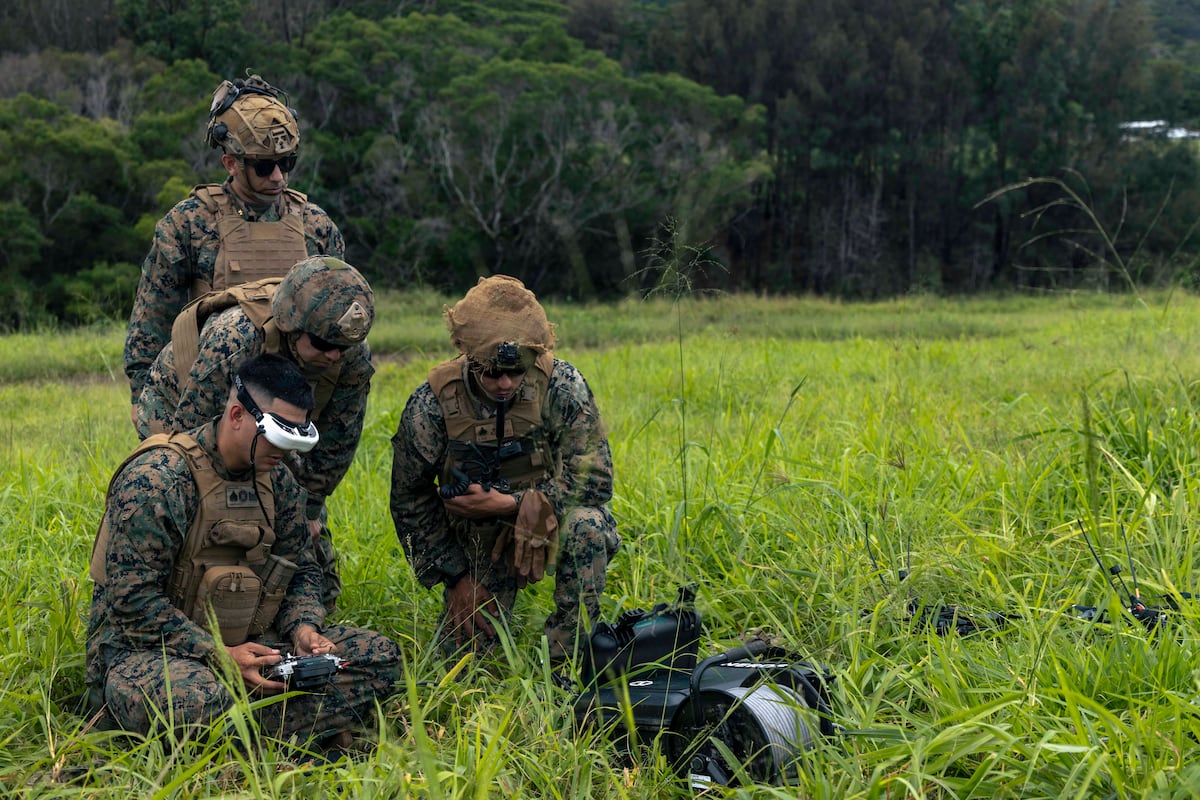

The U.S. Marine Corps has accumulated thousands of first-person view drones over the span of several months, with thousands more on the way, the service said Thursday.
The meteoric rise of the service’s autonomous weapons stockpile was a result of a clear edict from the top down and service member adaptability, according to Commanding Officer of the Weapons Training Battalion Col. Scott Cuomo, who spoke at the Modern Day Marine exposition in Washington.
“Rewind your brain to October,” Cuomo said. “We had zero FPV attack drones in the United States. We have over 3,500 right now.”
First-person view drones allow operators to watch a live feed through either goggles or a screen that provide visuals from the drone’s vantage point. Many weigh several pounds, can carry explosives and travel close to 100 mph.
Once the top brass signaled the service’s shift toward modernizing its unmanned strike capabilities, the Marine Corps responded swiftly, ramping up the service’s development and utilization of FPVs.
In January 2025, Commanding Generals of Training Command Maj. Gen. Anthony M. Henderson and Marine Corps Warfighting Laboratory Brig. Gen. Simon M. Doran launched the Marine Corps Attack Drone Team, recognizing the necessity of first-person view drones after the proliferation of the technology during the war in Ukraine.
The strides came with the blessing of Marine Corps Commandant Gen. Eric Smith, a vocal proponent of getting FPV drones into the hands of Marines quickly.
The team, based out of Marine Corps Base Quantico, works in lockstep with the Marine Corps Warfighting Laboratory to integrate the drones into the Fleet Marine Force.
RELATED
Part of the integration includes increasing troops’ proficiency with the technologies through Marine Corps attack drone competitions.
Marines from 3rd Marine Littoral Regiment, 3rd Marine Expeditionary Force, participated in the first attack drone competition in Okinawa, Japan, from Dec. 3 to 12, 2025.
By August 2025, the service issued an official 90-page handbook providing instructions on how to properly employ drones against adversaries.
Most recently, Marines with the 3rd Marine Littoral Regiment operated drones as part of the Marine Corps Attack Drone Competition at Schofield Barracks, Hawaii, in March 2026.
Over a two-week period, the team trained and certified U.S. Marines as drone operators, attack drone instructors and payload specialist instructors, according to a Marine Corps X post.
And during a live-fire event on April 27 at Exercise Balikatan in the Philippines, the Marine Corps conducted the first FPV attack drone strike that joint forces have executed in that part of the world, Cuomo said.
The Pentagon issued a call to defense industry executives in December 2025 to help it acquire and deploy over 300,000 small one-way attack drones by 2028 as part of a $1 billion initiative. The Marine Corps announced shortly after that it was launching six drone training programs open to any MOS.
Cuomo likened the service’s quick adoption and mastery of drone technology to a previous skill challenge it faced.
“The Marine Corps was not very good at marksmanship at the turn of the 20th century,” Cuomo said. “So what did our ninth commandant do? He created the Marine Corps Shooting Team. And now we all know the Marine Corps is … really good at shooting.”
Riley Ceder is a reporter at Military Times, where he covers breaking news, criminal justice, investigations, and cyber. He previously worked as an investigative practicum student at The Washington Post, where he contributed to the Abused by the Badge investigation.
Read the full article here
