



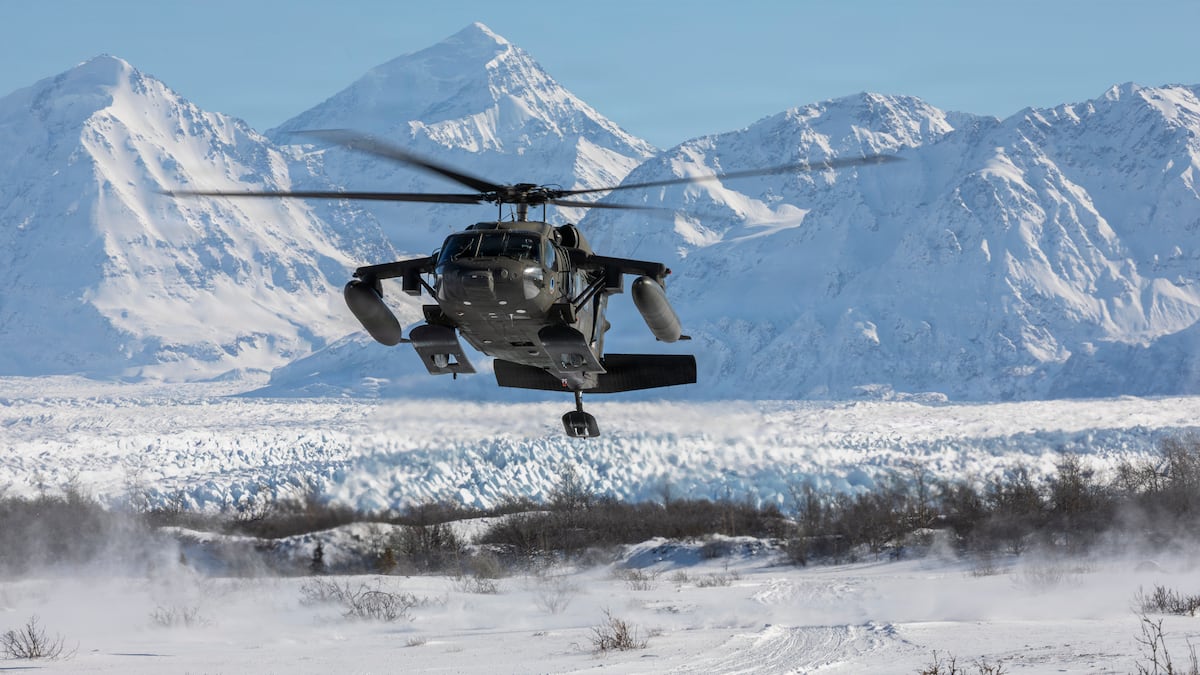

Want to safely land a Black Hawk on a frozen Alaskan lake? There could be an app for that.
The Army Corps of Engineers’ research and development component is working to disprove old assumptions about the risks of landing on frozen lakes and other “terrestrial ice” in hopes of opening up as much as 25% more space for soldiers to land on, take off of and even use as a base for firing and maneuvers from the aircraft.
The Corps’ Engineering Research and Development Center, or ERDC, conducted a critical test in January, completing a controlled and monitored landing with a CH-47 Chinook in Alaska’s Yukon Training Area, southeast of Fort Wainwright.
It proved that the aircraft could safely touch down on 21 inches of what researchers call “quality ice,” some 10 inches less than prescribed by the decades-old assessments that the Army still uses.
The research started around 2021 with Jenna Williams, an ERDC cold regions scientist who formerly served in the 11th Airborne Division, headquartered at Joint Base Elmendorf-Richardson, Alaska.
“One of [Williams’] personnel contacted me asking, ‘Hey, can we land helicopters on ice?’” said Kevin Bjella, a research civil engineer with ERDC. “‘We don’t have that in our doctrine, and we’re just wondering, if that’s possible, what could we do to make that happen?’”
Without established doctrine, the Army has been passing up opportunities to take advantage of what might be choice landing zones, operating with an excess of caution based on old and untested assumptions. Bjella said he expressed surprise that no clear doctrine existed for ice landings. So, the team got to work.
According to ERDC officials, the 1960s-era standards that have governed ice landings in the past require 31 inches — nearly three feet — of ice to support a loaded Chinook.
“It was kind of this chicken-or-the-egg thing,” Bjella said. “It’s like, ‘Well, it isn’t in the doctrine; therefore, it isn’t safe.’ And so, what we wanted to push is, for the Army’s needs, is it perhaps actually safe? And just from a desktop perspective, it’s like, ‘Yeah, absolutely we can do this.’”
For years, the Army and the other services have been ramping up emphasis on gear, training and preparation for operating in the coldest environments.
In addition to potential future operating theaters in Asia and Europe that might require cold weather proficiency, the Pentagon has trained a wary eye on the contested Arctic, where China and Russia have made claims and where warming weather has opened new sea lanes and increased opportunities for maneuver.
Bjella also emphasized that landing on ice represents a massive expansion in the ability of the Army to operate in Alaska and other icy regions.
“When we talk about Arctic missions, lakes are just all over the place,” he said.
Researchers estimate that being able to land on lake ice confidently, with established safety parameters, will open as much as 20% to 25% more available space for pilots to consider.
As ERDC put together its research plan, Williams said scientists were interested in developing landing parameters for a range of helicopters.
They also wanted to determine if soldiers could safely jump out of fixed-wing aircraft like C-130 transports and C-17 Globemasters onto ice, and set up a makeshift base of operations there.
While ice has been used “as a mobility platform” throughout history, as Bjella put it, some of the work had to do with changing incorrect thinking about the risks involved.
“The hard part is the risk assessment of it. They’ve got multi-million dollar aircraft that they don’t want to get wet,” Williams said. “[Commanders imagine that the second they land down on that ice, it’s going to be too thin. They’re going straight through. So, a lot of it is education and teaching them that it’s okay and you’re not going to go straight through, and even if the ice does break, that’s not how it breaks, and your aircraft is still going to be safe.”
Testing and validation has involved pressure transducers to measure how far the ice gets pushed down into the water below in a helicopter landing, along with other factors like ice fatigue — how many times or how long an aircraft can land in one spot before the ice becomes less reliable.
Along with new doctrine, one of the goals of the research is to disseminate a smartphone app called “Ice Guardian” that does calculations based on available information and determines if ice is landable.
While a version of the app has already been revealed, it was never pushed into broad circulation with soldiers in the Arctic.
“Right now, it’s a lot of communication with unit leadership,” Williams said. “We have a lot of buy-in from [Fort Wainwright’s 5th Squadron, 1st Cavalry Regiment]. They want the app, like, last month. … But then also socializing it with the aviation units [and] potentially doing some sit-down classes with a few leaders, and just teaching them how to use the app.”
Interest also extends beyond Alaska-based units, they said.
“The more northern [units], especially National Guard, they’re tasked with putting out ribbon bridges and things like that, [as well as] Special Forces,” Bjella said. “We’re getting a lot of inquiries about utilizing ice in general.”
Read the full article here
