



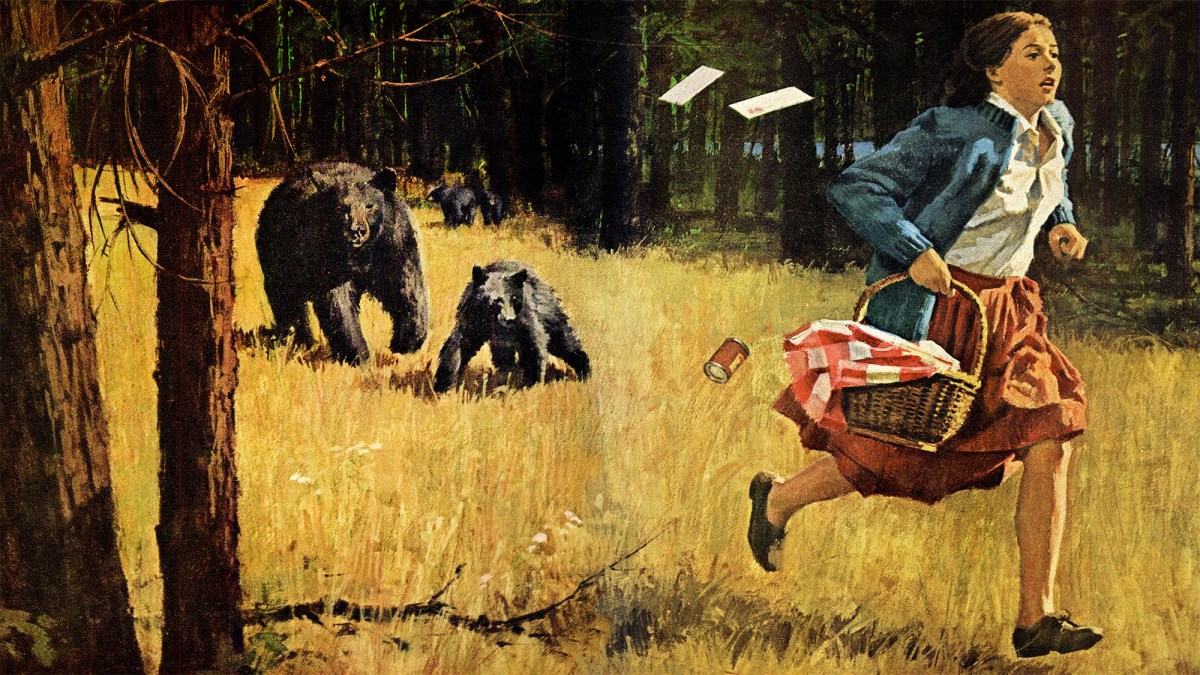

This story, “Bears in My Hair,” appeared in the January 1970 issue of Outdoor Life.
When I had my first argument with a black bear, the bear won hands down. But I’m happy to say I have evened the score quite a few times since.
That first run-in happened while I was living alone with my three children, Olive and Vala and Louis, on our homestead on the Stuart River in central British Columbia, a few years after my husband, Walter Reamer, a trapper, drowned in the wilderness of northern Alberta, leaving me to support myself and three little ones as best I could.
I left the kids at home one day toward the end of summer and walked two miles to the house of a neighbor, Jack Hamilton, to pick up mail and groceries he had brought out from town for me. Because I’d have enough to carry on the return trip, I didn’t take the old .30/30 Winchester Model 94 that went with me on most of my trips.
The country along the Stuart was wild and sparsely settled. You never knew when you were going to meet a quarrelsome moose, wolves, or something else in an unfriendly frame of mind. So I usually carried the rifle as a precaution. But that day I went without it.
When I was ready to go home I took a shortcut across the fields and through timber along the river. I hadn’t walked far when I saw a bear and three cubs grubbing ants out of a rotten log at the edge of a small burn.
Both my father and husband had been trappers, and I had lived most of my life in the woods and wasn’t really afraid of bears. I had met lots of them, but I had yet to come across one that didn’t run at sight of me. Nevertheless, I knew enough about them that I didn’t think it would be wise to walk on past that family. I was fully aware that a sow with cubs is likely to be short-tempered.
“Get!” I yelled at the top of my voice. “Get out of there!”
The old bear responded with a loud woof, but she and two of the cubs took me at my word. They lit out in the opposite direction. The third cub got confused. I guess he was so busy with his ant-hunting that he didn’t know where I was. He came straight for me.
The old female ran only about three or four times her own length before she looked back. Then she swapped ends, started after the cub, and let out a roar that fairly lifted me out of my tracks. I turned and ran for Jack Hamilton’s open fields as fast as my legs could carry me, but it seemed to me right then that I had lead weights on my feet.
I looked back once and she was gaining fast, but the cub stopped, and then she stopped. When I got out into the field, she was nowhere in sight. I went back to Hamilton’s house, borrowed a horse, and rode home. So far as I can remember that was the last time in the years we lived there on the Stuart that I ever went into the woods on foot without a gun.
That was my first encounter with a quarrelsome bear but it was far from the last. In “I Had to Have Moose,” OUTDOOR LIFE, May 1967, and “The Wolves Were the Worst,” OUTDOOR LIFE, June 1967, I told of leaving the homestead, of moving to a gold-mining camp at Germansen Landing, of Louis’s death, of Olive and Vala growing up and marrying, and of my own second marriage to Big John Fredrickson. John and I have a home in Okanagan Falls, B.C., now. I have lived most of my life in Alberta and British Columbia, on the homestead, a ranch, or at mining camps and sawmills. Even when I was living in town I made frequent trips off into the bush, fishing, hunting, camping, or prospecting. Looking back over the last 40 years, it seems to me I have had bears in my hair a fair share of the time. Some of the encounters were funny; some sent a few chills up my back. None were dull.
One of the most unusual encounters happened shortly before John and I were married. We were both working in Prince George. One Sunday in May we went for a walk along the Fraser River. We came to an abandoned field grown up with a few pines. Just as we reached the edge of it, a big black bear walked into the open, trailed by two cubs.
We were hidden in brush, and for the better part of an hour that family put on as entertaining a show as I have ever watched. They tore an anthill apart and lapped up ants until the two youngsters got into an argument that wound up in a battle royal. The mother tolerated that for a minute or so, then broke it up by swatting one of them on the behind hard enough to send him flying through the air. He brought up head-first against a stump, shook his head a few times, and patted one ear with a paw, making a noise as if trying to whine with his mouth full of bubbles. When peace was restored the sow sat down with her back against a small tree and suckled both cubs.
The whole bear family was showing signs of getting sleepy, when all of a sudden the old girl swung her head to one side and sniffed. Then she was streaking across the clearing and John and I caught a glimpse of a doe and small fawn running into the brush. There was a wire fence ahead of them. The doe turned and followed it, but the poor fawn smacked into it and bounced back literally into the bear’s arms. There was one long bleat before that old sow sank her teeth into its head. We were just close enough to hear her crush bones. I had seen more than I wanted, and it seemed likely that if she got wind of us right then she wouldn’t be in a very friendly mood, so we played it safe. As she started back to her cubs with the dead fawn, we sneaked away. In all the years I have spent in the woods, that was the only time I ever saw a bear make a kill. I’ll say one thing for her — she did it quickly and cleanly, without any of the tearing and tormenting I had watched wolves inflict.
Related: How Fast Can a Bear Run?
A few years after that John and I were running a logging-and-sawmill operation west of Prince George, and bears became so numerous around camp that they were a major nuisance. I had just acquired a dog, a fox terrier named Jeep. That dog wasn’t big enough to deal with bears, but he was determined to run them out of camp as fast as they showed up. He had more grit than sense. Every time I heard him barking, I’d scurry out to give him a hand or call him off.
We had bears at the garbage dump, bears around the buildings, bears at the door at night. Finally one big one started ripping the screens off the meathouse, then climbing in and helping himself. He didn’t seem to like fresh beef, but he cleaned up our bacon, summer sausage, and pork. John and I agreed he’d have to go.
We cut a four-inch opening in the cookhouse door overlooking the scene of his raids. The peephole was just big enough to poke a gun barrel through. We’d keep watch for him out of the cookhouse window.
He didn’t keep us waiting long. He came in shortly after dark the first night and walked straight to the window where we were posted as though aware we were there. Then he stood up with his big muddy paws on the glass and stared into the cookhouse. We had ducked back into a corner.
I’m not really afraid of bears, as I said, but I’ll admit that it made my scalp prickle to look that one in the face only six or eight feet away with nothing but a pane of glass between us. John could have killed him easily, but he didn’t want to break the window, so he waited until the bear dropped down and started for the meathouse.
John poked his .30/06, a Winchenter Model 54, out of the peephole. The bear was only a step or two away from the muzzle. The shot hit him in the ribs and he bawled and rushed between the I cookhouse and the meathouse. The alley wasn’t more than two feet wide, and there was more bear than that. He slammed into the side of the cookhouse so hard that every dish on the shelves rattled, but he squeezed through and ran for the brush.
John ran out after him, but I wanted no part of chasing a wounded bear at night, so I stood at the window and tried to help by pointing a flashlight. When John heard him break brush beyond the clearing, he gave up and came back.
Lea managed to stand up again, but the deer slammed into him and drove him back against a tree.
As soon as daylight came, we went out and let Jeep take the blood trail. We jumped the bear half a mile from camp, and John stopped him with a hip shot. He was still full of fight, snarling and thrashing around, and the fox terrier came within a hair of getting himself converted into dogburger before John wound things up with a 180-grain softpoint in the side of the bear’s head.
The next one that gave us enough trouble to get himself killed came along after we had moved to a ranch on the Stuart River. In April, shortly after our lambs and calves arrived, we began losing them to a bear. We did everything we could think of, keeping watch of the stock during daytime and penning the animals near the barn at night in the belief the killer would not come close to the buildings. But he was bold and persistent, and we continued to find dead sheep almost every morning.
Finally we decided to go looking for him. Because it was still early in the spring, it seemed likely he’d be hanging around near his winter den. Maybe we could find that. We still had Jeep, and I he was as dedicated to bear fights as ever, so we took him along.
Related: Uncovering the Secrets of Black Bear Denning and Hibernation
Jeep made the find. We heard him barking in a thick stand of young aspens, and when we got there he was fussing and fuming around a big hole under a stump. There were claw marks on all the nearby trees. We had discovered a bear den, all right, but whether it belonged to the right bear, or whether the owner was in it remained to be seen. Jeep, however, seemed very sure that the owner was home.
If the bear was home he paid no attention to the racket our pint-size dog was making, and John didn’t get any response when he poked into the den with a long pole. But his next move started things happening.
John peeled off the old shirt he was wearing, wrapped it around the end of the pole, set it afire, and rammed it down into the hole. There was a brief silence, then a loud sneeze, followed by a throaty grunt, more sneezing, and a gruff cough. At that point, the pole started to shake, and I shoved John’s .30/06 into his hands. A split second later the head of a very upset bear emerged from beneath the stump. John didn’t let him come any farther. He slapped his shot between the eyes at six feet. It turned out that we had killed the right bear too. We lost no more sheep.
Although bears deserve the blame for a lot of devilry, in fairness I want to emphasize that they are by no means the only troublesome characters in the woods. It took a buck deer to give one of my brothers the closest call any member of our family ever had with a wild animal, and over the years I have had almost as many arguments with moose as with bears.
I remember a story by the late Eric Collier (“I’m Sick of Moose,” OUTDOOR LIFE, July 1961) in which he complained that the big soreheads drove him off his trapline trail, chased him over his own garden fence, kept him from the outhouse, and even barged in on him when he sat down on a block of wood at the back door to hatch a story.
Related: The Top Moose Cartridges and Bullets
At that time Comer was living at Meldrum Lake, about 150 miles south of us, and when I read his story my heart went out to him. We had depended on moose meat, fresh and canned, for our winter food supply those first few years after I was widowed, and it had meant the difference between eating well and going hungry. John and I still hunt moose every fall enjoy it. And yet there have been times when I was as sick of moose as Eric Collier ever was.
The deer encounter took place while I was still a girl at home. We were living in northern Alberta at a small settlement called Moose Portage on the Athabasca River 165 miles north of Athabasca Landing. Freighters with horse teams took mail and supplies north to the Peace River in winter at that time. traveling the ice of the Athabasca. They would stop overnight at Moose Portage. In summer most of the freighting was done by steamboat.
My brother Lea Goodwin went hunting one morning, leaving instructions that if we heard him shoot we were to hitch our team to the sleigh and follow his tracks down to the river. We had been brought up not to waste ammunition. If he shot, it would mean venison.
About a mile from the house he heard a racket in a thicket. He worked in close for a look, and found two mule-deer bucks fighting a ding-dong battle. They were both big deer and fairly well matched for size, but one looked old and past his prime, and his rack was not so good as that of the other.
The younger animal seemed to be getting the better of the fight because he was quicker on his feet. As often as they met head-to-head, the older buck bucked the younger one into a windfall or toppled him sideways, but the younger deer could maneuver faster, and he kept ramming his horns into the rump and flank and neck of the old-timer.
Lea watched them for a few minutes and then decided to lay in a supply of venison while he had the chance. He was carrying a Winchester .32 Special, and he floored the younger buck with a shot behind the shoulder. The old fellow was a bit slow taking off, and Lea levered in another shell and dropped him too.
He walked up to that one first. There was no sign of life in the deer, so he leaned his rifle against a tree, took out
his knife, and bent over to cut its throat. The buck came to life at the first prick of the knife. The deer brought his hind feet up into my brother’s belly. The hoofs caught in Lea’s clothing, and he was thrown onto his knees. At the same time, a blow from one antler sent his knife flying into the snow. Then the deer was back on his feet and charging.
Lea managed to stand up again, but the deer slammed into him and drove him back against a tree. My brother broke off a short piece of dry limb and jabbed it at the buck’s eyes, but that didn’t do much good. The deer was too enraged, too intent on killing, to be stopped that way.
The deer’s next rush knocked Lea down and banged his head against a pine stump so hard that hesaw stars. but as he fell, his right hand closed around a piece of the stump hefty enough to serve as a club.
Read Next: I’ve Lived in Bear Country My Whole Life. Here’s What Happens When Bears Don’t Back Down
The deer lowered his head, and Lea brought the club down behind the buck’s ears. Then he grabbed an antler, swung himself back of it, held on with his left hand and clubbed the buck as hard as he could with his right. The deer was weakening but still had enough strength to reach forward with his hind feet and pound my brother on the legs and back. One of those blows caught Lea on the neck and cut a deep gash. That almost finished him.
In the end, neither buck nor man was able to do any real damage. They broke apart and staggered drunkenly around each other, sparring for an opening. The deer was first to go down. The buck fell dead, and Lea fell across the animal and passed out. That was how my younger brother and I found him half an hour later when we arrived on the scene with the team and sleigh. He was lying across the buck like a sack of meal with his head hanging down in the snow.
By the time we revived him and got him into the sleigh, his teeth were chattering. We wrapped two horse blankets around him. loaded a deer on each side to help keep him warm. and ran the horses home at a lope. Lea was so bruised and sore he couldn’t walk for days, but by a miracle he escaped serious injury.
That affair taught me a lesson. Since then, I have never gone close to an animal I have shot without keeping my rifle on it until I was positive it was dead. John and I like to walk in from the back with a rifle ready, reach around, and touch the animal in the eye with the muzzle. If there is a flicker of life left, it will blink. A deer or moose or bear that doesn’t blink is really dead.
In recent years I have gone even farther. In my early days, when ammunition was hard to get, I never felt I could afford to waste a shell, but now I always play safe with a final head shot.
Of my many moose encounters, two in particular stick in my mind. The first was my own fault and happened because I was guilty of about the same kind of carelessness that got Lea into his scrape. It happened while I was working at the gold-mining camp at Germansen Landing. A trapper came by one day and reported that he had found a cow moose that had a broken hip, the result of getting a foot caught in a crack in the ice. She was in such bad shape that she should be shot, he said, and he’d have taken care of it but he hadn’t had a gun with him. I hated to think of the poor thing dying a lingering death, so I loaded the .30/30, and my daughter Vala and I set out.
I wasn’t much more than her own length away with the creek bank behind me when she lurched to her feet and made a sudden, staggering lunge.
We found the moose without difficulty. She was in a deep hollow with vertical rock walls on three sides and a 50-foot drop over a creek bank behind her. She was down and couldn’t get up, so I worked in close to make sure of my shot. I was on snowshoes and should have known better.
I wasn’t much more than her own length away with the creek bank behind me when she lurched to her feet and made a sudden, staggering lunge. I couldn’t dodge, so I stood my ground and drove a shot into her head. She fell so close to me that I could have reached out and touched her with a snowshoe. Vala screamed, “Mama!” and for a minute I had all I could do to keep my knees from buckling. In all the years since, I have never made that kind of mistake again. Any injured or wounded animal I have to put away, I’ll do it from a safe distance.
Moose encounter No. 2 on the list of those I remember best was connected with a fishing-and-hunting trip on the Stuart that John and I made while we were living in Prince George. We were camping in the open under a lean-to tarp. There was an old hunting cabin nearby, but we didn’t want to use it because of the pack rats.
Along toward midnight, we were awakened by a sudden loud crashing in the willows. We jumped up and heard a heavy animal coming straight for the lean-to. It stopped at the edge of the brush no more than 30 feet away, but we couldn’t make it out because of deep shadow. Then it let out a hollow bellow that sounded half cough, half roar.
“That’s a bear,” John said, but I knew better. I had heard too many moose on the warpath not to recognize that bawl.
“It’s a bull moose,” I told my husband, “and he means business.”
I know of no other animal in the woods that has a vocabulary as expressive as a moose’s. A cow coaxing her calf along uses a soft grunt. Calling to a bull in mating time, she sounds a lot like a domestic cow mooing through her nose. The bull talks back with low guttural snorts, much like those of a stallion in like circumstances. But when he gets his dander up, he warns the world with a roaring, chopping-on-a-hollow-log bellow that makes your hair stand on end.
Moose or bear, that loudmouth was too close to our camp to be tolerated. John went after him with the .30/06, and the moose retreated slowly toward the river, keeping in the thick brush and blasting out a grunting bawl every few seconds. In the end he bluffed John out, and we skedaddled for the old hunting cabin.
John still thought we were dealing with a bear, but when the moose season opened two days later, I won the argument. We had counted 36 moose along the river by that time, and the first afternoon of hunting we found a place where two bulls had been fighting on an open hillside. The sign was very fresh, and we could even smell moose. We moved up the hill as stealthily as we could, but we must have made a little noise, for the next thing we knew, a big bull came crashing over the ridge straight for us. His cars were laid back, his eyes were blazing, and the hair on his neck and shoulders was standing up the wrong way. Every couple of steps, he let out the same kind of bellowing grunts we had heard in front of our lean-to.
Read Next: I Was the Youngest Duck Poacher in Saskatchewan
I suppose the bull had driven off a smaller rival only minutes before, and he was in no mood to put up with us. The whole thing was over in less time than it takes to tell it. He kept coming, and my legs were beginning to feel rubbery. When he was 15 or 20 yards away, crashing through the brush like a runaway freight train, John belted him. down with a shot in the heart. The next thing I saw was the cow that was the cause of it all. She was running over the ridge after taking the whole thing in from a vantage point a little way off on the hillside.
“Do you know now what we heard in the brush the other night?” I asked when the excitement had quieted down. “The same thing we heard just now,” John admitted with a grin, and you can bet that he never forgot that sound. Very few people do.
Read the full article here
