



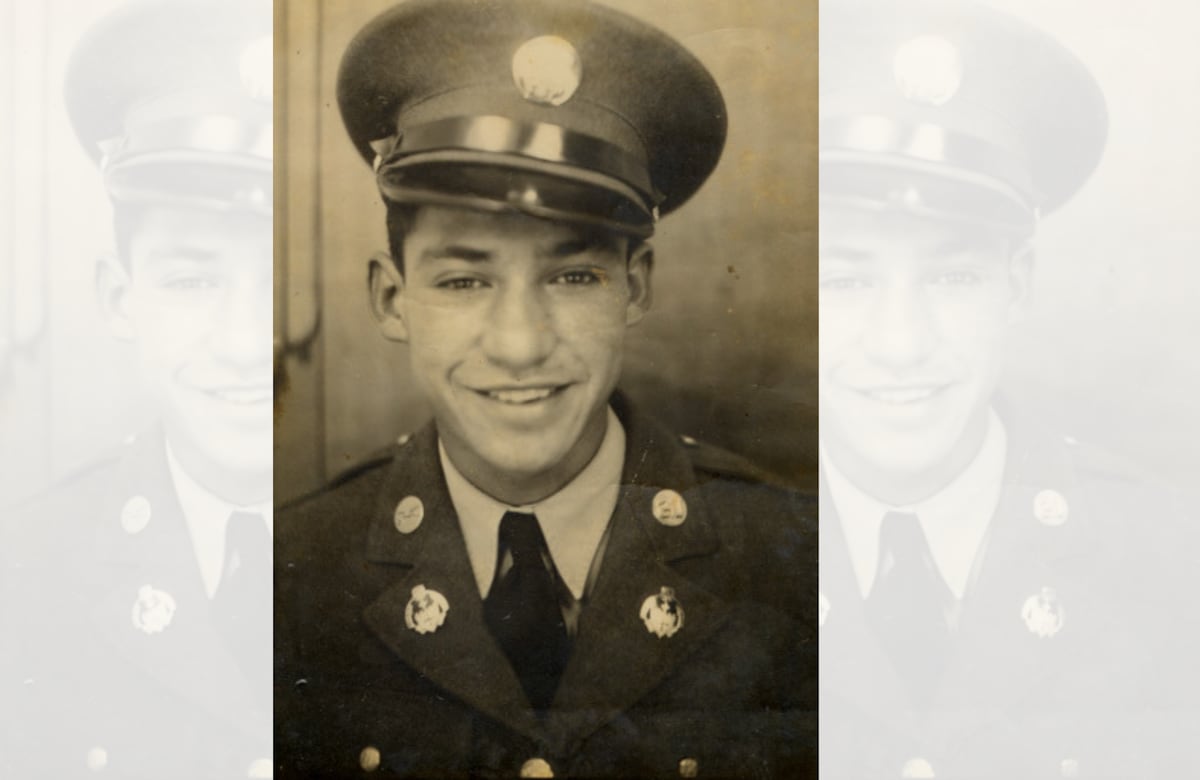

Born in Newgulf, near Corpus Christi, Texas, on Nov. 6, 1924, Michael Castaneda Pena chose his calling as a man of action early in life. He didn’t complete the sixth grade, but in 1940, after lying about his age, he persuaded his mother to sign a release allowing him to enlist at the young age of 16.
Mike, as his comrades-in-arms universally called him, spent World War II fighting in the Pacific and helping to liberate the Philippines. He was wounded twice over the course of the conflict and after the Japanese surrender, he served in the occupation of Japan.
He had indeed taken to his profession, albeit on his own terms, as explained to the local press by his brother, Alfredo: “One time they offered to make him a lieutenant, but he didn’t want it. He liked the action, the excitement, being with his men.”
As it was, by 1950 he had married and had risen among the non-commissioned ranks to master sergeant in Company F, 5th Cavalry Regiment, 1st Cavalry Division.
With a world war behind him, Pena got a new, thoroughly unexpected helping of excitement on June 25, 1950, when the North Korean People’s Army (KPA) surged across the borders of South Korea, seized Seoul and threatened to unite the peninsula under the regime of Kim Il-Sung.
Taken by surprise, the United Nations gathered what armed forces it could muster to back up its Republic of Korea army allies, but by mid-August 1950 the communists had all but overrun the country, save for those UN forces holding onto the port of Pusan. Among them was the 5th Cavalry.
By late August 1950, American aircraft had driven the North Korean air force from sky and the KPA was starting to run out of its most vital advantage: the initiative.
While its senior officers did all they could to win a breakthrough in the Pusan Perimeter, the UN troops did all they could to counter each enemy move.
On Sept. 1, the KPA committed four divisions to face Maj. Gen. Hobart R. Gay’s 1st Cavalry Division and the 1st ROK Division over a 35-mile front from Tabu-dong to the Naktong River.
On the evening of Sept. 4, elements of the “5th Cav” moved up on the town of Waegwan and right into a meeting engagement in which Mike Pena established his place in 1st Cavalry Division annals:
“That evening, under cover of darkness and a dreary mist, an enemy battalion moved to within a few yards of Master Sergeant Pena’s platoon. Recognizing the enemy’s approach, Master Sergeant Pena and his men opened fire, but the enemy’s sudden emergence and accurate point blank fire forced the friendly troops to withdraw. Master Sergeant Pena rapidly reorganized his men and led them in a counterattack which succeeded in regaining the positions they had lost. He and his men quickly established a defensive perimeter and laid down devastating fire, but enemy troops continued to hurl themselves in overwhelming numbers. Realizing that their scarce supply of ammunition would soon make their positions untenable, Master Sgt. Pena ordered his men to fall back and manned a machine gun to cover their withdrawal, he singlehandedly held back the enemy until the early hours of the following morning when his position was overrun and he was killed.”
Pena’s body was recovered the next day, but the North Koreans gradually but slowly forced the 5th Cavalry and the 1st ROK back. On Sept. 15, however, Gen. Douglas MacArthur’s landing at Inchon caught the weary North Koreans from their right flank and on the 16th the UN forces broke out of the Pusan Perimeter, driving the KPA into a full rout.
The Korean War had only begun, but the North Koreans would never have another chance like the one they had in September 1950. Saving South Korea and recovering Seoul did not come without sacrifice, however.
By the time the British 27th Commonwealth Brigade arrived to relieve its stretch of front, the 1st Cavalry Division suffered the death of 770 men killed, 2,616 wounded and 62 taken prisoner.
Pena was posthumously awarded Distinguished Service Cross, and a retroactive Bronze Star with Oak Leaf Cluster as well as a Purple Heart with Oak Leaf Cluster.
On March 18, 2014, in accordance with the Defense Authorization Act, Pena was among 14 service personnel judged unfairly honored due to their race, and his DSC was upgraded with President Barack Obama presenting the Medal of Honor to his son, Michael David Pena, in the White House.
Read the full article here
