




There’s a new kind of public-land group gaining momentum out West, and this one is wading unapologetically into the political arena. Its mission is to educate public-land users about which Wyoming politicians support public lands, and to encourage them to vote out lawmakers who don’t.
Protect Wyoming is a political action committee, or PAC, founded this year. And what it’s trying to accomplish is relatively untried in the outdoor space: influencing local elections in favor of pro-public-land politicians. That might sound sketchy, but PACs are well-established and regulated in America; they influence everything from the country’s real-estate market to sugar production through raising and spending money to elect and defeat candidates.
Despite a cold, weeknight windstorm, Cody residents turned out in force for Protect Wyoming’s first public event this week. And on April 15, the PAC plans to release the first of several public-lands report cards for Wyoming politicians. The goal, says co-founder Zach Lentsch, is to get those scorecards in the hands of every single resident hunter in the state.
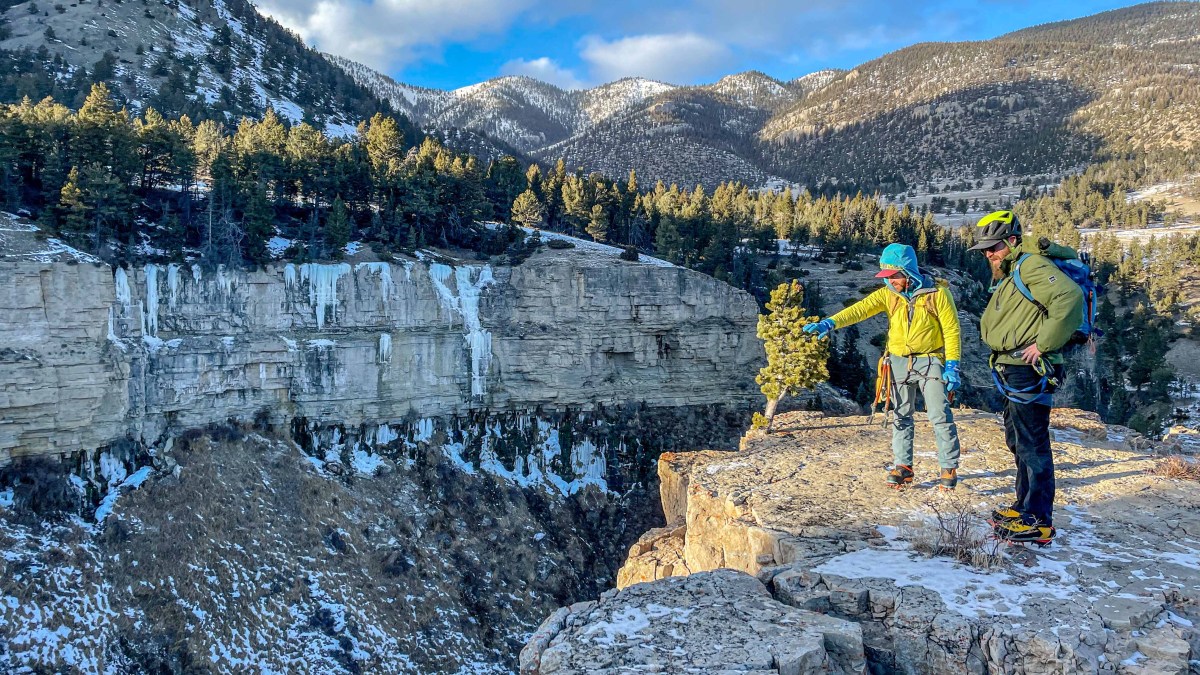
“In 2024 and especially 2025, there was an onslaught of legislation targeting public lands and wildlife in Wyoming. It was really scary for my business, as someone who works pretty much exclusively on public lands. It seemed like a total threat to my way of life,” says Lentsch, who owns Wyoming Mountain Guides, a climbing company that operates in three national forests, a national park, and five BLM districts ini the state. He’s also the son of a game warden and a lifelong hunter. “I never really thought that anything like that would happen in Wyoming. It seemed like that was the reason we all lived here, to hunt, fish, and recreate on public lands.”
Related: Wyoming Senators Demand 50 Million Acres of Federal Land. It’s Part of a Coordinated Land-Grab by Western States
Last summer’s failed federal land sale, spearheaded by Sen. Mike Lee (R-Utah), was one motivator for forming a public-lands PAC. (Wyoming’s lone U.S. representative, Harriet Hageman, and both U.S. senators for Wyoming, John Barrasso and Cynthia Lummis, voted against a measure that would have prohibited selling public land for budget purposes.) Another, says Lentsch, was when the Wyoming state senate almost passed SJ2, a bill seeking to transfer all federal land in Wyoming to the state for the purpose of selling it off. It failed, but just barely — by a single vote.
“A few people voting a different way could’ve prevented that from being even a likely scenario. So we strongly believe that we can make a huge impact even with a small number of voters,” says Lentsch. “We believe the hunting community, especially the greater outdoor community, isn’t really showing up to the polls. And one of our main missions is to engage that community and mobilize them as a voting block. The goal is preventing anti-public lands legislation and the privatization of wildlife legislation, from recurring in the future.”
Candidates are often elected by razor-thin margins of just a few hundred votes, says Lentsch. That’s why Protect Wyoming is fundraising to educate hunters, anglers, and other outdoor users about why voting matters for public lands, and who to actually vote for. (At this week’s public meetup in Cody, several attendees confessed to Lentsch that they had never before registered to vote.)
Those campaigns will involve everything from social media posts to highway billboards. The forthcoming scorecards are just one way the group plans to track the public-lands voting records of Wyoming lawmakers. Which, Lentsch says, “are not great.”
“To have such an anti-public lands delegation is just astonishing to me. But a big part of that is that people don’t vote,” says Lentsch. “Especially folks in my generation of 45 and under. We have well below 20 percent turnout in our primaries where most of the representatives are chosen. So if you look at voter turnout and think about how less than 10 percent of the electorate [at times] are showing up to vote? Maybe it’s not surprising that our representatives don’t necessarily reflect the values of the pro-public land majority.”
The nonprofits sportsmen normally think of when it comes to advocating for public lands and conservation in America — Backcountry Hunters and Anglers, the Theodore Roosevelt Conservation Partnership, critter orgs like Pheasants Forever — are strictly prohibited from intervening in elections, contributing to campaigns, or endorsing candidates.
Even the more politically active class of nonprofits — 501(c)(4) groups, like the relatively new American Hunters and Anglers — can’t make political activity its primary activity. That’s not the case with a statewide PAC like Protect Wyoming.
“There’s great advocacy in our state and across the nation regarding public lands, and there’s always more advocacy work that can be done,” says Lentsch. “But there is definitely a gap when it comes to political action and trying to get more public-lands-friendly folks in the office. And, and that’s what I felt like was my calling.”
While Lentsch didn’t specify how much Protect Wyoming has raised so far, the group is gathering donations.
“I believe the most important way to do politics in this day and age, and especially in this state, is to talk to people. We might not raise as much money as the billionaires who are trying to sell off our public land are able to donate to the other side, but we have the power of numbers.”
By that, Lentsch means that the general public — the masses — overwhelmingly support public lands and have the potential to throw their support behind the cause. Protect Wyoming is enlisting volunteers to knock on doors and canvass the state.
“We’re excited about the fact that we have a lot of small donor donations. A lot of people are signing up for newsletter and giving us five, ten, twenty dollars. Obviously the more money we can raise, the more impact we can have in the election. We’re ahead of what we thought we could raise, I’ll say that.”
There have been a handful of public-lands related PACs before, but only in recent years. They’re also typically affiliated with more preservationist-groups like the Sierra Club. While Protect Wyoming is necessarily focused within the state and on state politics, rather than federal candidates, its work stands to influence nonresidents who hunt, fish, and recreate in the state.
“Especially when it comes to federal public lands, we’re all public landowners, right? Everyone’s interest is at stake here [in Wyoming]. Nonresidents have such an important role to play in the management of wildlife in Wyoming, and obviously nonresident [hunting and fishing] licenses cost a lot more than resident ones do. Those [nonresidents] are really upholding the management system as we know it.”
Read Next: Federal Public-Land Recreation Generates $350M Daily
Lentsch is also optimistic that Protect Wyoming’s work can help influence public-land policy in neighboring states, and mobilize outdoorsmen beyond just the West.
“It’s all interconnected. What these Western states do affect each other and the national conversation about public-lands politics. There’s a lot of anti-public-lands rhetoric that’s been coming out of Utah and surrounding states recently and that definitely has bled over into our state politics,” says Lentsch. “The cool thing is that we’ve had folks from surrounding states ask how they could do something similar in, say, Montana and Idaho. So that’s pretty neat to see that this could potentially be useful, a useful tool for pro-public lands folks elsewhere in the country.”
Read the full article here
