



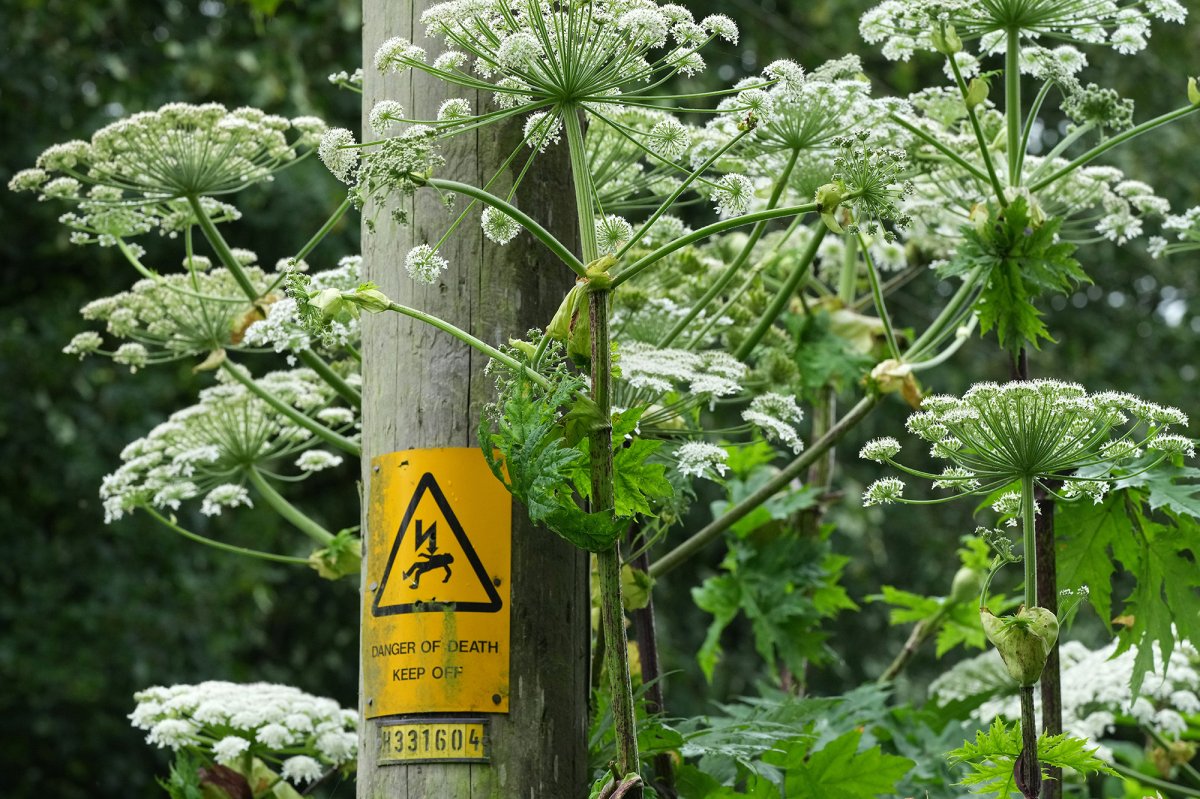

There are plenty of freaky invasive species to worry about these days. Florida is a hotbed of weird reptiles, zebra mussels are the bane of boaters nationwide, and spotted lanternflies are flying out of control. But some of the worst invaders are actually noxious weeds, which can be directly harmful to humans, livestock, pets, and wildlife. And one of the (literal) biggest problem weeds Americans should know about is invasive giant hogweed.
Hogweed sap is the biggest concern, as it can cause contact burns to your skin. And much like poison ivy, there’s usually a delayed reaction. Many people who are at risk for contact burns — gardeners, land managers, farmers, hunters cutting shooting lanes — don’t even realize the danger until it’s too late. That’s because giant hogweed is a member of the carrot family, and its nondescript leaves and white flowers resemble Queen Anne’s lace.
That’s what one Canadian man thought he was removing while pulling weeds in a parking lot near Toronto a few years back. What started as a “a few small white spots” on his arms and legs turned into blisters two days later. On the third day, his forehead and eyes were puffy and swollen. The reaction developed the longer he kept stepping out into the sun.
“The feeling that you get is intense burning,” the man told told Global News. “It feels like your arms are on fire.”
Unlike a poison ivy rash, however, the sap of giant hogweed is phototoxic. That means the rash is activated by sunlight; giant hogweed in particular prevents your skin from protecting itself from the sun’s UV rays. So in other words, if you get the sap on your skin and you continue to work in the sun that day, or the following day — even after washing up — the sun’s UV rays will trigger debilitating burns and lesions that sufferers have described as open wounds.
The reaction can start as soon as 15 minutes after exposure, with extreme burns kicking in 48 hours later. Moisture — from humidity, sweat, or a shower — can intensify the reaction.
Recovery can take months, as was the case with one teenager in Virginia. In 2018, seventeen-year-old landscaper Alex Childress was rushed to the hospital with third-degree burns on his face after unknowingly trimming giant hogweed.
“We were working outside a factory and I snipped down a bush and it fell and touched my face. I didn’t pay any mind to it because I do it all the time,” Alex Childress, then 17, told ABC 12. “I thought I had a bad sunburn, I got in the shower and my face started peeling.”
Childress was moved to a special burn unit in the hospital, where he remained largely in a dark room for 48 hours and received special treatment. Even minimal exposure to artificial lights irritated his burns, and recovery took months. In another case, a 10-year-old girl contracted horrible lesions on 10 percent of her body — mostly on her legs — after contact with giant hogweed.
It’s impossible to cure hogweed burns. Instead, victims must endure symptom treatment and painful recovery. Scarring can last up to six years, along with other complications like prolonged sensitivity to light. If the sap gets directly in your eyes, it can cause blindness.
“Obviously people’s bodies are different and respond to things differently, so you may be more or less susceptible to it,” says Lisa Rand, the master gardener coordinator and horticulture extension educator for the Penn State Extension in Erie County, Pennsylvania. “But that’s always a best practice if you either know or think you came in contact with giant hogweed, you want to wash. But if you’re already to that point, it may already be too late.”
The best way to prevent giant hogweed rashes and burns is to learn how to identify it.
Identifying Giant Hogweed
Identify Giant Hogweed
As you might’ve guessed, giant hogweed is, well, enormous. That’s one of the reasons it was introduced from its native Asia to Europe and, eventually, North America in the early 1900s. Enthusiastic gardeners seemed not to care that its sap causes painful skin lesions, and planted it anyway. (It’s now illegal to deliberately plant hogweed.)
“It’s such an interesting specimen plant. You can see it from a long way away. It’s very architectural and I think that overwrote a lot of common sense around it,” says Rand “I always thought that was kind of odd too, to introduce such a [hazardous plant]. But the more you look into it, and the horticultural trade, well, there’s a lot of stuff that came over in that time period — and even now — that is really suspect.”
While Rand has been fortunate not to endure the burns herself, one of the master gardeners she works with has. (Photos of the burns on her legs are used by Penn State to warn other residents.)
Giant hogweed is particularly troublesome in Erie County, with more than 100 hogweed sites identified (the most in the state). The noxious weed grows on roadsides and riparian areas, and while it’s not spreading at an alarming rate, it is still being identified by locals. Rand and her crew often get calls asking for help identifying the weed, which also resembles poison hemlock, as well as the more innocuous Queen Anne’s lace.
The dead giveaway, says Rand, is its height. Giant hogweed can range from 14 to 20 feet tall. Its hollow, ridged stems are fat, reaching 2 to 4 inches in diameter. They have dark reddish-purple blotches, according to the New York Department of Environmental Conservation. The large compound leaves can grow up to 5 feet wide. Its white flower heads (which don’t really have a floral scent, says Rand) can grow up to 2.5 feet in diameter. All parts of giant hogweed contain the phototoxic chemical that causes burns, including the flowers and seeds.
The location of a suspicious weed can also offer clues to its identity.
“Streams help giant hogweed to spread, so a lot of where you find it is along those stream banks,” Rand says. “Hogweed also likes roadsides and off-to-the-side places to thrive. It grows in similar places to the rest of the carrot family.”
Across the country giant hogweed is worst in the Northeast and Northwest, including Canadian provinces, though it’s also present in states like Illinois and Virginia.
“When you find it, it’s usually around wherever there’s been soil disturbance,” says Dr. Craig Harper, a professor of wildlife management and the extension wildlife specialist in the School of Natural Resources at the University of Tennessee. “It’s often associated with farms, feed lots, and those types of places.”
The good news, according to Harper, is that he’s not aware of giant hogweed posing any threats to wild animals or livestock. This is not the case with giant hogweed’s cousin, poison hemlock, which can kill cattle that feed on it in a matter of hours. Water hemlock is even more deadly to cattle and can also kill dogs and other pets.
“Goats, cattle, sheep — they will eat giant hogweed [to a certain degree],” says Harper. “Deer certainly do not select it.”
Rand says she’s never heard of any reports of sickened livestock, wildlife, or pets as it relates to giant hogweed. Her advice to anyone who is worried about giant hogweed is to take steps to identify it.
“The biggest thing is to just be aware. Using plant identification apps is really helpful. If you find something that you think may be hogweed or even poison hemlock, iMap Invasives is a good free app. It’s also a good one to use because if you happen to run across other noxious weeds, [the app] uses those reports to actually build databases of invasives they’re looking to eradicate.”
Read Next: After Record Levels of Cancer-Causing Chemicals Were Found in a New Mexico Lake, Hunters Are Urged to Contact Their Doctors
iMap Invasives location-tracking is currently only available for residents of Arizona, Maine, New York, Oregon, and Pennsylvania, but other general plant-ID apps like iNaturalist can help users identify giant hogweed, too. If you think you might have spotted hogweed, says Rand, keep a safe distance, snap a photo, and use technology or expert resources to make a positive ID.
Helpful sources at your university agricultural extension program can usually confirm the identity of noxious weeds like giant hogweed and poison hemlock. The good news? They’ll also usually remove it for free.
Read the full article here
