



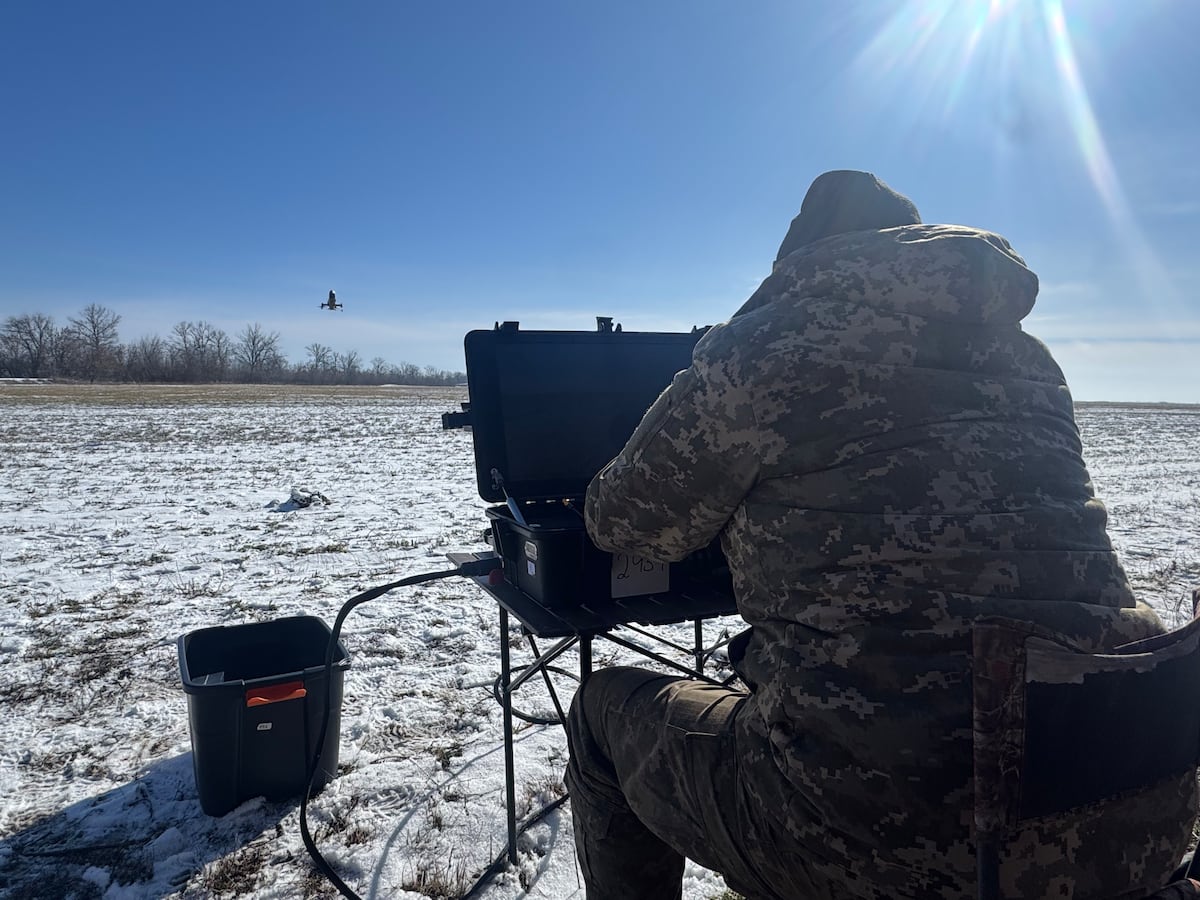

KYIV, Ukraine – One in every three Russian aerial targets destroyed over Ukraine is now brought down not by a missile or a gun — but by interceptor drones that each cost less than a used car, Ukraine’s air force says.
Over the capital, the new class of interceptors is even more effective. Drones were credited with more than 70% of Shahed downings in February, Ukraine’s Commander-in-Chief Oleksandr Syrskyi announced on Tuesday.
The math tells the story: A single Patriot interceptor costs over $3 million, a NASAMS round slightly over $1 million — and each Shahed costs Russia as little as $35,000 to manufacture, according to the Center for Strategic and International Studies.
That puts Ukraine on the wrong side of an approximately 85-to-1 cost exchange every time it uses a Patriot to defend against a drone.
But at $3,000 to $5,000 apiece and an average success rate over 60%, interceptors are now changing the calculus of war, Zelenskyy told Fox News late last year.
These drones, a weapons category that barely existed a few years ago, have become the fastest-growing layer of Ukraine’s air defense.
“We are the first in the world to have a system of destroying drones with drones in the air,” Col. Yuriy Cherevashenko, deputy commander of UAVs for air defense of the Ukrainian Air Force, said in a video marking the fourth anniversary of Russia’s full-scale invasion.
Facing an unrelenting adversary whose economy dwarfs its own by nearly tenfold, Ukraine had no choice but to outthink rather than outspend, and interceptor drones — mobile, cheap and scalable enough to answer Russian mass production with Ukrainian ingenuity — have emerged as their biggest bet.
Now, what began as battlefield improvisation has become a deliberate war strategy.
“Drones now occupy a wide segment of the air defense system,” Cherevashenko said. “In the future, they will be perhaps the most numerous means of destroying aerial targets.”
Their rapid development over the last year tracked Russia’s escalating use of Iranian-designed Shahed attack drones, which by mid-2025 were arriving in record-breaking waves that overwhelmed Ukraine’s missile-based air defenses faster than Western allies could resupply them.
“We needed to supply a lot of interceptors this year, because without them, the winter would have been even harder for Ukraine,” Alona Zhuzha, director of digitalization at Ukraine’s newly established Defense Procurement Agency, told Military Times.
The National Security and Defense Council (NSDC) said the country produced 100,000 interceptor drones in 2025 and reported that production capacity has grown eightfold compared to the prior period.
Frontline units received an average of over 1,500 interceptor drones per day in December and January — up from about 1,000 per day during the previous period, the MOD said at the beginning of the year.
That supply is translating into operational tempo: Last month, interceptor drones flew approximately 6,300 sorties and destroyed more than 1,500 Russian UAVs of various types, Syrskyi said.
Interceptors are now a top priority on the DOT-Chain Defence marketplace, the digital platform through which units order directly from manufacturers.
“They are very critical for our defense,” Zhuzha said.
Russian tech continues to evolve, too.
Moscow’s drones have been equipped with rear-facing infrared spotlights designed to blind interceptor pilots, and some have been armed with air-to-air missiles to shoot back, Serhii “Flash” Beskrestnov, a radio expert and early advocate of interceptor tech who was recently appointed as an adviser to the Ministry of Defence, wrote on Telegram in January.
Russia has also expanded its use of decoy drones — foam-and-plywood models including the Gerbera and Parody — which now constitute roughly one-third of all Russian mass attacks, specifically designed to exhaust interceptors and overload the detection layer, according to Defence-UA.
Ukraine now flies several distinct classes of interceptors: cheap FPV airframes built for last-kilometer kills — the kind that catch a Shahed before it reaches a substation or apartment block — and faster pursuit systems tied to forward drone lines, designed to launch immediately upon detection, climb fast, and intercept before the threat crosses into civilian airspace, according to the NSDC.
Higher-speed interceptors designed for targets like the jet-powered Geran-3 variants, where the old FPV chase math breaks, are emerging now too, according to Ukrainska Pravda.
And networked defense systems are beginning to link interceptor nodes across sectors, sharing tracks so a single incoming target can be handed off from one crew to the next as it crosses boundaries.
One unit trying to push forward the development and use of interceptors is Lazar’s Group — a drone formation within the National Guard’s 27th Pechersk Brigade known as one of the most effective interceptor units in the country.
Phoenix, who commands the group’s drone operations, told Military Times that the group has destroyed more than $15 billion in Russian military equipment since the full-scale invasion — part of Ukraine’s broader shift away from infantry warfare. Military Times agreed to refer to all active duty soldiers by their nom de guerre for operational security.
Strike drones, not interceptors — still account for “60 to 70% of confirmed hits” on Russian equipment and personnel across the battle zone. “Interceptors take out most of the rest.”
Lazar’s Group utilizes both. Fixed-wing strike models can engage deep targets and conduct reconnaissance well beyond the battle’s edge, while interceptors are optimized for counter-UAV work at shorter ranges and higher closing speeds.
For example: Ukraine’s Wild Hornets “Sting” interceptor — a quad-rotor designed to chase and collide with enemy drones — is reported to reach speeds over 300 km/h and operate out to roughly 25 kilometers in interception missions, with altitude service up to several thousand feet, while fixed-wing interceptor variants such as the VB140 Flamingo are designed with extended pursuit profiles that can engage reconnaissance drones at ranges up to 50 km.
The real challenge slowing interceptor innovation now? Sensors.
“We just need better radar,” Phoenix said. “It allows you to see your enemy and your plane. You understand where you are and where your enemy is, and you can fly to that position.”
Ukraine’s most common intercepts still start with cueing: radar tracks, acoustic spotters and stitched feeds from Ukraine’s master “Mission Control” battlefield management system that put a pilot in the right place at the right time.
“Without good radar — durable sensors, strong [electronic warfare] defense, etc. — it’s very difficult,” he told Military Times.
To counter Russian electronic warfare, another persistent problem, the unit builds its own interceptor drones with proprietary remote control and video transmitter systems designed to resist jamming.
“We create our own models because we understand the technical specifications that we need,” Phoenix said. “So they’re not immediately jammed or located.”
Illustrating the problem, SpaceX cut off Russian forces’ contraband Starlink terminals at Ukraine’s request last month — but the disruption also knocked out feeds for Ukrainian units sharing the same network, leaving parts of the front without connectivity or intercept capability, according to CNN.
Artificial intelligence has not yet come to dominate interception missions — today it is still manual ramming or close-in detonation.
“Our pilots mostly operate manually,” Phoenix told Military Times. “Because AI features are nice, but sometimes they just aren’t working.”
Finding solutions to the other common hurdles beyond radar — like battery endurance in freezing conditions or operator fatigue on overnight shifts — tends to be simpler, Phoenix said.
“After that, they just keep flying.”
Lazar’s Group’s strategy has become a national model for how to institutionalize a new layer of air defense into the existing military structure, both in Ukraine and abroad.
The 1,700-strong group is helping construct the country’s Drone Line — an unmanned kill zone stretching 15-kilometers deep across the front, announced by Ukraine’s Ministry of Defense a year ago.
In Brussels, officials have been pushing their own version of a drone wall to bolster defenses along Europe’s eastern flank, but the effort has run into political and technical hurdles, according to Reuters.
Kyiv has taken note, and begun leveraging its country’s battlefield tech, skills and data as a major benefit of remaining its staunch ally as peace trilateral negotiations to end the war continue between Ukraine, Russia and the United States.
“As we work together to protect lives in Ukraine, we are building a new system – a new security and response architecture, new approaches – to protect lives in any European country when needed,” Zelenskyy told his counterparts at the Munich Security Conference in February.
“Our wall of drones is your wall of drones.”
Read the full article here
