



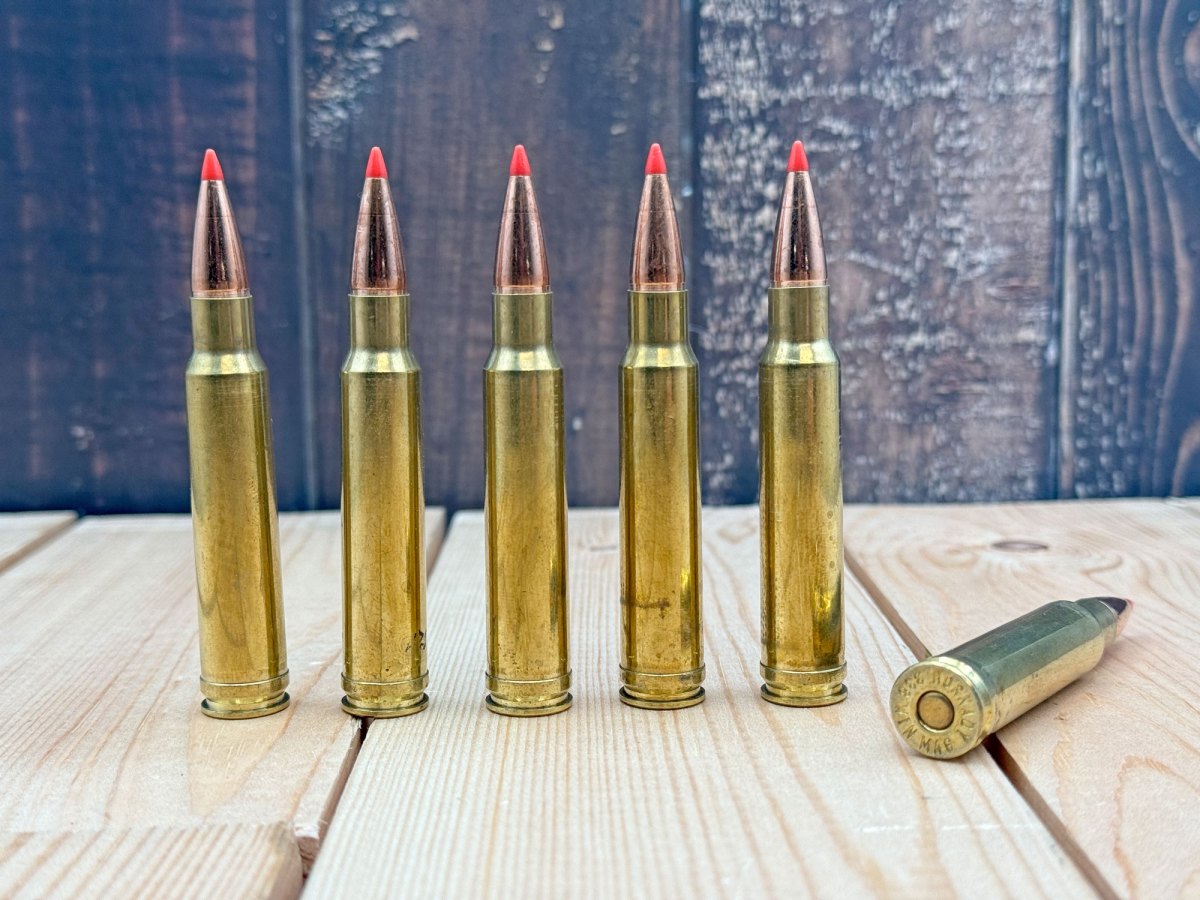

When talking about big cartridges for hunting large North American game, the .338 Winchester Magnum is a natural inclusion. It was introduced in 1958 and, at the time, occupied a specific niche. The .338 pre-dates the .300 Win. Mag. and 7mm Rem. Mag., and was designed as an alternative to the long-cased .375 H&H. It promised to fill the role that the .375 did so well, and has been popular ever since. Considering the choices we have today, however, there is little reason for a logic-driven hunter to choose the .338 Winchester Magnum. It lacks the versatility of the .30-caliber cartridges, and still beats the hell out of you without giving you true .375 performance.
.338 Win. Mag. Specs
- Parent Case: .375 H&H
- Shoulder: 25 degrees
- Case Capacity: about 86 grains of H2O
- SAAMI Cartridge Overall Length: 3.340 inches
- Bullet Weights: 200 to 300 grains (200 to 250 grains is most common today)
Why the .338 Win. Mag. Was A Winner
When it hit shelves in 1958, the .338 Winchester Magnum was unique. It was America’s version of a cartridge to hunt the big critters of the world, much as the .375 H&H had been since 1912. It was initially offered in 200-, 250-, and 300-grain loads — mirroring the 235-, 270-, and 300-grain loads of the .375. In fact, the .338 was made by shortening, and necking down, that belted .375 H&H case. It offered a more modern 25-degree shoulder and less case taper.
More importantly, this cartridge would fit into a standard long-action receiver. Both of the popular magnums of the time, the .375 and .300 H&H Magnums, required a longer magnum-length action that added to the cost and diminished availability. This problem eased when Winchester adopted a magnum action in the Model 70 and Remington offered H&H chamberings in the 721. But even today, the long-action magnums are more widely available and affordable than chamberings requiring a magnum-length action.
The .338 Win. Mag. compares pretty well to the .375 H&H, with both 250-grain .338 and 270-grain .375 bullets achieving about 2,650 fps from a 24-inch barrel. In common 26-inch barrels of the time, speeds were even better. It’s a solid performer on any North American big game, and inspired enough confidence that it remains a popular option among hunters and guides for brown bear, grizzlies, moose, and elk. It tackled a lot of jobs as well as the .375, in a more compact action that was less expensive. In 1958, it made sense.
Why the .338 Win. Mag. Sucks
For many years, the .338 Winchester Magnum has lingered as a sub-optimal cartridge. I’ve used one often, a Ruger Guide Gun I acquired in a trade, and it’s always worked well. For some people, that’s inspiring enough. Yet I’ve always felt that the .338 is a cartridge that’s stuck in the middle. It falls short of the performance of the .375 Ruger — which also fits in a standard long action — and it’s stubbornly inflexible compared to the .30/06. Even the .300 Winchester Magnum, which followed the .338, is comparable on dangerous game while providing more flexibility and versatility. Considering several of the other modern cartridges with similar capabilities, we must conclude that the .338 has run its course.
Now this doesn’t mean that the cartridge doesn’t work — it continues to do many things well, for a lot of things. You might interpret my lack of enthusiasm as me declaring it’s just no good; many readers often draw this conclusion. This is not all the case.
If you like the .338 and you’re invested in the ammo and hardware, keep using it. For the rest of us, if we don’t already have one, there’s simply no logical or compelling reason to choose the .338 Win. Mag. for any task. The primary reason mine has gotten so much use is that it’s got a short 20-inch threaded muzzle. I regularly pack it in my boat for creeping into active bait sites and kicking the brush for bears that have been shot. After deafening myself while putting the stop to a grizzly bear that was hoofing it my way from 15 yards in the timber and rose brush, I put a suppressor on it. Now, recognizing that the .30/06 will fill that role just about as well, I’m retiring the old girl.
If you’re not convinced, it may be helpful to examine the .338’s capabilities compared to other choices we didn’t have back in 1958. We must ask ourselves: What job do we want the .338 Win. Mag. to do? And how well does it do that job compared to the competition?
The .338 as a Dangerous-Game Stopper?
One of the classic roles of the .338 Win. Mag. is a stopper of large or dangerous North American game. Ask the average American hunter what rifle they’d choose if they were dropped into an alder thicket on Kodiak Island, and the .338 will be a common reply. It can serve that purpose. But if you want a big gun that will knock out your fillings, there’s no reason to choose the .338 Win. Mag. over a .375 Ruger or, for the real daredevils, the .416 Ruger.
The .338 Win. Mag. most closely imitates the performance of the .375 H&H when loaded with a 250-grain bullet which will generally be about 2,650 fps from a 24-inch barrel. Factory loads today range between 200 and 250 grains, with the original-style 300-grain load now extremely rare. Most .338-caliber bullets in the 275- to 300-grain range today are not ideal for the Win. Mag., but intended for more modern cartridges like the .338 Lapua and .338 Norma. A baked-in problem with the .338 Win. Mag. is that the chamber design and head height don’t allow for these long bullets. One could certainly pay for a custom reamer to headspace off the shoulder, tighten and extend the freebore to allow for these bullets. But then you’re looking at moving up to a magnum-length action and that’s a lot of trouble to still come in behind other standard modern cartridges.
My chief complaint about the .338 Win. Mag. as a potential rifle for this role is that, while it kicks nearly as hard as a .375, it just doesn’t offer what the .375 Ruger does in terms of performance. Compare these recoil figures, calculated for an 8.25-pound rifle with a 20-inch barrel. In a guide gun, the .338 has about 40 percent more recoil than the .30/06, and only 27 percent less than a .375 Ruger. In practice, this checks out. Both the .338 and .375 are punishing to shoot from a bench, with the .375 kicking harder, but not a lot.
| Cartridge | .30/06 Springfield, 175-grain Lehigh Defense CC, 2,700 fps | .338 Win. Mag., 250-grain Interlock RN, 2,530 fps | .375 Ruger, 270-grain Lehigh Defense CF, 2,670 fps |
| Recoil | 21.83 foot-pounds | 35.98 foot-pounds | 49.17 foot-pounds |
Overall, I haven’t found the terminal performance of the .338 to be dramatically better than the .30/06 — and it’s certainly not as versatile. In fact, when using rigidly-constructed bullets, I’ve been a bit disappointed in wound channels on black bears from my .338. For the black and grizzly bears I’m dealing with in interior Alaska, my Guide Gun in .30/06 will work just as well, and is significantly more pleasant to shoot. It’s loaded with 175-grain Lehigh Defense Controlled Chaos bullets which are fracturing copper hollow points. I can tell you from experience, those will shoot through a moose and leave a massive wound channel when fired from a .308. If I feel the need for more, I’ll step up to the .375 Ruger.
The .338 Win. Mag. As A Hunting Cartridge
Where the .338 really starts to fall behind its contemporaries is at slightly longer distances. It’s perfectly suitable for a lot of hunting applications, but rarely preferable. Because the ammunition selection is limited to lighter-for-caliber bullets these days — with 220- to 230-grain being most common — impact velocity drops below 2,000 fps sooner than the heavy recoil would make you think. If you’re pairing the rifle with heartily-constructed bullets, that can spell disappointment. Classic proven bullets like the Swift A-Frame, Nosler Accubond, and copper bullets like the CX and TSX won’t expand much or create a dramatic wound cavity much below that threshold. Most of these have a published minimum expansion velocity of 1,800 or 1,900 fps, but you’re skating on thin ice at that point.
Read Next: Townsend Whelen’s Top Big-Game Cartridges
With one of the most ballistically efficient .338 Win. Mag. Bullets available, the 230-grain Hornady ELD-X, the bullet drops below 2,000 fps at approximately 530 yards when fired from a 24-inch barrel at 2,750 fps at. For a 225-grain TTSX, that’s closer to 425 yards. Compare that to the 212-grain ELD-X fired from the .300 PRC at 2,900 fps from an equivalent barrel. It doesn’t drop below 2,000 fps until about 680 yards — with about 10 percent less recoil. A 7mm Rem. Mag. or 7mm PRC firing the 175-grain ELD-X at 2,900 will stay above 2,000 fps for approximately 710 yards. The takeaway is that while the .338 delivers a bit more up front, there are a lot of better options for potentially longer shots. If you must use the heaviest practical .338 bullets, pick a .338 Norma or Lapua and at least get paid for your brain damage.
If you’re only hunting up close, better cartridges are only limited by your imagination. The lowly old .30/06 will kill anything a .338 will kill within 300 yards. So will a 6.5 Creedmoor for that matter. If you want the warm and fuzzies from shooting heavier bullets, a 35 Whelen or 9.3 x 62 would deliver satisfactory results with less recoil than the .338 Win. Mag.
Final Thoughts
While the .338 Win. Mag. brought some real advantages to the market when introduced, time and technology have caught up. From a 24- or 26-inch barrel, a good 250-grain load is still on the heels of the .375 H&H, but it’s diminished in shorter barrels which are becoming the standard, and the beltless .375 Ruger delivers full H&H performance from a 20-inch barrel. The .338 is lauded for impressive killing power, but more efficient cartridges and bullets deliver better impact velocities at longer distances, with less recoil.
Though in the fading twilight of its career, rifles and ammo for the .338 Win. Mag. aren’t likely to disappear soon, and there’s not a compelling reason to get rid of yours if you like it. But if you’ve got a recently-contracted case of magnum fever, there are better choices than the .338.
Read the full article here
