



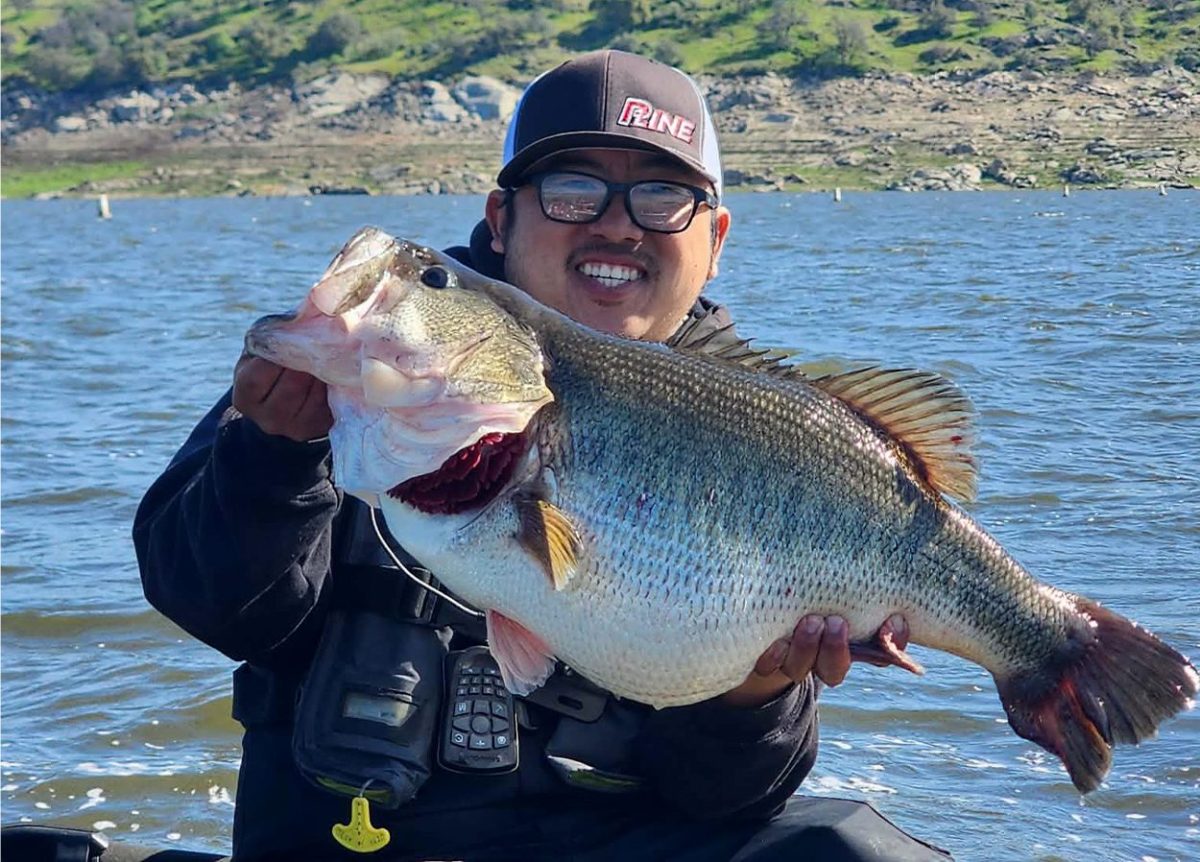

After catching one of the biggest bass ever seen in California, kayak angler Damian Thao isn’t sure if it will be properly certified as a lake record. The nearly 19-pound largemouth is big enough to qualify as a record, but a strange state law that Thao inadvertently broke while transporting and weighing the fish could get in the way of that achievement.
In a post he shared to Facebook Tuesday, Thao owned up to his error. He said he wanted “to be transparent with the monster fish,” his personal-best largemouth bass and his first over 12 pounds. Thao did not respond to a request for comment from Outdoor Life on Wednesday.
“Well, there’s good news and bad news,” Thao wrote in his post. “I finally ended up joining the teener club with this lake record fish but I ended up infringing the law.”
Thao explained that he was fishing from his kayak on Sunday when he hooked the giant bucketmouth on a big swimbait, a 10-inch Megabass MagDraft in Albino Pearl. He said it was in his first spot of the day during his first hour of fishing, but he did not name the lake.
“Fought her for 30 seconds and boated her. At first I thought it was just another 10 maybe pushing 12 until I held her up,” Thao wrote. “Put her on the scale the first time and she went around 17 pounds.”
After paddling to shore and weighing the fish on his hand scale a second time, Thao got a reading of 17.46, which his friend told him was big enough to qualify as a new lake record. They put the bass in his friend’s livewell while Thao tried calling the California Department of Fish and Wildlife, along with the U.S. Army Corps ranger station, to see about getting a certified scale brought to the lake. He didn’t get a response, which he said was understandable since it was a Sunday on a holiday weekend.
Thao decided to transport the bass alive in his friend’s livewell so they could bring it to a certified scale, where the fish weighed 18.75 pounds. He and his friend then drove back to the lake and released the huge bass. By this point, Thao had crossed into legally questionable territory, but he didn’t realize it until the following day, when another buddy called to congratulate him.
“I told him step by step of the day and of what I did,” Thao explained in his post. “He double checked an informed be that even though it seemed like it was the right thing to do; it was against the law. It didn’t even click with me until it was mentioned.”
According to that California law, it is illegal to move a live fish from the water where it was caught. The law exists to prevent the spread of invasive species and to protect native ecosystems, according to the state. But by requiring anglers to kill their fish before transporting them, the regulation makes California a bit of an outlier. Other states have laws against transporting fish alive, but they are typically more specific to invasive species or to the movement of a fish from one waterbody to another.
Fishermen in other states regularly transport their fish alive, especially potential records, so they can be weighed on certified scales — or in some cases, donated to state-run stocking programs. This has also become increasingly common as catch-and-release fishing has grown in popularity. Many of today’s anglers, like Thao, are adamant about not killing a fish if they don’t have to.
Read Next: ‘I Wasn’t Going to Kill That Bass.’ Tournament Angler Releases New State-Record Smallmouth
“Not making any excuses, just want to be transparent and own up to my actions,” Thao said in his post. “A good learning lesson, never thought I’d find myself in a position to hold the unofficial lake record fish in my hands.”
Several other social media users have re-shared photos of the giant bass and heaped praise on Thao, who is well known in the kayak fishing scene for catching huge California bigmouths. Among his accomplishments, he’s won several kayak tournaments and was on the USA team that took second place at the Kayak Fishing World Championship in 2022.
“You still hold the lake record to us all!” one Facebook user wrote in the comment section of Thao’s post. “At least the transparency will help people in the future [with] how to officially get a fish certified.”
Read the full article here
