



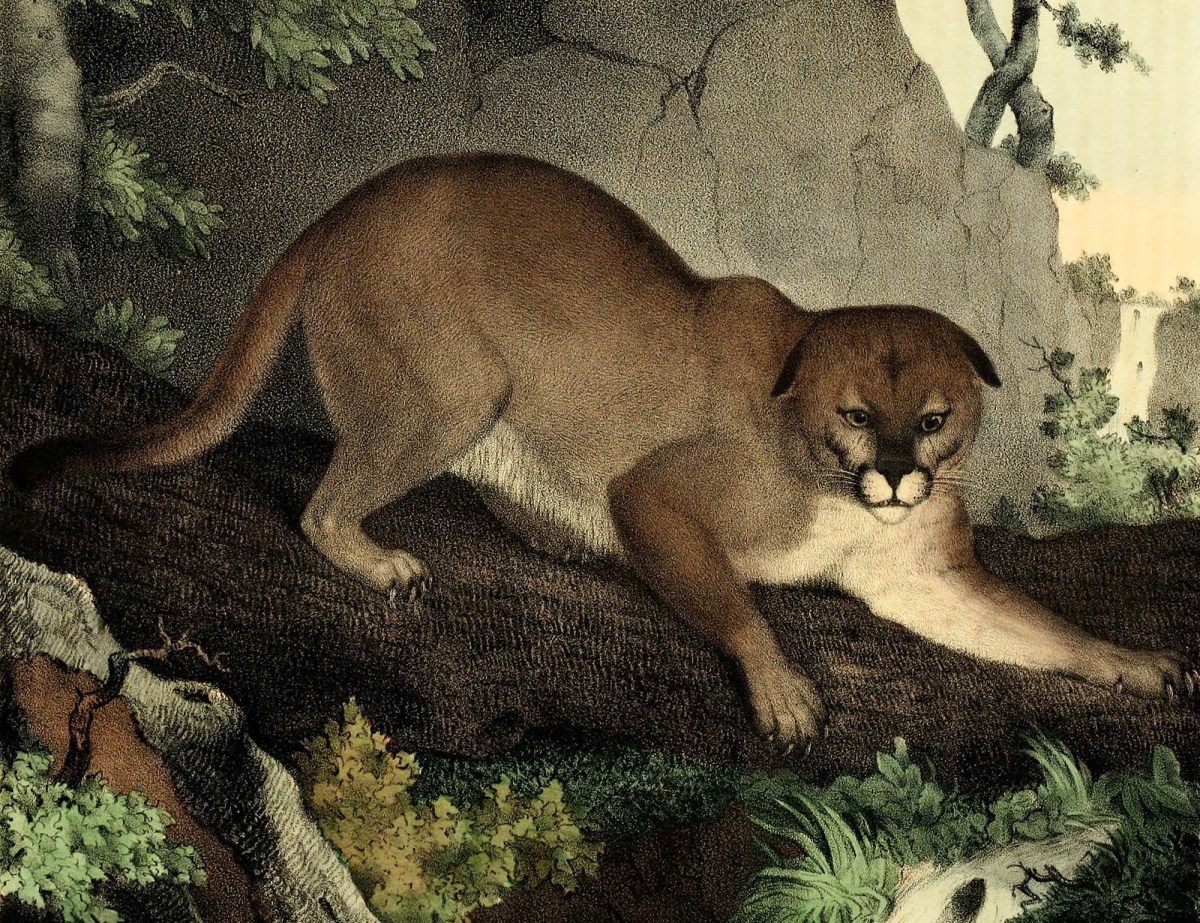

As a campaign to reintroduce mountain lions in Vermont moves forward, wildlife managers there and in neighboring states are asking lion advocates to slow down and “pump the brakes.” This was the predominant message in an op-ed written by a group of wildlife officials and shared by the Vermont Fish and Wildlife Department on Monday.
“We love Vermont’s wildlife and wild places, and we can appreciate why some are excited to bring back a native large carnivore,” the authors write. “We share the dreams of a wilder Vermont, but even so, we need Vermonters to understand that reintroducing mountain lions would be much more complicated than it might appear.”
The officials who wrote the op-ed include many of the state’s top wildlife management officials, including commissioner of the Vermont Fish and Wildlife Department Jason Batchelder. They note at the beginning of the article that the local rewilding campaign is being led by Mighty Earth, an international nonprofit organization. The group’s primary mission, according to its website, is “protecting Nature, restoring wildlife, and decarbonizing industry.” One of its stated goals is to rewild 250 million acres around the globe through the restoration of keystone species, which would include “returning catamounts to their rightful home” in the forests of the Northeast.
“Their return would deepen Vermont’s wilderness, inspire awe, and offer future generations of Vermonters a symbol of what’s possible when we choose to restore wildlife and invest in truly wild places,” reads the website for Bring Catamounts Home, a project of Mighty Earth.
A bill that’s been introduced in the Vermont House would take the first step in that direction by requiring VFWD to conduct a feasibility study. According to the bill’s text, the study would address how the big cats would be reintroduced, the locations suitable for reintroduction, and how to manage human-wildlife conflicts. It would also determine metrics for successful reintroduction, and provide an estimated timeline and cost for the effort.
Read Next: Mountain Lion Kittens Were Finally Photographed in Oklahoma. Skeptics Claim the Cats Have Been Breeding There All Along
Vermont officials caution that conducting a feasibility study would be “putting the cart before the horse.” This is because, as VFWD explains on its website, there isn’t much existing research on mountain lions in Vermont, where the species has been absent for more than 140 years. There hasn’t been a verified mountain lion sighting there since 1881, and the U.S. Fish and Wildlife Department officially declared the Eastern mountain lion subspecies extinct in 2018.
The agency says that until wildlife biologists can build a base of peer-reviewed research on mountain lions in the Northeast, it would be difficult and irresponsible to consider how to feasibly reintroduce the apex predators.
“[This comprehensive research] needs to be complete before we can responsibly grapple with deeper questions like whether bringing mountain lions here is the right thing to do, both for our communities and for the cats themselves,” the authors write. “Beyond the scientific and moral questions, there are also stark realities Vermont will have to face if we are serious about living alongside mountain lions.”
Those realities would include conflicts with farmers, as well as the effects that a restored cougar population could have on deer and other wildlife. There’s also the concern of mountain lion attacks on humans, which are rare but have occurred in several Western states over the past few years. Already in 2026 a mountain lion killed a hiker in Colorado — a state that is currently dealing with a host of conflicts stemming from its own ongoing large carnivore reintroduction of gray wolves.
Read Next: Colorado to Pause Wolf Reintroductions as Feds Apply Pressure and States Balk at Providing Them
As Vermont officials also point out, these realities would extend far beyond the borders of the Green Mountain State. Because of Vermont’s relatively small size and proximity to neighboring states and provinces — and the species’ natural instinct to disperse — any mountain lions released there would inevitably cross state lines into other areas.
The Northeast Association of Fish & Wildlife Agencies brought up these same concerns in a letter it sent to the Vermont House of Representatives in June, when H. 473 was first introduced. The group states that any considerations to reintroduce mountain lions in Vermont “must include close consultation” with every other state fish-and-wildlife agency in New York, New England, and the eastern Canadian provinces. NAFWA explains that with 100 miles being a common dispersal distance for subadult male lions, a cougar released in the middle of Vermont could easily travel to New Hampshire, Massachusetts, New York, Maine, Connecticut, or Quebec.
That dispersal distance might also be on the lower end. Journeys of 1,000 miles or more have been documented across the West, and even on the East Coast. In 2011, after a mountain lion was found dead on a Connecticut highway, wildlife biologists confirmed through genetic testing that the animal had traveled more than 1,500 miles from South Dakota before getting hit by a car.
“So, for the sake of the cats,” the Feb. 9 op-ed reads, “we are imploring mountain lion advocates to pump the brakes.”
Read the full article here
