



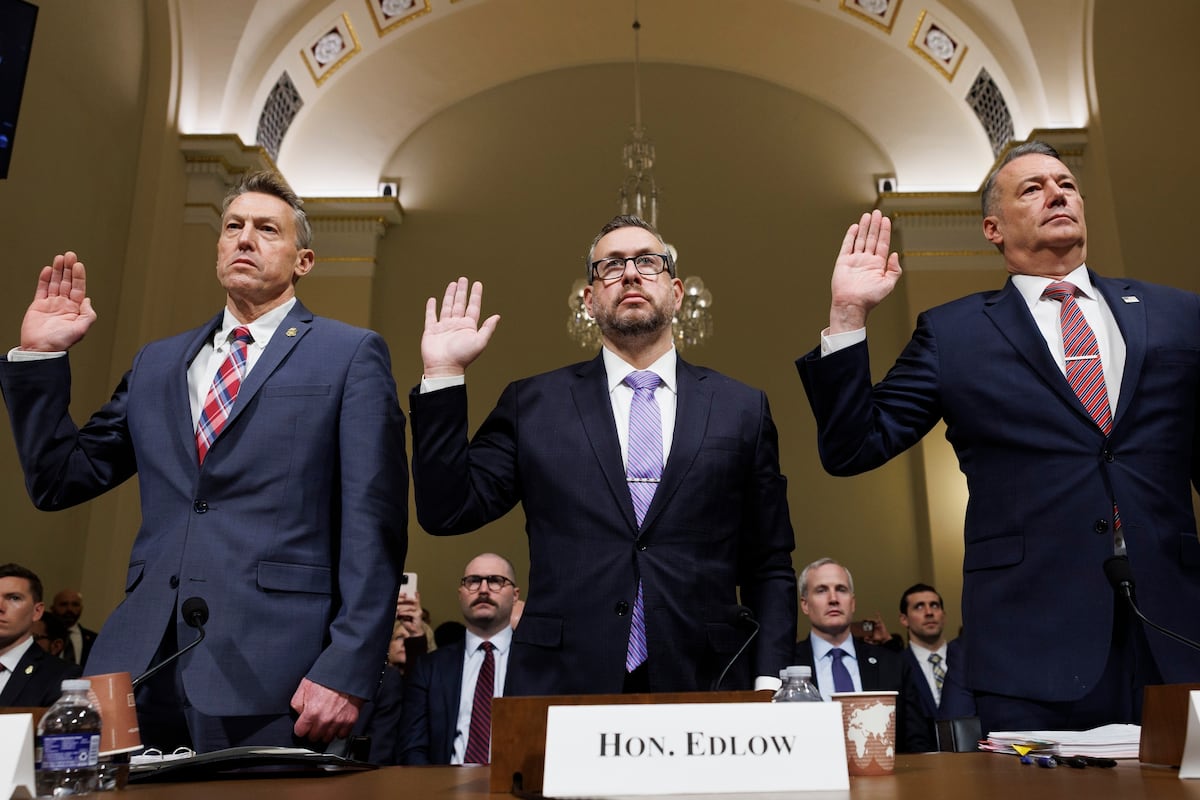

The heads of Immigration and Customs Enforcement and Customs and Border Patrol on Tuesday declined to comment on the January killings of Minneapolis protestors Renée Good and Veterans Affairs nurse Alex Pretti, citing ongoing investigations into their deaths.
During a House Homeland Security Committee oversight hearing on immigration enforcement operations, acting Immigration and Customs Enforcement Director Todd Lyons and Customs and Border Protection Commissioner Rodney Scott refused to answer questions regarding the deaths, which occurred last month during protests in Minneapolis.
Pretti, a registered nurse in the intensive care unit at the Minneapolis VA Medical Center, was shot and killed Jan. 24 while participating in a protest. From video footage, Pretti appeared to filming immigration enforcement officers and was helping a woman who had been shoved to the ground when he was pepper sprayed, tackled by federal law enforcement officers and pinned to the ground.
CBP agents then removed a concealed weapon from Pretti — one he had a permit to carry — and fired 10 shots at him, killing him.
In the aftermath, Trump administration officials cast Pretti as an instigator seeking to kill federal officers. White House Deputy Chief of Staff Stephen Miller called him an “assassin” and Department of Homeland Security Secretary Kristi Noem said he had committed an “act of domestic terrorism.”
Footage released after Pretti died showed him in an earlier incident yelling at law enforcement agents and kicking their car, breaking a taillight, a video that prompted Trump to call Pretti “an agitator, and, perhaps, insurrectionist.”
VA colleagues and Pretti’s parents say Pretti cared very deeply for his patients and others.
In a statement after his death, Pretti’s parents said the administration told “sickening lies” about their son, and called Pretti “a kindhearted soul who cared deeply for his family and friends and also the American veterans whom he cared for as an ICU nurse.”
Neither opening statement by Scott or Lyons mentioned Pretti or Good, a Minneapolis mom who was shot by an ICE officer on Jan. 7.
The committee’s ranking member, Rep. Bennie Thompson, D-Miss., called for a moment of silence for the VA employee and Democrats questioned Lyons and Scott repeatedly on his death.
When asked by Rep. Eric Swalwell, D-Calif., whether he would apologize to Good’s family for members of the administration calling her a “domestic terrorist,” Lyons replied “No sir. I welcome the opportunity to speak to the family in private but I’m not going to comment on any active investigation.”
Asked the same regarding Pretti, Lyons said he would not comment on any active investigation.
Rep. Shri Thanedar, D-Mich., asked Scott if Pretti deserved to die.
“I’m not going to comment on an ongoing investigation until it is concluded and all the facts are available,” Scott said.
Thanedar then asked Scott whether Pretti had a right to protest and lawfully carry a gun. Scott replied that he believed “every person in the United States has a right to their constitutional rights.”
Panel Republicans had little to say about Pretti, with the exception of Committee Chairman Rep. Andrew Garbarino, R-N.Y.
In opening remarks, Garbarino discussed his death in the context of an increase in violence against law enforcement and public distrust of the police, the investigative process and government operations.
“We must take down the temperature. We have seen a significant increase in violent rhetoric and agitation and attacks on federal law enforcement. … Obviously, we have seen the deaths of two American citizens in Minnesota. This is unacceptable and preventable,” Garbarino said. “I can’t put myself in the shoes of law enforcement nor can I imagine what the families of Ms. Good or Mr. Pretti are feeling.”
Since the start of deportation operations under the Trump administration, ICE has arrested nearly 400,000 persons. Nearly 60% of those arrested have had prior charges or convictions, though just 14% had previously been charged or convicted of violent crimes.
The number of migrants intercepted at the border by CBP has declined from an average 5,000 per day under the Biden administration to roughly 250 a day in 2025, according to Scott.
But American citizens have been caught up in enforcement raids and taken into custody when they can’t immediately prove they are citizens. The families of some veterans, including the undocumented father of three U.S. Marines, have been beaten and detained.
Good and Pretti’s deaths have sparked a growing outcry over the immigration enforcement efforts.
“There appears to be no shame on the part of these officials who undoubtedly watched some of your officers conduct themselves in ways I know you do not condone,” said Rep. Troy Carter, D-La. “I can’t understand why you show no shame, no contrition, no remorse for the human lives that have been lost, the trampling of the Constitution and the tearing apart of the moral fiber of our nation.”
The officials said the Minneapolis operations have been challenging because it is a sanctuary city where local government and law enforcement refuses to assist in supporting federal operations. They alleged that many of the protestors in the city are paid agitators who have ramped up attacks on law enforcement.
“Paid agitators are actively trying to stop law enforcement action,” Scott said. “Without that, you would have no idea that most of these arrests were taking place.”
Officials did not provide updates on the status of the investigations into Pretti’s death. The Department of Justice has opened a civil rights investigation into the shooting.
Democrats have called for Noem to step down and some want to abolish ICE. Discourse over the operations has been at the center of congressional debate over DHS funding for fiscal 2026, leading to a short-lived partial government shutdown last week.
As a result of an agreement to reopen the government, DHS is funded through Feb. 13. If new negotiations fail, DHS will shut down at midnight Saturday.
Personnel not considered essential will be placed on furlough while those necessary for security and protection of life and property, including many law enforcement personnel and the U.S. Coast Guard, would work without pay until the issue is resolved.
Patricia Kime is a senior writer covering military and veterans health care, medicine and personnel issues.
Read the full article here
