




This story, “Hawaiian Hara-Kiri,” appeared in the December 1962 issue of Outdoor Life.
Raymond Arraujo and I climbed up a dry watercourse on the leeward coast of Hawaii Island, following Ray’s dog Phil, who was sniffing his way along the maze of old tracks in the sand. Phil wasn’t showing much enthusiasm, and neither were we. The tracks were old, and it was hot. There was hardly a breeze in the sun-baked gully, and it was like climbing in an oven.
We were hunting wild boar which abounded in the dense forest below us, but we weren’t at all sure we’d find any up in these barren gulches and rocky hillsides we were now climbing. Most of the pigs we’d seen in the lower forest had been of average size, about 90 to 100 pounds, but we knew there were some real monster boars hanging around here somewhere. Once, we’d had a glimpse of two of these giants, each of which would have weighed at least 300 pounds, but no chance for a shot. According to local residents, these big boys came down during the night into the forest to feed and water, but returned before daylight up into these dry gulches and out onto the lava-covered ridges, where they sought shade and quiet in small caves. To get one, we’d have to follow them home and root them out.
We’d been climbing for over an hour, and had just about decided to call it quits and return to the lower country where we knew there were pigs. The tracks here didn’t look fresh, and the caves we’d poked into were empty, though many of them showed boar sign. Worst of all was Phil’s lack of interest. He was experienced at this game, and had many scars to prove it, but his present actions told us plainly that there hadn’t been game around here for some time.
Then, suddenly, he changed completely. His body tensed, and his nose tested the faint breeze. Then he streaked up the left bank of the dry wash and into thick, thorny brush. Ray and I held our breath, waiting. Then came a sudden burst of excited barking! “He’s got one!” Ray yelled as he scrambled out of the gully and into the brush. I checked my gun and followed.
The pig should have dropped dead in his tracks, but he didn’t. He just whirled around, forgot the harassing dog, and came at me.
I was carrying the only gun that day. Ray, who works for a sugar plantation and operates a tour service on Hawaii Island in his spare time, had left his rifle at home, not wanting to carry the extra weight and figuring I could do all the shooting. Before the day was over, he’d regret not bringing it.
My weapon is an A.F.S. Ferlach combination rifle and shotgun, a beautiful, Austrian-made, all-purpose weapon. The lower barrel is chambered for the .30/06 cartridge; the upper is a 12 gauge shotgun. Each barrel, of course, is a single-shot, but I had practiced enough so that I could break open the action and reload in short order. I planned to use the rifle barrel for boar, and had it loaded with a DWM cartridge firing a 167-grain soft-point bullet. I carried a second cartridge between the fingers of my left hand for quick reloading. For emergencies, I had a .12 gauge rifled slug in the shotgun barrel.
As we crashed through the brush and over the loose rocks, we could hear Phil’s frenzied barking ahead of us. He seemed to be staying in one place.
“He’s got the pig cornered and may try to grab him,” Ray panted. “If it’s a big one, he may get all cut up. Hurry!”
We broke out on the rim of the next parallel gully, and there was Phil below us, barking at the base of a small cliff at our feet. But we could spot no pig. We slid down into the watercourse and ran around a projecting rock. Then we saw something; back in a small cave was a black form.
“He looks like a big one,” Ray hissed. “Shoot him!”
Shoot him? I couldn’t see anything but a big, black shape and couldn’t tell one end from the other, much less see where to put a bullet. Then the boar stood up. He looked immense in that little dark cave. Before I could fire, he whirled out of another entrance, shot up the side of the gulch, and disappeared into the brush, with Phil in hot pursuit.
Ray followed up onto the ridge, while I ran down the gully, trying to get ahead of the chase. It was a short run. Phil had the boar stopped in less than 75 yards, and I could hear the squealing, growling, and barking of a real battle. I scrambled up the slope, and not 30
feet from where I topped out, the dog and boar were having at it. Phil was wheeling around the enraged boar and darting in, nipping at him and trying for a good hold. The boar lunged and turned, attempting to slash his tormentor with razor-sharp tusks. He almost succeeded, too. In his excitement, Phil got momentarily tangled in the bushes, and the boar was on him in a flash, rolling the dog over several times with a savage thrust of his snout; but his tusks missed their mark, and Phil was up and snapping.
Suddenly, a big sow caught him with a rush, and the dog went end over end with the sow right after him.
All this happened lightning-fast while I was raising my rifle. I caught his shoulder in my sights, and the .30/06 cracked. At that range, I couldn’t miss. The bullet broke his shoulder, completely scrambled his lungs, and passed out on the far side.
He should have dropped dead in his tracks, but he didn’t. He just whirled around, forgot the harassing dog, and came at me.
No time to reload the rifle barrel. I switched my finger to the second trigger and tried to aim at the oncoming animal, but Phil was still snapping at his heels and in the line of fire. Wait till he’s clear, I thought. I can’t wait any more; he’s too close! The 12 gauge roared, and the boar went down hard and stayed there — not six feet from me. He was so close I was shooting almost straight down on him. The heavy slug drove through the point of his shoulder, smashed his spine, lungs, and heart, and out through the lower ribs, burying itself in the ground. If I’d shot any sooner, it might have ranged through him from front to rear, passed out, and hit the dog behind him.
The boar wasn’t one of the granddaddies we hoped to find, but he was big enough to rip me wide open if he’d made it. He weighed 152 pounds on the scale I carried, and his tusks were a bit over two inches long, honed sharp as a knife. Wild boars don’t have to be big to be dangerous; they make up for size in ferocity and fighting spirit, as this one had just proved, and two-inch tusks could easily lay my leg open to the bone with one slash.
After doing a post-mortem examination, as a part of my job for the Hawaii Division of Fish and Game, and dressing the boar out, we packed it to my jeep at the edge of the lower forest. I still wanted another specimen from this area, so we decided to make a short hunt under the shade of the forest where it was cooler.
If we didn’t get anything in an hour or so, we’d call it quits.
I came to Hawaii six years ago from Colorado, and have been working ever since as a wildlife biologist for the state. Two years ago, I was stationed on Hawaii Island to start a life-history study of wild boars, a project which still has me collecting specimens for post-mortem examinations, weights, measurements, and blood samples. Probing through a wild boar’s plumbing after each kill makes an interesting but messy job.
Turning Phil loose, we started through the mature algarroba trees, also called kiawe, that stand about 50 feet high. The heavy, twisted trunks are spaced wide apart, and there is little underbrush, but the crowns overlap, forming a canopy of feathery leaves. It was still hot, but not like those open, broiling gullies and ridges where we’d hunted in the morning.
Pig tracks were abundant in the dry dust, and beds were evident under many of the leaning trees. We’d moved no more than 200 yards from the jeep when Phil threw up his head and took off at a run. Ray watched the dog vanish among the trunks, glanced at me with a big grin, and said, “Let’s go! He’s got a hot trail.”
We’d hardly started when an awful conglomeration of noise broke out about 100 yards ahead. Growling, barking, yipping, squealing — all mixed up in what sounded like a roaring battle. “Phil must have tackled a couple of big ones,” I panted, “and they’re eating him up!”
Ray, born and raised on Hawaii Island, has hunted wild pigs for over 10 years and has seen and heard a lot of fights, but he looked a little pale around the gills as we ran to see what was happening. He told me later that he’d never heard a commotion like this one before, and thought Phil, the best of his three dogs, was in trouble. He was. We broke into a clearing and skidded to a stop about 40 yards from the doggondest sight that I have ever seen.
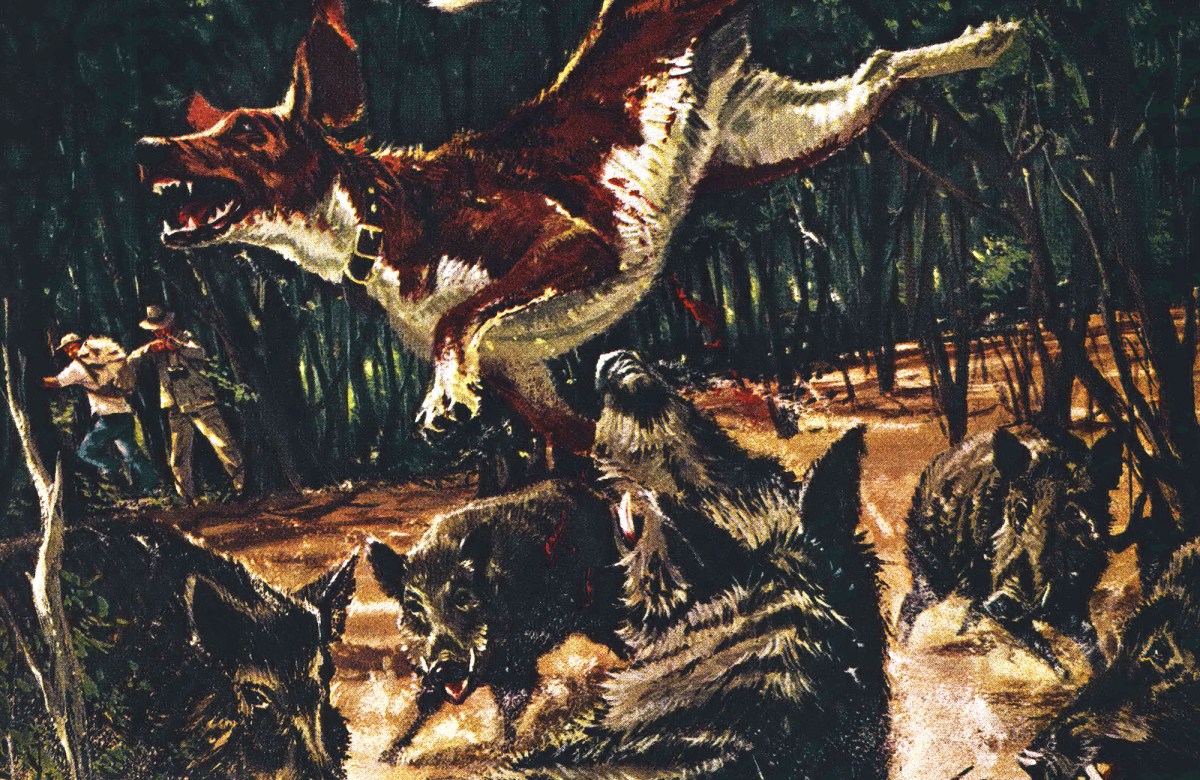
The dog had run smack into a bunch of about 10 hogs. Instead of running away, they were all hot after Phil, charging him from all directions at once, and making no effort to get away. He was game, though, and kept trying to harass them even though they were doing more chasing than he was. I couldn’t shoot for fear of hitting the dog. But Phil couldn’t keep out of reach of all those fighting-mad pigs for long. Suddenly, a big sow caught him with a rush, and the dog went end over end with the sow right after him. Sow and dog disappeared in a cloud of dust, and the other pigs charged in.
This is it I thought, Phil’s a goner for sure. But I was wrong, and out of the dust-cloud jumped Phil, the pigs right after him. He’d had enough though, and started hot-footing it back toward Ray and me for protection, bringing the whole herd of his tusk-chopping friends with him. Up to that moment, I was only worried about the dog, but now I saw Ray jump for a tree. It suddenly dawned on me that since he was unarmed, all that stood between us and the oncoming herd were the two shots in my gun, and I was sure that they would attack us. In most cases, boars won’t charge humans unless provoked, but once they’re excited they’ll take on anything they see — and they’d see me any second now.
I took quick aim at the big sow right behind the dog and touched the front trigger. Down she went. At the shot, the dog wheeled off to the left, pigs following, and I had time to eject the empty, reload, take aim again, and drop the next pig in line. After the second shot, most of the pigs broke off the chase and scattered, leaving me feeling a little more self-confident. Phil and one boar were still going round and round. I loaded another cartridge and killed it in its tracks. I didn’t want any more specimens, but I’d had enough of this bunch of demons and decided to keep shooting as long as any hung around looking for a fight.
When I looked away from the boar, there were no more hogs in sight. Ray was down off his tree and grinning sheepishly as he checked Phil over for wounds.
“I didn’t have my rifle,” he said apologetically, “and couldn’t have done anything to help with just a knife. I thought they’d be right on us before you could stop them.”
“No excuses needed,” I answered while wiping my brow and eyes. “I don’t blame you a bit. If they hadn’t turned after my first shot, I was going to whack one more with the 12 gauge slug and then get in that tree with you.”
Phil had escaped with only minor tusk slashes, a lot less damage than I thought he’d have. We checked the three pigs I’d shot and found them just average size. The sow weighed 94 pounds; the second pig, a young boar, 80 pounds; and another boar, 112 pounds. Nothing to brag about, but for my study, one specimen is as good as another. Anyhow, we didn’t feel the need for bragging. We were just glad it was all over. Pound for pound, these dry-country, lowland pigs were the fightingest porkers either of us had ever met.
You’re probably wondering if I haven’t been exaggerating the danger from these animals, and, in fact, just what are these Hawaiian wild boar that I’ve been talking about? Let me answer the last question first.
Pigs were first brought to Hawaii by the Polynesians who first settled the islands.
They were the only large mammals, except dogs, that were present here before the arrival of the white man. I haven’t been able to find out exactly what those early Polynesian pigs looked like, but they must have been domesticated descendants of the so-called European wild boar, which is found throughout much of southeast Asia as well as in Europe. By the time Capt. James Cook discovered Hawaii, pigs had become established in almost all parts of the islands, and were running around free and completely wild.
Later settlers introduced many varieties of domestic pigs, also descendants of the original European wild hogs. In time, some of these domestic pigs escaped into the forests and crossed with the Polynesian wild pigs, particularly in areas near civilization. But in the high, remote forests, especially the slopes of Hawaii Island’s two great mountains, Mauna Kea and Mauna Loa, the wild pigs eventually reverted-through inbreeding and isolation — back to a form that is almost identical to that of their forebears. These mountain pigs have been identified as Sus scrofa, the same species as the European, or Russian wild boar, and are, to all appearances, practically the same animal. They are all black, though a few do have white feet. They have pointed snouts, high shoulders, sloping rumps, comparatively long legs, and mulelike tails. They’re covered with coats of heavy bristles, and many have the thick, wooly undercoat of fine hair, typical of the Russian boar. Boars grow thick shields of skin and connective tissue over their shoulders for protection in fighting. I’ve measured such shields that were over 1-inch thick. Their long, sharp tusks, which sprout from the lower jaw and curve up and out, fit against the front edge of matching upper tusks, which are shorter and blunt.
Sows lack the heavy shields and long tusks, but they have short, sharp tusks that can do plenty of damage. When excited, boars chop their jaws together rapidly, honing a razor edge on the lower tusks by rubbing them against the uppers, lubricating the sharpening by heavy salivation. These tusks are formidable weapons, and a mad, cornered boar, glaring out of little yellow eyes, and rapidly chopping his ivory, will give anyone goose pimples.
Pigs of the lower elevations, closer to civilization and more apt to be invaded by domestic swine, tend to show characteristics of these domestic animals. Some are brown, some almost white, some spotted, though most are black. Their general physique is more like that of domestic pigs than of European boar, but they’re still wild and mean, and they grow a lot bigger. While large “mountain boars” sometimes reach 250 pounds, the low-country “forest boars” frequently exceed this weight, and may reach 400 to 500 pounds. Several months ago, Ray killed one in the Kohala forests that weighed over 450 pounds, and he tells me that he’s killed larger ones that he didn’t get to weigh.
All the major Hawaiian Islands, except Lanai, have wild pigs in their forests. Hawaii Island, being the largest and having more wilderness, has the greatest number. Although no census has ever been made, this island probably has a population exceeding 100,000 wild pigs. About 10,000 are taken each year by hunters from this island alone, and possibly more. Pigs inhabit almost every part of the island that has not been settled or is not cultivated.
On the public game-management areas of the state, boars are managed as game animals and are under the control of the Division of Fish and Game. Seasons and bag limits vary from island to island, but on Hawaii Island, the season runs all year with a daily bag limit of two pigs per hunter. On other land not under Division of Fish and Game control, hunting is unlimted, and all that is needed is permission of the landowner and a hunting license, which costs $5 for a resident, and $10 for a nonresident.
Hunting methods vary almost as much as the habitats. The favorite method used by local hunters in the thick jungles is dogs and knives. No guns, just big knives. The dogs are trained to stop the pig and grab its shoulders or ears; then the hunter must run in, grab it by the hind legs, flip it over, and cut its throat. And if you don’t think that can get real hairy at times …
In more open country, dogs are frequently used to locate and stop pigs, but the hunter kills them with a rifle. Or else, they’re just hunted by riflemen like most other big game. There are even quite a few archers who take their pigs with arrows, though more are wounded and escape than are retrieved by this method.
Game laws require that rifles used in public hunting areas must deliver a muzzle energy of at least 1,200 foot-pounds, and only soft-point bullets can be used. On private lands and in forest reserves, however, anything goes, from .22 Long Rifle on up. Many hunters who back up their knives with rifles prefer the M-1 carbine for close work since it is so easy to carry and can be fired rapidly. I’ve used the M-1 carbine with soft-point bullets with good effect at close range, but military bullets do a lot of wounding and shouldn’t be used. The .30/30 lever-action carbine is another favorite. I personally prefer a little heavier caliber for pigs, though I’ve killed them with a .222 Remington, and even a .22 Winchester Magnum.
I’ve done most of my hunting with a 7 mm. Dumoulin carbine, which is light and packs a powerful punch, but lately I’ve been swinging to my new Ferlach combination gun. It balances perfectly and is the most accurate .30/06 I’ve ever owned. Then, too, when carrying it, I also have a shotgun barrel which can be loaded with a rifled slug for irate boars, or a shot shell during bird season when both birds and big game can be hunted at once.
But let’s get back to wild boar, and the risk involved in hunting them. This, like any other dangerous-game hunting, depends on the conditions. As I said before, they will rarely attack unless provoked — except for sows, which may charge on sight to protect their young — and I wouldn’t hesitate to walk through pig country unarmed, as long as I didn’t have a dog with me to stir up trouble. When they can, boars will invariably run at the sight or scent of a human. Hunting them in the more or less open country with a good rifle, a man can usually place his shot and kill even the largest quickly, or finish off a wounded one from a safe distance, and usually no danger involved.
Hunting them with dogs in cover, or even in relatively open country, can lead to plenty of excitement. Once dogs start boars fighting and stop them from escaping, they change radically. Frequently, as soon as they spot the approaching hunter, they forget about the dogs and charge the hunter. Well-trained dogs can stop them most of the time, but if they can’t, the hunter had better shoot straight or start climbing.
The men who hunt the jungles with only dogs and knives are the ones taking the real chances. They depend almost entirely on their dogs’ ability to hold the pig until they can get it by the hind legs, which makes a boar pretty helpless. But many of them have been badly cut when pigs got away from the dogs at a critical moment in the operation.
When he was halfway through, the boar got away from the dogs and charged. The man didn’t have a chance.
Take the case of the man who was hunting recently on Oahu Island. His dogs had bayed a large boar under a patch of dense brush, and he thought they had the boar pinned. This man had been hunting pigs for many years and was no amateur. He was also armed with a rifle, not just a knife. But he couldn’t see well enough for a shot, and the only way to get closer was to crawl in along a pig trail. When he was halfway through, the boar got away from the dogs and charged. The man didn’t have a chance. He couldn’t shoot quickly enough, and the boar hit him full force. It made only one pass, then went by him and on down the trail, or he probably wouldn’t be around to tell about it. As it was, it sliced all the tendons in both wrists as he tried to ward it off, and he’ll never have full use of his hands again.
Then there was another man who recently made the mistake of entering a pen with a captured wild boar. It took 39 stitches to sew up his leg, which was ripped to the bone from ankle to knee. And these are not just isolated cases; there are quite a few pig hunters in Hawaii who bear scars of such encounters.
Several years ago, two men were hunting in the jungle-covered Kohala Mountains. One of them shot a large boar and knocked it down. Thinking it dead, he approached. Suddenly, the “dead” boar jumped up and charged. It all happened too fast for either hunter to shoot, and the boar was on the man before he could move. Again, this one made only one pass, then took off. But he left the hunter with both femoral arteries severed, and the man was dead before help could arrive. This is the only fatal attack I’ve heard of, but I wouldn’t be surprised to learn of others.
Read more from this author: Hunting Goats in Hawaii Isn’t Especially Hard. It’s Packing Them Out That’s the Problem
Hunting dogs fare far worse than hunters, and lots of good dogs have been killed by boars, while most others have scars from deep cuts. Ray’s dog, Phil, already has his share of scars, and he’s been hunting pigs only a little more than a year.
Even a comparatively minor tusk slash is messy. Both upper and lower tusks are covered with filth in the form of rotting vegetation, carrion, and just plain dirt from rooting, and any cut from these promises a bad infection unless it’s promptly cared for. Although the edges of the lower tusks may be knife-sharp, these teeth are roughly triangular, so they make ragged wounds, hard to sew and slow to heal. All in all, these animals are not to be taken lightly and should be definitely considered as dangerous game.
I’ve had several wounded boars try to charge me. But — except for the one I described already — they were sufficiently broken down so that they couldn’t make much progress. A friend of mine had an encounter with a wounded boar recently that was a real hair-raiser, and which illustrates how one little slip can almost turn a routine hunt into a tragedy.
I’d picked up Capt. Andy Andrus of Ashville, New York, about noon one day at Pohakuloa, a military training camp where he was stationed as a helicopter pilot for the Marines. An hour’s drive brought us into prime pig habitat on one of the large cattle ranches nearby. This was Andy’s first hunt for wild boar, and he was hoping for a trophy pig.
After leaving the jeep, we headed cross-country to see if we could kick a boar out of his daytime bed under an old log, in a shady nest beneath a brush patch, or in a small cave. Although a few are seen feeding in the open at all times of the day, most remain bedded down until the main feeding period which begins at about 4 p.m. We kicked out pigs all right, but nothing worth shooting from Andy’s point of view. I decided to drop down to a water hole I knew about and see what came in there.
As we approached, I could see a number of pigs around the water, including one that appeared much larger than the rest. We ducked behind a grove of trees and stalked closer for a better look. Sure enough, when we reached the edge of the grove about 100 yards from the water hole, we found that this animal was truly a good-size boar.
He was pale and shaken, but unhurt, and his shot from the hip was one of the luckiest I’ve ever seen.
“He looks like a pretty good one,” I whispered to Andy. “Do you think you can take him from here?”
He answered by raising his borrowed, iron-sighted .30/30, resting it against a tree, and squeezing off a shot. The hollow plunk of the striking bullet proved he could hit it, but also indicated a paunch shot rather than a killing hit. The boar squealed, recovered, and took off at high speed. Andy missed a second shot at the running boar, so I tried my luck, hoping to drop him before he got away. My bullet merely punched through his withers above the spine, not fazing him in the least. By then he was disappearing through the trees, and we had a last glimpse of him as he went over a shoulder of the hill and down a small ridge.
“What happens now?” asked Andy.
“We follow him,” I replied. “He probably won’t run too far.”
I thought of warning Andy to be careful now that the boar was wounded, but we were running, and I didn’t get around to it. I should have. I sent Andy down the ridge on which the boar was last seen, and I crossed over to the next ridge about 50 yards away, starting down parallel to him. With one of us on each ridge, I believed we’d have a better chance of spotting the undoubtedly enraged animal.
We’d hardly separated, when I heard a rifle crack to my left. Whirling, I saw Andy staggering backward with the black boar rolling between his legs. My first thought was that the pig had slashed Andy and would get him again, but the boar rolled to a stop and didn’t rise. Andy didn’t yell; he just stood there looking down.
“Are you O.K.?” I yelled as I scrambled down and across the small gully.
“I’m all right. I guess,” he answered.
“Wow!”
“What happened?”
“I was walking along, looking ahead,” Andy said, “when I heard a noise behind me. I looked around, and there was the boar, charging me. He was right on top of me! I just had time to swing my rifle and shoot from the hip before he hit my legs.”
He was pale and shaken, but unhurt, and his shot from the hip was one of the luckiest I’ve ever seen. It took the charging boar right in the brain, killing him instantly and saving Andy from what could have been a horrifying situation.
Backtracking, we learned what had happened. The boar, soon as he was out of sight and over the shoulder of the hill, had stopped behind a log on top of the ridge, where we found mashed grass and a little pool of blood. He heard Andy approaching, waited until he was 20 feet past, then charged from behind. Luckily for the hunter, the boar kicked a small piece of wood on the way, making the noise which caused Andy to turn his head. There’s no question about it: that boar made a deliberate charge and he’d waited until he thought he had Andy at a disadvantage before launching it. If it hadn’t been for that piece of wood and a very lucky shot, I’m sure my partner would have been nursing some very serious cuts.
Read Next: 11 Wild Photos of the Hog Hunting Dogs from Alabama
Examination of the dead boar showed that the first shot had hit him in the flank, penetrating his intestines only. The .30/30 didn’t have enough shocking power to knock him down and hold him there with that kind of a hit. Although it would probably have been fatal eventually, its immediate effect was only to make the animal sick and mad. My shot through the withers was only a minor flesh wound and just made him madder.
“Maybe I’ll get a boar with longer tusks someday,” Andy said as he looked at the 2 ½-inch tusks, “but this is the one I want mounted. I could actually feel those choppers in my legs before I shot. I want this guy’s ugly puss on my wall to remind me to be very careful where I put that first shot from now on.”
I gained something that day, too — even more respect for the fighting qualities of these ugly, short-tempered, and well-armed wild hogs than I’d had before. They’re half blind and generally not too alert, so hunting them in this type of habitat is usually too easy to be very exciting, but get one stirred up and mad at you, and he’ll provide memories — or scars — that you’ll not soon forget.
Read the full article here
