



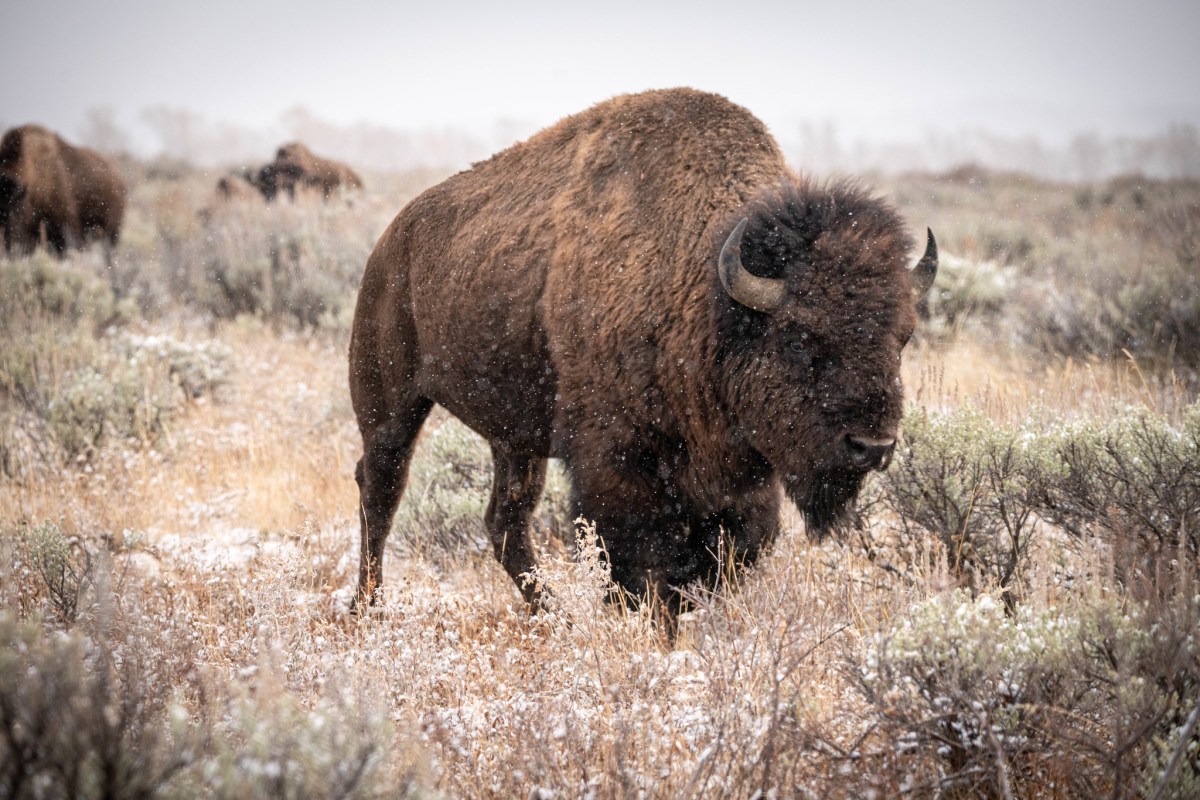

As disagreements over restoring free-roaming bison to the West grows more heated, dozens of tribes are weighing in. The united front from more than 50 Native American tribes comes in direct response to a recent decision by the Interior Department to revoke American Prairie’s bison grazing leases on several Bureau of Land Management parcels in Montana.
On Friday the conservation nonprofit followed through on its promise to challenge that decision, delivering an official letter of protest to the BLM’s state director in Montana and the Dakotas. That letter expands on American Prairie’s stance that the BLM’s Proposed Decision to revoke seven parcels under its management in Phillips County is “unlawful, factually incorrect, and procedurally deficient.” The 20-page document came on the heels of a handful of strongly-worded letters sent by Native American Tribes and their supporters.
American Prairie suggested the Interior’s decision could unwind decades of established norms surrounding public-land grazing in the West. The nonprofit says the BLM has been issuing bison grazing permits for more than 40 years, and that reversing the agency’s longstanding interpretations of the law could affect dozens of bison ranchers across six Western states.
Meanwhile, tribal rejection of the Interior’s Jan. 16 decision sets the stage for a larger legal battle that could pit the second Trump administration’s DOI against the majority of Indian country.
“It is offensive and unacceptable that the federal government would still seek to keep any buffalo off these lands,” Chairman of the Cheyenne River Sioux Tribe Ryman LeBeau writes in his Jan. 28 letter, adding that BLM lands are former buffalo lands. He calls the decision painful and a reprise of “the genocide the Federal government attempted to commit against us and our relative the buffalo.”
“BLM’s well-reasoned and thorough decision is a principled recognition of its limited authority, set by Congress in the Taylor Grazing Act,” BLM spokesperson Brittany Jones told Outdoor Life in an emailed statement last month. “Our priority is to apply the law faithfully and ensure decisions align with statutory requirements.”
LeBeau speaks in the letter to the key role that the Cheyenne River Sioux Tribe has played in the history of America’s buffalo, which were nearly eradicated during the late 19th century. The tribe was instrumental in saving the species from extinction, LeBeau notes, and now manages the largest tribal-owned buffalo herd in the country at 2,500 head — as well as one of the largest tribal-owned buffalo meat processing companie. He refers to the exclusion of American Prairie’s buffalo herd from BLM land as a rejection of tribal management practices and a threat to tribal sovereignty.
Another letter, sent on Jan. 30, came from the Coalition of Large Tribes, which represents more than 50 federally-recognized tribes and more than half of the country’s Native American population. Along with a statement from the Cheyenne and Arapaho Tribes, COLT’s letter addresses the Interior for not consulting with any tribes before issuing its decision to revoke American Prairie’s bison grazing permits.
COLT contends that the Interior’s decision to single out American Prairie’s herd is based on “unworkable definitions” of the Taylor Grazing Act, including the creation of a new term — “production-oriented purposes” — that is not used in the language of the act.
The group warns that under this interpretation of the TGA, “it is unlikely that any tribal government or tribal citizen buffalo herd would ever be eligible for BLM grazing leases.”
COLT says this would have immediate consequences on the tribes that exchange bison with American Prairie, and it would be a major blow to the tribes currently working with the BLM to acquire their own bison grazing leases. Many tribal fish and game agencies across the West have been working on their own bison restoration programs in recent years.
COLT’s letter also speaks to the political calculus that it sees as guiding the Interior’s decision. COLT points out that while multiple studies have shown the ecological benefits of grazing bison on BLM land, it has historically been difficult for bison operators to obtain grazing leases due to the influence of cattle ranchers and the political weight that the livestock industry carries. The Jan. 16 decision, COLT contends, is “affirmative action for cattle.”
Read Next: After More Than a Century of Conservation Efforts, Why Can’t We Recover America’s Buffalo?
This characterization speaks to the longstanding conflicts between cattle ranchers and bison advocates in the West, where buffalo are often managed by state governments as both wildlife and livestock. As efforts to rewild bison continue to gain steam in the region, many livestock producers remain concerned about the impacts that free-ranging bison could have on their operations. Their concerns have extended to groups like American Prairie, which has been acquiring private ranchland in Montana in an effort to conserve native grasslands and restore bison there.
Read the full article here
