



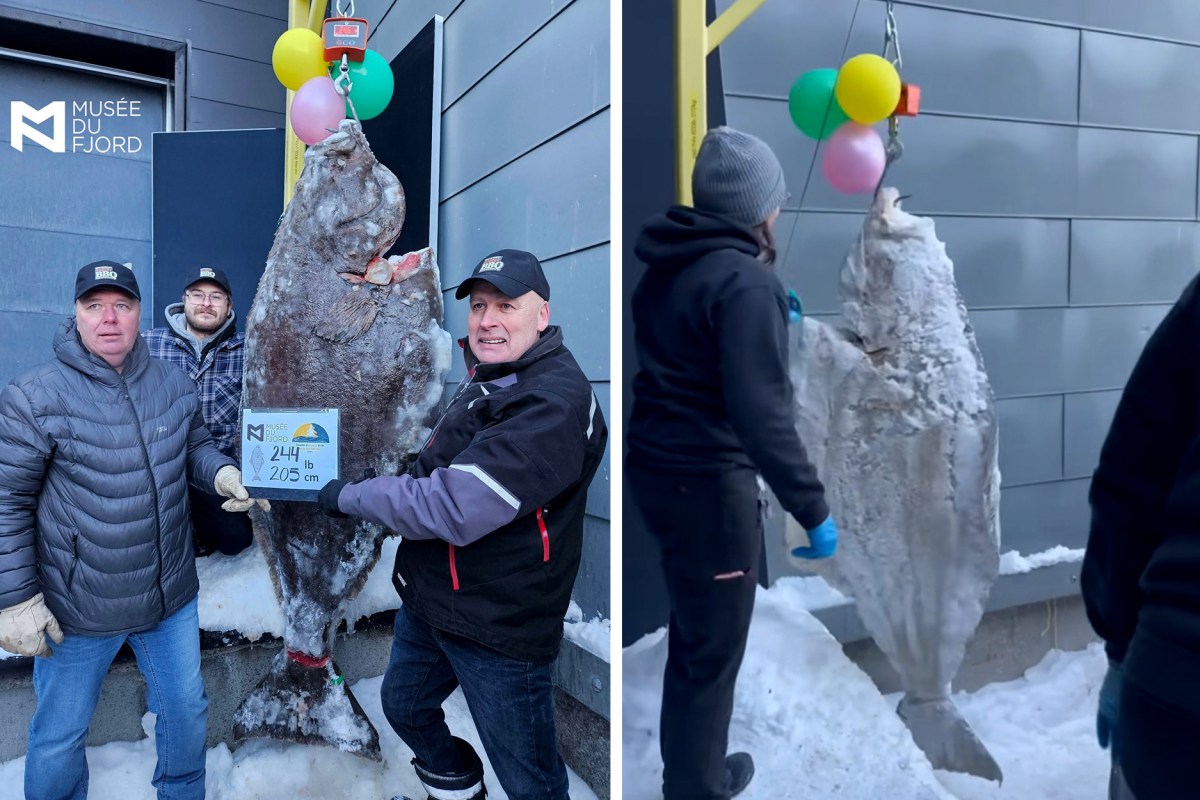

A group of Canadian ice fishermen caught a huge Atlantic halibut Monday that’s been declared a new record by scientists in Quebec. The fish measured more than 6.5 feet long and weighed 244 pounds, according to the Musée du Fjord.
Alain Hamel is credited with catching the giant flatfish, which was pulled through the ice after a two-and-a-half hour battle. A video shared by the Musée du Fjord shows the huge fish up being hoisted up on a scale in front of a cheering crowd.
Hamel and his crew caught the halibut under a special scientific permit in Quebec’s Sanguenay Fjord. This narrow, deep inlet in the Gulf of St. Lawrence is a unique fishery, where freshwater from the Riviére Saguenay flows over the gulf and freezes solid. (Seawater freezes at a lower temperature than freshwater, and it has to be colder for longer since bays are typically deeper than lakes.) It’s one of the only places in North America where you can catch (and harvest) Atlantic halibut through the ice.
Read Next: This Kid Just Wanted to Catch Something Big. He May Have Caught a World Record
The species is protected throughout some of its range, and Canadian regulations typically require catch-and-release. However, Fisheries and Oceans Canada has made an exception in the Sanguenay Fjord, where it launched a scientific winter fishing project starting in 2022. The research project aims to better understand Sanguenay halibut, which are considered a “sink population” that are isolated from the rest of the world’s Atlantic halibut.
The winter fishing project doles out around 35 special licenses per year, and it requires all fish under 85cm (or 33.5 inches) to be released. The larger specimens, like Hamel’s fish, are harvested and donated to the Musée du Fjord, where the heads and stomachs are analyzed by scientists. (The fishermen will be able to keep the roughly 170 pounds of meat that came off the halibut, according to CBC News.) Hamel’s fish was number 27 this winter, and the fishery was suspended soon after his catch to keep the quota from being surpassed.
“Ten years ago, we would never really see people catching Atlantic Halibut,” Marc-André Galbrand, the president of the committee that oversees the fishing program, told CTV News earlier this week. “Since the last four years, we’ve been getting a lot, and this year, we had so many halibut that we’re getting out that we had to suspend our scientific permit.
A relative of the more common Pacific halibut, Atlantics are typically migratory, traveling throughout the North Atlantic and into the North and Barents Seas. They also grow much larger than Pacific halibut. The largest known specimen was taken off the coast of Sweden and weighed 720 pounds, according to the International Game Fish Association. The IGFA all-tackle world record Atlantic halibut weighed just under 419 pounds and was caught in Norway in 2004.
Read the full article here
