




This Shooting column, “Using a Rifle Sling,” appeared in the Dec. 1972 issue of Outdoor Life.
A guy I know has very positive opinions on practically everything. Mostly they are opinions against something or another. Among his pet hates are rock-and-roll singers with long hair, mini-skirts, side-by-side double-barreled shotguns, Irish tenors, lady golfers, the .30/06, the .270, and all other cartridges designed before 1945, TV commercials, and slings on rifles.
Of all his pet abominations, I think he probably loathes rifle slings the most.
The very thought of one almost gives him a seizure. Actually I think if he saw a lady golfer in a mini-skirt, holding a double-barreled side-by-side shot-gun as she did a TV commercial while an Irish tenor with long hair stood beside her carrying a .30/06 by a sling, the shock would be too much for him. The old boy would probably keel over cold and there would be no further movement except a slight twitch as the spirit left the clay.
I have always found the right kind of sling exceedingly useful on a hunting rifle, but there are many people who don’t care for them. My wife, for example, who to say the least is a stubborn lass, will have nothing to do with slings. She will not try to learn to use one in shooting, and she won’t carry a rifle by the sling as she claims the sling (even a wide one) hurts her shoulder. She thinks the darned things are silly anyway.
Instead she insists on carrying her rifles in both arms, exactly the way the Ugly Duchess is shown carrying the pig in the original illustrations in Alice in Wonderland. I think it highly probable that the reason the Little Dove has never become enamored of the sling is that she has covered most of her territory while hunting from the quarter-deck of a stout mountain horse, or from a seat in a hunting car. If she had walked the many miles with a rifle that I have, I think she would regard the sling with tenderness and affection as one of mankind’s great inventions.
I’ll quickly grant that a leather sling dangling from a rifle does nothing to improve its looks. I’ll also admit that for certain types of hunting — in heavy brush where quick shots can be expected, for example, a sling is only in the way. I don’t think attached slings add to the decor when a dozen handsome hunting rifles are lined up in a glass case or in an open rack. But that is what detachable swivels are for. Presto! and the swivel and sling can be removed, and only the small and unobtrusive bases remain on the rifle.
There are two kinds of gun slings. One type is intended to be an aid in carrying the rifle and nothing else. Such slings are favored by British and European sportsmen wherever they hunt. Continentals often have sling swivels on shotguns and various types of combination guns. The British and the Americans have never gone in for shotgun slings.
The second type of sling is that used as an aid to shooting as well as carrying. Most of those who use slings in shooting are real riflemen — generally citizens who have learned the use of the sling in military service or in a civilian rifle club.
We might add a third type of sling — one that is only for target shooting and is worthless for carrying, since it is attached to the front swivel only.
The sling has been used for carrying almost as long as there have been awkward and burdensome firearms to carry. The “shooting” rifle sling, however, was not developed as an aid to steady holding by the United States Army until the 1890’s. Target shots of other nations adopted the sling for shooting, but as far as I know, the army of no other nation besides the United States has done so. Slings for some military rifles are actually attached to the side of the stock.
Although I love rifles I must admit that the darned things are awkward to carry. If a rifle is equipped with a telescope sight it is still more awkward, since the scope comes right at the point of balance in case someone wants to carry it with one hand.
Anyone hunting in brush and forest and expecting an animal to jump any moment has little business with a sling. Instead he should move with the rifle carried across his body like a bird hunter walking up quail. This also goes for anyone following up wounded dangerous game from bears to tigers.
1966 Buck Trucker Hat
Get Yours
While we are at it the crack about the tigers is not as far fetched as it might seem. In 1955 in northern India I foolishly took a shot at a tiger when I actually could not see it. The tiger had come to a bait, had approached from behind a bush, and had pulled the bait to him.
When the Indian with me turned on the flashlight, he indicated that he could see the tiger. I could not. Assuming that he would put the bright center portion of the flashlight’s beam on the spot I ought to hit, I cut loose.
The next morning we found blood, but not a great deal. We followed it all day, along the main valley and then up a rugged side canyon. I was tired after a night with almost no sleep and a long hot day. I was carrying my .375 by the sling when I finally came up on the tiger.
The bullet had merely scratched the cat along the cheek, and it was lying by a little spring with the sore cheek cradled in wet cool sand. If I had been carrying my rifle ready for action I could have got the tiger. But when I made a sudden movement to bring the rifle to bear, the tiger made one leap and was out of sight in the jungle.
Unless a hunter makes a practice of using the sling as an aid to shooting, it is of doubtful utility when the rifle is carried in a saddle scabbard. Actually it is something of a hazard, since if the sling sticks out of the scabbard there is a chance that it might catch on something and yank the rifle out by accident.
Slings used only for carrying are simply straps of leather or webbing of a length to make carrying comfortable. Sometimes in Europe the strap is narrowed at the ends so that it can be inserted into large screw eyes and tied. Some hunters claim to like this method of attaching a sling because it never rattles.
Most slings are attached by swivels. Sometimes they are detachable. Sometimes they are permanently screwed into the rifle stock forward of the toe and just back of the fore-end tip. I like the popular detachable swivel best. With this type, only the swivel base is permanent. The swivel and sling quickly come off.
The detachable swivel in the form now commonly used was, I believe, invented by Winchester a couple of generations ago. For many years all custom gunsmiths got their quick-detachable swivels from Winchester. However, they often made their own swivel bases. Now, I believe Winchester buys its q.d. swivels made elsewhere. Those used by most manufacturers and custom gunsmiths are similar to the old Winchester pattern except they are smaller and lighter.
The rear swivel base is in this country usually attached from 2 ½ to 3 ½ inches forward of the toe of the stock, and the front swivel base just behind the fore-end tip or about 15½ inches ahead of the center of the trigger. On rifles of very heavy recoil, I think the forward swivel base should be attached directly to the barrel ahead of the fore-end tip. This can be with a band that goes around the barrel or it can be sweated on.
Swivel attachment like this has two advantages. One is that the violent recoil does not whack the swivel against the left hand and maim it. Another is that since the Big Berthas are usually used in brush this method of attachment brings the barrel lower when the rifle is carried by the sling. I once had a .458 with the front swivel just back of the fore-end tip. Unless I remembered to hold my left hand away from the swivel the recoil would gouge the swivel into my hand and cut it.
Holding the left hand hard against the forward swivel is the secret of the proper use of the shooting sling, but no one ever shoots a .458, a .416 Rigby, or a .470 Nitro Express with a tight sling. I have often heard big-bore lovers describe the recoil of one of these cannons as a “long, slow push.” I have owned a .458 and two .416’s and have shot .470 and .465’s. That alleged long, slow push is about as slow and gentle as a belt in the chops by Muhammed Ali. Anything with more recoil than a .375 should always have the front swivel on the barrel, and actually I think it a good idea for the .375 and the .338.
Most slings for sporting rifles are 7/8 and 1 inch in width. The old military sling I got accustomed to on the 1903 Springfield was 1½ inches wide. Sometimes the portion of simple one-piece carrying slings are made that wide at the place where they rest on the shoulder. The wider the sling is at the point of contact with the shoulder, the less bothersome the weight of a heavy rifle is.
But since the hunter does not go on 20 and 30-mile marches with his rifle, there is no need for either a carrying or a shooting gun sling to be so wide. The narrower 7/8 or 1-inch sling is neater and lighter. Shooting gun slings are of the two-piece type or of the one-piece “Whelen” type invented by the late Col. Townsend Whelen years ago.
A two-piece sporting sling I have is made by the Lawrence Company of Portland, Oregon. The long strap that goes through the front swivel and which forms the loop is 47½ inches long. The short or “tail” piece is 22½ inches long with a metal loop on one end and a claw hook on the other. The long piece has a metal claw hook and two keepers.
The Whelen sling is, for my money, neater, lighter, and more practical for a hunting rifle than the two-piece sling. It consists of a single leather strap 7/8 or 1 inch wide and generally 72 inches long. On one end is a claw hook. The other end is plain. The strap has double perforations to take the claw hooks and a leather lacing that comes with it. The lacing and two leather keepers complete the outfit.
To put a Whelen sling on a rifle, you should proceed as follows: Put the two keepers on the sling, and push them close together. Put the rifle flat on a table with the muzzle pointed to your left. Then take the end of the sling with the claw hook on it and pass it from left to right through the butt swivel. The next step is to take the plain end of the sling with the holes in the left hand and pass it from right to left through the forward swivel. One leather keeper should be pushed up against each swivel. The ends of the sling are then passed through the keepers.
The placement of the leather lacing through the holes punched in the sling is determined by the length of loop you want for your left arm. I have a favorite and elegant .270 stocked in French walnut. It is now about 15 years old and has been extensively used. On this rifle the front swivel is exactly 15¾, inches in front of the center of the trigger. The nearest holes in which I have inserted the lacings are 19 inches from the center of the swivel base. With the claw hook put in the holes so as to make the sling about the right length for carrying the rifle, the loop is convenient for the sitting position. So adjusted for shooting from the sitting position and for carrying, the sling on the .270 rifle I have just mentioned is 35 inches long from center to center of the detachable swivels.
This loop is too short for the prone position, but I prefer to keep the slings I use in the plains and mountains for shooting at fairly long range adjusted just right for shooting from the sitting position. I do this because prone is not a very practical position for big-game hunting. It can be used only from the top of a ridge or a knoll or from level country that is unobstructed by high grass or low bushes.
In the Canadian Rockies above timberline I have shot sheep, caribou, grizzlies, and whatnot from prone. I have knocked off no end of plains animals from prone on the short-grass plains of northern Tanganyika. But even under the nearly ideal conditions for prone shooting these areas afford, it is generally just about as easy to shoot prone over a rest of some sort as it is to use a sling.
In 1959 when my wife and I were after leopards in Tanganyika, we had to knock off a little Thomson’s gazelle now and then in order to keep body and soul together. The Tommies were grazing on grass as short and as green as a well-kept lawn. I used to sneak up until they had spotted me at 200 to 250 yards, then shoot from prone with the fore-end of my rifle rested over the stiff leather case in which I carried my 9 x 35 Bausch & Lomb binoculars.
Sitting, by comparison, is a much more practical position to use for big-game shooting than prone. It is not quite as steady as prone, but it is steadier than kneeling and much steadier than offhand. I have certainly shot at least 50 percent and perhaps 60 percent of all the big game I have knocked off from sitting — and a great deal of it from the sitting position with the sling. If the shot is an easy one at 100 to 150 yards, or if the animal is about to take off or is running, I do not use a sling. But if I must make a difficult shot at a standing animal and conditions are such that I cannot use prone, I get into a tight sling and shoot from the sit.
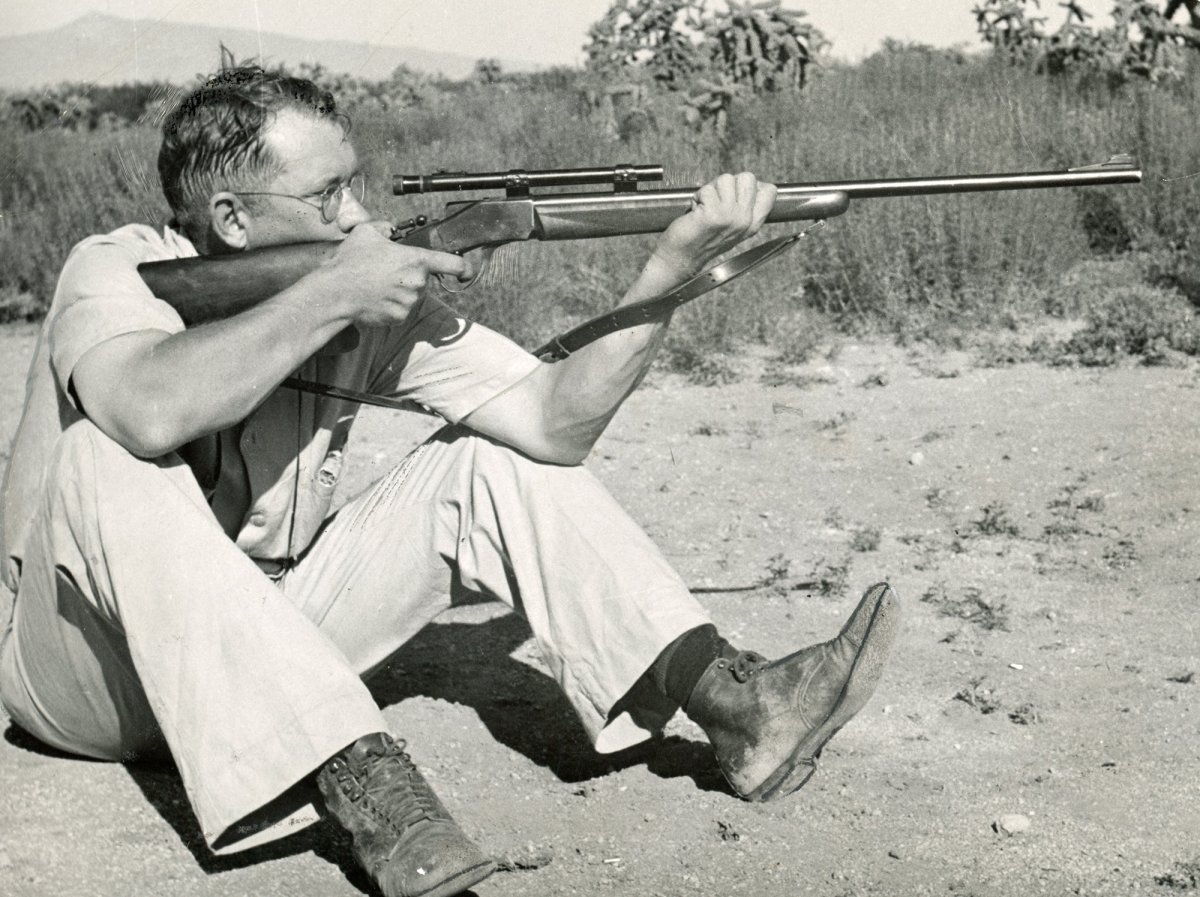
To do this, sit down and face away from the target to the left at an angle of 45 degrees. Hold your rifle in your right hand by the grip. With the left hand, turn the loop over so that the portion of the strap that has been on the bottom is now on top. Thrust the left arm through the loop, and then push the loop as far up on the upper arm as you can manage. Next push the keeper right up against the arm.
Now bring your left hand around to the left, over the sling, and then put it against the front swivel. The loop of the sling should be adjusted so short that you must use your right hand to put the butt to your right shoulder.
Then you should lean well forward. The heels should NOT be dug into the ground unless you are sitting on a steep hillside and must dig in to keep from sliding. On a hillside that steep, it is difficult to use a sling anyway. When you’re sitting on level ground, your feet and legs, in fact your whole body, should be relaxed, as tenseness introduces tremor, and tremor makes for poor shooting.
The wobbly elbows should never be against wobbly kneecaps. Instead, the flat part of the upper arm above the elbow should be against the flats of the shins forward of the knee. In this position the tight sling and the tension of the back muscles hold arms against shins.
The right hand does nothing except to steady the rifle a bit and to squeeze the trigger off with the right index finger. Actually if the sling is properly adjusted and a good position has been assumed, the rifle is very steady even if the right hand is not touching the stock at all.
The two-piece shooting sling is used in exactly the same way as the one-piece Whelen sling, but the size of the loop is regulated by the placement of the claw hook in the long front section of the sling. Then the length for carrying is adjusted by the claw hook on the tail piece. Some riflemen like the two-piece sling, say it is easier and quicker to adjust. I like the one-piece type, as I am used to it and think it is a bit neater. In effect one is about as good as the other and as good as any. I think both are probably open to improvement.
To make the sitting position with tight sling work, the left hand should be jammed up hard against the forward swivel. That is why big-bore target shooters wear heavy gloves on their left hands. If they did not, long continued firing even with a .308 or a .30/06 would bruise the hand.
I cannot wax very enthusiastic about the use of the so-called “hasty” sling, but I know some excellent shots who use it. The hasty sling can be assumed with a single-strap carrying sling since it does not employ a loop. To use it you simply thrust the left arm between the sling and the fore-end, then around, over, and up against the fore-end. Try it! Some shoot better with the hasty sling, but it has never seemed to me that I do.
I have mentioned that the woods hunter who must be ready at all times doesn’t have much use for a sling, and that the horseback hunter who carries his rifle in a saddle scabbard and seldom uses it to shoot with is probably better off without it. But for anyone who walks long distances, and particularly for the mountain hunter, a sling is highly desirable. The shooting sling can be lengthened by changing the position of the claw hooks so that the rifle can be carried across the back so both hands are left free. This makes climbing with both hands possible — something that has to be done in really rough country.
Read Next: Improve Your Hunting Rifle Accuracy With These 6 Marksmanship Aids
I almost always carry a rifle muzzle up, sights to the rear, with the sling strap over my right shoulder. I keep the right hand on the strap to steady the rifle. Another way to carry a rifle with sling is to have it over the right shoulder, muzzle down and sights to the rear. Those who use this method claim they can get into action quicker with the rifle in that position. They may well be right. I have never practiced that type of carry enough to be proficient.
But however hunters use slings to carry their rifles I am surprised that so few use their slings as an aid to shooting. The rifleman sitting down and using a tight sling will shoot a group about half the size that he will shoot without it. —Jack O’Connor
The Best Deer Hunting Rifles
Read the full article here
