



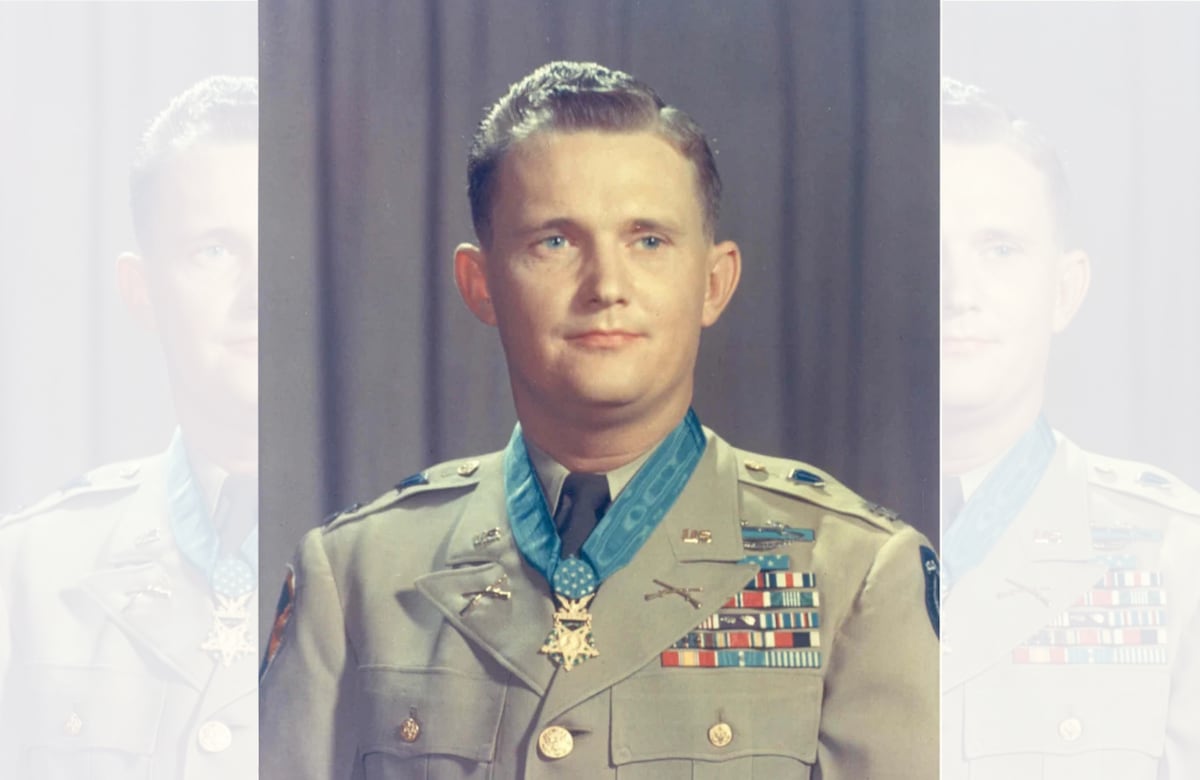

On Oct. 28, 1951, 1st Lt. Lloyd Burke was at his unit’s command post, looking at the ticket in his hand. His 13-month tour of duty in Korea was ending and two miles to the rear an airplane was waiting to fly him out.
He’d soon be reunited with his wife and infant son back in Arkansas. At that very same time, however, his unit, G Company, 2nd Battalion, 5th Cavalry Regiment, 1st Cavalry Division, was trying to advance across the Ch’ongch’on River and assault Chong-dong, but things were not going well.
For the past few days Chinese soldiers dug in on Hill 200 had ground the company’s progress to an exhausted halt. The lieutenant visited the 35 remaining troops of his platoon and recognized in their the “thousand mile stare” of broken men.
“Scooter” Burke, as his men called him, had no requirement — in fact, no authorization — to push his luck any further, but he picked up some grenades and rejoined his men. Later, he explained, “I couldn’t see leaving my guys up there without trying to do some something.”
Born in Tichnor, Arkansas, on Sept. 29, 1924, Burke dropped out of Henderson State College in 1943 to join the U.S. Army and served as a combat engineer in Italy, rising to sergeant when World War II ended.
In 1946, he returned to Henderson State, where he graduated in 1950 as a member of Phi Sigma Epsilon fraternity, Reserve Officers’ Training Corps and his school’s Distinguished Military Graduate. When he returned to Regular Army service in Korea, he was a commissioned second lieutenant. It was thus, as he was finishing his tour, that he plunged into his most unnecessary —and most distinguished — day of battle.
Calling on his troops to a renewed effort on the hill, Burke obtained an M1 rifle and a grenade throwing adaptor and led an assault on three key enemy emplacements to what his citation called an “exposed vantage point.”
There he led an assault on one of the emplacements, taking the center of the bunker and killing three of the enemy. As he charged the third enemy position, Chinese soldiers threw grenades at him, only to see him pick them up and hurl them back.
Inspired by his example, his men overran another position, but were then pinned down again. Securing a .30-caliber Browning M1919 machine gun and three boxes of ammunition, Burke dashed over an open knoll, set his weapon up in an advantageous position and killed 75 enemy troops.
Although he himself was wounded in the fight, Burke retired only to obtain more ammo and return to his machine gun, with which he and his platoon wiped out two mortars and a machine gun position. Then, cradling the heavy M1919, he joined his men in securing the bunker complex, having killed another 25 Chinese in the process.
Having played an unofficial role in reversing his platoon’s fortunes, Burke returned home with a Silver Star. On April 11, 1952, however, he was called to Washington to receive an upgrade from President Harry Truman — to the Medal of Honor.
Continuing his Army career, Burke entered his third conflict as commander of 2nd Battalion, 16th Infantry, 1st Infantry Division in Vietnam — only to see the Viet Cong achieve what the Chinese could not. On July 22, 1965, his helicopter was shot down near Bien Hoa and his injuries put him out of the war. After recovering, he was stationed in Germany and later served as the Army’s liaison officer to the U.S. Congress.
In 1978, Burke retired as a colonel with the Medal of Honor, Distinguished Service Cross and five Purple Hearts. Lloyd L. Burke died in Hot Springs, Arkansas on June 1, 1999, and is buried in Arlington National Cemetery.
Read the full article here
